Mrs. Tittlemouse

Let’s begin by finishing off that bird contest: Congratulations, Janet, on winning!  Congratulations, also, to April and Laura, winners of the Gaston and Quackers giveaway.  Let me just note that it felt awfully good, in the wake of the Orlando tragedy, to have my own quiet way of saying “no” to hate and “yes” to love.  Thanks to those of you who participated or wrote in to affirm that you felt the same way.  If you have older readers who need something to read and you want to give them something that says “yes” to all the right things, can I just recommend Marvels, by Brian Selznick?

Moving forward, this week is going to be dedicated to Beatrix Potter.  I’ve noticed several new and beautiful books about our Lady of the Lake District, and since I’ve, erm, acquired a few favourites, we can have a week composed of one Beatrix Potter original and a couple of books about the lady herself.  We’ll be experts by the time the week is out.  (Well, no, but I hope it will be fun.)

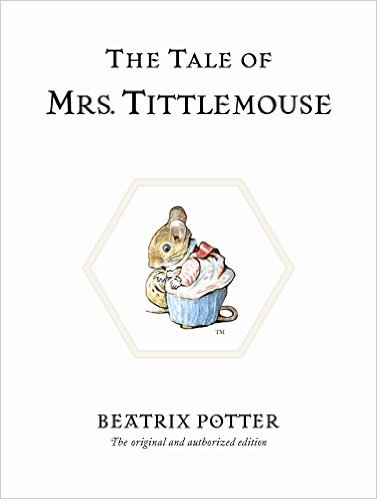
Have you read The Tale of Mrs. Tittlemouse?Mrs. Tittlemouse.jpg

I ask because I get the distinct impression that not everyone has– it’s not Peter Rabbit or Tom Kitten.  Neither is it Pigling Bland, but it’s still not one of the most popular books, and I wonder why.  I think, if I may anticipate my own conclusions, that it might be because this one really feels like it’s written for the parents rather than the children (although, well, the Changeling currently loves it).  It’s definitely not one of the books I remember well from my own childhood.  But, reading it these days, I find myself thinking that Mrs. Tittlemouse reflects life very truly: sometimes she seems a representation of my aspirations, sometimes a reflection of my own life, sometimes of my fears, sometimes of my hopes.  But let’s talk about the plot a bit now.

Mrs. Tittlemouse (who is, by the way, a recurring character in the Beatrix Potter universe– she also appears in the Flopsy Bunnies) is “a most terribly tidy particular little mouse” (p. 12).  She is forever cleaning her little house and resents any signs of “little dirty feet,” as she repeatedly describes them throughout the book.  One day she notices little footprints in her house and smells some honey where it shouldn’t be.  It turns out that one Babbitty Bumble has moved into her house uninvited, accompanied by her family, and filled a storeroom with “untidy” dry moss (“untidiness” being the ultimate crime, of course).  A certain Mr. Jackson, a particularly untidy personage, who “lived in a drain below the hedge, in a very dirty wet ditch” then turns up in search of the honey he’s smelled from the house, due to the intrusion of Babbitty Bumble.  Mrs. Tittlemouse handles the additional intrusion as politely as she feels she must, but clearly objects to Mr. Jackson’s large wet footprints and dripping coat tails.  (She goes around with a mop, of course.)  Ultimately, following the scent of the honey, Mr. Jackson evicts Babbitty Bumble, Mrs. Tittlemouse is left with her tidy house in an utterly ruinous state, and her spirits in the depths of misery.  She reduces the size of her doorway (“I will make it too small for Mr Jackson!”) and spends two weeks cleaning her house to perfection.  And that’s the story.

I see two things about this story: a) Like many of Beatrix Potter’s stories, I think a modern editor would sniff and say, “Not much story here.”; b) At the same time, it’s a pretty substantial mouthful of a plot once you accept the premise that a messy house is a story.  That is to say, the plot really is that a housewife is made miserable when her house is messed up, and spends a long time cleaning it again.  Not much story there, no.  But when you get into the emotions of the thing, it is really, really quite rich, and even a little disquieting.  It’s about a housewife who sets her heart on a clean house, but whose peace of mind is disturbed when her house is invaded consistently by a sequence of uninvited intruders.  The final intruder evicts all the others, but leaves her house, and, consequently, her feelings, in a complete shambles in the process.  She then obsessively cleans and puts everything back in order, and, in the process, rediscovers her peace of mind, particularly by tightening her home security against the intruders.

I hope you’re beginning to see why I think this is a book which is pitched at adults in a very real way, and also, perhaps, why I think it’s so reflective of reality: of hopes, aspirations, and, perhaps most of all, fears.

“Aspirations” is easy: hell, don’t you wish that you had a tidy house?  Don’t you want to be tidy and particular and live in harmonious cleanliness?  (Answer: yes, but not enough to actually clean properly.  Also, I know that at least a few of you reading this are puzzled: you already are “tidy” and I salute you!  I, alas, am not.)

“Fears” is also easy: Fear of disruption of all you love.  Fear of intruders into your personal space.  Fear of having your routine disturbed and your life left a shambles.  Mrs. Tittlemouse is not the only book to represent this so well, although maybe it’s one of the best books describing it at the intersection of children and adult literature.  A good adult book describing that fear is The Man Who Was Thursday, by Chesterton.

“Hopes” maybe throws you off a little, but I still think it’s in there.  We all hope for a response to disruption and intrusion, I think.  “But what are you going to do?” we shrug wearily.  “Shit happens,” we say.  Mrs. Tittlemouse doesn’t.  She gathers twigs and tightens her door.  She doesn’t completely cut off contact with Mr. Jackson, but she does, definitely, deny him further access to her house.  She, in other words, figures out a resolution to her problem.  She doesn’t say, “Shit happens.”  (I can’t imagine bad language in Mrs. Tittlemouse’s mouth!)  She just figures it out, and, once she has, she holds a party.

Hopes, fears, and aspirations: I think this is a great, underappreciated book.  I think it shows Beatrix Potter at her best, both in terms of representing animal life, and in her shrewd reflections on human relationships.  I hope more people, adults and children, will give it a real chance.

And, as my Changeling says, “Tiddly-widdly-widdly!  Bizzz wizzzz!  That’s funny!”  (In other words, there’s a lot of good sound effects in this book.)

Dear Pope Francis

First things first: I still have two giveaways running with time to enter both, so read on over here and enter!  Please share with your friends and family and let’s get good books into eager little hands: Bird contest + book giveaway reminders

Now for today’s book.  I’m going to acknowledge right up front here that this is a very unusual book for me to write about.  Let’s count the ways: a) I normally do picture books my daughter enjoys; b) I don’t normally do books aimed at specific audiences; c) I’m, well, not to put too fine a point on it, but I am Jewish.  But there you have it: I did write about Esther’s Story at Purim, right?  So why not write about Dear Pope Francis when I admire it quite as much, as a book of its own kind?

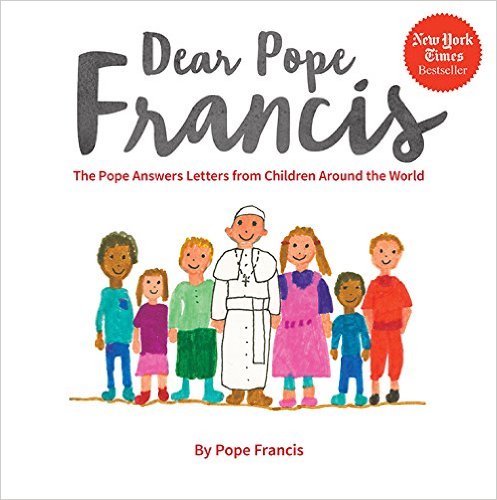
Dear Pope Francis.jpg

The premise of the book is very simple: Pope Francis welcomes letters from children all over the world.  (Well, he welcomes messages from everyone worldwide, but we’re focusing on children, here.)  Children write to him, and he wants to respond.  This book is a collection of messages from children, each with a question and a picture, accompanied by his responses.  Yes, some are very Catholic: one child asks about bearing witness and bringing others to Christ.  (Fair enough, too, that is a Catholic teaching!)  But others are much more universal, such as the child who asks about what to do if your parents argue.  Others are sweet and even a little funny: one asks the Pope about dancing (the Pope strongly supports dancing).  The Pope takes each question seriously and warmly and responds carefully and precisely.  The whole ensemble is a little gem: a blend of the child and the mentor, and a true witness to the value of dialogue between the two.

The question is this, though: I bought the book even though I’m a Jew and don’t really need Catholic teaching for my child.  Do I think this is a book other non-Catholics can use, and, if so, why?  The answer is this: I think anyone can find value in this book, although whether you want it in your home is really up to you and your own value system.  That said, I’m going to write here to people who are open to the concept of an overall moral system in the world, because those are the people who are most likely to see something special here.  In other words: Yes, absolutely, there is a lot in this book which is for everyone, but there is also the absolute assumption that if you care enough to be looking at the book, you believe in God.  (If you truly are an atheist this probably isn’t for you– probably, but not 100% certainly… oh, you’re the best judge of what’s right for you.)  Read on for more specifics.

What makes this book so special, regardless of whether or not you are Catholic, is the voice that it gives to the children.  They occupy half the book.  They lay out the overall premise.  The Pope is merely responding to them.  What makes it more special, and more about the child is this: the Pope’s responses give yet more voice to the child by virtue of the attention he pays to each voice.  It’s a lesson in attentiveness, in good childcare, and reminds me of my favourite parenting book, How to Talk so Kids Will Listen and Listen so Kids Will Talk.  The premise of that book is that it’s important not to shut down children, but to give them room and attention so that they’ll be able to express themselves.  Pope Francis listens and attends so carefully that each voice is heard and each child will surely feel like continuing the conversation.

Take João: he tells the Pope that he felt great joy when he saw the Pope, and asks him what he feels when he sees children.  First of all, can we pause to say: “Wow, what a great question!”  I wouldn’t have thought to ask that, yet it’s simple, sincere, and important.  Second, the Pope’s response: he tells João that he feels great tenderness when he sees children, but also great hope, as he knows that children are the future.  (He says it better than I paraphrase, so read him, not me.)  In other words, he reads, pays attention, thinks, and responds carefully and precisely.  More than that, he responds with words that show equal faith and affection to João’s own: he says, in effect, “You love me– and I love you, too, and I have faith and trust in you to do wonderful things in this world.”  I’m guessing that João’s answer is something like this: “Thank you!  This is what I want to do…”  And I find myself wondering: what is it that João is going to do next?  What’s the next step in this story?

And that’s the way for each page.  Each page is a little snippet of a story.  The child who wonders how Jesus walked on water.  The child who wants to know where the Pope likes to pray.  The child who asks whether our deceased relatives can continue to see us.  All of these are beginnings of stories.  If you take them seriously– as the Pope does– then you want to know more: Where did that question come from?  Who is this child?  What does he or she think of the Pope’s answer?  And that– look, that’s why this book is so wonderful.  Because it makes sure we care.  We care about these children and these questions and these snippets of their stories.  The book isn’t called “Love, Pope Francis,” it’s called “Dear Pope Francis.”  Questions to Pope Francis from children around the world.  And Pope Francis is showing us how to take them seriously, listen to them, encourage them to talk.

And that’s why I think that this is a book that has value for anyone who cares about children.  Because this is a book of their voices, and a book which shows how to care for the small people who ask such wonderful questions.  They deserve our care and attention, and the Pope shows us how to offer it.

And, with that, uh… Shabbat Shalom!  I’ll be back to non-faith-specific programming next week, but I hope that you enjoyed this little trip into an interesting side-area as much as I did.

Bird contest + book giveaway reminders

Hi, everyone, since overlap often = confusion, this is just a quick reminder of my two giveaways/contests going on right now:

a) The rules for the Apples and Robins contest are right here: About that contest…  Just tell me a bit about a bird near you (“I have a blue jay in my yard right now” is sufficient) and you’re entered;

b) Let’s fight hate with love!  Email me at deborah@childrensbookroom.com and tell me the first name of the child who will be reading the book, and I’ll send you a copy of Quackers, one of the most loving books out there.

Gaston (+giveaway)

(Read to the bottom of the post for a giveaway of today’s book and of Quackers.)

I think the closest I’ve come to discussing real-world events here is when I injured my finger.  But I can’t pass over the attack in Orlando, and I feel like if you read my blog you probably understand that.  You know I have a daughter, and, frankly, you probably either have or know children yourself.  And at the word “shooting” I always feel more than usual like holding onto my daughter, as though holding her could protect her against whatever it is that makes shootings happen.

And that’s the real point, isn’t it?  Politicians, pundits, lawmakers, police– and ordinary people like you and me– everyone’s going to be talking and talking about this shooting.  But all the talk comes down to an essential point: “What made this happen?”  How is it that a person was capable of taking firearms and shooting his fellow brothers and sister– how is it that someone can ask “Am I my brother’s keeper?” instead of stating “I am my brother’s keeper.”  How is it that he couldn’t hear his brothers’ blood calling out to him from the ground?

Obviously, if you catch those heavy-handed biblical allusions, this is an old, old question.  None of the politicians, pundits, lawmakers, neither you nor I… none of us will be able to answer it.  Even the shooter wouldn’t be able to, were he still alive.  But, being that I am who I am, I still have another question:

So many schools these days try to teach us about each other, in the hopes of promoting understanding and love of our fellow human beings.  Others, of course, don’t.  So many homes do the same.  Others, of course, don’t.  But, as part of that climate of love and understanding, we have so many books which try to teach us love and understanding.  Some are preachy or pedantic, others are marvellous.  We’ve encountered some here: Leo: A Ghost StoryThe GiftQuackers.  All of these are great books for reminding us of the humanity of our fellows.  But did the shooter read these?  If he had, would it have helped?  Did he, in a word, read Gaston by Kelly DiPucchio and illustrated by Christian Robinson?

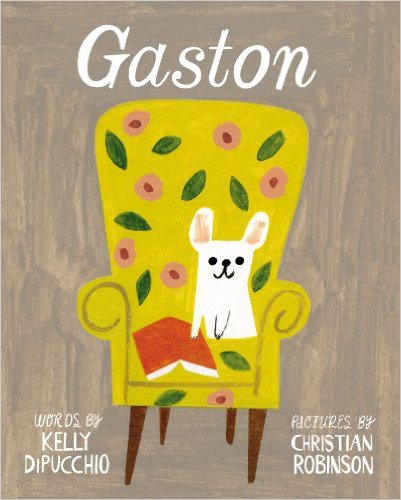
Gaston.jpg

(NB two things: a) Christian Robinson is the wonderful illustrator who did Leo, and b) My husband firmly believes it should be Kelly DiPoochio, not DiPucchio.  I’m sorry about that.)

Why do I ask whether the shooter had read Gaston?  Well, here’s the thing: the story of Gaston is fundamentally about love across differences of all kinds.  I think anyone who grows up reading Gaston must grow up with laughter and love and sympathy.  Here’s the story:

Gaston is a member of the Poodle family.  He and his sisters, Fi-Fi, Foo-Foo, and Ooh-La-La are raised to be proper pooches.  They’re tidy and graceful and look pretty in pink.  But Gaston, as the family soon discovers, looks different… he looks like a bulldog.  When they meet the Bulldog family in the park and see that one of the tough little bulldog puppies (Antoinette) looks an awful lot like a poodle, Gaston and Antoinette swap places.  Everyone is sad: the dog mummies miss their own puppies, and the puppies miss their proper families.  The next day everyone resumes their proper places and the two families decide to be friends.  Ultimately, Gaston and Antoinette marry, and all is harmonious: looks don’t matter, it’s what’s inside that counts.

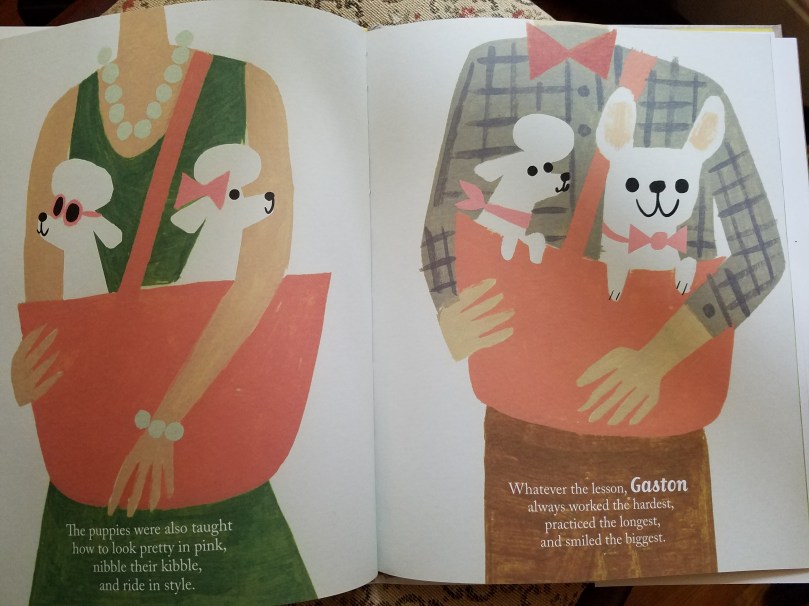
As a writer, I’ve been told not to use vague words like “charming,” but sometimes that’s the only word that will do, and this is one of those times.  Take a look, for example, at this:20160615_131213.jpg

You see here exactly the best points of both Kelly DiPucchio’s text and Christian Robinson’s art.  There’s the lilting prose: “pretty in pink,” “nibble their kibble,” “ride in style,” all lead up to the three superlatives describing Gaston: “worked the hardest, practiced the longest, and smiled the biggest.”  There’s the way the names are all highlighted in the text to look extra-elegant and extra-emphatic: Gaston has to stand out!

There’s also the art.  Christian Robinson is at his best here: each little puppy is distinct, one in a scarf, one in a bow, one in sunglasses, and Gaston in a bow-tie.  The cuteness makes you want to squeal.  But it’s not just the sweetness.  There’s his vintage colours: that slightly dusty shade of rose, that slightly sage shade of green, those off-white pearls which harmonize with the green dress… and let’s not miss that the gentleman’s own bow-tie works beautifully with the pink bags and bows of the little puppies, right?  Everything is just slightly vintage, just a bit old-fashioned, and yet so very perfect for today, too.

But why does that matter for the book?  Here’s the thing: a book of this kind, so very fashionable, so very sweet, right down to little pooches riding in handbags, runs the risk of becoming a little bit too much “of the moment.”  And yet, by making the style just a little bit retro, Christian Robinson says, “Not just today.  Yesterday, too.”  And we complete the thought, “Tomorrow would be nice, too.”

And it’s not just the style which gains an extended lifespan, but the message, too.  Remember the message?  “It’s not just about where you look like fitting in.  It’s what’s inside that counts.  It’s where you feel like fitting in.  Love is love.”  Personally, I stand by that, and I’m hoping that this is a book that lasts, and that it’s a book which gets around.  It may be silly and idealistic, but I still believe that books like Gaston and Quackers can help us stand against horrors like the Orlando attacks.

And that’s why I’m hosting a little giveaway here for a free copy of this book and one free copy of Quackers.

RULES:
The first person to email me with a) which book they want, and b) the first name of the child who will be reading this book will get it.  That’s it.  That simple.  Just write to me at deborah@childrensbookroom.com and tell me who will be reading it, and I will rejoice that the message of love is getting around and send you a copy.

If a lot of people email me, I may send more than one copy, so don’t hesitate to write.

And, of course, don’t forget About that contest…

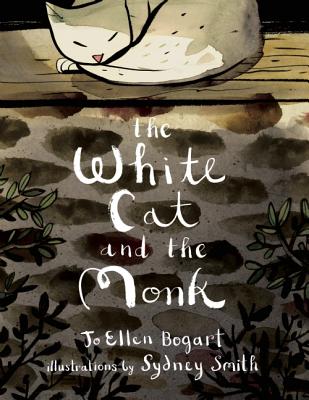
The White Cat and the Monk

First of all, a few notes: a) Remember the contest!  Click right here for the rules, please, and share them, and get your entries in.  You cannot see me bouncing excitedly, but I assure you that embarrassing excited dancing is happening.  b) I am going to be away this weekend for the Jewish holiday of Shavuot, and while I normally plan ahead for holidays so you won’t go without the wonder I add to your days, this time I, well, I was working on my dissertation.  I know, I know, sometimes I cheat on you with my day job.  It happens to the best relationships.  That’s why I’m posting late, too.  I’m sorry, I really am, but the good news is that, while I’m late posting this book ramble, and won’t post at all on Friday or Monday, I was inspired to write about this story, a gift from my supervisor, who loves the Changeling.  (Please note my beautiful transition from introductory notes to substantive post; I’m proud of how that happened to work out.)

That shouldn’t really be a parenthetical note, except that it should.  The story we’re about to look at is, itself, apparently a parenthetical note, or based on one… except that it’s not.  It’s a comment, except that it’s more of a commentary than a comment… it’s… it’s time for me to tell you what the hell I’m talking about.  Excuse me: please remember that I’ve been being an academic.  I’m talking about The White Cat and the Monk, text by Jo Ellen Bogart, illustrations by Sydney Smith.

Pangur Ban

People, let’s go over a few basics here.  This is a visually stunning and spiritually uplifting book.  I do not care which religion you practice, or whether you don’t practice any religion: you’ll find this a reassuring, inspirational, and somehow exalting book to read.  But let’s talk a bit about what this book is.  (It’s Canadian.)

It’s based on an Old Irish poem called Pangur Bán, written in the 9th C.  The book is not a translation of the poem, but a simplified adaptation of it.  Let me put it this way: I can be awfully pedantic, and my supervisor has very strong and definite tastes in translations of poetry.  (Seriously, her views on translation are beyond excellent.)   We each separately picked up this book with skepticism, loving the original poem as we do.  And we each were surprised by how much we loved this adaptation.

I’m not going to go into the original poem here.  This isn’t a place for academic navel-gazing or for worrying about being sufficiently precise or presenting the correct analysis.  This is my place for talking about good kids’ books.  I do recommend reading Pangur Bán (look for Paul Muldoon’s translation, although there are also nice ones by Seamus Heaney and Auden), but I’m not going to go into the years and years of academic analysis which surround it.  Let’s just say that it’s a poem a monk wrote about how he and his white cat live together, each pursuing their own tasks, and each achieving all he can within the bounds of his own nature.  It’s a lovely poem, but not one I’d have arrived at on my own as a poem for children.

Well, that proves me for a fool.  It’s perfect for children– and adults.  Here’s the thing: it’s a smart book, but it’s not an intellectual book.  The poem is, or has become, intellectual.  It asks you to think with it, to think about it, to take it very seriously… or academics do, anyway.  The book, though, asks you to read and enjoy it, and, if you like, to think a little farther, a little deeper.  Let’s talk about how the Changeling enjoys it, for example.

The Changeling follows the cat.  The cat first appears outside the cloisters, and then jumps in through a window and trots down a long hallway, down stairs and through passageways until he finds the cell with the light glowing under the doorway… the monk’s cell.  All of this is wordless and almost monochromatic, dark shades of grey and occasional browns, illuminated only by the white cat until the yellow light glows under that door.  Then, after that light appears, colour gradually floods the book.

First you see the cat’s pink nose (the Changeling loves that) and the monk’s warm face, and the first words, all at once: “I, monk and scholar, share my room” and the page turns… “with my white cat, Pangur.”  Then the story, as it were, begins.  Again, seeing it from the Changeling’s perspective, we follow the cat: the monk reads and writes books, but the cat is chasing a mouse.  Now, the monk tells us that each of them does their job– the monk chases understanding, the cat chases the mouse.  And each has, as it were, job satisfaction.  But I don’t think this is what appeals to the Changeling.

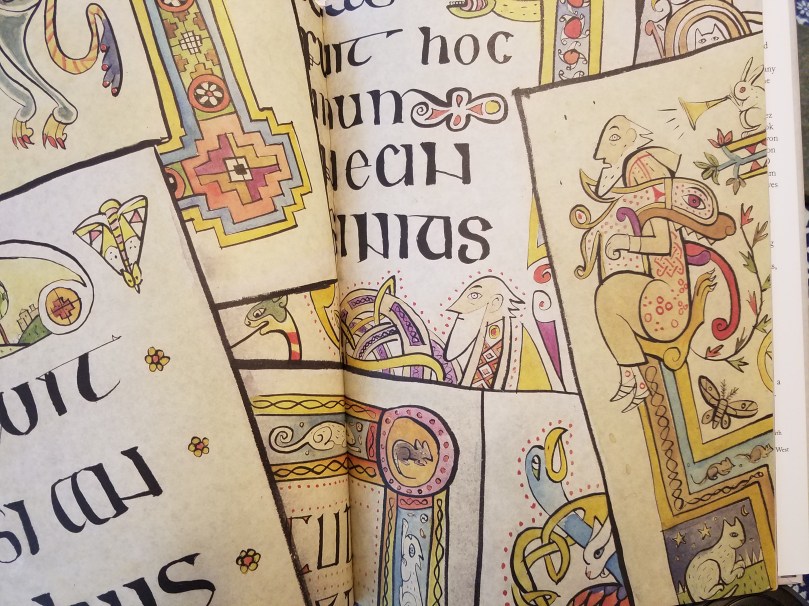
Yes, the monk chases meaning, the cat chases the mouse… the Changeling chases the cat.  And I, mother and book-prattler, chase the Changeling.  What does she think?  What does she love?  And the answer I come up with is that in this book, pace the anonymous scribe and poet of the 9th C., she loves Sydney Smith’s imaginative illustrations, weaving the white cat, Pangur, in with his imaginative take on medieval manuscripts.

20160609_150503.jpg

Do you see the white cat anywhere?  Keep looking… he’s around there.  (Tell me in the comments how many you see and I’ll enter you for that book giveaway!)

That’s the glory of this book.  Nothing is reduced, nothing is toned “down,” nothing is “made accessible for younger readers!”  (You have to read that in a bright, chirpy voice.)  It just is accessible, it just is a bit simpler.  The art is quite as deep and quite as intelligent as the words are: both owe a lot to that poet over a millennium ago.  And yet this genius duo of author and illustrator manage to make it talk to children as well as to adults.  I am frankly in awe of them.

About that contest…

I just wanted to create a separate contest post for easier visibility and to make it easier to share.  And please do share widely!  I want to hear all your bird stories, see your bird pictures, or just chat about apples and robins.

Apples and Robins
Here are the rules:

Write to me at deborah@childrensbookroom.com by Friday, June 17 with a story about a bird near you (it doesn’t have to be a robin– I have a blue jay nesting near me!) for a chance to win a copy of Apples and Robins.  

One submission per person.  One winner.  Deadline is June 17, and I will choose a winner by a random number generator on Monday, June 20.  I’m afraid you do have to be in the USA or Canada.  Apart from that, have fun!  Share widely, and anyone can submit so long as you’re in the USA or Canada.


Monthly Retrospective May 2016

AHEM: Be sure to scroll down all the way so you don’t miss the announcement about a little contest with a book prize!

First thing first: dear my readers, do you love the little book house up there as much as I do?  I just got it made for us and I’m so happy about it I couldn’t resist a little bragging. (It was made for us with pencils and coloured pencils by Clare Dean, who caught exactly the “book illustration” style I described to her rather romantically.)

On to the books. As those of you who have been reading along this month know, this month was all about reading picture books with an eye to how older children might respond to them. This was inspired by Betty Carter’s article in The Horn Book Magazine, Escaping Series Mania, in which she argues for the value of inspiring older children to read more picture books. So almost everything today is going to be going back to the same question: What can an older reader (say, Grade 1-3) get out of a picture book?

The very first thing which occurs to me is how little I altered my choices and methodology when I decided to experiment with making a month about older child readers. I attribute this to two things: a) I already read a fair number of “older” picture books, such as Jazz Day and Willy’s Stories; b) It’s really not hard to find value in giving even ostensibly “younger” books (such as Apples and Robins, which is listed for ages 4-6) to older readers. After all, I find value in reading them at age 29, so why not at age 9?

Thus much for my stint on the soapbox. I’m going to give you my spotlights now, and as a new little feature, keep scrolling after the spotlights for a few words from an editor at Charlesbridge (remember Feathers: Not Just for Flying?) about what one of their books has to offer an older audience.

One last thing: remember my Chesterton craze? Well, I’m stymied. I’m still reading Chesterton, but E. T. A. Hoffman has also somehow turned up. Flitting back and forth between the two is really weird. Bombs and automatons and placid smoking and wild crazes… I’m telling you, it’s a very strange place to be right now. But I can’t put either one down voluntarily, so I’m taking votes as to who I should focus on first. Chesterton or Hoffman? You tell me.

Now for the spotlights:

Ada Byron Lovelace

Ada Byron Lovelace and the Thinking Machine:

The story of young Ada and how she grows up to write what’s considered the very first computer program– before the computer even became a reality.  This is a brilliant match between author and illustrator, the story is clear and compelling, and the premise is strong without being overwhelming: Don’t let societal conventions stop you from pursuing your passions.  Ada was a mathematician at a time when women weren’t: maybe you can be, too.  For authors, this is an exemplar in the art of “show, don’t tell.”

Have You Seen My DragonHave You Seen My Dragon?: A young boy travels through New York City looking for his dragon, always accompanied by a large, and scaly friend who somehow goes unnoticed. Witty, whimsical, and just wise enough to bring you back again and again, this is now on my “buy for every child I know” list. Steve Light does things with black and white art punctuated by unexpected colours that make my own pens speechless with awe.

Apples and Robins
Apples and Robins
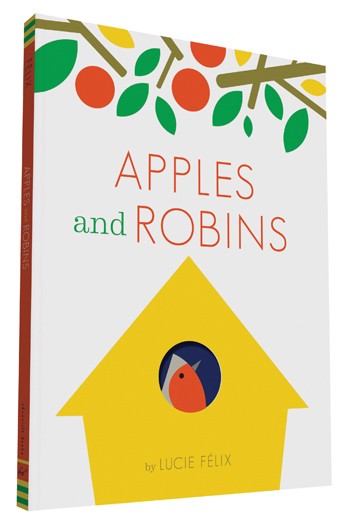
: There are apples, there’s a tree, there’s a ladder, a bird, a birdhouse. Then comes a storm. The child gathers the apples and rebuilds the birdhouse, and we watch what happens as the seasons continue to turn. The prime attraction in this book, what will engage younger readers, are the brilliant colours and shifting shapes as the pages turn: cleverly cut paper turns geometric shapes into birds. But older readers will appreciate both the breathtaking pictures and the story of the year turning and the seasons changing– and beginning again!


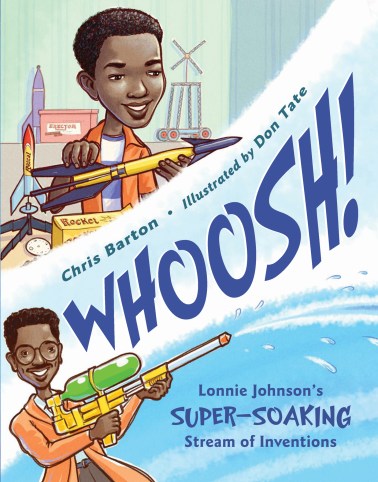
WHOOSH jkt 300.jpgThis was generously shared with me from Julie Bliven at Charlesbridge: WHOOSH! is about Lonnie Johnson’s eventual and accidental invention of the Super Soaker—one of top twenty toys of all time. A love for rockets, robots, inventions, and a mind for creativity began early in Lonnie Johnson’s life. Growing up in a house full of brothers and sisters, persistence and a passion for problem solving became the cornerstone for a career as an engineer and his work with NASA. Older readers might engage happily and enthusiastically with this particular picture book because it shares themes of curiosity, perseverance, and experimentation—traits innate to many kids as they navigate what does and doesn’t interest them in this vast world.

How about an experimental contest?

Write to me at deborah@childrensbookroom.com by Friday, June 17 with a story about a bird near you (it doesn’t have to be a robin– I have a blue jay nesting near me!) for a chance to win a copy of Apples and Robins.  

Rules: One submission per person.  One winner.  Deadline is June 17, and I will choose a winner by a random number generator on Monday, June 20.  I’m afraid you do have to be in the USA or Canada.  Apart from that, have fun!  Share widely, and anyone can submit so long as you’re in the USA or Canada.


Finally, here is my list of all reviews for the month of May (and, erm, June so far):

The last thing I’ll leave you with is the Changeling’s current reading obsession: A Castle Full of Cats.  Every day now.  She’s starting to “read along.”

And that’s it for this month!  On Wednesday we’ll be back to reading new books.

Apples and Robins

My basically self-inflicted finger injury (dear God, that sounded so stupid I feel ridiculous) is healing well, and I’m able once more to scatter my pearls of insight across WordPress.  No, really, you don’t have to thank me.  It’s my gift to the world.

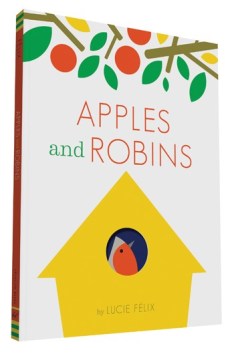
OK, you all remember the hint I gave you in my apology for taking a day off due to an injured finger (seriously, doesn’t sound any less stupid the second time around), so this will be no surprise.  Maybe you all clicked the link and found yourselves staring at such a lovely book you spontaneously bought it.  You brought it home and loved it so much that your lives are enriched to such an extent that you’ve devoted your lives to the study of geometric forms and what combinations produce the finest robins.  Ultimately, you’ll discover that Lucie Félix (her site is awesome, so visit it!) already came up with it in Apples and Robins (originally Après l’été), which brings us right back to where we started: our book for today, which is an astoundingly simple and elegant exploration of geometry, life, and natural beauty.  It’s like if Wagner’s Ring Cycle were more, well, um, not to put too fine a point on it, but… enjoyable?  (Sorry, music-lovers, including my dad.  I greatly admire the Ring, but you’ve got to admit that it’s not all apples and robins.)

Apples and Robins

But what do I mean, and why, precisely, do I risk alienating all the Wagner fans out there?  Bear with me a moment and we’ll see if I can redeem myself at all.

First of all, let’s talk about how, once again, Chronicle Books has found a remarkable French book to bring to American eyes.  Keep doing this, Chronicle Books, and I will keep buying them.  They are so pretty.  They are so clever.  They are so smart.

Smart and clever are perhaps the first words to come to mind right after the “oooooh, pretty” infatuation abated.  (That’s a technical term right there.)  I snapped this book up in all of five seconds after I spotted the illustrations and flipped the first two or three pages.  It just spoke to me.  But I admit that I wasn’t sure it would speak to the Changeling, so it settled on a shelf for a little while, only read by me.  Then, this past weekend, I realized something which should have occurred to me before, but didn’t because I am apparently as dense as bad soda bread:

IT HAS BIRDS IN IT.

I don’t know if you’ve heard about this before, but, y’know, the Changeling loves birds.  So we read it, and she loved it.

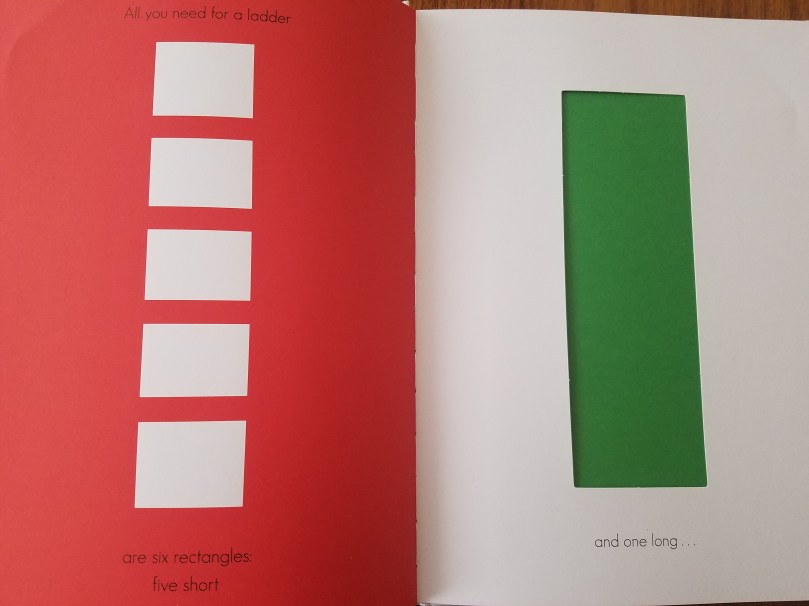
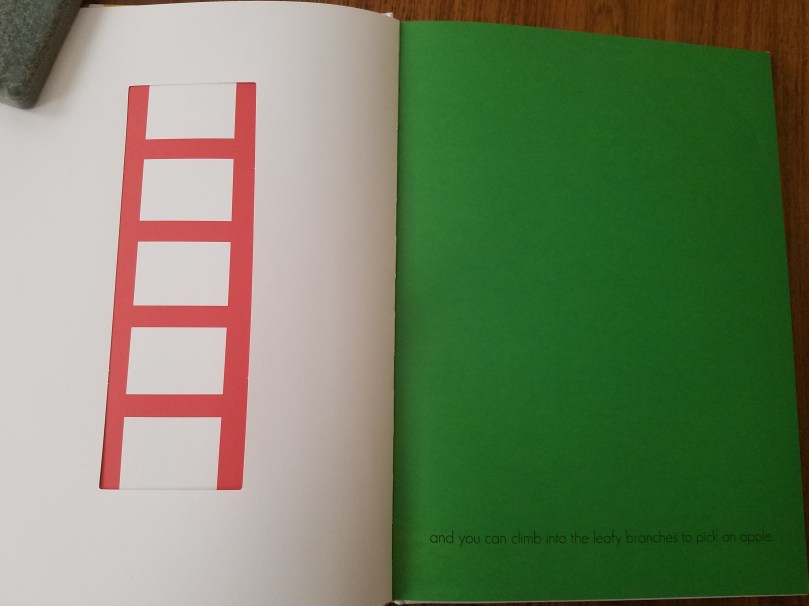
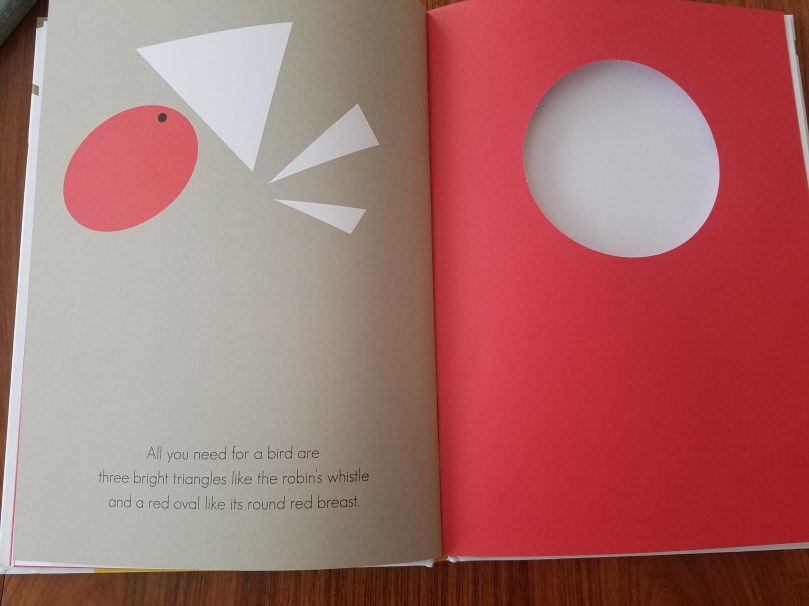
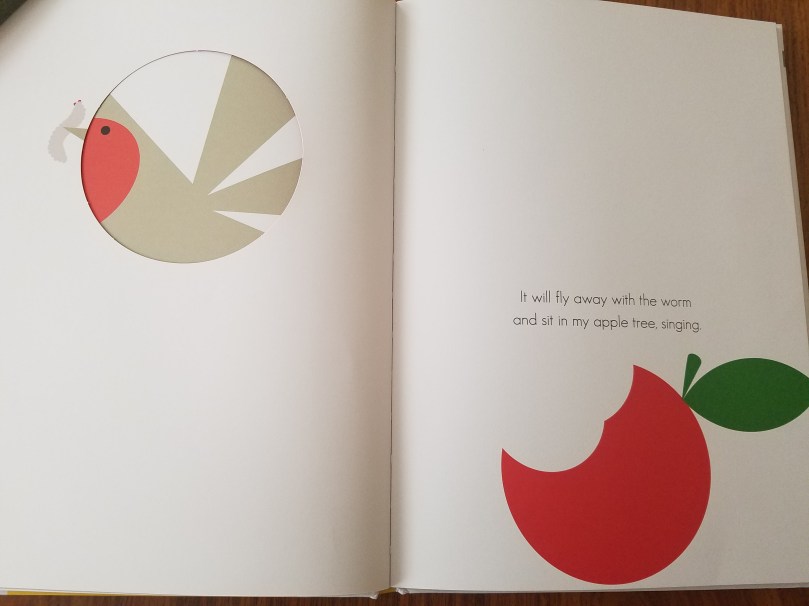
“But, wait a second,” you ask.  “Why in the world weren’t you sure that your book-loving toddler wouldn’t go for this book?”  An excellent question.  First of all, I’m dense.  Second, this really is a very, very clever book.  It’s engineered in a visually stunning way: geometric shapes on the page, when the page is turned, become apples, or a ladder, or a flash of lightning.  Here, let me show you:

20160603_11133120160603_11135820160603_11141820160603_111431

That should give you a basic impression of the book, but the Chronicle Books trailer can really show it off:

You see how it works?  Shapes which just seem abstract and geometric become, when the page is turned, a whole new world of storms and apples and birds.  As I said, it’s smart: it’s one of the smartest books I’ve seen this year, and, being rather dense, I thought it was too smart for my daughter.

Yeah, right.  Too smart for me, maybe, but not for her.  She loves watching the transformations, and, I think, even loves the story which quietly underlies the transformations.

You have apples.  And then you have a ladder.  Next, you add the robins and a birdhouse.  Then comes the storm which disrupts the natural order.  Slowly, though, it is rebuilt.  Apples are gathered and the birdhouse is restored– and then the birds make it their home until spring comes and you have more birds, apple blossoms, and the prospect of the whole cycle beginning again.  (See?  Just like Wagner, but happier, and, well, less dreary.)

Why shouldn’t that be a story which my daughter can understand?  Because, perhaps, she’s too young to remember from season to season?  She remembers winter.  She remembers people.  She remembers almost every word of Green Eggs and Ham, and recites it daily.  So, why assume she can’t remember the season?  Perhaps I was assuming that she’d be bored because there wasn’t a more vivid story?  Well, if I was mesmerized by the changing shapes and colours, why wouldn’t she be?    Perhaps I thought that she couldn’t draw comparisons with Wagner?  Happily, being not-yet-three, no, she can’t.  But I think you can enjoy this book without being familiar with Wagner.  (Now there’s a pull quote for you!)

Honestly, I’m not sure why I thought this book was so much too old for the Changeling.  She’s a clever almost-three-year-old, and this book is recommended for ages 4-6, her usual range in books.  It’s true that she can’t track the geometric changes as the pages turn, but she does find them mesmerizing to watch, just as I do.  It’s true that she’s too young to really grasp the cyclical nature of the world and nature, but she’s also too young to know about theories of the fantastic but she still enjoys The Tea Party in the Woods.

The fact remains that I think there is one simple, poetic story in this book which can be apprehended in as many different ways as you can draw apples and robins: it’s the story of the turning year, and turning pages, and turning leaves.  It’s as beautiful as taking simple boxes and ending up with a slender ladder to get you up into greenest trees.  It’s also as fun as watching a bird pop out of a hole.  It’s a story which grows with you.

Dammit, I’m not sure how to do this book justice except to link to it again here and say this: I’m labelling this book for all ages.  I think the colours will engage an infant (just keep it away from grabby fingers or the holes will tear), but the shapes and story will engage a toddler, and the older you get the more you’ll see.

Also?  This is another one I really want to see in the original French, just to compare.

Guys, this is beautiful, and, sneak peek: this is going on my spotlight list for Monday’s monthly blog summary, you bet it is.

Apologies

Sorry for the radio silence around here!  Obviously Monday was a holiday, which I spent with the Changeling, my husband, and a whole whack of sheep (i.e. we promised my daughter a trip to a farm, which is to say the sheep and wool festival).  Today, I meant to write a post about a fantastic book which all three of us enjoyed multiple times over the holiday weekend but then an, erm, accident left my right index finger in a terrible swollen state.  Don’t ask.  Point is, typing is not fun.  I’m wincing right now.  So you’ll find out all about this book on Friday, I devoutly hope, and you’ll get the monthly round-up on Monday.  Wish my finger better!  (Finger injuries feel so damned stupid, don’t they?  But they’re nasty little beasts, they really are…)

Ada Byron Lovelace and the Thinking Machine

I couldn’t leave off my month of older picture books– or, to be more precise, thinking about picture books as they would work for older children– without going in for some of my personal passions: girls in science.  Well, let’s be more precise.  Today’s blog is all about precision.  I’m not just for girls in science– I’m a bleeding heart Canadian liberal and am for girls in whatever the hell suits them best, honestly.  I’m for liberating the humanities from the current view of them as fluffy leftovers, and I’m for seeing the hard honest edges around science: what works and what doesn’t and why we should be suspicious of the current Big Data craze.  There’s a lot to talk about in the academic world these days, and that’s why I’m for bringing girls into the conversation.

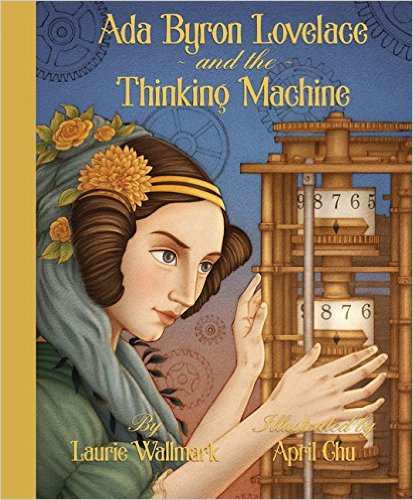
Just as Ada Lovelace was.  And this book, Ada Byron Lovelace and the Thinking Machine (credit where it’s due: for once Amazon brought up a book I wanted, so I’m rewarding it with a link) by Laurie Wallmark and illustrated by April Chu, cleverly and succinctly shows just how Ada became such a mathematician, and, frankly, why she was so very awesome.  If you do not think that Ada Lovelace is awesome already, then you will after reading this book.

Ada Byron Lovelace.jpg

OK, OK, it has been brought to my attention by my brain that my gushing calls for explanation: I am a total fangirl for Ada Lovelace.  I adore her.  I feel sorry for everything she went through in her life, I feel proud for all she accomplished, I am a total, complete fangirl.  As for what she went through in her life?  It can maybe most succinctly be represented by this little comic from Kate Beaton (remember her?) about young Ada Lovelace:

Kate Beaton Young Ada Lovelace

That’s it in a nutshell.  It’s explained somewhat more delicately in Ada Byron Lovelace and the Thinking Machine, but Lord and Lady Byron, well, why they ever got married is beyond me, but they did, and had young Ada.  It wasn’t long before Lady Byron left with Ada, and, wanting to combat any tendency towards poetry in her daughter, she instilled math assiduously.  Lady Byron herself had an affinity for math, and young Ada caught onto it quickly and eagerly.  Despite not seeing either of her parents very often– her mother was not particularly maternal and Ada was kept far away from Lord Byron– and probably being very lonely, she enjoyed her math lessons and became quite remarkably skilled.

The defining moment for her, as is drawn out beautifully in this book, is her meeting with Charles Babbage and the moment he shows her his Difference Engine, a new and powerful mechanical calculator.

DSC_0491

Damn, I’m sorry.  It’s awfully hard to get good pictures of glossy book pages with my limited setup here.  Hey– do yourselves a favour and get your own copy of the book so you can see better!  Anyway, what you want to see here is the following:

a) Charles Babbage is talking to Ada as to a colleague.  To quote the text from the previous page: “He treated her like the fellow mathematician and inventor she already was.”

b) Look at Ada’s stance: she’s completely unselfconscious and poised.  She is unembarrassed, talking ably and intelligently to a colleague.  She sees no need to apologize or explain: she’s simply good at what she does and is doing it.  (Any jealousy you detect in my typing must be in your own imagination.)

c) The focus of the page is the machine, the work they mutually understand and enjoy and are striving to expand to the level of a true “thinking machine” (a programmable computer).

Ada goes off with her head full of ideas and continues to correspond and work with Charles Babbage.  She develops an algorithm to test his thinking machine when it will be built– which, alas, it never is.  But that algorithm is seen as the world’s first computer program.

This is why I love Ada so much, can’t you see?  She wasn’t just a brilliant mathematician.  She wasn’t meek.  She wasn’t particularly pushy, either.  She just was.  She did her thing.  She shared it, unapologetically, unashamedly, unselfconsciously… she worked and thought and worked and did her math things brilliantly.  She was herself, Ada Byron Lovelace, to the fullest.

That’s the Ada who comes across so beautifully in Ada Byron Lovelace and the Thinking Machine, and that’s why I love this book so much.  Laurie Wallmark tells her story simply, elegantly, and cleanly: I think Ada would have appreciated the precision with which it’s pared down and tidy and runs in smooth lines.  April Chu’s illustrations highlight the key moments, such as Ada’s first encounter with the Difference Engine shown above, and they do so with beauty and elegance, like cleanly written code.  Together they make a stellar team for bringing to life such an important story.

“Important?” you ask.  “Interesting, certainly… but important?”

Yes, important.  I stand by that word.  Remember we’re talking about schoolchildren here.  Remember that I said I envied Ada’s stance on that page– poised and vigorous in presenting her views, not at all worried about putting herself forward.

I’m going to start a new paragraph for emphasis here.  Quite as important as finding your field and pursuing it is the ability to pursue it with confidence and self-reliance.  Being able to do the work is one thing, absolutely.  Being strong enough to share your ideas with your fellows as an equal and being able to speak confidently and clearly is also important.  And that’s the image which comes through strongly in this book, and that is why I strongly recommend this book to everyone, male and female, from kindergarten up.  Without in any fashion being preachy, it teaches you to be strong, be confident, be smart, be competent.  Ada Lovelace was, and you can be, too.

Folks?  I dare you to read this book and not love Ada as much as I do.  Go on, try it.  Here’s the link again: Ada Byron Lovelace and the Thinking Machine