
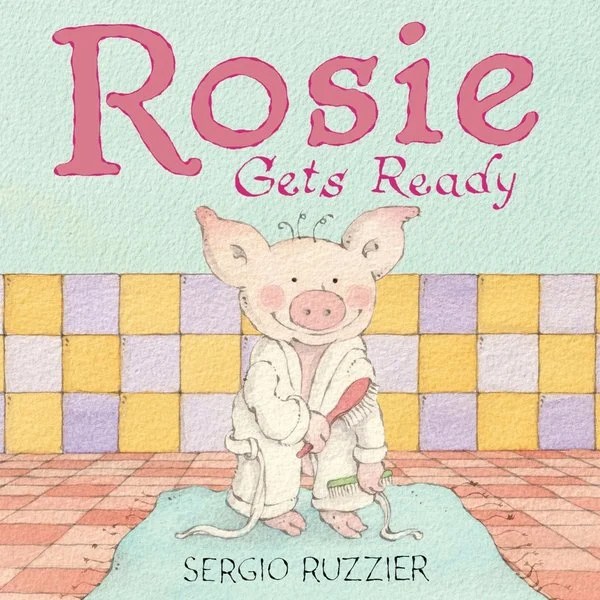
With the publication of Rosie Gets Ready, I’m allowing myself the chance to sit and write about Sergio Ruzzier, one of the real geniuses of the picture book at work today. I have been leafing puzzling delightedly over his art for about a decade now, starting with This Is Not a Picture Book!, and I’ve never quite been able to figure out the form and boundaries of his particular genius: spare in form but textured in feeling, and infinitely varied in storytelling.
I hit pause here to note, for the sake of marketing: you should get this book, particularly if you’re a teacher, for the new school year. It will be the single best first day of class read for any Pre-K or Kindergarten class. The kids will love it, and so will you. I’ve read it to my 5-year-old several thousand times already, and it delights each of us equally.
But read on for my true review and analysis of Sergio Ruzzier’s work, which is what I really want to tell you about.
After all, why not, and why look for boundaries? Genius is manifested in many ways: sometimes through rich text and simple art, other times with terse text and luminous art. It can be simple or complex. It can be lofty and elegant or marked by the most plainspoken poetry. There’s no boundary to what genius can look like on the page. But every genius works within boundaries.
Sergio Ruzzier has a distinctive style, and works within his own plain limits: the deft ink line marking his page like territories on a map. This is, I’m convinced, a necessary element of his work. Whatever story he tells, whether his characters are innocent or hard–edged, whether safe or in danger, the locale is emphatically, consistently, and unnervingly real. From the relatively light Bianca and the Butterfly to the utterly bizarre Gli Uccelli, his creatures move through a world ranging from jagged, high peaks to blasted, smoking trees, and on to the calm lakes. He himself knows every tiled floor and every bathtub. I am convinced that if he once walked, like Felix Clousseau, into his own artwork, he would know exactly where to go to reach one of the better appointed homes.
But I admit that I prefer to admire his art from the relative security of my own home. Eleanor Cameron’s description of one of the paradoxes of fantasy comes to mind while I look at the confidently defined scribbles of those ink lines: “[The first paradox is] that though it contains assumptions no sane person would be willing to admit and that though it assaults and breaks the scientific laws of our world, all fantasy that lives and continues to live possesses a strange, private, yet quite powerful and convincing reality of its own.”1 Sergio defines a powerfully convincing world filled with extraordinary creatures, real and lasting figures. From Fox and Chick’s words to the expressions and behaviour of the wordless Two Mice, they behave with a logical consistency on the page, moving through textured colours which feel so real that, on looking up, I almost find myself blinking to see my own home around me again.
Rosie is fortunate to live in one of those better appointed homes found in a Sergio Ruzzier creation. This very pleasantness feels like an omen of danger; from the moment she wakes up in her nice bedroom, I feel apprehension set in.
In the work of a lesser author, we would be admitted to every thought and feeling, every nook and cranny of her inner life, as she washes, dresses, eats breakfast, and brushes her teeth. Sergio, deftly designing her outfits and preparing her fennel tea, shows us only her clean, contented face and elegant outfit. The crispness and aroma of her breakfast rose biscuits tantalizes me as the page turns, but, even so, it can’t distract me from the sense of impending doom. What is it that’s warning me? Is it simply that everything is going too well, or is it something in the corners of her possibly too happy smile? Or is it that Sergio Ruzzier’s ink lines speak their own language?
Those lines carry restraint, of course. Boundaries do that, and these are lines on a map: they define the territory of his books. They also carry a certain irrepressible humour, the anarchy of youth.
I gave my little boy a tiny dragon for Chanukkah, and he caressed the creature with perfect love and named him Chaos: “I bring Chaos wherever I go,” he declared. To this day, I can’t tell to what degree he knew what he was saying, though I have my suspicions.
This same little boy has a perfect affinity for Sergio Ruzzier’s books. After we read Rosie Gets Ready at least seven times over Shabbat, he gazed at Rosie’s face on the final page for a long, long time, and said, in a voice I can only describe as tragicomic: “Here we are again!” Then he smiled at me, and added sweetly, “That’s what we should write underneath her.”
Sergio Ruzzier marries the deceptively easy line of Raphael with the childlike audacity of, well, my son. The combination is an indefinable, and brilliantly unnerving, world of its own– the paradox of fantasy: self-contained, self-defined, and convincing.
And, always, astonishingly beautiful.
- From “The Unforgettable Glimpse” in The Green and Burning Tree, p. 43. ↩︎

