
Per the OED:
Banal: Commonplace, common, trite; trivial, petty
It’s rather a late word, borrowed from the French, and came to English in the 1830s, which was rather a surprise to me.
I love a surprise. Chernobyl, Life, and Other Disasters by Yevgenia Nayberg was a surprise.
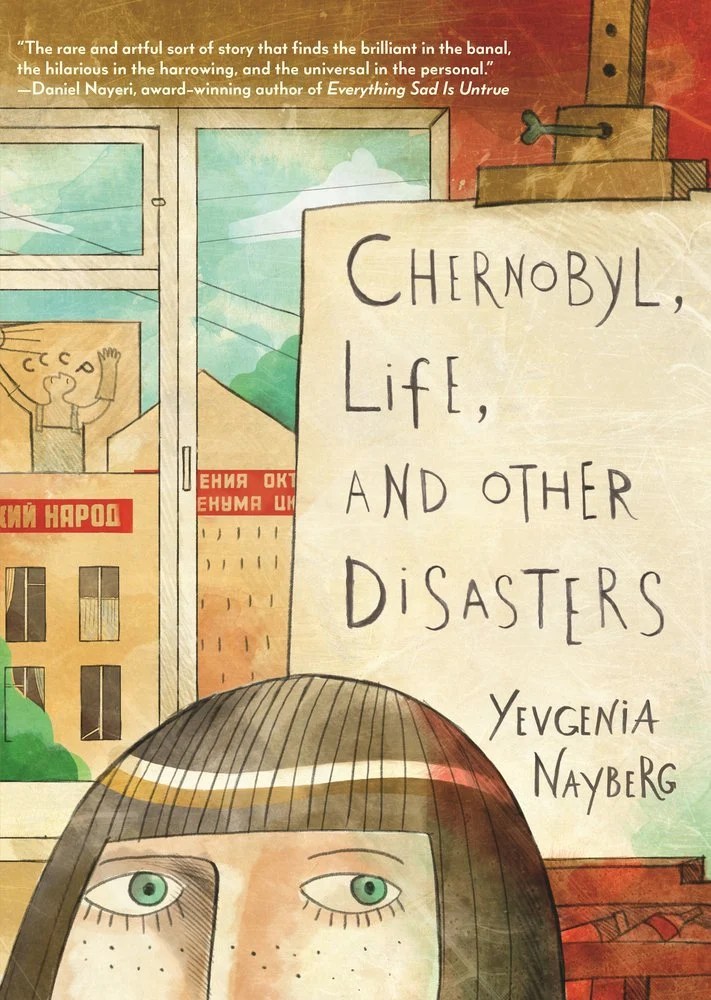
I will put myself on the chopping book by confessing I do not, on the whole, care for graphic novels, especially those from North America.1 And, on top of that, I’m not fond of gritty memoirs from painful time periods, self-indulgent navel-gazing, and grim realism.
But, for some reason, I love the unflinching realism of this graphic novel memoir by Yevgenia Nayberg, set during the Chernobyl disaster, and coolly facing everything from the antisemitism of unspoken quotas to the deliberate government lies and disinformation during a nuclear disaster.
Why?
I received this as an ARC several months ago and have read it, I would guess, at least a dozen times since then, struggling with this very question. The easy way out of the question is to say that while, yes, it’s grim and realistic, Genya is a very funny narrator, and, yes, it’s a graphic novel but the art isn’t exactly typical, so it’s ok– in a nutshell, Yevgenia Nayberg does a very good job, so I can handle it.
But I do not like easy answers. They are commonplace, trite. Banal.
I want to push into why this book succeeds as a book, and at least part of the reason is that it lives in a place of intense self-interrogation, including of form. But it doesn’t say so.2
The narrated text lives in a jarring tension: the space between Genya’s mind as known in the past and the narrator’s memory of the past is not always distinct in the text, but the fuzziness is precise, there for a reason. It reflects the very things “adults don’t say,” the unspoken words of life in the Soviet Union. Genya both declares internally (“Did she ever say it aloud?” my mind wonders) “I want to be banal!” and remembers, as the narrator today, the feeling of desire to be ordinary, conforming to the world of her peers. But we don’t know how much she expressed openly in this oddly sequestered world.
Nayberg’s realism is a truth beyond the bland precision of a row of neatly rimmed panels with saturated colours. In her art, past and present run up against each other in rimless panels, oddly scribbly or misty backgrounds, and slightly eccentric figures with elongated lines, dramatic poses, and at times gorgeously grotesque proportions. Her figures at times recall Modigliani, especially in the curve of a neck here, the tilt of a head there, the shape of an eye glancing to the side.
The art pulls you out of your own sense of realism and says, “This is a different world. This is Genya’s space.”
In this world, you never know what you’ll meet on the next page: “And then there are the war survivors that never quite survived.” The line is on a vividly green background, a beautifully alive page followed by a dreary, half-dead page after the turn. The jarring impact of life against death (“What is survival?” I wonder) rattles the reader.
There are no simple answers. Genya must not be banal. We know this, she knows this. Except that, in order to get into art school, she must conform. Then she can do whatever real art she likes. Another jarring contrast. And, of course, only if she can get to the art school entrance test through the radiation and then pass it.
What is realism, in all this? Reality was, at the time of Chernobyl, so odd that it seems unreal. And Yevgenia Nayberg’s true genius is that of an artist who does not conform to the banal expectation of explication. She records it from her narrative memory, Genya then and now, in all the distortions that she experienced it, without simplification and without apology. It really was that strange a world.
What if it still is?
- The Belgians and French do it better, of course. I cut my graphic novel teeth on Goscinny and Uderzo, today I love Catherine Meurisse, and I make no apology for being a snob. I like what I like. ↩︎
- Except in the author’s note at the back, which I almost wish weren’t there. Only I kind of like it, so I don’t know. Notes from the author seldom add much, since a good book needs no apology. But since it’s been published already, it can stay. ↩︎
 The Children's Bookroom