
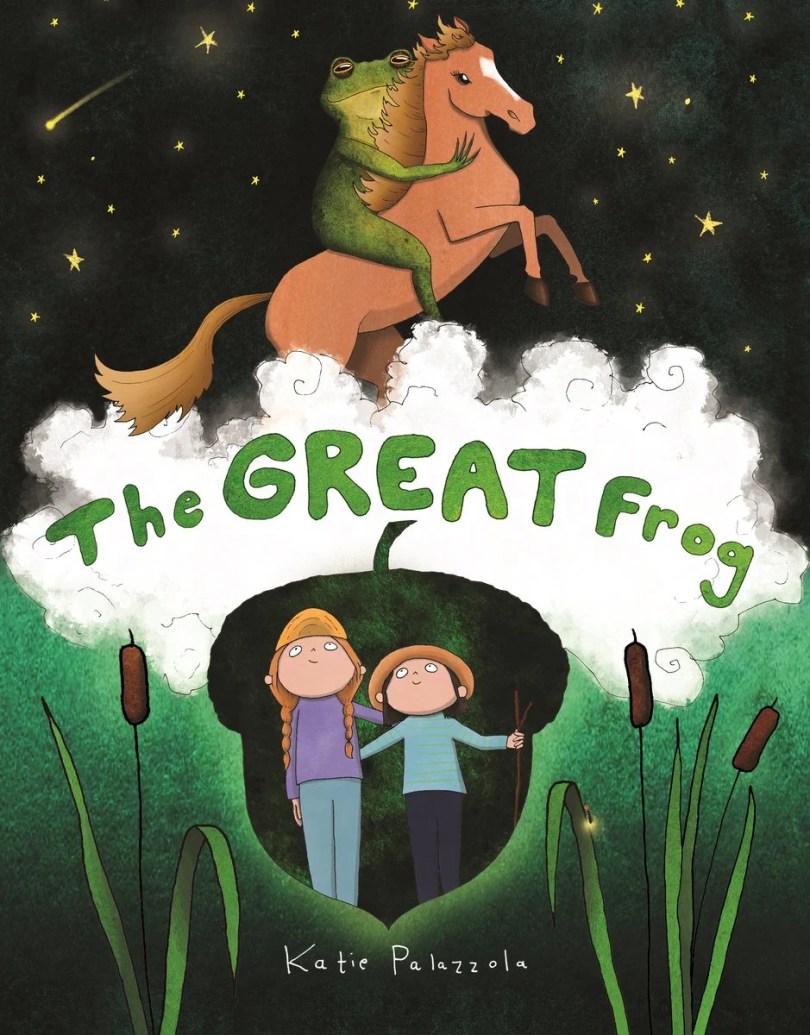
Sometimes a book tumbles right in your lap when you need it. Or, rather, when you come home from a weekend trip, Holiday House has sent you a review copy and it’s on your doorstep just in time for bedtime.
It is unlikely to come as a surprise to my readers that my younger child, a singularly sweet-tempered boy who plans to dance with the Philadelphia Ballet (he’ll drive his log loader to work) and the Paris Opera Ballet (sans log loader), become a choreographer and then Artistic Director of a ballet company, and go on to become a bird catcher like Papageno, has a very vivid imagination.
This weekend was a challenge for my peaceful and cheerful child. He, a real Ferdinand by nature, who likes to sit “just quietly” and smell the flowers, unless he’s dancing, was staying with a fiercer child, who can do nothing but everything all at once, and whose imagination is strongly influenced by what they’re reading, watching, or playing.
My little dancing sprite sees things differently. A measuring tape is a Ball Python Number Snake. When a silver sugar bowl is Winnie-the-Pooh’s honey pot, that’s about as robustly normal as it gets in my house. To stay with a rigidly exact child with a hot temper was hard for a child who believes very seriously that he was from Saturn before he was born (and has a narrative to explain it all), and my boy stood up quietly for his viewpoint, but had a hard time.
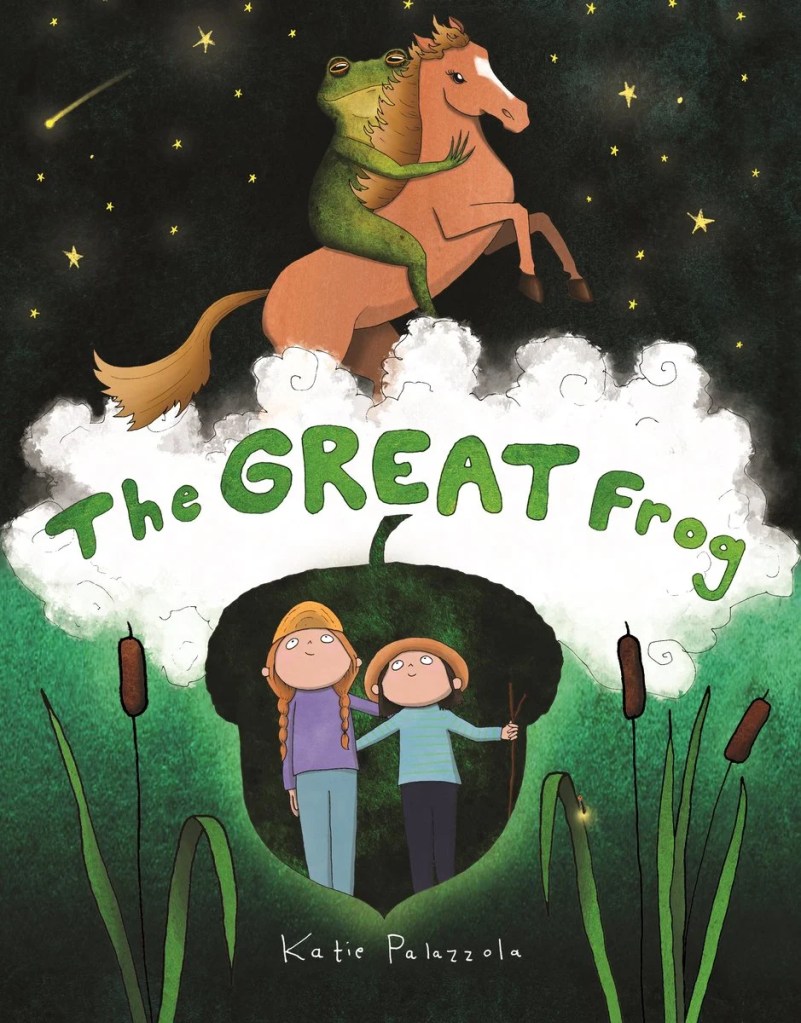
So it was very reassuring to him to come back to The Great Frog by Katie Palazzola.
Why?
This book is a merger of differences, and they are two types that coexist in most children; truly, in most humans, but children matter most, especially in literature for children.
One is the real. The other is the true.
Two children are looking at frog eggs. The big sister, Kit, knows about frog eggs and the stages of development. The little brother, Peedie, is a curious little fellow prodding with a stick. His sister explains, and tells him the story of the Great Frog who protects all little frogs and rides a horse called Tarnation. Peedie is fascinated and believes every word. The story grows in the telling, as stories do, until Kit sighs and confesses she made it all up because she thought he’d like the story.
Peedie, who may as well be my son, they’re like as two peas in a pod or frog eggs in a pond, replies, “Lots of true things are stories.”
Initially, I wasn’t sure I’d like this book. (Thank you, Holiday House, for sending me a copy of a book I was hesitating to order in for myself!) The kids have those sticky-out loop ears in the art that set my teeth on edge. But when I put my hand on the cover and look only at the Great Frog on Tarnation, I see the way there are two kids, two views, two arts, two stories, and they come together on each page. I am, simply, on Team True rather than Team Real. I believe that in fairy tales there is a truth beyond reality. Rafael and Vermeer and Holbein painted who people are rather than what they may have really looked like photographically. The image of the Great Frog on Tarnation called me; the cover image of the kids didn’t attract me in the same way. (Overall, the art was a mixed bag for me, but I loved the skyscapes, pond, the kids sprawled on the ground, and seeing Kit put acorn caps on her fingertips.)
Kit, loving big sister, sees this truth in her little brother even if she doesn’t see the truth in the Great Frog. I see it in my big girl and little boy. And I see the truth and beauty in my friend’s gorgeous, rigidly hot-tempered kid, too.
But I could see my dancing sprite of a boy’s eyes light up when Peedie declared, “There should be a looker-after for everything little,” and I knew that an idea had taken root, just like an acorn sprouting.
What a lovely book. And what perfect timing.

