Twelve Kinds of Ice (and giveaway)

“Yes, but it’s not actually poetry,” I scold myself.

“OK, but…”

“Just because it sounds and feels exactly like poetry by times doesn’t make it poetry, you know!  There’s rules!”

“Methinks the blogger doth protest too much,” I give in drily.

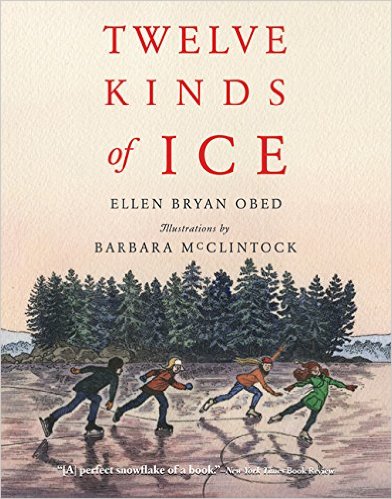
This is the mental debate I’ve been having over one of the kindest gifts I’ve ever received, a signed copy of Twelve Kinds of Ice written by Ellen Bryan Obed (author of Borrowed Black), and illustrated by Barbara McClintock.  Ellen Bryan Obed generously sent me a copy of Twelve Kinds of Ice, a book of hers I hadn’t yet read, and receiving it was just like getting a steaming cup of hot cocoa after you come inside from tobogganing or, of course!, skating on a cold winter day.  The same grateful feeling, the same comfort.  (And read to the end: since I got this for free, I’ll be giving away a copy myself to pass on the kindness.)

Twelve Kinds of Ice.jpg

Despite the comfort of reading it, though, I had, and continue to have, this internal debate: Why does it feel so much like reading poetry?

Well, all right, I grudgingly allow that part of that is due to expectation.  I grew up with Borrowed Black and Wind in my Pocket and they formed me as much as, by contrast, Neil Gaiman tells us that he was by Doctor Who and Batman in his own childhood.  Which is to say: they shaped me.  And they were poetry.  Going back to Ellen Bryan Obed, it’s very logical that I should expect more poetry.  Yes, very logical.

That’s the easy explanation.  The harder one to pin down is the experience of the first page:

The First Ice

The first ice came on the sheep pails in the barn– a skim of ice so thin that it broke when we touched it.

Read that aloud (go on, you’re probably alone in the house and your cat won’t tell on you; never feel ashamed to read aloud), and tell me for sure that you aren’t reading poetry.  You aren’t sure, are you?  It seems to have some metre to it, but you aren’t sure what it is, is that it?  Are you trying to scan it, but you’re stumbling over whether “first” or “ice” is stressed?

I hope you’re experiencing some befuddlement or other, because I don’t want to be entirely alone here.

It’s like when you’re reading Dickens and suddenly stumble onto a passage which feels a little out of sync with the rest, and then you realize it’s basically in iambic pentameter.  “Oh, well, that explains it,” murmurs a voice in my brain.  Except that there’s no iambic pentameter up there: well, there could be if you rewrote it a little–

The first ice came on sheep pails in the barn

A skim of ice so thin it broke when touched

Which would ruin the whole thing.  That beautiful caesura of the m-dash!  And with that thought, it clicked.  It’s not (quite) accentual-syllabic poetry.  It could be.  Ellen Bryan Obed has proven again and again that she’s very happily in league with our modern English poetic muse, whoever she is these days.  Yes, if she wanted to, the author of Borrowed Black could absolutely write a perfect poetic sequence in praise of ice.  But that’s not what she wanted to do.  She wrote something more like a story-saga in praise of ice, something with room for dashes of humour and dreams of silver (whoops, there I slipped into Borrowed Black territory again).

I want to take a little aside here to apologize to Ellen Bryan Obed if I’m being too much of a poetry geek, and veering too far off from what your actual intentions were.  This is just how it reads to me, and I tend to be immersed up to my ears in poetry most days of the week.  Mea culpa.

This story-saga of the winter months to me recalls older poetry, accentual verse.  Yes, it’s written in prose, I acknowledge that, and that’s why you don’t have the syllabic line structure of formal modern English poetry (iambic pentameter and so on), but you definitely do have accented words: “ice,” “pails,” “barn,” “skim,” “broke.”  And just read aloud, again, these lines:

We sped to silver speeds at which lungs and legs, clouds and sun, wind and cold, raced together.  Our blades spit silver.  Our lungs breathed out silver.  Our minds burst with silver while the winter sun danced silver down our bending backs.

But I’ve failed if I don’t give some sense of what this story-saga is about: what are the twelve kinds of ice?  Well, Ellen Bryan Obed takes us on a winter stroll through the cold months of the year.  These are marked for her not by months, but by how the weather spoke to them.  I remember thinking of October as the First Cold Month: the question was whether it would be too cold for Hallowe’en costumes without coats on.

For our young narrator, winter speaks through ice.  You’ve met the First Ice.  The Second Ice can be picked out of the pails like panes of glass and shattered on the frozen ground.  The Third Ice stays firm.  But after these ices of anticipation come the ices that the children (and, we soon learn, not just the children) truly waited for: the various ices you could skate on.  There’s Field Ice, and Stream Ice: both ices for skating on various places around home.  There’s Black Ice on the Great Pond, too.  But most of all for the children there’s the ice in their own garden, Garden Ice, their very own ice rink in their very own yard, maintained by the whole family, especially the father.  Ice they share with the neighbourhood, ice that endures through the winter and ultimately gave rise to the Rules of the Rink and, after the Perfect Ice came, the Skating Party.

These are just some of the ices which Ellen Bryan Obed reminisces about in this slim volume.  And I find myself reminiscing about my own ice: Marsh Ice.  When there was a January thaw and then a hard freeze, then it was safe enough to trek out into the backyard and clumsily put on our skates (we weren’t such expert skaters as the skaters of Bryan Gardens in the book!), and go skating on our own patch of marsh.  We’d carefully weave in and out of the frozen bulrushes, not going too far out in case the ice did break, and would eventually run back inside for hot chocolate, thrilled at getting the better of the ice rink in town: we’d gone skating in our own yard, wow!

If you have any memories of your own types of winter ice, then expect them to be awakened by this read.  The lilting almost-certainly-prose-really will wheedle open your oldest memories of ice and winter and skating, and you will fall in love with winter again as you close your eyes and dream of ice.  Then make some hot chocolate.  Do you have dreams of winter and ice?  Feel free to leave them in the comments!

As I said at the top of the post, this beautiful book was a gift, and I want to pass on the kindness.  If you want a copy, email me at deborah@childrensbookroom.com and the first to write will win the giveaway.  First come, first served, for readers in the USA and Canada. It’s a beautiful book, so I promise you, you do want this book.

The Charmed Children of Rookskill Castle

My parents really love murder mysteries.  I admit that it’s a little beyond me, but then they seem politely perplexed by my love of Star Trek.  But there’s one murder mystery show we all enjoy: Foyle’s War.  If you don’t know it, it’s set in WWII England, with the detective, Foyle, solving all kinds of mysteries during the years of the war: some involving German spies in England, many more involving English bureaucrats or problems within the British system.  Each episode is like a short, exquisitely-crafted war movie.

The odd thing is that I don’t really like war movies.  That said, I do like “exquisitely-crafted” works of art.  This also goes to explain why I so enjoyed The Charmed Children of Rookskill Castle, written by Janet Fox.

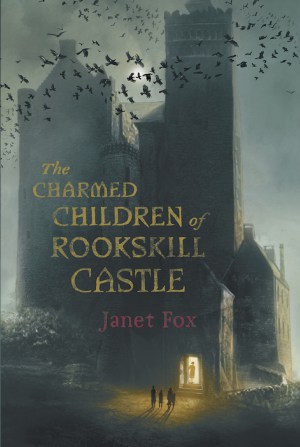
Charmed Children Rookskill Castle.jpg

As you know by now, my dear and dedicated reader, I rarely write about novels.  (The exceptions have been Moominland MidwinterThe Secret Garden, Fairylandand Marvels.)  Why?  Well, basically, I’m mostly reading picture books with the Changeling right now, and rarely have time for novels.  I absolutely love a good children’s novel, though, and this is a good one.

Given that I’m out of touch with what’s going on in the world of children’s novels, though, it took a lucky bit of happenstance to put me onto this one.  You will be unsurprised to learn that this lucky bit of happenstance occurred at the Children’s Book Shop in Brookline.  The shop owner has some of the best taste in children’s literature I’ve ever met.  (“What’s that book up there?”  I asked.  “Oh, that’s the shop owner’s recommendation.  It’s–” “I’ll buy it,” I interrupted.)

OK, so, if you haven’t been to the Children’s Book Shop, and don’t know the owner, then you may require a bit more explanation about what the book involves than I did in order to be persuaded to give it a shot.  First things first, though, a warning: This reads like the first book in a series.  If you do not want to be hooked on a series and waiting impatiently for the next books to come out, then I heartily recommend not reading this one.  I am living proof of what happens if you do: “What happens to–?   What happens next?”  I walk around whispering.  I am spooked, electrified, jumping at small noises– utterly hooked.  And, also?  It’s a fast read.  I read it in a day, easily.  And without even neglecting my other responsibilities!  (I promise.  I even made salmon croquettes for supper.)

OK, enough of all that.  By now you want to know, “Yes, but what’s the book about?”  It’s about a girl and her family in wartime England.  They’re being broken up by the war: Katherine (Kat) Bateson and her brother (Robert) and sister (Amelie) are being sent away from the London bombs into Scotland; their father is doing something very mysterious; and their mother is staying in London with their great-aunt, Margaret.  Before the children leave, Great-Aunt Margaret gives Kat a chatelaine (an old tool for keeping useful tokens close by in the days before women got pockets), and also gives her a warning: these are times, she tells Kat, which call for the imagination and for hope.  Don’t be too pragmatic.  For Kat Bateson, the warning not to be too pragmatic is difficult to process.  She’s wholly pragmatic, her father’s “logical girl.”  It’s her sister, Amelie (Ame), who’s the imaginative, lovely, dreamy one, and even Robbie has dreams of being knightly and engaging in daring deeds against the Jerries once he’s in the castle in Scotland.  Kat just wants to make sure they’ll all have warm clothes.  (I love Kat.)

But once they’re in the castle in Scotland, strange things start to happen.  The Lady of the castle, Lady Eleanor, seems cold and remote, although she certainly feeds them well.  But her hands are so cold when she greets them!  And who are these children Kat keeps glimpsing– a poor-looking girl in a summer dress, trying to fish in a dried-out pond?  A boy with cats?  How come she can never reach them or speak to them, and why does Lady Eleanor deny all knowledge of them?  Things feel… strange, spooky… dare I say haunted?

Let me note that I’m being crueler than the book here.  The book isn’t one of those absurd novels which torments you with hints of magic while dragging on and on a pretext that there is none.  There’s magic aplenty, and it’s entirely and wholly acknowledged by the narrator from the beginning.  The difficulty is with Kat: how to get practical Kat to acknowledge the magic and solve the problem of the children.

And, of course, Kat has help: her two siblings, and their friend, Peter, who is her own age, and brave and clever.  The children are all individuals, all strikingly well-drawn characters, and some of them (little Amelie, my favourite) are particularly lovable.  But I think the main strength of the book comes from Kat and the Lady, both standing together, an uneasy couple, at the centre of a web of history.  Who is this Lady? we wonder.  Where does she come from?  The book tells us a story dated to the 18th C… and then brings us back to 1940.  And only Kat and the Lady, each with her own chatelaine, seem stable in that shuttling back and forth.  The web of seeming chaos around them teams with frightening dreams of claw-like hands, secret passageways, drugged hot chocolate, and, always, children disappearing, one at a time.

Finely drawn characters, spooky atmosphere, intricate plot structure– I refer you back to what I was saying about Foyle’s War above: this is an exquisitely-crafted work of literature.  Kat Bateson is brave, intelligent, and heart-breakingly human.  Her siblings are lovable and Peter catches our interest from the beginning.  And the plot is terrifying without being quite chilling.  It’s very much in the Gothic tradition, filled with suspense, mysteries, horror-filled dreams, and a double-helping of black magic.  The difference is that instead of having a female protagonist who faints a lot and “lets fall a tear” so often that her eyes can’t ever be dry, Kat does a lot of math, solves a lot of puzzles, and finally has a face-off with the lady which is easily one of the best scenes of the kind I’ve read:

“But,” Kat said as the blood rushed into her ears and her voice became faint, “but why?”

“Why?  Why?  Because I was once a helpless child, not nearly so privileged as you.  Because I was once a powerless woman in a man’s world.  Because all I asked for was love and shelter.  And instead I got bruises and misery and heartbreak. […]”

I had to cut it off where I did for your own good, but believe me it gets even better.  But notice a few things: this is extremely traditional, this face-off moment.  It’s particularly Gothic, if you’ve read any Ann Radcliffe.  And yet– it’s different.  This is between two women, and Kat truly is a woman at this time, not a child any longer.  And they’re both strong.  And we feel sympathy for both, but are rooting for Kat, and– well, it’s powerful, powerful storytelling.

A word about age-appropriateness: Be aware, there is some graphic stuff that goes on here.  A hand gets crushed, a woman describes being beaten by her father, body parts are dismembered.  It’s not terribly graphic, the magic is far spookier than the real stuff, but I would recommend maybe Grade 6 and above.

So, be prepared: it’s a fast, addicting read.  It’s spooky and special.  It gave me nightmares (I’m an easy mark for nightmares).  It has wonderful, lovable characters.  It has evil, terrifying characters.  It is spectacular.  Be prepared to be hooked.

One Little Two Little Three Little Children

I’ve been working on what my supervisor and I agree is probably the dullest, dreariest section of my dissertation, but one which I have to push through.  (That’s what’s been taking me away from here, mostly.)  It’s meticulous work.  Delicate to perform, dull to read.  Believe me, you’d rather I do it than do it yourself.  It’s the neurosurgery of the academic world: Tedious, precise, and deadly if you get it wrong.  (Well, no.  Not really.  That may be the anxiety talking.)  But I am a little tired and may be less than totally articulate today.

That’s why I decided I wanted something light, happy, a little soppy, and a little frivolous to take my mind off of things.  One Little Two Little Three Little Children by Kelly DiPucchio (whom we met already from Gaston) and Mary Lundquist, fits the bill. One Little Two Little Three Little Children.png

This was a discovery from my wonderful Children’s Book Shop in Brookline.  Remember that place?  I may have mentioned it a few times.  Well, it’s so good that when my husband and I decided we were owed a date before he begins his new job, I suggested we go to the Children’s Book Shop, and because my husband is a respectful and lovely man who understands what makes his wife happy, he said he thought that was a wonderful idea.  (We also went to a movie, don’t worry: Love and Friendship— it’s excellent, and you should definitely go.)  While we were there, my husband picked this up and flipped through it: “This is a bit too lovey for me,” he said, “but I think you’ll like it.”

He knows me well, dear reader.  I do like it, and I think you will, too.  Here’s why.

Kelly DiPucchio and Mary Lundquist totally revolutionize an old, rather, well… um… we just don’t do that sort of thing anymore song (you can search “Ten Little Indians” if you want, but I’m not doing any links for it because it makes me feel squirmy and uncomfortable).  They do it so thoroughly that in the new version nothing is left of the old but the chanting rhythm of “One little, Two little, Three little…”

Nothing?  Well, no, not nothing.  What they do is take the bouncy, wonderful rhythm from an old song and use it as the vehicle for a strong, loving story.  The combination results in a bounce-on-your-knee read with your child which also has the benefit of introducing your child to, well, everything in the world.

OK, maybe not everything.  Your child won’t learn quantum mechanics from this book.  But your child will see everything they’re likely to meet out on the playground: children crying, children smiling, parents of all genders and all colours, children who are cheerful and children who are shy.  And they’re going to hear sounds and voices which are both familiar and secure as you go through the book.  It’s both broadening and comforting at the same time: in short, it’s a wonderful way to absorb a diverse world in a quiet, gentle way.  (I admit: I love the idea of taking a basically racist old song and revamping it into a message of acceptance and diversity.)

Let’s take a look at a spread from this book:
20160706_211739_001.jpg

First of all, at a glance you see different ages of children, different colours, different genders.  But I want to point out something else: you also see different moods.  As the mother of a girl who can be pretty shy sometimes, I have to say that I’m glad to finally see shyness represented in a book.  I’m not saying that the shy are a minority who are discriminated against, or anything like that– I’m just saying that I think cheerfulness is the baseline of what we expect from children, and that’s what we tend to see in picture books.  Seeing crying, shy children is something of a relief, honestly.

The words, though, are the real reason I chose this page for you: “Loved little, hugged little, snugged little children.  Cry little, shy little, my little children.”

Isn’t it perfect?  It’s a shame my daughter’s in bed right now because typing that out made me want to grab her up and give her a cuddle.  Also, I tend to pine for my daughter at around 9:30 or 10 pm, after she’s been in bed just long enough so that I have a chance to forget the day’s trials and tribulations.  But that’s where this book came in for me: trials and tribulations.

You see, the Changeling and I were having some trials and tribulations.  Perhaps they involved putting on clothes.  So often they do seem to involve putting on clothes.  (Why am I so unreasonable as to wish to clothe my child?  It’s strange, isn’t it?)  I took a deep breath.  I picked up this book and said, “Hey, I bought you a new book!”  The tears stopped.  New book?  Oh!  We sat on the couch and arrived at this page pretty quickly.  Soon we were giggling and cuddling.  (And ready to put on clothes.  Thank God.)  Look, I’m not saying it’s magical or that it’s going to solve all your parenting problems, but I am saying it helped me out when things were pretty stormy at Château Changeling.

But let’s sum up.  I feel that I’ve perhaps been somewhat scattered today, and I don’t want to lose the thread of what makes this book special.  It’s a beautiful book, thanks to Mary Lundquist’s gentle and warm pencil and watercolour illustrations, but what really marks it out is the diversity which comes through both the text and illustration: that warm message of absolute acceptance.  The text represents all children as worth loving, and all parents as capable of loving.  The images show all families as being in the business of parenting and growing up together.  Like Mary Lundquist’s art, it all comes through with gentleness and warmth, and that very gentleness makes it comforting to read.

If you’re lucky enough to have a child who likes sitting on laps, please do yourself a favour and find a copy of this book.  Then go bounce-bounce-bounce… “One little, Two little, Three little chil-dren!”  Cuddle and giggle and let your child find the interesting bits of the pictures.  And enjoy!

Monthly Retrospective for July

I wondered, as I was scrolling through the past month, whether this month even had a theme.  But then it clicked: some of my own anxiety about my work and whether I was Doing the Right Thing (a PhD dissertation, even if you have as wonderful an advisor as mine, is an excellent vehicle for anxiety) must have crept in.  This month has had a lot of contemplative books: books about finding yourself, finding your place in the world, loving yourself and others for who they truly are, or just about voice, whether listening to another’s voice or finding your own.  That means we have a real range of books!  Some are old (Mrs. Tittlemouse) and some are very new (Beatrix Potter and the Unfortunate Tale of a Borrowed Guinea Pig), some are religious (Dear Pope Francis) and others have a more universal feel (Gaston).  But I find all of them uplifting– perhaps the most explicitly uplifting being Beatrix Potter and her Paint Box and, above all, The Monk and the White Cat.

This is a shorter month than usual since I took a little working vacation: my vacation posts with all of the excellent book links in them are here– The Perils of ProcrastinationVacationChecking in from TorontoChecking in from Toronto II.  But short or not, I still found it agonizing to choose books to spotlight for the month.  Here they are, in the end, and I hope you find them as inspiring as I do!

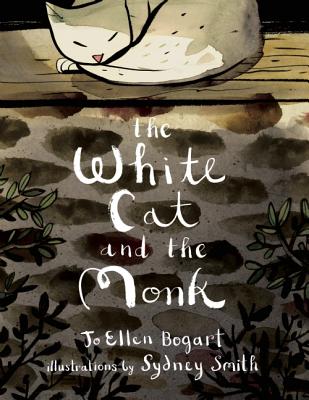
Pangur BanThe White Cat and the Monk: Based on the Old Irish poem Pangur Bán, a monk lives with his white cat, each pursuing his own craft: scholarship or hunting.  This is a particularly inspirational and uplifting book.  The illustrations reflect the contents, moving from darkness to light as the monk’s thoughts likewise become enlightened.  Children will love hunting for the hidden animals in the manuscript pages, and parents will be awestruck by the glorious illustrations.  This is wonderful for toddlers and up, and when I say “up” I mean all the way up to parents, who will find themselves saying with me, “How about this cat book again?”


Dear Pope Francis

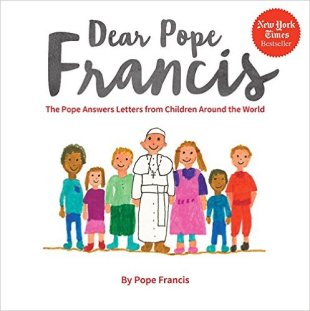
Dear Pope Francis: Pope Francis receives, and delights in receiving, letters from children all around the world.  In this book, he answers questions from these letters: questions ranging from the religious (How did Jesus walk on water?) to the secular (Do you enjoy dancing?).  Everything from the title to the layout gives the children’s questions the privileged place in this volume: they’re in colour, they’re transcribed for easy readability, and let’s not forget that the Pope’s answers make sure we take every child’s voice seriously.  A must-read for the religious, but I think everyone can appreciate this book.

Beatrix Potter and the Unfortunate Tale of a Borrowed Guinea Pig

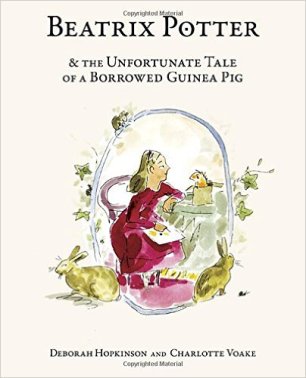
Beatrix Potter and the Unfortunate Tale of a Borrowed Guinea Pig: This might be my absolute favourite book of the month.  Striking a perfect balance between nostalgia and originality, Deborah Hopkinson and Charlotte Voake evoke Beatrix Potter’s own tales while presenting a wholly new one which gives readers a flavour of the famous author-illustrator’s childhood and personality.  Children will love the illustrations of animals and emphasis on the pets she kept.  (Parents may be forced to come up with an answer to requests for snakes and lizards!)  Parents and children alike will love the humour and honesty of both the story and the illustrations.  And let’s not forget that it’s just an excellent story.


Finally, here is my list of all pieces for the month of June:

  • Beatrix Potter and the Unfortunate Tale of a Borrowed Guinea Pig (I’d recommend for ages 5+, although the Changeling, who’s nearly 3, already enjoys it.)
  • Beatrix Potter and Her Paint Box (Lyrical, with watercolour text to match the images.  The Changeling requests it a lot, so toddler and up is probably fine.)
  • Mrs. Tittlemouse (Toddler and up, especially for parents and anyone who frets about housekeeping.)
  • Dear Pope Francis (Grade 1 and up.  If your kids have big questions, they’ll probably enjoy the validation.)
  • Gaston (Toddler and up.  Being a story about love and family, this is a great one for snuggles between parents and children, and for conversations about loving someone for who they are.)
  • The White Cat and the Monk (Toddler and up.  A story about finding and understanding your place in the world.)

The Perils of Procrastination

Normally, I feel that my habit of procrastination isn’t so much procrastination as, well, gracefully waiting for the golden words within me to come bubbling up and spill onto the eagerly waiting paper.

Or something like that.

Sometimes this backfires.  It generally backfires when I have three (3) (III) THREE different writing projects waiting for me– one of which is only my freaking PhD dissertation, y’know– all on similar deadlines, and then I realize that I have travel plans which, shall we say, put the seal on this deadline.  That would be this week.

So let’s relieve some of this pressure, shall we?  I still have to sort out exactly what I’m going to be able to manage for the rest of this week, but for today, well, I’m going to wing it.  I’m going to talk a bit about the Changeling and her literary tastes at the moment.  Some of this is going to take us back into older territory (books we’ve already read) and some into newer territory, but we’re going to take it a little bit easier today, because, for crying out loud, I have a lot of writing to do and basically no time left.  (Why do I do this to myself, people?  Why?)  (Don’t answer that question.)

First, let’s talk about one of the unsung trials of potty training.  Please don’t be squeamish: you know I have a toddler, right?  That means talking about poop at some point.  Right, so, here’s the thing.  Sometimes your toddler will make it very clear they need to go on the potty.  They will volunteer to go.  Then they’ll sit down, get bored, and say, “Hey, I wanna go do something else!”  So, how do you keep them sitting long enough to find out if something’s going to happen or not?  Obviously, you read a book, right?  Right, that’s what I thought, too.  Our book?  Here Babies, There Babies.  It’s short, zippy, and entertaining.  Most of all, it’s become ritualistic.  And there’s something about the rhythm which does seem to, ahem, help move things along…

But what else is she reading these days?  My Wild Family has become a favourite bedtime book, and Robert Munsch’s Good Families Don’t (that’s a Canadian link; you can listen to the book for free over here) has, by virtue of the similarities between the titles, also become popular.  It’s funny because the two books couldn’t be more dissimilar.  My Wild Family, as we’ve discussed, is an elegant, slightly humorous, and gentle book about the characteristics of different people in a family.  Good Families Don’t is about a fart.  It’s funny, chaotic, zany, it’s cheerfully inelegant.  Where My Wild Family teaches you to look inside yourself to see what makes you special, Good Families Don’t, if it has a lesson, teaches you that, actually, good families sometimes do.  Sometimes you should just embrace the farts, because they can be there, and there’s no use in denying them.

And, of course, it has every Canadian’s favourite line in a book: “Good Canadians don’t have farts!  What would the Americans say?”

And that’s what we’re reading over here these days.  And now that I’ve scandalized all of my readers (I am so terribly sorry), I have to try to meet my other deadlines.  Wish me luck!

Beatrix Potter and the Unfortunate Tale of a Borrowed Guinea Pig

My very dear readers, yesterday I offered you something simple and perfect: a very pared-down biography.  Basically, I gave you the perfect rice pudding: creamy, smooth, wholesome, and altogether dreamy.  Today, I’m giving you the reverse: I’m giving you ice cream with everything in it and on it, right down to the chocolate fudge sauce, whipped cream, and a cherry on top.  It’s fun, it’s intelligent, it’s beautifully illustrated by one of my very favourite artists working today– it’s Beatrix Potter and the Unfortunate Tale of a Borrowed Guinea Pig, written by Deborah Hopkinson and illustrated by Charlotte Voake.  (Be careful: that link includes this, along with other art by the genius.  I wantsss it, my precioussss…  One day, one day.)

Actually let’s take this out of the parentheses.  Have I told you my dream?  My dream is that one day I’ll have a study for writing and reading.  A perfect, strong desk for writing and doodling.  A perfect, deep armchair for curling up with a book.  And walls lined with two things: Books, of course, but also art.  Art from Charlotte Voake.  Art from Charles Vess.  Art from Edward Ardizzone.  Art from Steve Light and Liz Wong and Paul O. Zelinsky and all the people who do such marvellous, beautiful work every day out there.  Art is one area where I just never learned the ropes, but looking at it helps me work, and my dream-study isn’t complete without lovingly-framed gorgeous art from the people who inspire me on a daily basis.

Which brings me back to this beautiful ice cream sundae of a book, which is just like my perfect dream-room: it has everything, and something for everyone.

Beatrix Potter and the Unfortunate Tale of a Borrowed Guinea Pig.jpg

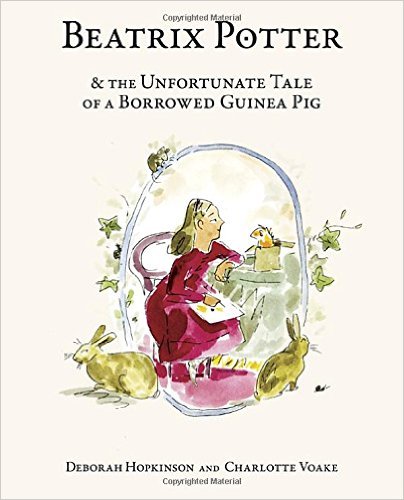
I mentioned yesterday that I felt the dangers of writing a book about Beatrix Potter aimed at children, particularly one illustrated in watercolours, was that you might end up with something derivative and a little cheap.  I am so impressed by the different ways David McPhail, Deborah Hopkinson, and Charlotte Voake all worked to make their books consistent and individual masterpieces.  In this case, I want to draw an apologetic analogy to Star Wars VII: The Force Awakens.  Like The Force Awakens, Deborah Hopkinson and Charlotte Voake had to do two things: a) play into a history of nostalgia and affectionate memories; b) create a new story with both new and old characters, good dialogue, and a full, consistent tale of its own.  And, in my humble opinion, like The Force Awakens, they succeeded in both aims extremely well.  As you can see from the cover posted above, the style, font, and format remind readers of the Beatrix Potter books, but the rich story is very much Deborah Hopkinson’s own, and Charlotte Voake’s art is definitively in her own style.

Let’s get into more detail.  The story is aimed a little bit older and has a slightly broader focus than Beatrix Potter and Her Paint Box.  Two key differences are: a) It has a richer and punchier narrative, as opposed to the soft and delicate walk through Beatrix’s life David McPhail provides; b) Instead of the very close story of Beatrix’s art, Deborah Hopkinson talks a lot about her more varied interests, including both her art, nature, animals, stories, and her friends.  I’d say that the plushier story gives a more rounded and fuller picture of Beatrix from this book, and it’s a hell of a lot of fun.

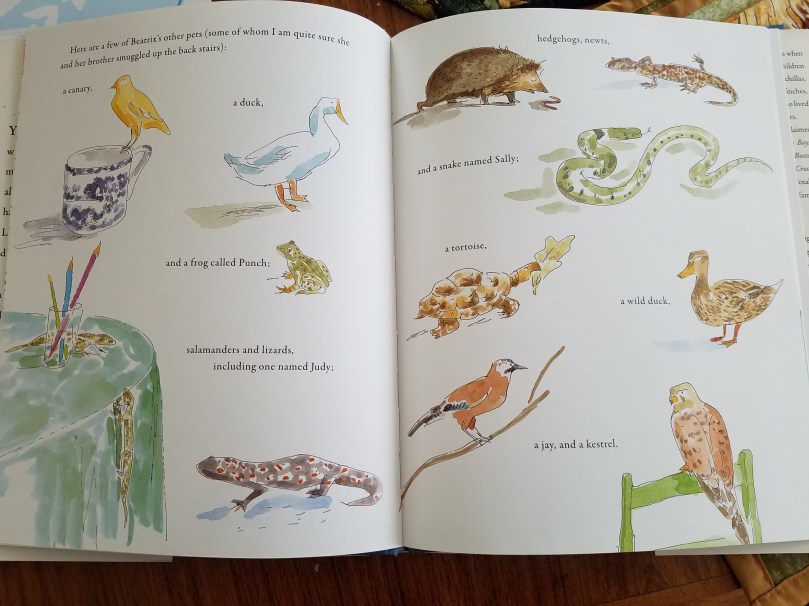
The story goes like this: Young Beatrix and her brother lived in a house in London with their family, but also with a complete menagerie of pets.  This complete menagerie is laid out very fully in the first few pages of the book, and just look at these illustrations:

20160624_153601.jpg

Now, what Beatrix does not have is a guinea pig.  And she dearly would love to paint a picture of one.  Therefore, she betakes herself to a neighbour’s house to ask for the loan of one of her loveliest guinea pigs so that she can draw it.  The loan is granted, and off goes young Beatrix with the guinea pig.  (Can you guess what’s going to happen?  I bet you can.)  Beatrix sets to work and everything is going along splendidly until she’s called away from her work.  She leaves the guinea pig on the work area, rather unwisely.  The guinea pig looks around, and begins what Terry Pratchett and Neil Gaiman term a “crude forensic examination” (Good Omens) of the materials on the table.  Paste, paper, everything is nibbled up.  These prove unhealthy for the poor beast, who expires.  Beatrix is shocked and heartbroken, but brings the painting of the poor, dead guinea pig to her neighbour, who is not notably mollified.  The book ends with an appeal to the neighbour to find out whether she has kept the illustration, and indicating that it would have been a very good idea if she had held onto it since it has decidedly appreciated in value since the time it was drawn.

We must all agree that it’s not often that you hear me talking about a funny story where a little girl killed her neighbour’s pet, so you can tell from this that the story is extremely well-told.  What helps here is perspective.  David McPhail had an extremely sympathetic narrator, but it was a third-person omniscient narrator talking about a little girl named Beatrix, for all that.  Talking sympathetically, talking lovingly, but talking about her.  Deborah Hopkinson works differently.  Her narrator is constantly looking through Beatrix’s eyes.  When Beatrix wants a guinea pig, so does the narrator, and so do we.  When Beatrix realizes what’s gone wrong, we’re all horrified together.  It’s an extremely close relationship, and what distance comes into the relationship works like Charlotte Voake’s elegant pen strokes: it’s in the outline.  Any distance is in the author delineating the lines of the story, and giving the historical perspective.  That’s where the affectionate humour comes in, that’s where the bright, dark lines of the story are drawn, and of course these appear in the introduction and conclusion, especially.

I want to conclude with just a word more about Charlotte Voake’s illustrations, which I love almost too much to dare to talk about.  She works in a style uniquely her own, but in a British tradition of pen and watercolour which goes back pretty far.  I mentioned Edward Ardizzone above, but there’s also Marcia Brown, who comes to mind.  I, personally, associate Charlotte Voake with Elsie Piddock Skips in her Sleep, and thus with Eleanor Farjeon, but her work goes far beyond that.  What I’m saying is that she’s a host in her own right: part of a tradition, but her own unique force.  What her style lends this book?  Oh, Lord.  It brings a softness and a richness at the same time: the warm sweetness of watercolour, much as Beatrix Potter herself worked, bolsters the warmth and gentleness of the tale.  But the pen and ink lends vigour and activity, humour and spirit.  I cannot think of a more perfect accompaniment to Deborah Hopkinson’s text.

I’ve been told I should practice writing pull quotes, and it’s something I’m terrible at, but I’ll try here for once, mostly because I really want to give you all a message to walk away with: For warmth and humour equal to Beatrix Potter’s own, this is a perfect book for parents and children to share.

And that’s it, folks.  One story of Beatrix Potter’s own, and two perfect little gems about her, each for a different age group.  Go forth and read, and have a wonderful weekend!

Beatrix Potter and Her Paint Box

The bad news: Remember that poor, shy kitty I got a month ago?  Telemachos by name?  He’s still really shy and hiding under the rather dusty, dirty futon.

The good news: While I was dealing with my writer’s block yesterday, I stood playing with a cat dancer, and he finally batted at it from under said futon.  This is a new development, and I’m delighted.  Then he came out and chased it!  A lot!  My poor, semi-feral cat actually played with me.  This is very, very good news.  Here he is out of the sofa, but not quite being playful yet (ignore the mess, please):

20160622_111734.jpg


The burning desire of my heart: To get rid of that blasted futon between me and the cat.  I know it’s unreasonable– the abovementioned futon gives Telemachos a safe space to hide and it’s probably best to leave it for him for a little longer, at least.  (I still hate the damned futon, though, and intend to replace it with a cozy armchair, the kind you can really curl up in, though.  For reading purposes.)

Further bad news: This means I’ve been severely delayed in posting.  I spent my writing time playing with my kitty.  Mea culpa.

Further good news: I did, however, have an enjoyable time socializing a semi-feral kitty and also talking with a charming and intelligent friend who showed me a very good new-to-me book.  (The other distraction yesterday.  Mea culpa again.)

So, lots of quiet but excellent developments in my head and my house– but it does mean I was around here a bit less.  My apologies for that.

Oh, blast it, sorry… wait, no.  I was going to apologize for rambling about my cat for so long, but here are two reasons for me not to apologize: a) This is the internet.  On the internet we ramble about cats; b) I’m about to talk about a lady so obsessed with her pets that she spent her spare time painting them.  If Beatrix Potter had had a smartphone and the internet, she’d have had the world’s most popular Instagram account, or a website called “My Cute Wild Animals.”  The book is Beatrix Potter and Her Paint Box, by David McPhail, and it is all about how an ardent admirer of the natural world learned the art to share her vision with her fellow humans.

Beatrix Potter and Her Paint Box

If I were to lay my finger on one thing which makes this book distinct from other books I’ve seen about Beatrix Potter, it’s that it’s not just a biography: it’s the biography of an artist, and is focused directly on how Beatrix Potter grew to be an artist.  As such, it’s an inspiration to other children to see how she worked and how she became an artist– a quiet “you can, too.”

The story goes that young Beatrix has always loved art.  One day, her mother gives her her paint box, and Beatrix goes from admiring art to making her own art.  She paints pictures of everything– including, and, perhaps, especially her pets!  (The book doesn’t focus on her pets to any great extent, but if you know about Beatrix, you know that there were pets of all kinds.  We’ll get to the pets in our next book in this series.)  She painted rabbits and mice and even, when she went to the countryside with her family, toadstools and other natural scenes.  As she grew older, she only painted more, and, finally, this transitioned into her career of illustrating her own stories about the animals she knew, becoming the books we know and love so well today.

There are a few elements that make this book special, and I want to single them out briefly:

a) How, very quietly, painting is shown to be therapeutic to the young Beatrix.  The book doesn’t say in so many words that Beatrix was lonely, but it gets it across.  She didn’t see so much of her parents as of nannies and tutors, we are told.  She missed her brother when he went away to school, and then she painted more, McPhail says.  As adults we can fill in the gaps– and children might intuit, or tuck it away to figure out later: Beatrix didn’t have a warm, active family life, except, perhaps, when her family was together in the country.  Painting seems, in the picture we’re shown here, to have been a hobby and a therapy for her, a healthy way of coping with otherwise empty time or feelings that had no other outlet.  I love this.  It’s a “show-don’t-tell” way of indicating to children what they might do if they find themselves in a similar situation.  Feeling lonely?  Make something.  Time on your hands?  Get creative.

b) I admit: I was worried about the art.  Watercolours, to talk about Beatrix Potter?  Was it going to be derivative?  Hah, no!  David McPhail is a highly experienced and excellent artist in his own right, and here he strikes the right balance of capturing the late Victorian spirit you need to illustrate a story about Beatrix Potter without going so far as to be timidly imitative or, on the other side of the risk bracket, too bold to seem relevant at all.  An illustrated story about an illustrator brings up its own difficulties, and what David McPhail does is very wise: he cannot be Beatrix Potter, so he’s simply David McPhail.  He renders beautiful watercolours of Beatrix Potter’s house and surroundings growing up, and shows her at work, painting, in all the places she was likely to do so: her schoolroom, London, and outside in various parts of the countryside where her family spent the summers.  All are softly done in rather dreamy tone-on-tone colours which blur the line between story and history, just as the text draws out the artist without needing to involve every detail of Beatrix’s life.  In other words, the illustrations are perfectly appropriate to David McPhail’s story of Beatrix, to her childhood and upbringing, and elicit all the right tones from the text.

This is a lovely story, and both the illustrations and text charmingly draw out a picture of a young girl growing into an artist, step by step through her life.  I’d venture to guess that this would be a good book for early readers, too.  The words aren’t too difficult, although some (“tutors” for example) would be unfamiliar for modern American children.  The nice thing about it, I think, is that it’s a great accompaniment to the Beatrix Potter stories.  If you can read one, you can read the other.  My Changeling loves this book, for example, and it will only become more relevant to her as she grows older and learns that, oh, hey!  This ties into that, I get it!  (The charm of toddlers is that they have rather fluid notions of history and biography…)

So, forgive me for the lateness of this post, and check in tomorrow (if I don’t get distracted again) for the last installment of this little series…