
Dear H.,
I’ve never done this before, writing a letter to one person openly, but when you shared your staggeringly impressive reading list with me, and my thoughts in reply coincided so exactly with what I was writing here, you said, “Share it with me!” And I thought: Why not write it as a letter to you? After all, talking to other people about books for you is always pleasant, but talking about them with you directly is more fun.
In May, I provided a slight bibliography of literature on children’s literature. Even at the time, I had a nagging sense of absence. There had to be more. Thankfully, since that time, Terri of the old Children’s Book Shop of blessed memory reminded me of The Green and Burning Tree by Eleanor Cameron, a remarkable book, which I recall she’d recommended I read at least a decade ago but I had never written the title down and forgot it.
Let that be a lesson to you:
Always listen to the Wise Women of your life, those you meet in the woods who give you directions. Never touch the Golden Cage, always write the title down, or, better still, buy the book or request it from the library right away. You don’t need the Golden Cage or the Golden Harness, but should always have pen and paper handy.
The Green and Burning Tree is a collection of essays collected from a life of reading, writing, and reviewing, and Eleanor Cameron heroically edited it into a cohesive volume. It covers a great deal, but, here I wish to draw forward a single thread and amplify it. Cameron, in “Dimensions of Amazement,” argues forcefully for children’s literature to be a required course of study in any teachers’ college out of a respect for the child and the child’s imagination. Consequently, it should breed a deep respect for the voracious and eager way in which the child reader devours books as food for that imagination. She argues that young teachers are still newly out of the teenage years when they desired above all else to see the difference between the child they were and the person they’re growing into. Further, no young teacher has, at base level, the simple time to read the foundational texts, or even keep up with new releases. (I think feelingly of beloved teachers I know and am always, always happy to help with suggestions. With all the demands we put on them, how can they also be expected to develop a foundation in the literature independently? It’s not reasonable.) Often, these teachers desire the background. Without the background, they can lack the discernment to understand what a given class needs at a given time, or recognize what provokes the most interesting response or the greatest love and passion from a class. Eleanor Cameron argues that new teachers, often not yet experiencing childhood vicariously through children of their own, can’t do better than to relive childhood by immersing themselves in children’s literature. But not just any books. She points out that the very greatest authors of literature for children are gifted in reanimating those years by accessing that dimension of amazement in themselves, through vivid memories of their childhood, often rooted in a particular place.
I think it’s a particular truth that people who grew up after the Harry Potter movement, which has become the default series and difficult to move on from but which followed the publication of The Green and Burning Tree, need to do an extra lot of work to access the best literature from the earlier days, so it’s exceptionally worthwhile to think deeply about the foundational texts of literary value, how they evoke a feeling of wonderment and possibility.
What do I consider a foundational text, and for whom? I’m not simply talking about very old or very good books. In this context, I’m talking about books which I consider the most useful baseline texts to read when developing an understanding of how children are fascinated with and delighted by the world, and to appreciate that dimension of an amazement a child feels. It is the author, who is of course not a child, who conveys this wondering eye and sense of awe to the reader, and must use craft and artistry to access a memory of it and channel it in writing. Therefore, I consider these books foundational and delightful not just for the teacher reaching to understand how a child reads, but also essential reading for a student of writing, someone who wants to be that kind of author, and, therefore, wants to understand how that craft works. Many of these books are older, then, and a few more recent. I’m not looking to the (often brilliant) folklore collectors, even though I believe that Joseph Jacobs and Andrew Lang have an exceptional knack for telling stories to children with the voice of the past formed by their own literate voices. Those collections are a bit more scholarly. I’m thinking, here, of the authors who laid the foundations for drawing their own memories of childhood through a mature craft to lay them in the hands of children to allow them pleasure and understanding.
I am very specifical not, at this stage, referring you to the literature around children’s literature. You can read those later. I refer you to the books themselves. The primary links between each and every item on this list are: 1) A confidence in the space in which each story is set; 2) Writing which is easily read aloud for the sheer precision and cadence of the text on the tongue of the reader; 3) An absolute respect and identification with the child, without attempting to be a child.
And here you are. A list– not complete, but each author or work carefully considered.
I can’t think of a better work of fantasy rooted in place than The Wind in the Willows. Oddly composed of pure animal instinct and identity and pure humanity simultaneously, Kenneth Grahame understands the gift of childhood: to be exactly who you are and a water rat, a badger, a toad– or, in my son’s case for quite a while– a beaver at the same time.
Joan Aiken, author of The Wolves of Willoughby Chase and all that chronicle, was as gifted a novelist as a short story or fairy tale author, but when I think of her books, I think first of her fairy tales. A Necklace of Raindrops was the first collection I remember from her, illustrated by Jan Pieńkowski, whose silhouettes on jewel tones still dance in my mind’s eye. Her stories, imaginative and playful, are utterly matter-of-fact, from needing to get your unicorn properly shod to retrieving a pet raven who was mailed to Wales by an absentminded great-aunt.
Continuing with stories, everyone should read more folk and fairy tales. Ashley Bryan is one of the finest authors and illustrators of stories to read aloud or to oneself. Most classes stick to his Beautiful Blackbird, which is a fine and beautiful story indeed, but his collections, including African Tales, Uh-Huh, really belong on the Foundational Children’s Literature Syllabus. They are wonderfully Story Rug readable, or even tellable, if you can internalize them well enough to keep your eyes on your audience while your voice rolls along with his words, and your own surroundings vanish as the scenes he evokes spring up around you.
As he with Africa, Eleanor Farjeon with Sussex. The Little Bookroom (from which title I spun “The Children’s Bookroom!”) collects many of the best of her stories, but don’t by any means neglect her Martin Pippin in the Apple Orchard or her poems. Her uncanny gift is maintaining an absolutely real and traditional fairy tale, one so real that I find myself looking for where she can possibly have gotten this– surely I read something like it somewhere long ago?– but no. It was hers.
Jerry Pinkney is similarly dedicated to the very real form of a story. I turn, again and again, to his beautiful picture book versions of The Grasshopper and the Ant, The Lion & the Mouse, and The Ugly Duckling, among many others. Andersen’s Denmark is not erased in Pinkney’s Duckling, for example, but he sees the story unfolding with such vividness that he draws us, his audience, to see it through his own eyes and ears. It becomes his own, without negating Andersen, and without fracturing the story. (I was thrilled to see each and every Jerry Pinkney story neatly stacked on the library couch yesterday beside an Adult and Snuggled Up Child, happily going through them together.)
What of time? Children like a sense of stability in place, because their security is in the familiar spaces around them: home, playground, classroom. My younger child is particularly sensitive to authors who know the places they’re writing about, so Winnie-the-Pooh, The Wind in the Willows, and Brambly Hedge become his own games and he particularly yearned to visit Brambly Hedge. Time is much harder to grasp at the adult level, because, especially as a young child, 6 months can make the difference between not being able to read and reading with near fluency. Even at age 12, a book in which a child walks through a door and into another century feels so much more probable than it does to the average adult at age 40. At age 12, you’re walking through a door and feeling that you’ve moved from childhood to adulthood. At age 40, the main time flexibility is “but I put my keys here a minute ago!”
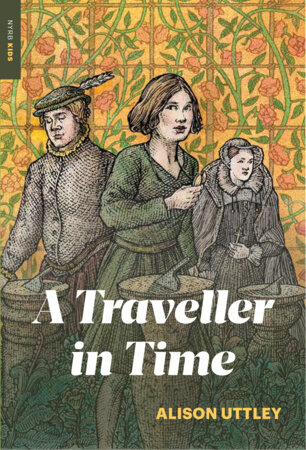
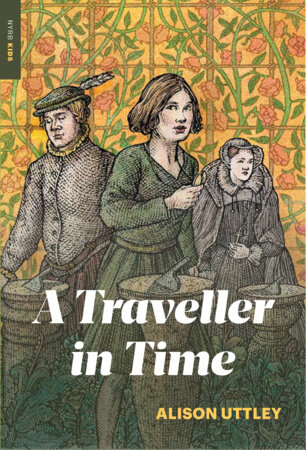
A Traveller in Time by Alison Uttley is one of the earlier examples of a time-slip novel. Penelope, a young girl, goes to a family home in Derbyshire and finds herself hearing about the Babbington plot to rescue Mary, Queen of Scots, which happened right around the place. In her own time, she hears of it almost as though it happened a generation ago, so little stress did the locals attach to time. And she herself walks through a door, and into the Renaissance. The fluidity of time and durability of space feels, as you read, so natural, that when the covers close on the final page, it’s strange to see that time has continued normally.
Philippa Pearce is another deft handler of time, and I love her Tom’s Midnight Garden, probably the best-known of her works. For myself, Minnow on the Say probably struck a little deeper. I don’t know why. I love boats, so maybe that’s it. Minnow doesn’t truly move in time; Tom does. But I think both share a psychological tug on time: the power of the human heart and mind regarding time’s fluidity. I read Tom’s Midnight Garden aloud to my daughter and felt criminal for stopping at the end of some chapters, so I yielded to entreaty and read on. Not a single word felt arduous.
Obviously, this list has many limits, most of them conscious. I stuck heavily to novels because the picture book is a different medium and the interaction of art and text changes both everything and nothing. For example: Ezra Jack Keats would fit perfectly on this list with no explanation. Maurice Sendak requires explanation, but is no less splendid. Here, I’m focusing on text.
The list is also heavily British, heavily white, and heavily female. Partly that’s because I’m influenced by taking my parameters from Eleanor Cameron– British, white, English. But it’s also because, historically, many of the very good early novels in the English language for children came from there, and were written by women. That doesn’t mean others haven’t used the same methods. It’s simply that the roots are here: Joan Aiken, Eleanor Farjeon, Alison Uttley, among many others. They aren’t household names in the US or Canada today, but, truly, they should be on class lists for teachers and students of writing.
And, I think, for parents. I have read all of these aloud to my own children. And I have never regretted one minute of the time spent. We often turned one chapter into two (or more). And if my daughter read ahead, she always lied about it so she could enjoy hearing it read aloud, and I pretended I believed her. (“I wasn’t reading ahead, I was reading behind,” she said.)
Again, for texture of language, for concrete believability of the book’s physical space, for respect for the audience– these are the books that stand out to me. They aren’t the only ones, by any means, but each of these does. In a nutshell, these are all people who would nod when E.B. White said, “I would rather wait a year than publish a bad children’s book, as I have too much respect for children,” no matter from what part of the globe or what time period in which they were writing.
And, most important of all, each and every book mentioned here is one I think you, my dear, would enjoy reading– enjoy to the hilt. I would never recommend a book I didn’t think you’d be happy to vanish into for a few hours, and then come out feeling like you’d been on the most wonderful adventure.
Much love,
Deborah

