
“I swear there wasn’t a dry eye in the house when she gave her reading.” “I have to admit I got a bit weepy at the end.” “I found myself tearing up while I was reading the last page aloud.”
These are all things I heard adults say about Swan: The Life and Dance of Anna Pavlova, by Laurel Snyder, illustrated by Julie Morstad. In fact, I’m the one who was tearing up as I saw that final feather fall, beautifully rendered by Julie Morstad, when I was reading it to the Changeling.
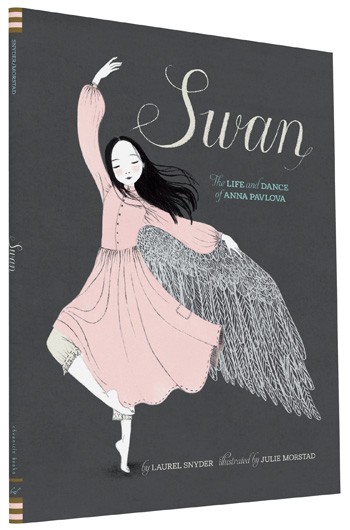
You could say the book’s a biography of Anna Pavlova, simple enough to read to a toddler, with pretty pictures to engage the child’s interest, but interesting enough to keep the adult happy. But then what is it that brought so many adults to tears? And how do children react? Here’s my take.
Two things make Swan stand out for me as an adult, and for what I notice as a mother:
a) The perfect linking between text and illustration. As a side note, I’ll say this is one of the things I love about Chronicle Books. They always seem to match author and illustrator and end up with 1+1=A Whole New World. In this case, the words are spare, perfectly reduced to the poetic essence of Anna’s young mind, and the illustrations more than flesh them out, a perfect balance between realism and dream world. Note, for example, young Anna at the beginning, dancing as she works: the workaday world is clear to see, but the soft, lush lines show how much more young Anna is experiencing than the broom or the laundry in her hands. You don’t need extra words– the few lines of text are meticulously crafted, and the pictures let you immerse yourself further and further in the story and in Anna’s feelings, from page to page. Hell, I wish I could (legally) embed pictures from the book in here, because they speak for themselves, but follow that link above and scroll down the page, then know that they’re only more spectacular in person, printed on the lovely paper that Chronicle’s production team gave this book. (While you’re at it, think about adding a few copies to your cart: one for your family, one for a friend’s child, and one to donate to a child who could use it.)
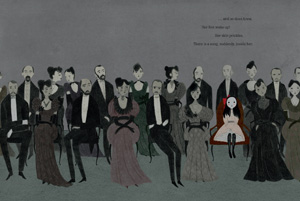
b) The story is simply Anna’s, and, as such, a story for everyone. This is a biography. That means we’re reading the story of Anna Pavlova’s life. So that’s it, right? Yes, except that in these pages we’re getting what’s remarkable about her life, why we should care about, of all people, Anna Pavlova. And, as the story unfolds, we do care. We absolutely care. We feel her disappointment when she’s too young to go to dance school. We feel her joy when she’s finally on stage. We feel her restlessness, her desire to share, her love for dance and her fellow humans. And, as we understand her story, it draws out our own humanity and compassion and desire to do, to overcome obstacles, and to share one’s accomplishments. This is 100% her story, and, at exactly the same time, a story for everyone. In a word, without being in the least bit didactic, it is inspirational.
What about a toddler, though, Deborah? Are you telling me that your Changeling really got all of that? Well, of course not, although, let’s be honest– with toddlers who can tell? Why do you think I call her the Changeling? Hidden depths, my fellow readers, hidden depths, I tell you. That said, what did the Changeling tell me? Well, given her current obsession with birds, it’s unsurprising, but here you go:
“There’s the swan! It’s a bird! Oh, is the swan sad? Should I kiss the swan? The swan is dancing! I can dance. Look at me, I’m dancing!”
Draw your own conclusions, book-lovers, I leave the interpretation of this oracular speech to you. I can tell you that she liked it a lot, and that my suspicion is that interest will only grow with age and understanding.
I think this is a book that’s going to last. I know it’s going to last in my family, and there’s a reason it jumped at me as the first book to talk about here. It made my soul grow, and I hope it will help the Changeling in due time, too. It’s a book I’ll be buying as gifts for new babies and donations for children in need. My only fear for this book is that it will be seen as “a book for girls.” It’s not: it’s a book for anyone who loves beauty, who can fight for what they love, and be generous with their skills and accomplishments. I love a book that’s for everyone, and this is such a book.

