Arctic Dreams

First of all: Would the person who misplaced every book I own and simply cannot find please step forward?  Thank you. I promise I will be merciful, I would just like my books to be returned where I can find them.

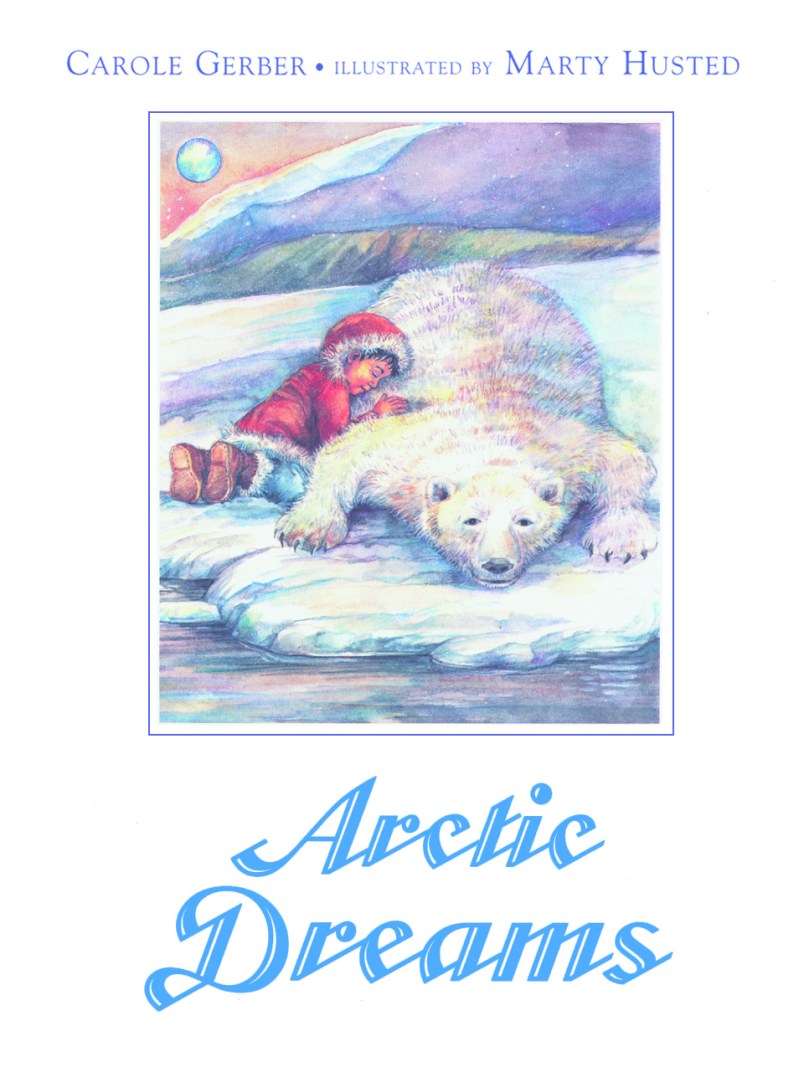
See, it goes like this: the Changeling and I get really into a book and read it all the time.  It’s usually left out on the sofa or side table because we’re probably just going to read it in another five minutes, anyway.  Then… it disappears.  Then the Changeling really wants to find the Arctic hare in Arctic Dreams by Carol Gerber, illustrated by Marty Husted, and the book is nowhere to be found.  Her lip jumps.  I quickly explain that the book will come back and can she be a brave girl and choose another book until it comes back?  She stiffens her upper lip and nods and says that there’s an Arctic hare in her animal book.  What a brave girl, thank you!  I breathe a private sigh of relief.  And then, a week later, Arctic Dreams is back, and I have no idea how or where it was.

Arctic Dreams

So, I know someone out there’s playing tricks in here, and it’s driving me up the wall.  Oooh, that’s what you want, isn’t it?  Well, the bad news is that you let me find Arctic Dreams again, and so long as I’m reading this book, it’s impossible to feel anything other than perfect serenity.  This is, I’m positive, the Buddha’s favourite book.  If we could just give every world leader a copy of this book and persuade them to read it every morning, we’d have world peace by next Tuesday at noon.  This is the book Gandhi read before he decided on his personal Credo of nonviolence.  This is, in a word, serenity encapsulated between the covers of one of the best bedtime books I really hope lots of parents know about, because, seriously, it will relax your kids, I promise.  Or, if it doesn’t?  You won’t care, because your blood pressure will have relaxed, at least.

Now, my previous standard for “super-relaxing bedtime book” was Goodnight Moon, that basic staple of the children’s bookshelf.  I wasn’t even looking for other “bedtime books” because, c’mon, I have Goodnight Moon.  This makes about as much sense as not trying lemon-strawberry sorbet because you already have a really good vanilla ice cream.  They’re both delicious, both frozen desserts, but sometimes you’re in the mood for rich and creamy, sometimes for lighter and tangier.  This book is, at one and the same time, more complex and simpler than Goodnight Moon.  Goodnight Moon is vanilla ice cream: rich and deeply loved and lovable, you always love it, you had it when you were a child and you know your grandchildren will have it, too.  It’s reliable, a little old-fashioned.  And then you stumble across lemon-strawberry sorbet on a day you need a bit more of a change, and it’s also lovely on a hot day, also wonderful for chilling you out, but there’s a bit more variety going on, and it really hits the spot.

Or at least that’s how I felt when I found Arctic Dreams.  It’s not that recent (published in 1999), but it was new to me, and it may likewise be new to you.  The text of the book is very simple, lilting and rhythmic, but the vocabulary is a bit more complex than in Goodnight Moon, partly because it draws on a particular cultural background, the Inuit culture (well, so Canadians would say– the book says Eskimos, but I was brought up Not To Do That in the Canadian school system).  And so you have a mixture of the simple, repetitive “Snuggle deep, my little one. / Snuggle deep. […]  Dream in peace, my little one. /  Dream in peace,” and textured, occasionally surprising passages such as, “Let sleep surround you as silently as a snowdrift… and cover you as softly as the fur of nanook, the large white bear.”  The gentle, soothing rhythm is still there, but I find my brain suddenly feels that soft, warm blanket of fur in a quiet snowfall.  (Fate?  Please note: I do not actually wish to be flumped on by a hungry polar bear in an Arctic snowstorm.  That sounds like a terrible, if memorable, way to die.  Memorable for everyone else, that is.  I’d be dead.)

Marty Husted’s pencil and watercolour illustrations, however, take this book from lovely and relaxing, to utter serenity.  We begin with the mother murmuring to the child in his bed, and then enter the child’s mental dreamscape, where his mother’s words and his dreaming imagination take us to world’s we couldn’t really inhabit awake.  See my above memo re: death by polar bear in a snowstorm.  However, who doesn’t want to, in some absurd, dreamy level of their mind, snuggle with a polar bear in a gentle snowfall?  How lovely!… in the dreaming imagination.

That dreaming imagination is what we see in these warm yet dreamy images (the precision of the pencils is offset by the softness of the watercolour), and it pulls your mind halfway into sleep, just like cuddling a kitty taking her nap: that sleepy serenity is contagious.  We none of us are really going to snuggle up with a group of walruses (or at least I hope we aren’t), but wouldn’t you sort of like to be on a wild rock, surrounded by the sea, roaring with the walrus?  No, you wouldn’t, says your logical mind: that would be smelly, uncomfortable, and deadly.  Yes! screams your idiot imagination. What a breathtaking experience.  “Exactly,” says your logic, dryly. “Breathtaking, indeed.”  [Huh, apparently we don’t write “drily” any longer.  It’s “dryly” now.– Ed.]  I’m not even going to go into my favourite page: diving down deep in the blue ocean on the back of a bluer whale, surrounded by orangey-gold squid and seals, and schools of silvery fish.  How gloriously impossible!

This book is dreamy in every sense of the word: it conveys dreams, draws you into dreams, and is a dream to read with a droopy, dreamy child.  Also, pipes up the Changeling, “it has so many animals!”  Yeah, that’s the only issue: you may be headed into dreamland– but then your toddler may pop up her eyes again to say, “That’s a tern!  And a puffin!  A puffin!”  Go to sleep, my little one.  Go to sleep.

The Princess and the Pony

I never do this, but before we begin, here’s two notes: (a) I have been working on getting permissions to post images for various posts.  If you scroll down, for example, you’ll see some images from The Fox and the Star (thank you, Coralie Bickford-Smith!).  Do go look: they’re lovely.  Thanks are also due to Kate Beaton for giving me permission to use images from her website today.  (b)  On Sunday, I’m going to go to Catherynne Valente‘s signing at the Brookline Booksmith where I will try not to embarrass myself.  I will then gobble up the book, probably weep because it’s over, and then try to compose my thoughts about the whole Fairyland series into a blog post.  (That might take a while.)  If you are near any of the locations on her tour, may I suggest stopping by?  Her books are wonderful.

Do you know what?  That paragraph serves as a pretty good introduction to my confession: I am such a fangirl.  I pretend not to be.  I’m not much of a one for movies or actors or anime or any of the things I’ve decided are “fan” categories.  If you don’t chase the Beatles, you’re not a “fan,” right?  Wrong.  I’m an embarrassing, melty fangirl around authors I admire.  Ask my husband how long it took me to be able to open my mouth when I met [name redacted because, God, that was embarrassing].  He had to speak up for me before I could manage to get past, “Oh my God, I’m finally meeting [name redacted] and I’m making a fool of myself!”

Well, I’m like that for Kate Beaton.  When I saw she was coming to Boston for a signing  for  Step Aside, Pops and I couldn’t go: (a) I threw things at the wall; (b) I realized it was better to be sad I couldn’t meet her than to be a writhing ball of embarrassment for whatever I said or didn’t say if I did meet her; (c) I wrote a note to the Harvard Book Store to order a signed copy and beg them to ask her to personalize it.  I am not proud of that note at all, but it got me a personalized, signed copy, with a truly lovely little sketch from Kate Beaton’s hand, and I am proud of that.  You will pry that book out of my cold, dead hands.  Death, thou shalt die before I surrender that book.  Got it, buddy?  IT’S MINE.

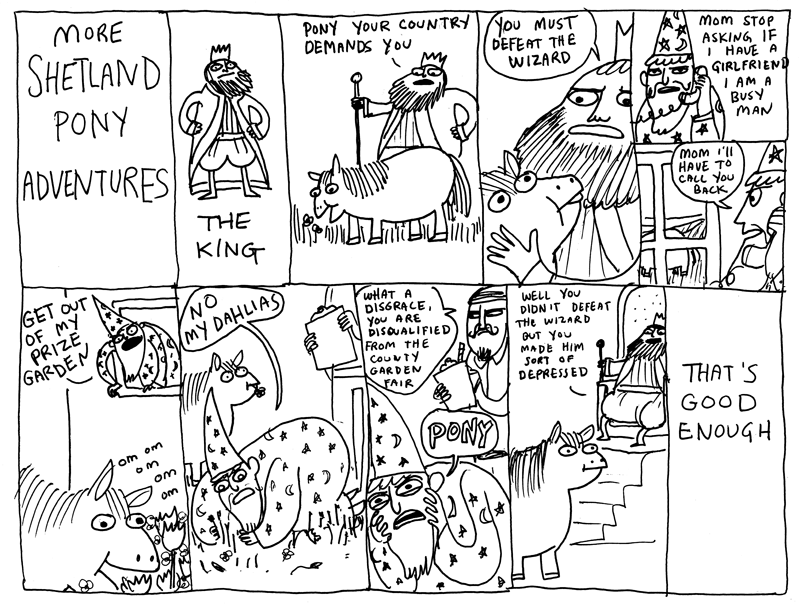
Sorry, got a little carried away there.  My point is: people, Kate Beaton is fantastic.  And… She Is Canadian.  More than that, she is a Maritimer, from Nova Scotia, and, well.  First I read her historical comics lovingly teasing my own beloved Middle Ages and I truly admired them.  Then I heard she was from Nova Scotia and, I mean, I’m from Sackville, New Brunswick, right next door, and suddenly I became the girl who begged and pleaded with the Harvard Book Store to get me a personalized copy of her latest book.  And then I heard that she was writing a children’s book, The Princess and the Pony (this link includes activity sheets for your child), about one of my favourite of her comic characters, the pony.  You can see the pony, because Kate Beaton was nice enough to allow me to post this comic, below:

Fat Pony original

That one still makes me giggle, and anyone who giggled at that will be thrilled to know that this was relatively early work, and the pony’s character has developed considerably in The Princess and the Pony, where he works with Princess Pinecone to, against all her expectations, become champions.

Princess and the Pony

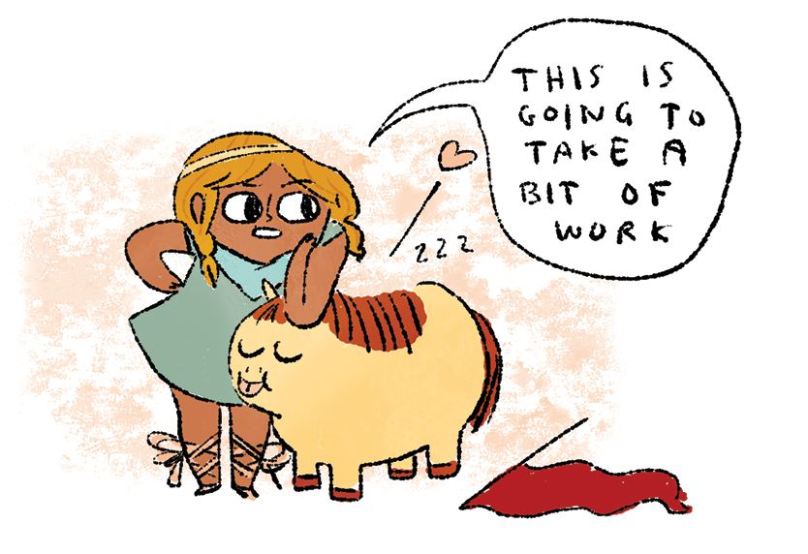
Princess Pinecone, you see, is a warrior, the smallest (and, arguably, most adorable) warrior in her kingdom.  She’s made it very clear what she wants for her birthday: a strong, proud, noble warrior’s horse.  Instead, she gets a small, round, funny little pony.  She is somewhat disappointed, but diligently works to try to teach her little pony to be a real warrior’s horse.  The pony ambles around, rolls on the ground, and farts too much.  Princess Pinecone is glumly convinced that they will never be champions, but when the battle comes up, the pony proves unexpectedly successful in a wholly new way, and he and Princess Pinecone are unanimously awarded the prize for Most Valuable Warriors.

It’s a charming little story, but the illustrations are what take this book from “Book I enjoyed” to “Book I truly love.”  As with Here Babies, There Babies and Jillian Jiggs, you’ll find someone in here who looks like you and speaks to you, which is an aspect I love: all colours and genders are represented here.  But Kate Beaton’s style, her humour, her zest, all come through here brilliantly in characters who speak as much through the illustrations as through words.  Pinecone, seen above, is a sweet and serious girl, very invested in her interests.  Her anxiety when she first meets her pony is visible: Oh God, do I sympathize with her!  An “almost” right birthday present can be such an awkward piece of business, yes.  But the personality is what truly pulls at my heart: trying so hard to make something not-quite-right work?  I’m almost 29 and I still identify with that.  Who doesn’t?

Princess Pinecone might be the most developed character (apart from the pony, perhaps), but my Changeling and I have endless conversations about the others.  She loves to examine each warrior’s face and equipment and talk about who looks “a little sad,” “a little angry,” or “so, so happy!”  She carefully analyzes the battle, Princess Pinecone’s parents, each ice cream cone on the battlefield, and all of the weapons of battle.  The detail, in short, is impressive, both in the layout of each large spread, and in the pages bare of background detail which focus on particular characters to tell you their story.  These are the pages my Changeling can “read” on her own, and I love watching her develop the stories from the art.

Most impressive of all in that regard, perhaps, is the pony himself.  He’s a major figure (and he has a most impressive figure!), but is limited in speech.  And yet he speaks to you so clearly: his big round eyes, his funny mouth (sometimes tongue out, sometimes in), his round figure, all tell you the same thing… “Awww,” you squeal with Otto the Awful, “what a cute little pony!”  The Changeling’s eyes bulged like the pony’s the first time she saw him: “I want a pony, too!” she announced.  (OK, I’ll admit it, she got one for Chanukkah: he lives in her crib, and you can get one right here.  Cave, submit, leave me not alone in my shame.  You can also get a onesie, shirt, calendar, or mug.  I don’t have those… yet.)

I’m still not clear on this pony, I’ll admit.  Shake your head all you want, but I still analyze him: how much does he understand of what’s going on?  He is a most reserved pony.  He watches more than he speaks.  Does he know what he’s doing at the battle?  Does he know what he’s doing during training?  I suspect he’s much more clever than he lets on, but I can’t swear to it.  I’ll just have to read it a few more times with my Changeling, and maybe ask her opinion again.  Last time, I got good suggestions from her.  She thought it over, and said, “Let’s read it again.”  I suggest you do the same.

(Kate Beaton?  Thanks so much for the permission to use your images, and sorry for the fangirling.  I really love your work, in case that wasn’t clear.)

I Have to Go!

Yesterday was a warmish, if slightly windy, brisk-feeling day.  I felt invigorated, and talked earnestly about a beautiful, deep, soul-enhancing book.  Today is grey, rainy, and I feel the need for lightness, laughter, and a bit of silliness.  Or that’s what I thought when I picked up today’s book.  Then I thought a bit more, and realized maybe there’s less of a difference between yesterday and today than I’d thought.

Let’s talk about Robert Munsch— Bob Munsch, as I grew up thinking about him, because, well, he felt like a friend.  I think all Canadian kids felt like he was our friend, honestly: Who spoke for us when we wanted markers?  Bob Munsch (Purple, Green and Yellow).  Who spoke for us when we got muddy?  Bob Munsch (Mud Puddle)!  Who, always and forever, told us we were loved?  Bob Munsch (Love You Forever).  I don’t think it’s quite easy for adults to understand exactly what Bob Munsch means to kids.  I remember going to one of his storytelling tours when he came through the bustling metropolis of Moncton, NB, and I was a kid growing up in the little town of Sackville, NB about 30 minutes’ drive away (wait– in those days I think it was 45 minutes away: that was before the big highway).  I loved my little town, and Moncton was a bit scary, but Bob Munsch was coming to talk, and I was thrilled.  I didn’t get to meet him in person, but, somehow, it still felt like he was talking just to me.  His voice and personality have that quality (to hear him read, click those titles up above), and it permeates his books, too.  He’s an adult who knows how to talk to kids, and if you’re that kind of adult, you’re special.  And kids will love you.  Every Canadian kid I know loves Bob Munsch.

Americans?  Well, those Americans I know who know Bob Munsch also love him.  I can count those Americans on the fingers of two hands– um: my cousin, my aunt, my other cousin, my uncle… um…

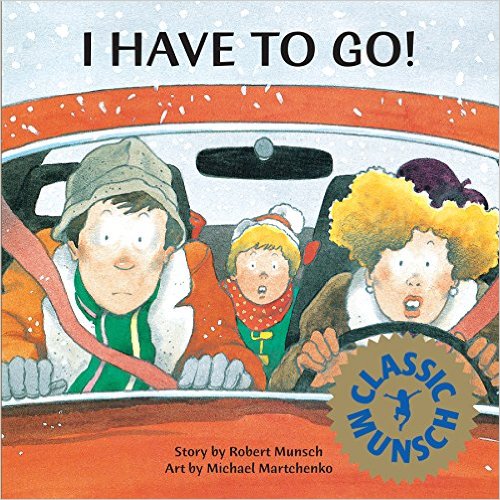
See, this is just another one of those cases where something really, really good didn’t quite cross the border properly.  And I want to tell you why it’s so good it’s worth seeking out.  The book we’re talking about is one of the current favourites of my Changeling, who is quite interested in the topic these days: I Have to Go!, story by Robert Munsch, art by Michael Martchenko. 

I Have to Go!

Do you know what?  I’m going to recommend a little homework.  Click that link, and listen to the story first.  It’s not every day that I can give you the story I’m about to read, but today I can, so give it a listen– it’s only a few minutes long.  Have you listened?  Good.  Now, here’s a secret: this is not exactly the story in the book on my desk, the one you can buy here.  That’s because Bob Munsch is telling the story, developing the story as he listens to his audience, and, in fact, you can hear the story of how the book happened right at the end.  That, in a nutshell, is Bob Munsch.  The listener, the understanding storyteller, the mediator between child and adult.

Why do I say mediator?  Well, think about another aspect of that recording– and, yeah, yeah, we’ll get to the story soon, but I want to talk about Bob Munsch right now.  Did you hear something behind the story?  The audience?  Did you hear the kids talking and sharing their stories?  I love that.  Did you hear when the kids laughed?  I love that, too.  Did you hear the adults laughing?  That’s why I’m an evangelist for Bob Munsch.  Folks: not every kids’ book out there has kid and parent laughing together through the same experiences.  Remember when my kid used up all the sheets in my house when she had her stomach flu?  I know I grossed some of you out with that.  Bob Munsch has all of you laughing at that, kids and parents both, and it gives you courage to live and go at it another day.  More than that, he gives your kid the language to talk to you: You heard those kids chanting with him: “I have to go pee!”  My Changeling does that, too… sometimes.  And when she does, I can carry her at the speed of lightning to the bathroom, and, hey, presto!  A diaper saved is a diaper earned!

What is it we’re laughing at, though?  There’s a kid (his name is Andrew in the book), his parents are desperate for him to let them know when he has to go pee, but the kid refuses.  No, no, no, no, no!  He has decided never to go pee again!  (Guys, I haven’t even opened this book yet– the words are ingrained.)  This pattern repeats throughout the tale, the parents are exasperated, Andrew is doing his own thing… and at the end, he turns the tables on the grownups, asking his grandfather if he has to go pee.  And the grandfather is not exasperated.  He listens, and he answers honestly: “Why, yes, I think I do.”  Note that, in the book, this beautiful moment is reinforced by Michael Martchenko’s illustration, showing the two of them smiling warmly at each other, holding hands, on the way to the bathroom.

There are two points I want to make about this.  First, I want to answer my own question (what are we laughing at?) and second, I want to add an observation about what Bob Munsch is teaching us.  I think we’ll see they’re related.

For my first point, let me point out how realistic these scenes are.  Andrew is being a kid, the parents are being parents.  When Andrew goes outside they “put on Andrew’s snowsuit.  It had five zippers, 10 buckles and 17 snaps.  It took them half an hour to get the snowsuit on.”  And then he throws one snowball and yells, “I HAVE TO GO PEE.”  Kids giggle, parents sigh and laugh simultaneously.  We all look at it and say, “THAT’S ME!!!”  And so we laugh, because it’s familiar.

But I think there’s something else, and that brings me to my second point.  When we say, “That’s me!”  Well, we’re also saying: “I’m not alone.”  It’s a feeling of relief.  “I’m not the only kid who wets the bed.”  “I’m not the only parent who weeps at 3 am with damp, filthy sheets and a deliriously exhausted child at my ankles.”  And what Bob Munsch is teaching us is: “It’s OK.  Be honest.  No one is completely whole and perfect.”

And that brings me to my final point: Bob Munsch has been open about his struggles with depression and addiction.  When I found out about that, a little part of me said, “I’m not alone.  If Bob Munsch has done so much, and spoken to me so much, while he’s been struggling, then I’ll be OK, too.”  Addiction isn’t a problem of mine, but depression is, and I’m humbled by how much Bob Munsch has accomplished by his openness, his generosity, his honesty.  He writes about this on his own website, in his own words, and finishes, “I hope that everyone will talk to their kids honestly, listen to them, and help them do their best with their own challenges.”  No, I’m not crying.  (Yes, I am.)

Listen to Bob Munsch, people, and buy his books.  Get them down south of the border, if you can.  We need his honesty, his openness, his warmth down here quite as much as Canada does.  We’re all people, we all need books like these.  I know my Changeling’s life will be better for Bob Munsch, just as mine has been, and I hope other kids will be able to say the same.

The Fox and the Star

I have been hesitating to write about this book for months, since before I started this blog.  Let me tell you why, before I start talking about the book itself.

I love it.  The very moment I saw the ARC at (you guessed it) my favourite children’s book shop I knew I needed it.  I didn’t just want it– it was talking to me, it told me I needed it.  I immediately placed a pre-order for it, and when I came out in November and I finally got to read it from cover to cover I have to admit that I actually slept with it under my pillow the way I used to with fairy tales when I was a kid, hoping they would get into my dreams.  That’s how beautiful this book is.  And that’s why I hesitated to write: Where do I start?  What can I say to get across its loveliness?  Am I good enough to get it across?

Then I read it with the Changeling this morning and I realized I loved it in my way and she loved it in hers, and, while the book might be one step over from absolute perfection in its own way, no one’s looking to me for the perfect blog post.  The book didn’t need me to be perfect.  All I want to do here is share, as best I can, how truly I, Deborah, love this book.  And I’ll screw my courage to the sticking place and do my best, with all my uncertainties.

One uncertainty is that I don’t know is whether it’s a children’s book.  Judge for yourself.

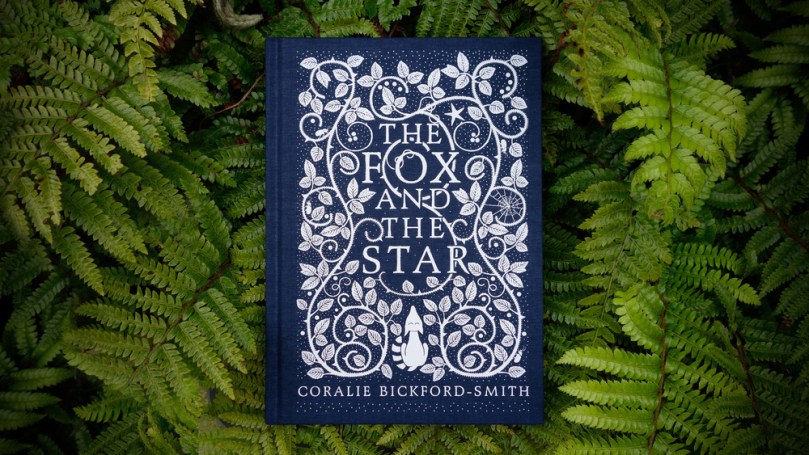
The Fox and the Star

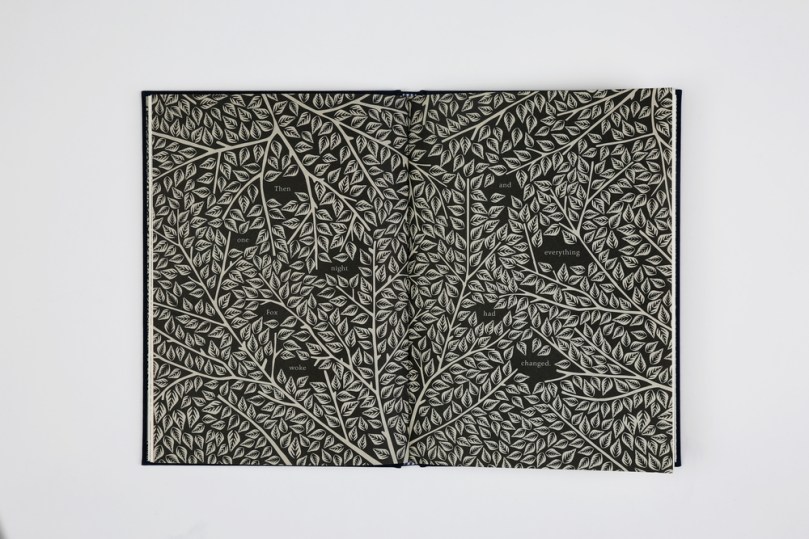
I do know that The Fox and the Star, written and illustrated by Coralie Bickford-Smith, is a work of art.  I mean that absolutely literally.  I said that with Madlenka’s Dog I stopped trying to protect it from the Changeling.  With this book, I keep it out of her reach, and when I read it with her I explain that this is one of the books I truly love and would like her to be careful about touching.  (Let me brag for a second: She’s such a good listener!  OK, I’m finished bragging now.)  The cover is beautifully designed.  I want the endpapers as wallpaper.  The illustrations are exquisite, each one lovely enough to be a print, or William Morris-style fabric (or more wallpaper– I love wallpaper).  The words, beautifully chosen in and of themselves, are integrated into the illustrations so that they make a seamless fabric.  Sometimes they’re set into the page like a tablet poised in the branches of a tree, sometimes each word is woven into the thorns of the forest, but, always, the words and the pictures suit each other.

Integration of text and image Fox and Star

And then there’s the story.  Or, perhaps, parable would be a better word.

I remember discussing with a professor of mine what the modern-day equivalent of the parable would be.  We agreed that children’s stories often work as parables: they’re stories in themselves, but often convey greater themes.  The Tale of Peter Rabbit would be a classic example.  He suggested Katie and the Smallest Bear as an even simpler and more exemplary option.  I think this book pares both the story and the themes and message so closely to the core elements that it makes an excellent example of a parable.

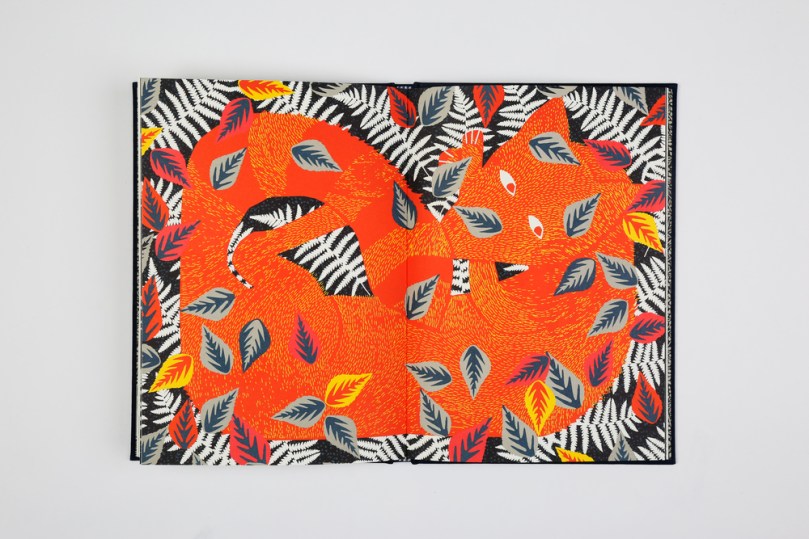
The story is about Fox and Star, and Fox’s love for Star.  The two of them, and all the others Fox encounters on his journey, are what they are, and need no other names.  Fox loves Star, his only friend, a friend he relies on for a soft glow of light at night in his dense, dark forest, where he walks only a little way from his den so that Star can light his path.  But one night he wakes and Star is gone.  (If you were reading the book, your eyes would fill with tears here.)  First, he huddles in his den, dreaming of Star’s return, lonely and scared, but finally beetles come seeking his den and Fox wakes up and eats.  Then he goes searching for Star.  He asks all those he meets about Star: the thorns, the rabbits, and the trees, but either they don’t know, won’t answer, or can’t hear him.  Finally, he comes to a lovely clearing and calls out his question.  Leaves fall, settling on the ground to tell him: “Look up beyond your ears.”  And when he looks up he sees a sky full of stars, and knows one of them, somewhere, is a star that once was his.  (If you were reading the book, not my measly summary, you’d be choking up right now.)  And Fox walks on through the forest.

Part of what scared me about writing up this book is that this is where you should say, “And this book’s message is X and teaches you Y and it’s so universal!”  I can’t do that to this book.  It does have broad, universal messages and themes and they’re beautiful.  If I put them into words it would diminish them.  To me, that’s why this is a parable: there are things that plain, sensible words can’t say.  There are things that you can only experience and feel through the interwoven, perfectly balanced mixture of words and images in this book.

I will tell you that this book came out while I was in a deep and miserable depression.  Frankly, it sucked.  It was horrible.  This was the first book I bought for myself rather than because I thought my daughter or husband would love it in a long, long time.  (As it turns out, of course, we all love it.)  The Fox’s lonely and courageous journey through a dense, dark forest, looking for beloved starlight spoke to me and got me to sleep at night and up in the morning.  It got me thinking about working in children’s books, too, because who wouldn’t love a world of books that can encompass everything from The Very Hungry Caterpillar to a book like this?  I will always love and be grateful to this book, and to the Fox’s courage.

As for my daughter?  She loves the Fox.  She loves watching the beetles crawl across the page, she loves the rabbits, she loves the leaves, but, most of all, she loves watching the Fox on his journey.  And when we come to the last page she bounces and beams: “He found the Star!  He found the Star!”  “Yes,” I answer, “he found so, so many stars!”

One day, I know, she’ll learn for herself why the Star had to go away so Fox could find so many stars– and what finding so many stars means to her, in her own words, and her own experience.  And maybe she’ll be able to tell me about her journey, and I can tell her mine.

Fox and leaves Fox and Star.jpg

Look, I don’t say this for every book, but: Go buy this one.  And let yourself cry when you read it, if you need to.  It’s too beautiful not to move you, and you’ll grow for it.  Walk through the forest, look up beyond your ears, and find all the stars.  Then tell me about it.

Note: I updated this with pictures taken from Coralie Bickford-Smith’s website with her very kind permission.  May I point out she also has a store where she sells prints?

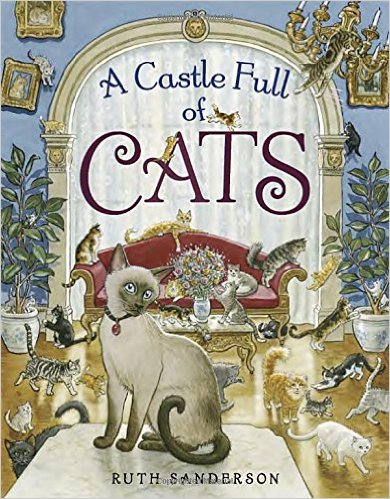
A Castle Full of Cats

While keenly aware that if I run this right after my Little Red Riding Hood post I run the risk of being “one of those cat blogs” (so sorry, Daddy), this Sunday I went to my favourite store in the entire universe again: The Children’s Book Shop.  What that means is that I came back with new material for you all.  And yet here I am writing about a book I got last time I went there.  It goes like this: when I go into a shop like that and casually pick up another copy of that book I got last time because I need to give it to someone for a gift, honestly, I do, no, it’s not just because I want to hold it in my hands at all times… well, isn’t that a sign it’s a book I need to talk about here?

Castle Full of Cats

Those who know me may say that any book called A Castle Full of Cats, written and illustrated by Ruth Sanderson gets its own post here on the basis of the title alone, but those people are wrong for the following reasons: a) If it didn’t work for me and fell flat I’d be too angry to write about it, and, anyway, I intend only to write about books I like (what’s the point of writing about books you hate?); b) Did you know there are cat books I don’t like?  Oh, there are plenty; c) Shut up, Daddy, I do so like books that aren’t about cats– I wrote about Madlenka’s Dog once.  I run my selection process here by a complex and most stringent algorithm written up in Python using processes too technical to share with you, but, to simplify it for the plebes, it can roughly be translated as such: Do I love this book oh so very much that I have got to write about it right now so help me God?  And with this book, well, when I went right into that store, ran over to the appropriate spot on the shelf and yanked it off?  “It’s… for a present,” I muttered, hugging it.  (“Maybe I should get two,” I thought.  But I resisted.  Because there was only one on the shelf and I was embarrassed to ask for a second.)  Well, when that happened I knew there was more to it than “contains cats.”  “Contains cats” will get a look from me.  It won’t get love.

What got love?  I’ll admit one thing up front: this is still a bit too old for the Changeling.  It’s not that she doesn’t sit through it or like it.  On the contrary, she really loves the pictures, poking through and naming the cats and finding the ones that look most like the ones she knows.  She enjoys it.  But there are elements of the story and illustrations which are just over her head and make this more of a book for me than for her for the moment, whereas a book like The Tea Party in the Wood spoke to both of us differently and more-or-less equally.  This one is here for both of us to enjoy, but is waiting patiently for the Changeling to grow and find certain jokes and plot points click as the months go by.  I can tell that’s going to happen.  So, we both do enjoy it, but this is largely my perspective right now.

The basic story goes as follows: A king and queen live together in a charming castle.  The year appears to be, perhaps, 1779.  I think we can assume we’re living in a parallel universe France where the tiers état is happy and satisfied and we needn’t worry about what would happen to aristocratic cats come the Revolution.  This is a calm, lovely, happy, watercolour Baroque world, one where you just want to fall in through the pages of the book, stroke the cats, and run loving fingers across the soft damasked upholstery.

But I digress: the king and queen are living happily, and the king presents the queen with a pair of charming kittens.  She is delighted, and, when you turn the page, you see the whole castle swarming with cats.  The cats know the queen adores them, and she provides them with fish for every meal, right at the table with her and the king (who would maybe appreciate a filet mignon from time to time).  She paints portraits of them, she cuddles them, and they’re happy, except… except they’re concerned that the king might not love them.  They leave him gifts, play games and frolic, but somehow they don’t seem to be able to win him over– until one day the king loses patience: “That’s it! I’ve had enough! / He dropped his spoon. / He grabbed his cane. / He marched off in a huff!”  Allow me to relieve you of your terror: He does return, but what can he do to make all well and resolve the problem in the castle so that he, the queen, and the cats can all live happily together?  Dare I tell you?

Oh, I’m awful at keeping secrets!  He brings them all presents: flowers for the queen and a big, beautiful, cuddly dog for the cats.  They’re all thrilled, and the cats are so busy playing with their new friend that the king and queen are even seen to be dining (on chicken– he must be thrilled!) by themselves.  And they all live happily ever after.

The story itself is, in a word, charming.  The cats’ behaviour is generally catlike: it’s not falsely sweet (as in every silly boardbook), and it’s not falsely evil (as in every adult book).  It’s true, and real, and translated for human readers so that we can chuckle along and sympathize as kittens investigate instruments, knock over books, and leave mice in the king’s shoes.  It’s not so ploddingly realistic as to be boring, I hasten to add, anticipating cat-lovers’ corrections: has anyone seen dozens of cats gathered at a table eating out of bowls?  Right.  But it’s realistic enough to give you that chuckle of recognition: two of the kittens hop right up  on the table to help themselves from a platter or nibble from another cat’s bowl.

All of this is rendered in gorgeous watercolour, with sufficient authentic Baroque detail to make the adult reader’s heart go pitter-pat, but with enough kittenish antics to make pet-lovers of all ages smile and laugh.  As I said, the Changeling can excitedly pore over the pictures with for ages, pointing out who “looks like Remy” and who “looks like Penny” and declaring “let’s find Guinness!”  She also enjoys the gentle, rhyming rhythm of the text.  I, for my part, secretly analyze the furniture and clothes and admire the lush textures Ruth Sanderson manages to get across with her glorious watercolours (I didn’t see any prints from this book for sale on her website, but that doesn’t mean there won’t be later– this book is pretty new).  And, of course, I love the cats’ antics and the gentle, joyous surprise of the dog’s arrival.

And for everyone, cat-lover or not, adult or child, I think the story is valuable: without didactic baggage or getting too heavy, here’s a gentle story of love, friendship, and how compromise can lead to greater happiness for all, not lesser happiness for some.  As the Changeling grows to click with more and more of the little jokes in the book, I hope that’s another note that will click.

OK, husband of mine: Now can I have another cat, and also a dog?  It works so well in the book…

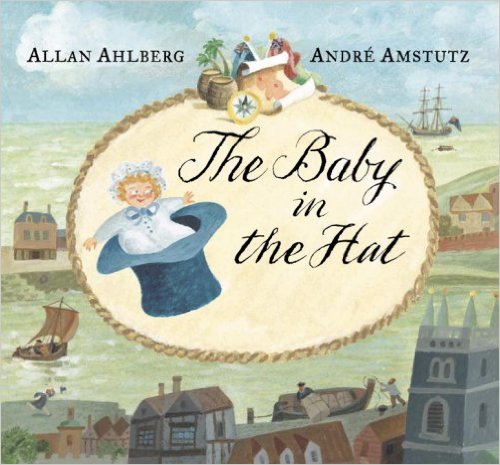
The Baby in the Hat

This morning, as the Changeling was eating a grapefruit with her customary intensity and seriousness, I popped the question: “Which books do you like best of all?”  The question was chewed over with as much seriousness as the grapefruit.  “A Bird Is a Bird,” came first, of course, but we soon got to The Baby in the Hat, by Allan Ahlberg, illustrated in gouache by André Amstutz.  “What do you like about The Baby in the Hat?” I asked.  Her face glowed, bouncing right out of that seriousness: “The ships!”

Baby in the Hat

Ah, my plan continues apace.  One day, I tell you, one day in the future, the Changeling and I will run away to sea in a tall ship and sail far and wide, see remarkable things, and return, baked by the sun and beaten by the wind, to see our old world with new eyes.  (My husband is welcome, too, I promise, but he seems to be less fond of boats than my daughter and I.  It’s the only thing about him I find truly odd.  How can you not love boats?)  Anyway, yes, I have read all of Patrick O’Brian’s books, and I love them truly, madly, deeply.  Well, The Baby in the Hat is like Patrick O’Brian on training wheels: same world, same time period, but without the, ahem, scandals, and aimed at… oh, crap, I really need to write up a post about why I’m bad at gauging age.  The School Library Journal puts this as Kindergarten to Grade 2, and Barnes and Noble says 5+.  That sounds OK to me, except the Changeling is two and a half and she loves this book with a pretty fierce passion.  And I’m nearly 29 and I love this book with equal passion.  Maybe she’s precocious and I’m a slow bloomer?  I dunno.

I have one burning question about this book: the US edition was published by Candlewick in 2008.  It is now 2016 and you’ll note that I linked you to AbeBooks above (you can also find many copies on the Amazon Marketplace and elsewhere).  You will not find it at your local bookstore.  It seems to have… disappeared.  My burning question?  Why?  My Candlewick, my Candlewick, why hast thou forsaken me?  I love you, Candlewick: why not let me buy copies for everyone, bankrupt my family, endure a foreclosure on our condo, anything but let this book go out of print?  OK, maybe not all of that, but I will say that sometimes the vagaries of the book market astonish me, and I think this book is a gem that will hopefully get itself the cult following it deserves.  Please do me the honour of allowing me to prove to you why it deserves at least a visit from you at the library, if not tear-soaked letters to Candlewick to bring it back into print if at all possible.

Let’s start with the glorious illustrations.  You’ve been to an art gallery, right?  Seen some 19th C masterpieces?  This book is not composed of 19th C masterpieces.  Instead, the vivid and charming pictures evoke J. M. W. Turner (think The Fighting Temeraire) and Jacques-Louis David, but with humour, affection, and sensitivity.  You get the wonderful ships, of course, the gently curling Romantic-era hair, the sweeping cloth and dramatically outstretched arms in battle scenes.  You also get cats chasing mice across the ship, tumbling sailors, and humorous faces.

One of the sweetest and funniest aspects of the illustrations is woven directly in with the story, however, so let’s get to that.  The story is told in the first person by the friend of the main character.  Think of The Great Gatsby, only good.  (Sorry, I know I just drowned my credibility in the stormy sea, but I stand by my position, as I stand by my dislike of The Itsy-Bitsy Spider.)  Our narrator is a serious, bespectacled youth, who grows to be a serious, bespectacled man.  Serious, as my daughter is serious in eating her grapefruit, but equally apt to break into a warm, glowing smile as the main character achieves great things: catches a baby in his hat, uses his reward money to go to London, falls onto a ship and ends up at sea, rises in the ranks as he battles pirates and the French (NB: if you don’t hum or sing La Marseillaise at this point then, I’m sorry, but you’re reading the book wrong), and ultimately returns home, a wealthy captain, to fall in love with a lovely young woman who… oh, dare I spoil the ending for you?  No, I can’t do it.  Go read the book.

But didn’t I tell you that there was some aspect of the illustration which was woven into this thrilling tale with sweetness and humour?  That comes through the commentary.  At various points throughout the story, we get little word bubbles of commentary.  At first, these come directly from our narrator, who might poke his smiling face around the edge of the page to say, “Believe me!” in a fine script, but, as our main character is swept away to sea, others take on the same role: a seagull, sailors, a mermaid in the Southern Seas– everyone joins in, and this mischievous and lovely chorus of voices brings together text and illustration in a wonderful way.  It’s a picture book, not a graphic novel (the story itself is told in plain text), but it has that same quality of interaction between the characters and the story and the reader that you find in the very best graphic novels.  I imagine, for example, that Charles Vess and Neil Gaiman would love this book.

The swashbuckling tale, the romance, the soft but vivid illustrations, the humour and whimsy– the best overall word I can think of for this book is lively.  It bounces right off the page, it makes you smile and laugh and sing martial or nautical songs and national anthems, and sends you straight to harbour to choose yourself a ship.

Ahoy there, readers!  Grab yourself a copy, and be not tardy or I’ll cut down yer hammock!  See you on deck at six bells.

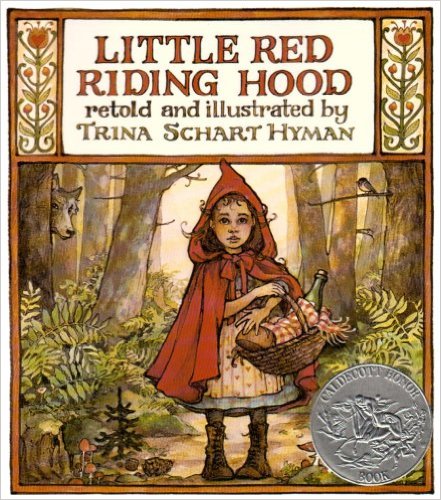
Little Red Riding Hood

“Remy has big eyes!”

“The better to see you with, my dear.”

“Woofy has big ears!”

“The better to hear you with, my dear.” (transcribed from a conversation with the Changeling)

Yes, Little Red Riding Hood: it’s become automatic, hasn’t it?  It’s as much a part of our language as the King James translation of the Bible: “Out of the mouth of babes and sucklings,” “Be strong and of good courage,” and so on.  The way we use them might be, shall we say, frequently divorced from the original context, but, Lord Almighty, the Bible has permeated our daily speech to the point that we talk about our “daily bread” even when we’re on a carbs-free or gluten-free diet.

Fairy tales have also made their way into the collective fabric of our thought (sorry about the grandiose language there), but more through tropes than through language: everything comes in groups of threes; if you lose a shoe, it’s made of glass; if you kill a giant, your name’s probably Jack.  And (shhh… don’t tell God) I think I’m even crazier about fairy tale infiltration of our word-world than the Bible’s, pretty as that often is (try this: “Many waters cannot quench love,” from Song of Songs– lovely, right?).  As I said, however, what fascinates me is that while both literature groups have become so familiar to us, the Bible’s language seems to have had a profound effect on the words we use, whereas in folk and fairy tales it’s the tropes which have achieved that level of familiarity.   What I mean here is that, in fairy tales, tropes remain consistent from tale to tale, whereas language can change radically between retellings.  To put it as plainly as possible: three sons are familiar to us, but the precise words they use are not.

Let me stop you right now: Yes, I am generalizing so badly that they’re going to call me up any minute now and revoke my academic permit, I know this, so bear with me a while longer.  Also, I want to put in a few caveats here: a) I’m just musing here based on what I’ve noticed and strikes me as curious, so forgive me for the lack of footnotes or proper research; b) My credentials?  Um… well, I read a lot of fairy tales and have spent many years doing so.  By no means am I an Opie or Zipes or Ziolkowski, and I by no means claim to be anywhere near their level here.  I humbly bow to anyone else’s greater knowledge or experience.  (If you are Jan Ziolkowski?  Hey, call me, let’s talk fairy tales!)

See, I told you it wouldn’t take long, because right here is where I am immediately going to overturn what I just said about tropes vs. language by referring you upwards: Little Red Riding Hood.  Generally, I stand by what I said: there are certain patterns from fairy tales which you can casually reference almost anywhere and your audience will get you (three sons, where the youngest succeeds).  But Little Red Riding Hood is a bit different.  First of all, by no means are wolves generally bad or little old ladies generally innocent in fairy tales.  By no means is there even a clear, consistent lesson between all tellings of Red Riding Hood except, probably, “don’t trust strangers.”  Is the wolf representing creepy, predatory men you should avoid?  Or is the message to listen to your mother’s instructions?  That part isn’t so consistent.  Well, what is consistent in this story from version to version?  Or, to put it another way: What has endured in the collective Western memory of this story?*  I’d answer: the very conversation I started you out with, and the wording it came from: “Grandmother!  What big, hairy ears you have grown!”

Now, I want to point something out to you.  What edition or version of Little Red Riding Hood did I just quote?  Anyone, anyone?  You in the back?  Oh, you were just scratching your ear.  You don’t know, do you?  That said, everyone recognized the line, right?  Yes, you did.  In other words, the words have made it into our memories.  Wolves could mean a lot of things: in some stories, wolves save the hero, but in this story, the wolf is dangerous.  What rings comfortable familiarity for us in this case is the wording, of all things, despite the fact that I just conclusively and exhaustively proved that the familiarity of fairy tales comes from tropes, not languages.**  OK, let me spare you the suspense and, at the same time, clear my own head of excitement: I’m quoting, and plan to discuss, Little Red Riding Hood retold and illustrated by Trina Schart Hyman.  I am here to tell you that it gets across both the weird and wonderful richness of fairy tale trope and the familiarity of language we know and expect.  These are woven together in both text and illustration as only Trina Schart Hyman is capable of.

Little Red Riding Hood TSH

Right here, right now, I’m going to apologize to my father.  He is probably reading along saying, “Hmmm, clever enough.  I wish you’d actually cite something, Deborah, but you’re doing quite well… wait, now you’re going to talk about cats?  For crying out loud, Deb, still with the cats?”  Yes, I’m sorry.  I’m really sorry, but we’re switching gears from high criticism to… cats.  Why?  Because I firmly believe that Trina Schart Hyman, in her endless genius, uses cats to excellent effect in her illustrations here: they tumble playfully, kittens and cats together, at her mother’s home; one sleek, black creature follows Red Riding Hood through the woods, just to the side of her encounter with the wolf; the grandmother has a cat who observes the wolf, while Red Riding Hood’s cat pursues the huntsman until he finally goes to check on the grandmother; and both cats joyfully greet the grandmother and Red Riding Hood once they are saved.

These cats never turn up in the text.  They are wild, walk by themselves, unacknowledged by the author, but intimate with the illustrator.  They add immensely to our understanding of the story, but never, ever in the text.  Well, I ask you: Is the wolf a creepy man or a beast?  Is a wolf bad or good?  Is an old woman in a cottage an innocent or a witch?  Is Red Riding Hood a child or on the verge of womanhood?  Is sex involved or not?***  With all these unanswered questions about this story, why not add: Are there any cats in this story?  And are the cats signs of domesticity and comfort, or of an element of wildness half-tamed?  To me, they are like words that are as familiar as our daily bread, and yet make our skin prickle ever so slightly with discomfort.

If there is one woman out there it guts me to think I will never meet, it’s Trina Schart Hyman.  She died in 2004, as I found out two years ago, and I cried when I read that.  I wanted so badly to be able to say “thank you” to her, and now I knew I never could.  It was her Snow White and Hershel and the Hanukkah Goblins I knew growing up, and I only saw Little Red Riding Hood recently when my sister gave me this book for my birthday (she knows me well).  When I read it, it felt like someone had pulled the story out of my brain and put it on paper.  Familiar and strange, knowing more than I’d known I knew, it glowed with shadows on the page (sorry, sorry, I’ll cut out the grandiloquence).

Do yourself a favour, and get yourself a loaf of new bread, some sweet butter, and a glass of wine.  Then shut the doors to strangers and friends, and quietly read this book with your cat winking at you from the shadows.

*Jeepers, can you tell I’ve got my academic coat on today?  Get me talking about language, tropes, versions, retellings, etc. and I suddenly start getting very choosy with my language!  I could have just said, “What’s familiar to us?” but I had to go all fancy and precise.

**OK, I can’t help it.  There is one other case I can think of where the wording in a fairy tale means familiarity: Hansel and Gretel, when the witch says, “Nibble, nibble, little mouse. Who is nibbling at my house?”  If you can think of anything else, let me know, but these are the only two instances which occur to me.

***The Opies say there ain’t no sex involved, absolutely not, and I’m going with them because the thought creeps me out just a bit too much.  On the other hand, a part of me suspects they’re probably wrong.  Oh God, I hope they’re right….


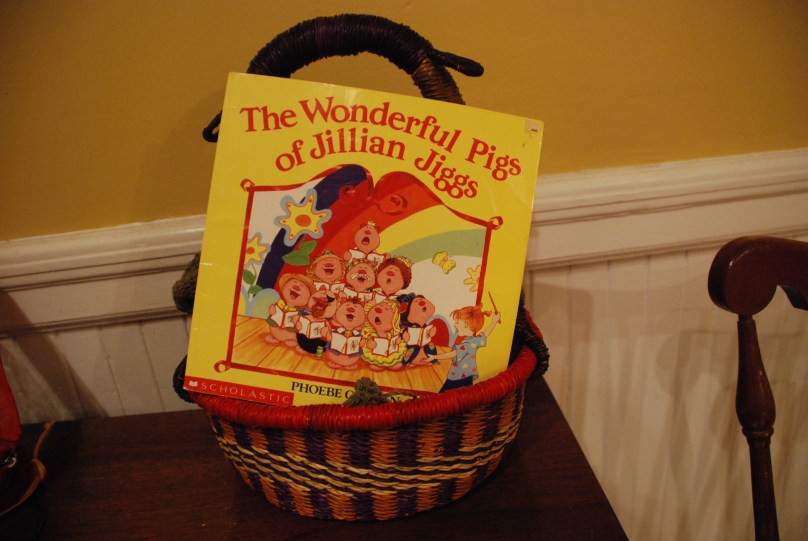
The Wonderful Pigs of Jillian Jiggs

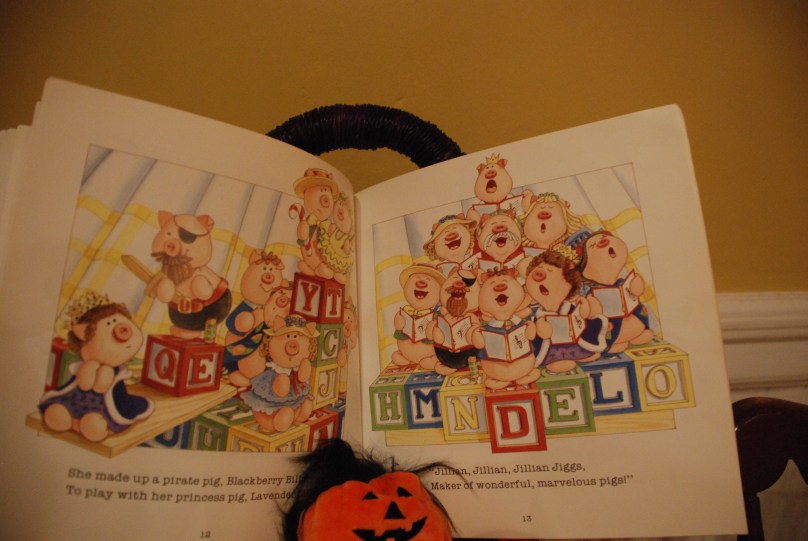
Today is most unusual in this little corner of children’s book blogging.  Normally I choose books to write about by a carefully honed algorithm of “oh, this book’s great, I really feel like talking about this one!”  Yesterday, Annabelle inspired me.  “Yes,” thought I, “she’s so amazing!  Who’s another kick-ass female protagonist in children’s books?”  And my absolute favourite, bar none, popped right into my head: Jillian Jiggs.  There are a number of books about Jillian Jiggs, but the one that was easiest to hand today, and which I truly believe best illustrates her as a kick-ass female protagonist is The Wonderful Pigs of Jillian Jiggs, written and illustrated by Phoebe Gilman.  Note that I linked you to AbeBooks, because that’s the easiest place to get it these days (oh boy, anger’s bubbling…).  Here’s the Scholastic Canada page, but how you actually order it is a mystery to me.  You basically can’t find it in the United States (growl…), and if I don’t stop myself right here I’m going to end up using language most unsuitable for a mild-mannered blogger of charming children’s books because holy fuck why is it so hard to find this book south of the border?  Someone, please, get to marketing this book pronto or I may have to start a cross-border march: “Bring Us Jillian!”  (Note that these are pictures from my camera, since it’s hard to find good pictures online.)

DSC_0455

OK, let’s start off by thinking about those words “kick-ass female protagonist.”  I want to be clear right here, right now: I’m not talking about a trying-so-hard didactic book about how “a girl can do that, too, you know!”  That’s boring and insulting to everyone.  Of course a girl can “do that, too” (except in exceedingly specialized cases inappropriate for children’s books), and I don’t admire patronizing dreck.  I’m talking about a good book: a book which is about a kid who has crazy ideas, follows through on them, grapples with challenges, and comes out triumphant.  Her name is Jillian Jiggs, and I love her.  I love that she’s a little bit crazy and thoughtless (what kid isn’t?), I love that she reminds me of some of my favourite people rolled into one (crazy ideas like my sister, bubbly like my best friend, problem-solver like another one of my friends…), and I love that she cheerfully pitches into her projects head-first because what could possibly go wrong?  I love that she acts quickly and faces consequences later– and there are consequences, because this is life.  I love that she is, in every way, a real child, but maybe does some of the things we dream of, as children, but don’t quite dare to do.  When I was little, I know that I dreamed through Jillian Jiggs, much as I did through Pippi Longstocking, later.

So, what are her crazy ideas?  Well, one day, Jillian Jiggs cleans up her room (wonder of wonders!), and, in the process she finds a jar full of buttons that look just like the noses of pigs.  She makes little pigs out of tights and plans to sell them.  She makes all kinds of little pigs, in all kinds of outfits– lady pigs in old-fashioned lace, vampires, pirates, and babies.  She even names them!  (Oh, you know where this is going, don’t you?)  She and her crew (her little sister and her friends, Rachel and Peter) gather all the pigs and march down the street to sell the pigs.  Her customers line up with dimes in hand, ready to buy her entire stock… and then crisis hits: Jillian Jiggs loves her pigs.  How can she sell them?  But the mind of the truly creative entrepreneur finds a way!  How about selling a how-to lesson, instead?  (Seriously, someone get Craftsy on the phone with Jillian Jiggs!  This could be big…)  The disappointed and angry customers (and Phoebe, genius that she was, shows you the whole range of emotions on those little faces) become happy customers, and everyone’s satisfied.

That’s the basic story, and I think you can see how plucky and creative Jillian is.  But that doesn’t nearly get across the exuberance and joy of the book: that comes through the lovely rhyming  couplets, Phoebe Gilman’s extraordinary art, and the unspoken message, reinforced by a tutorial at the end, that you can do it, too.  Go on, give it a try!  Even without being able to understand the tutorial page, my Changeling announced that she wanted to make a pig, too: Jillian’s excitement is palpable throughout the book, the gleam of the next great idea fairly bounces from page to page, and it inspires you without ever directly instructing you to be inspired.  How about a doctor? or robots! or maybe a princess.

DSC_0460

Each page murmurs quietly, “How could you dress a pig to get that idea across?”  And then the illustrations fill in the gaps: the stub of a pencil becomes the pirate’s wooden leg, while pipe cleaners make robot antennae.  Anything is possible in the world of “Jillian, Jillian, Jillian Jiggs,/ Maker of wonderful, marvelous pigs!”  And, you know, she gets caught up in her own work, too: “She might still be sitting there, sewing away,/ Except Rachel and Peter came over to play.”  We all love the pigs.

OK, scroll back up and read those lines aloud.  Then tell me: doesn’t that feel and sound good?  The whole book is that fun to read, especially when you get to do Jillian’s voice: “‘I simply can’t do it.  It’s over. I’m through…’/ Then all of a sudden she knew what to do./ Step right up, friends! Have lots of fun!/ Sew your own pigs! Learn how it’s done!'”  And, with that, Jillian takes her disappointed customers and turns the situation around.  (Note that, as with Here Babies, There Babies, you and your child should be able to find someone who looks like you at some point in the book; it just reflects life honestly, without making a fuss.)  A very successful startup, run by a creative and charming CEO, indeed, and one of Canada’s foremost proponents of the textile arts.  I love it.

I don’t know if I even think this is the very, very best of Phoebe Gilman’s books.  I have a special soft spot for Grandma and the Pirates, and for The Balloon Tree, and the original Jillian Jiggs book is fantastic, too, and then there’s the one book which did make it south of the border: Something from Nothing.  How to quantify which is the best?  Oy.  Look, give me a break, I am but a humble kids’ book blogger.  Another day I’ll write about another of her books, and then you can amiably argue over which is better– I sure as hell don’t know.  But, right now, while I was thinking about Annabelle, about tough girls who can go for it and do great things?  Jillian’s pig project reminded me a lot of the first day I sat down to write here for the first time: “Hey, here’s an idea!  Let’s go for it.”  And I hope the Changeling will have her own moments of “Hey, why not?” too.

Oh, and don’t let me forget– I need to rustle up some pig components.  I don’t think I have any spare tights in the house…

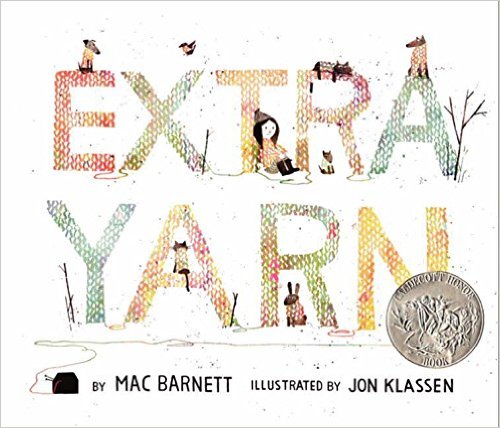
Extra Yarn

I have a friend.  Not just any friend; I hope we all have a fair few friends.  But I hope everyone also has a friend like my friend: when I was pregnant, this friend brought me a baby present.  This present was a book, which is already a good start.  The book was called Extra Yarn, by Mac Barnett, illustrated by Jon Klassen.  What this demonstrates is that my friend Knows Me, with those uppercase letters used consciously.  It’s wonderful when people provide you with good and useful things before you have a baby– soft blankets, sturdy burp cloths, pretty clothes.  It’s lovely, and I’m touched and grateful.  But when someone looks around and says, “Deborah would not want to bring her baby into a house without a charming new book about yarn and knitting for that child,” then?  Then you know that you should make that person the executor of your will (thanks, lady!).

Extra Yarn

Have you ever knit something?  Let me tell you: there’s nothing quite so terrifying as the moment when you’ve been knitting merrily along, feel your ball of yarn, and get an “uh oh…” feeling, as in, “That feels a bit… small?”  Maybe you weigh it to see if you have enough left.  Maybe you knit faster, trying to outrun the yarn.  Maybe you knit more slowly, on the basis that “haste makes waste.”  But there’s nothing like the sinking feeling when you’re sure, oh so sure, your yarn is going to run out!  But way on the other side of the spectrum is the placid security that comes with an assurance that you’ve got Extra Yarn.  Maybe enough for a matching hat?  Or matching socks for your baby?  You feel peaceful, at ease, even a little smug.  And that’s the peace we see in Annabelle, one of the most confident protagonists I’ve ever had the good fortune to meet in a book.  Let me tell you: I want to be Annabelle when I grow up.

The story is one of the most engaging I’ve written about here: Annabelle lives in a colourless town, but one day she finds a box filled with yarn of every colour.  She knits herself a sweater, but has extra yarn.  So she ends up knitting sweaters for everyone she knows.  Then for the animals, then for buildings and cars, and, through it all, she never runs out of yarn, she just carries on placidly knitting.  It’s a knitter’s fantasy.  Then an evil Archduke comes and steals the box!  Only, when he gets to his castle, he opens the box… and it’s empty.  He throws it out the window with a curse, but the box ignores the curse and goes back where it was always meant to be– with Annabelle.

I think this marks the first time I’ve written here about a book where the plot and character were the driving force in what made me fall in love.  (OK, yes, and the yarn.)  Annabelle, throughout the book, runs into mild to forceful opposition.  And yet she never talks back.  She never whines.  She never raises her voice.  She never caves.  She just carries on knitting.  You can see in Jon Klassen’s wonderful drawings: her face maintains a slight smile, and perfect repose.  To put it in a somewhat more blunt fashion, she shares John Scalzi’s Christmas gift from this year (I promise you want to click the link).  When her friend Nate laughs at her sweater, she says, “You’re just jealous,” and knits him one, too.  That shuts him up.  At school, her teacher scolds her for distracting the other students with her colourful sweater, so she just knits them all sweaters, too (and, I hope, teaches Mr. Norman a lesson– dude, don’t tell your students “You can’t.”).  And when the Archduke tries to buy her beloved yarn, she just calmly turns him down, over and over again, and sends him away.  As my sister would have said when she was little, Annabelle is a “big strong girl.”  More than that, she’s tough.  She’s resilient.

And that’s where I truly love this book.  Annabelle is the model here.  The adults don’t teach her; she teaches them, if they care to learn.  Some of the adults she meets are fun and give you a good chuckle (“Mr. Crabtree […] never wore sweaters or even long pants, and […] would stand in his shorts with the snow up to his knees.  ‘No sweater for me, thanks,’ said Mr. Crabtree.  So she made Mr. Crabtree a hat.”), but more often they’re minor obstacles.  I’ve mentioned Mr. Norman, the teacher who tells her off for distracting the class by quietly wearing her sweater, and who, when she proposes to rectify the situation by knitting everyone sweaters, expostulates, “Impossible!  […]  You can’t.”  Annabelle doesn’t answer back; she just does it.  And as for the spoiled, petulant, domineering Archduke?  Annabelle quietly carries on doing her own thing, sticking up for herself, and the yarn chooses her in the end.  He throws a temper tantrum, but she just carries on carrying on, and is happy.

This is just a story about a girl doing her knitting.  From Annabelle’s perspective, I think the world around her is just full of big opportunities and minor nuisances.  I picture her, if the book were turned into a movie (Oh my God, Mac and Jon?  Can you make that happen???  This would be such a good animated short!), occasionally sighing, or flashing that slight smile at Mr. Norman as she casts on a new sweater.  Perhaps the Archduke would elicit so much as a little shrug, as thought to say, “Dude, just leave me alone, OK?”  But her focus is on what makes life fun for her, not on the nuisances, and, in the end, she gets more of what she pays attention to: knitting.

The Changeling took to this book immediately.  “Read me Extra Yarn,” she’ll beg.  Or she’ll add it to the pile of books to take with us when we travel.  One of my very favourite moments was when she took it over to my friend, now her friend, too, and clambered onto her lap.  “Read it to me, please?”  And, as they went through the book, the Changeling did what she always does: “And she knit a sweater for the doggie!  And that’s a cat!  I see a bunny, and a bird, and is that the birdie’s house?  They all have sweaters!”  It’s enthralling.

I love seeing her admire Annabelle’s handiwork.  I hope, as she grows up with Annabelle, she’ll also learn just to do, and keep on doing, awesome things, no matter who tries to persuade her that she can’t or shouldn’t.  Just go for it, kiddo!

Jamberry

Do you ever get something in your head and end up chanting or singing and dancing your way around your empty house, possibly scooping up your poor, defenseless kitty in the process?  Don’t worry, I won’t make you answer that.  But I will reveal the full depths of my own embarrassment: for me, this morning, it was Jamberry, written and illustrated by Bruce Degen (I link to Porter Square Books, the marvellous, well-curated store where I bought my copy).  After reading it to the Changeling a few times this weekend, I couldn’t get it out of my head and spent the morning dancing around the living room, stumbling over Calico Critters, and swinging my patient cat through the air while chanting: “One berry/ Two Berry/ Pick me a blueberry!”

Jamberry

This was when I had a “click” moment.  I should know by now never to doubt my mother when she makes a remark about a children’s book, but when she compared Here Babies, There Babies to Jamberry I confess that my thought was, “Really?  I mean, they’re both rhyming stories, but so is Jillian Jiggs, for example, and, well, I just don’t see it.”  But after I read Here Babies, There Babies to the Changeling last week we spent a few days, as usual, chanting about babies in the most random places.  “I see a baby!” the Changeling would call from her stroller.  “Here babies, there babies…” and off she’d go.  That’s when Jamberry ever so gently started to nudge my brain again.

Then the Changeling started to play “going under the bridge” as she ducked under her stroller handlebar.  “And over the dam,” I went on, “Looking for berries, berries for jam!”  Next thing you know, we’re in full-on Jamberry mode: we read it a few times, and our natural mode of discourse seamlessly moved from Here Babies, There Babies to Jamberry.  We speak in berry rhymes (Merry rhymes, fairy rhymes, prattle in berry rhymes!  Sorry, folks, that one wasn’t even any good, was it?), we sing strawberries, we dance in meadows of strawberry jam… um, I mean in the living room.  It’s jubilantly moved in and taken over.

What is it about these books?  Why do they take over in a way that other charmingly rhyming books don’t?  There are lovely rhyming books, such as Each, Peach, Pear, Plum or Jillian Jiggs, books I desperately want to write about here.  They entertain when you read them, and then nestle nicely back onto the shelf when you’re through.  They don’t take over your tongue and make you dance in your sheepy pyjamas for the next day.

Partly, of course, it may be a question of metre: Jamberry‘s initial dactyls (“One berry/ Two berry/ Pick me a blueberry.”) rumble along like a folk dance to a drum, but then swap out for longer lines, most of which end with a bouncy stressed syllable: “Under the bridge/ And over the dam/ Looking for berries/ Berries for jam.”  This slight shift sweeps you along with the canoe in the picture, and if you don’t find yourself swinging your child on your knees?  Well, that probably means you decided to swing your child in your arms instead, right?  Right?  You’ve gotta move with this one, you really have.

And that’s because this little story here isn’t about the story.  Like Here Babies, There Babies where the emphasis is on the babies around you, not on a specific tale, Jamberry does have characters and a plot of sorts, but the emphasis is elsewhere: on jammy jubilation.  I don’t think I’ve ever read it without laughing at least a little at one point or another.  The beat and the song of it, the increasingly zany pictures, the berry-stained fingers and mouths, and the sudden urge to grab a pail and find some berries… well, that’s what this is about.  You read it and feel celebratory.  You read it and feel warm sun and sweet berries.  You read it and sing.  You read it and dance.

Oh, and there’s also a boy in there, and he meets a bear and they pick some berries.  Not really sure about how the bear has a hat, but he seems like a nice bear.  And I think that maybe CPS should check on the kid’s family because he seems to be seeing elephants skating on raspberry jam, which is, in my experience, unusual.

You see?  This is not a book where you should, as it were, focus on the story.  Sing it, move to it, dance your kid around to it– but, for the love of God, check your logic at the door.  (Which is, of course, where it differs from Here Babies, There Babies, initially leading me to doubt the wisdom of my mother.  That book feels intensely real, leading its own singsong verses to blend into the world around it.)

I’d add one last note here: Jamberry‘s fantastical celebration of berries is so very zany, so ebullient, and so jubilant that it really has a tendency to break through barriers and take over.  As I said, it takes over language and makes you hum it over and over.  It makes you use words like “ebullient.”  It also takes over seasons.  It might be February (albeit a very warm February), but it feels like June when you read Jamberry.  It’s really the polar opposite of Moominland Midwinter, which, as I noted feels like the epitome of winter.  Moominland Midwinter I only ever feel like reading when it’s starkly, icily, snowily cold.  Jamberry?  It makes February into June and has me wondering where I can get strawberries that taste like something.

What does the Changeling think?  “Berries for jam!” she cries, flinging her hands up.  Does she eat jam?  No, absolutely not.  Never, ever, ever.  (She won’t touch ice cream or candy, either.  I’m thinking of asking the doctor if she’s OK, and what else we can use as bribery.)  But she does love the pictures, and she does love the words, and the animals, and berries.

So, what can I say?  Even if you don’t have a kid handy, get out your copy, and start dancing at your own Jamberry bacchanal!