Madlenka’s Dog

I’ve known ever since I started writing here that I really, really wanted to talk about Peter Sís.  The only question was where to start?  Which book?  I pulled them all off the shelf and pondered the feast before me.  Ice Cream Summer makes me giddy just to look at it, and that’s the latest, too, so it has that going for it.  Starry Messenger was one of the early ones, the art is extraordinary, and it’s positively inspirational.  I think the first one of his I saw was The Pilot and the Little Prince, and that remains a favourite.  I finally picked up the most battered, though: the one which has been hugged, read by every person in this house over and over, which has dried tears and elicited giggles out of the depths of sadness and exhaustion (both the toddler’s and the adults’!), which has been lost and found more times than I can count, and gotten tangled in bedclothes bedtime after bedtime.  In other words, this book has gotten accolades higher than the Pulitzer, Booker, Newbery, Caldecott, and Nobel Prize for Literature combined: Madlenka’s Dog, written and illustrated by Peter Sís, has won love.
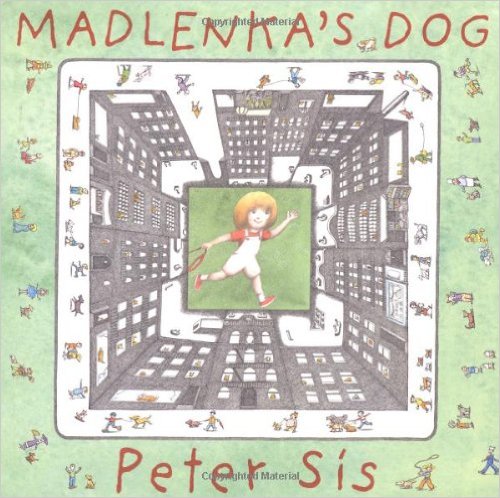
Madlenka's Dog.jpg

The Changeling and I found this book at our natural home in Boston, the Children’s Book Shop in Brookline.  It turns out that the owner is friendly with Peter Sís (he did all the lovely artwork for their website, and for a poster for the store), and she definitely shared her excitement about his work with us: almost all of our Sís books have come from there. I’m pretty sure this is one of the books which the Changeling had to carry with her out of the store, into the car, and hold the whole way home.  I don’t mind: it means she’s less likely to get carsick.  (Odd, isn’t it?  If I read in the car: beware, beware!  If she has a book, it’s all clear.  Maybe it’s because she can’t read yet?)  Please forgive that ever so slightly tasteless digression; the point is that Madlenka’s Dog was instantly engrossing.

What’s interesting is that, in many ways, this is the simplest of books: a girl named Madlenka wants a dog.  That’s it, really.  So what makes it so engrossing?

Well, for one thing, whether or not you specifically want a dog (maybe you want a cat, or a particularly beautiful book, or your own house, or just someone to love…) who among us doesn’t want something?  Maybe, speaking to adults who shuffle their feet and mumble, “It’s not so bad, really, I mean, I’d like a dog one day, but I can cope,” a better word to use is “longing.”  I’m sure there’s something you long for– and so does Madlenka, and so does your child, if you have one.  This isn’t What Pet Should I Get? (not meant critically– the Changeling enjoys that book, too), which is about the excitement of choosing an animal.  No, this is an exploration of the universal longing for that one thing you love deep in your gut.

Let’s start with that word “universal.”  Both my husband I were particularly hooked by the opening to this book: “In the universe, on a planet…”  That’s right: this book about a girl who wants a dog starts by a little meditation on the cosmos.  (Honestly, that’s the only reason I feel justified in plunging into the serious analytics here; Peter Sís totally started it, dude, OK?)  Before bringing us specifically to the girl named Madlenka, we start with the most general of the general.  Even when we do meet Madlenka, she takes us on a walk around her block inspiring everyone she meets to remember their own childhood dog.  Once she meets her friend, Cleopatra, who has a similar longing for a horse, they plunge into a dreamworld with their imaginary pets, until called back to reality: “Madlenka! Come home…”  And all of the dogs of her walk’s dreaming go with her.  In short: while Madlenka is our emotional link here, she’s really a window onto the whole universe’s love and longing.  I smile, even laugh, when I read this with the Changeling, but I never put it down without feeling a little wistful: “It’s true, I really do love…”  And then I give my Changeling an extra-big hug while she says, “And I think I want a cat first, and then we’ll have a dog.  Do you want a bird?”  “Yes,” I say, “but I love you best.”

I think you’ve gotten the general impression of the Changeling’s review already, but how does she engage with Madlenka’s Dog?  I mean, apart from dragging it off the shelf, “reading” it to the cat, and pulling it up onto my lap?  Well, she knows it at least half by heart, and, when we’re curled up reading it, even if she’s half-asleep she’ll know when it’s time to jump up and open the flaps to find the dogs.  As she opens the flaps she’ll tell stories about the dogs, and name them.  (They’re all named Remy, except for the black and white one who “looks sort of like Penny,” our cat.)  She asks all about the huge two-page spread pictures showing Madlenka and Cleopatra playing together: “Are they in Egypt?  Are those the sca-rab bee-tuls?  Scarab beetles, yes!  And let’s find the rabbits on the next page…”  But the part that always makes my heart throb a little is the softening in her voice at the last page when she sees Madlenka at the door and says: “Look, all the dogs came with her…”

This is a beautiful book, and I’ve stopped trying to protect it too much.  The Changeling is generally gentle with books, but toddler-love still leaves its marks, and maybe one day we’ll need a second copy.  I don’t mind.  I think Madlenka would be flattered that the Changeling, and her parents, share her dreams.
 

Mr. Postmouse’s Rounds

I’m a Canadian girl, born and bred, and by “bred” I mean “brought up reading all the classics of Canadian children’s literature.”  After a few years living in the USA, I know perfectly well that when I tell Americans that I get a fixed, frozen smile while my polite interlocutor rapidly shuffles through the bookshelves of memory while thinking, “Crap, what did I miss?”  Let me save you the pain of that moment: Phoebe Gilman’s Something from Nothing definitely made it south of the border, and so did Robert Munsch’s Love You Forever (give me a second, even typing the title brings tears to my eyes), so you may have heard of those.  Both authors wrote lots of other fantastic books which aren’t so common here, and maybe I’ll write about them and all the other great ones (like Dennis Lee, ooh, and Borrowed Black) another time.  The problem is, lots of Canadian books really just don’t make it south of that irritating border.  That’s why I was totally thrilled when, on two separate occasions, I got home with books I’d grabbed from prominent, face-out displays at the Harvard Book Store, opened them up, and saw they came from Kids Can Press!  Good on you, Kids Can Press, for getting your excellent books down here where I can buy them.  Let us scatter our writings across the world: bread, circuses, and good books for everyone!

Let’s talk about one of those books: Mr. Postmouse’s Rounds, text and illustrations by Marianne Dubuc; translated by Yvette Ghione.  This book is simply charming.  Let me start by complimenting the translator: I had no idea I was reading a translation until I finished the book, flipped to see who had published it, and read: “English translation by Yvette Ghione.”  Please keep translating, Yvette, OK?  You make me want to read the French just to see if it can be as smooth and sometimes witty as your translation.

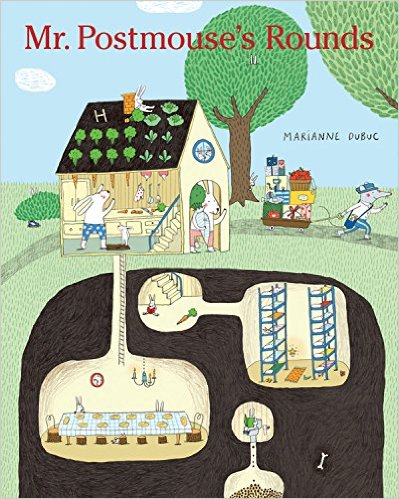
Mr. Postmouse's Rounds.jpg

But what makes this book stand out for me as a book?  Well, the story is about a mouse who takes the post to all the other animals around and then brings the last package home and it turns out it’s a gift for his son, Milo.  (Yes, a narrow, logical-minded reader might ask why he carried the package around with him all day instead of hiding it under the bed or something, but let’s not be that way, OK?  Maybe he just forgot he had it at the bottom of his cart.  Shut up and read the story.)  It’s a simple, straightforward story, and Marianne Dubuc uses it in an ingenious way: she takes the reader along with her to learn about various animal homes.  Let’s look at a rabbit burrow, or a snake’s house, or a squirrel’s nest, or various birds’ nests!

Well, that’s cute, but don’t we have nature books to do that?  There are all kinds of great Eyewitness books, or A Bird Is a Bird, or any number of others, right?  Well, that’s what I love about this one: it’s not a nature book.  It never forgets that it’s a whimsical, charming work of fiction.  The rabbits have a nice house above ground with a rooftop garden… and then a ladder leading down to various burrows beneath the ground, including a cute and clever lavatory.  It’s a sensible lavatory: you get a chance to look at rabbit poop.  It’s a nonsensical lavatory: do rabbits normally sit on a toilet reading the newspaper?  The birds each have their own rather fantastical nests, including the thieving magpie’s den with a “WANTED” poster on the tree.  In short, each page has a nugget or two of natural sciences if you want that (Mr. Postmouse is thrilled he doesn’t have to go to Mr. Snake’s house, his natural predator), but happily plunges into the absurd, too (Mr. Postmouse stops for lunch with his friend Mr. Dragon).  And yet the whole work has the same kind of natural logic that you find in Richard Scarry’s books: it makes sense in its own world, and is rich, full, and textured.

Mr. Postmouse has another special meaning to me: this is the first book the Changeling chose entirely for herself.  She spotted it on the display, made a beeline for it, grabbed it down, begged me to read it to her, and instantly said, “This is the book I want to take home with me.”  (Of course I said yes.  I mean, I’m writing about it right now, aren’t I?  And, oh all right, my heart melted within me.  I’m only a book-loving mama, I’m not made of stone, y’know.)  So, that’s the heart of the Changeling’s review here: it grabbed her immediately.  From what she tells me about it, I’d say she loves the richness of detail in the illustrations as much as I do: “And there’s a bird!  And the bird has a swing!  It’s a yellow bird.  And there’s apples!  Is that a tree and an umbrella?  The umbrella is beside the tree.”

Each page is full of things to explore, so let me warn you: this isn’t a quick book to read.  This is a book for cuddles, and giggles, and a leisurely chat as you go from animal house to animal house.  Let Mr. Postmouse show you around, and check out each bit of sense and nonsense as you go.

And Kids Can Press?  Please keep doing what you’re doing, and maybe pass on a few tips to Nimbus and the others up there.

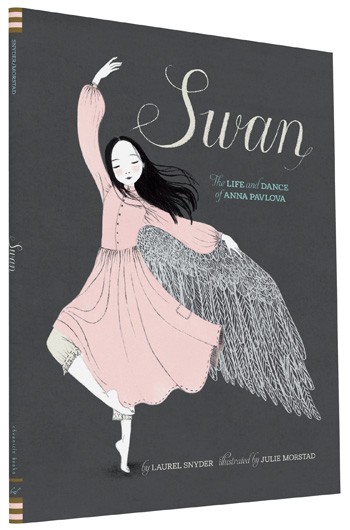
Swan

“I swear there wasn’t a dry eye in the house when she gave her reading.” “I have to admit I got a bit weepy at the end.”  “I found myself tearing up while I was reading the last page aloud.”

These are all things I heard adults say about Swan: The Life and Dance of Anna Pavlova, by Laurel Snyder, illustrated by Julie Morstad.  In fact, I’m the one who was tearing up as I saw that final feather fall, beautifully rendered by Julie Morstad, when I was reading it to the Changeling.

Swan

You could say the book’s a biography of Anna Pavlova, simple enough to read to a toddler, with pretty pictures to engage the child’s interest, but interesting enough to keep the adult happy.  But then what is it that brought so many adults to tears?  And how do children react?  Here’s my take.

Two things make Swan stand out for me as an adult, and for what I notice as a mother:

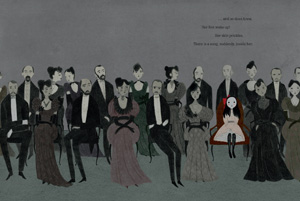
a) The perfect linking between text and illustration.  As a side note, I’ll say this is one of the things I love about Chronicle Books.  They always seem to match author and illustrator and end up with 1+1=A Whole New World.  In this case, the words are spare, perfectly reduced to the poetic essence of Anna’s young mind, and the illustrations more than flesh them out, a perfect balance between realism and dream world.  Note, for example, young Anna at the beginning, dancing as she works: the workaday world is clear to see, but the soft, lush lines show how much more young Anna is experiencing than the broom or the laundry in her hands.  You don’t need extra words– the few lines of text are meticulously crafted, and the pictures let you immerse yourself further and further in the story and in Anna’s feelings, from page to page.  Hell, I wish I could (legally) embed pictures from the book in here, because they speak for themselves, but follow that link above and scroll down the page, then know that they’re only more spectacular in person, printed on the lovely paper that Chronicle’s production team gave this book.  (While you’re at it, think about adding a few copies to your cart: one for your family, one for a friend’s child, and one to donate to a child who could use it.)

Anna's first encounter with ballet.jpg

b) The story is simply Anna’s, and, as such, a story for everyone.  This is a biography.  That means we’re reading the story of Anna Pavlova’s life.  So that’s it, right?  Yes, except that in these pages we’re getting what’s remarkable about her life, why we should care about, of all people, Anna Pavlova.  And, as the story unfolds, we do care.  We absolutely care.  We feel her disappointment when she’s too young to go to dance school.  We feel her joy when she’s finally on stage.  We feel her restlessness, her desire to share, her love for dance and her fellow humans.  And, as we understand her story, it draws out our own humanity and compassion and desire to do, to overcome obstacles, and to share one’s accomplishments.  This is 100% her story, and, at exactly the same time, a story for everyone.  In a word, without being in the least bit didactic, it is inspirational.

What about a toddler, though, Deborah?  Are you telling me that your Changeling really got all of that?  Well, of course not, although, let’s be honest– with toddlers who can tell?  Why do you think I call her the Changeling?  Hidden depths, my fellow readers, hidden depths, I tell you.  That said, what did the Changeling tell me?   Well, given her current obsession with birds, it’s unsurprising, but here you go:

“There’s the swan!  It’s a bird!  Oh, is the swan sad?  Should I kiss the swan?  The swan is dancing!  I can dance.  Look at me, I’m dancing!”

Draw your own conclusions, book-lovers, I leave the interpretation of this oracular speech to you.  I can tell you that she liked it a lot, and that my suspicion is that interest will only grow with age and understanding.

I think this is a book that’s going to last.  I know it’s going to last in my family, and there’s a reason it jumped at me as the first book to talk about here.  It made my soul grow, and I hope it will help the Changeling in due time, too.  It’s a book I’ll be buying as gifts for new babies and donations for children in need.  My only fear for this book is that it will be seen as “a book for girls.”  It’s not: it’s a book for anyone who loves beauty, who can fight for what they love, and be generous with their skills and accomplishments.  I love a book that’s for everyone, and this is such a book.

What is the Children’s Bookroom?

I have never liked long and complicated explanations of a blog’s purpose and what it’s hoping to attain.  As far as I’m concerned, the writer should go for it and show what they’re up to, which is what I’m planning to do.  That said, I do have a little note to address to myself.  Let’s call it a chance for me to think over what I want to do– a journal entry I happen to be posting on the internet, perhaps:

  1. What am I going to write about?  I want to write about books.  I read a lot of books, and I like them, so I’m going to write about the books I like.  I’ll give a little overview of the book, and then write about what I like.  (I don’t think I’d bother writing about books I don’t like, because where’s the fun in that?)  This will probably be mostly children’s books, because, well, I love children’s books, and also I’m a mother, so I read a lot of books with my Changeling.
  2. Will these be old or new books?  It will be a gory party of whatever I pull out of my library, or whatever I’m reading.  That means some will be old or obscure favourites, or Canadian books I’ll be railing at the world to notice, and a lot will be new children’s publications because I do try to keep up with those.
  3. Who am I talking to here? Myself, pretty much.  I’ll write about what I like, and think about books the way I like them, and if anyone else wants to join the party, welcome!  But this is really my space to think about books I like, and that’s it.
  4. Why the name?  When I was thinking about starting this, the image that popped to mind is one of an old favourite of mine, Eleanor Farjeon’s The Little Bookroom.  Well, that name was taken, and, anyway, I wanted something that got more closely at the children’s literature focus I’ll probably take here, but I still liked the idea of giving the nod to Eleanor Farjeon.  She has a quality I love of steeping herself in the traditional, the old, the literary– and producing something entirely quirky, original, and new.  I want this space to be something like that: a space where I can steep myself in all the books I know and love, and perhaps that process will bring me somewhere entirely new, original, and hopefully a little quirky.

So, that ends my note to self, which I suppose could also be a little guide to whoever happens along, and next week I’ll start talking about books.  We shall see where we begin– perhaps with Swan, or perhaps with Cat Valente’s Fairyland series, or perhaps with the Moomin books?  Who can tell?  (Well, I could, if I could make up my mind, I guess.)