The Little Bookroom

Did you have a little bookroom growing up?  I bet you did.  Maybe it was a corner in a library.  Maybe it was, um, your mother’s study.  (Sorry, Mummy.)  Maybe it was a bookstore.  Maybe it was a state of mind, which drew everything into a bookroom in your head.  Maybe it was a state of fingers which drew all books into a bookroom in your bedroom.  (Sorry, Mummy.)  Maybe it was all of the above.  I know I still live in a little bookroom in my mind, and I never feel this more than when I’m anticipating a trip to one of my physical little bookrooms.  The Cambridge Public Library with its brilliant children’s librarians is one such place:

“Hi,” say I, “you were responsible for my child’s obsession with A Bird Is a Bird…”

“Oh, great!” they chirp.  “Here’s more by the same author and if it’s birds she’s after here’s three other books she may love.”

I look them over and in half-a-second at best I know which one is going to steal the Changeling’s heart next.  I sigh and decide to get ahead of the game.  I call the physical location on this earth which most closely resembles the little bookroom in my soul.  “Dear Children’s Book Shop, please put a copy of Feathers aside for me.”  That’s where I’m going today, and I know, I just know, I won’t only be leaving with Feathers.  It’s my little bookroom on this earth, and I love it oh so much.

Unsurprisingly, the Children’s Book Shop is the place where I first encountered The Little Bookroom, by Eleanor Farjeon, illustrated by Edward Ardizzone, the book which is my namesake for this blog.  I want to say right here and now: it’s wholly unfair I won’t be talking about Ardizzone today when he did so much for that book: just believe me that his illustrations are lovely and I have an embarrassing crush on him and his work.  I simply need to talk about stories today– sorry, Edward, I still love you!  Just look at this cover and know that the line drawings inside are even lovelier.
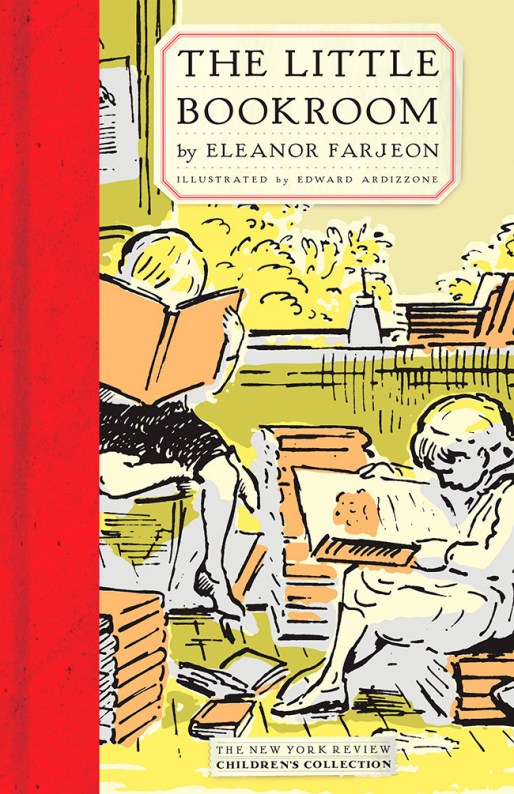
The-Little-Bookroom_1024x1024

The Little Bookroom is the first book I bought at the Children’s Book Shop, I think.  I had always loved Eleanor Farjeon, whose Martin Pippin in the Apple Orchard taught me what stories could do.  I can’t think of another way to put it than that: that book does things with stories which make them sing and dance with glee to know that someone out there gave them such lovely new places to grow and games to play.  (Oh, I did figure out another way to put it.  How lucid I am!)  Martin Pippin was the first time I lent a book to someone and she simply couldn’t get into the book.  I urged her to try.  She refused to give it a second chance.  We stared at each other, perplexed by our respective positions.  I look back at it and smile ruefully: that book was just a bit too old and a bit too peculiar for my friend.  I’d been living in a little bookroom for at least two years at that point (I was about nine or ten), but my friend, a clever, even brilliant girl, simply wasn’t used to such a range of story-play.  I wonder, now, how she would have done with The Little Bookroom?  Would she do better with either one now?

For myself, I nearly cried when I first read it.  I’m not sure that I didn’t.  Granted, I was pregnant, and discovering new-to-me Eleanor Farjeon was enough to get me crying.  But the stories– oh, the stories.  The very first one had me hooked in that special, Eleanor Farjeon way: I hadn’t expected that.  What was going on?  What sort of stories was I in for?  Gradually, as story by story unfolded for me and I had to pause between each one to digest a new explosion of “I didn’t know a story could do that!” I decided that it was a compendium of newness.  After I closed the book, I paused and thought: “I know I’ve read these.  Where have I read them before?”  The thought popped up that it was a compendium of oldness, of the traditional in stories.  And then I realized: if the collection has a pattern to it, it’s that the stories each give you that feeling that somewhere, somewhere you’ve read something like this before… and yet you haven’t.  It’s entirely new: it’s one of the children of Eleanor Farjeon’s internal bookroom.  In her bookroom she housed all the old stories, and they’ve danced and played and gossiped together until, one by one, they made something wholly new.  And up it popped, danced onto paper through her fingers, and, thank God, she made them available to us to read.

That’s the best way I can figure to give you a theoretical description of what you’re getting into.  Expect to have your whole notion of how a story works exploded, at the same time as being deeply reassured by how very traditional they are– all with Eleanor Farjeon’s characteristic quirk and charm.  (No, no, I’m not at all teary, thinking about this.)  Apart from that, the best I can do is tell you to read them and figure out your own way of thinking about these stories.  And that goes for you, too, however old you are.  I’m not entirely sure, in fact, that these are children’s stories at all.  Except that they are– everything about the style and fairytaleness of them proclaims that.  In fact, when my Changeling was fussy I read her one of them when she was six weeks old.  But they really aren’t for children, not precisely, not as such– just try one and see.  Wait a second while I categorize this post as “All Ages.”

Old stories and new stories, for adults and for children– are you seeing a pattern here? These stories cover ground. Eleanor Farjeon defies description and I’m done trying.  Let’s talk about one of the stories instead.  That’s what she’d really like.  Let’s talk about “The Clumber Pup.”  A young man, left alone in the world, heads forth to make his fortune.  Along the way he rescues a pup and her mother from being drowned.  After he becomes a royal woodcutter, the pup helps him to succeed in three tasks set by the princess, ultimately winning her hand in marriage.  What a fairy tale!  Rather boring, almost, right?

No.  Dear readers, the depth of love I have for this story cannot be measured in pint pots.  The young man is left in distressing, real poverty when his father dies, and he has to leave behind the one thing he cares for: his father’s chair.  He’s cheated when he rescues the pup, but he doesn’t care, because the pup needs saving and they bond so deeply together. How can I put it?  I believe that even my father, notoriously impervious to any animal’s charms, would be forced to admit that the bond described in this book is lovely and true.  The circumstances of his advent to Royal Woodcutter are mysterious: did the previous woodcutter come back as an apparition to help him?  Did his father’s spirit move things?  How and why did things happen as they did?  We never quite know.  As for the three tasks– the princess is no austere and distant figure in a tower.  She’s a girl who lost her kitten, saw the nice man who brought the kitten back, and started to pine to know him better.  The tasks are traditional: a ring, a note, a gift.  And yet they are almost comic: the note reads: “My love!  I love you because you are as lovely as my clumber pup.”  After all, would a woodcutter be able to write an elegant epistle?  And each of them, princess and woodcutter, loves their animal: he his pup, she her kitten.  And they love each other.  And he doesn’t just move into the castle when they wed: they are happy to stay half the time in the woodcutter’s cabin, especially once he gets his father’s chair there, which is, in the end, his only request.

Do you see what Eleanor Farjeon’s done?  She’s made people.  Real, warm, flesh-and-blood people.  People you love.  Not in a cynical way (so many “modern fairy tales” are just a smidgen too gritty for my taste), but in a way deeply steeped in the fairytaleness of the fairy tale, and also steeped in her own English countryside, and also steeped in stories beyond fairy tales, and finally sprinkled with a healthy pinch of her own humorous and charming style.

I did read this one to my Changeling.  It was too old.  She loved it, though, for the story about the kitten and the pup.  She loved the narrative voice– the charming styles of speech peculiar to each character.  These are wonderful stories to read aloud, and a toddler responds to that.  And, one day, she’ll see the story’s place in the wider Realm of Story, and she’ll be charmed by that, too.  I hope by then she’ll have her own little bookroom, and will be able to roam around it, puzzling out the traditional and the new, and how exactly Eleanor Farjeon did talk a story into trying that little trick.  Maybe she’ll even try her hand at dancing with a few new stories of her own.

It’s been over a month I’ve been writing this blog, and making my own bookroom here has been more fun and more rewarding than I could have imagined.  So, well, I thought it was time to tell you about this blog’s namesake, and if anyone reading this wants to celebrate a month of The Children’s Bookroom, why don’t you find The Little Bookroom and read a story?  Then tell me what you think of it.  I’m off to my own bookroom to find some more material to talk about here.
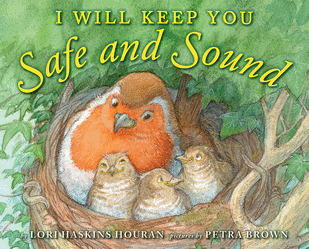
I Will Keep You Safe and Sound

Yesterday, the Changeling and I were headed to the library.  We were both happy.  The Changeling was prancing along in front of the stroller, dancing and singing.  The birds were singing.  The Great Writer Who Wrote that first Word was pouring the loveliness of the heavens on us because that’s what writers do when they want to give a real sense of Impending Doom™, don’t they?  Impending Doom™ just doesn’t work when things are already pretty shitty.  Things have to be really idyllic to get that Impending Doom™ feeling rolling.

Well, sure enough, next thing you know, right in the middle of a tinkling rendition of “The ABCDs,” the Changeling goes flying: first her knees hit the ground, then her middle, then her face.  All I remember is thinking: a) “Crap, I can’t reach her in time”; b) “Thank God her legs and stomach hit the ground before her face: she’s probably fine.”  Fine she was (just a scratch on her upper lip, for those of you who are related to her and are probably worried right now), and we were right near a real, very good pharmacy, so we got her cleaned up and checked over in no time flat, but we were all shocked and scared for a bit.  The library gave us balm in the form of a few bird books I’ve already reserved at my favourite children’s book shop.  (Don’t give me that look, I’m investing in my child’s education.)

But it got me thinking about a book I’ve read to the Changeling fairly regularly for a long time now.  It was a baby present from the same lovely person who gave us The Itsy Bitsy Spider, an old friend with excellent taste in books, and who actually keeps up with new releases.  (Protip: Foster such friendships.)  The book is I Will Keep You Safe and Sound, by Lori Haskins Houran, illustrated by Petra Brown, and it is as much of an antidote to nasty falls as the title suggests.  This book is equivalent to a kiss on a booboo, a hug to the soul, or a Mickey Mouse bandaid to your courage.

I will keep you safe and sound

When I watched my darling baby falling, I stifled my screams so I wouldn’t scare her even more, but those screams sort of cut me up inside a little.  Well, she needed cuddles, and those cuddles helped me, too, but reading stories?  Stories are the best medicine, I think we can all agree.  (I mean, we’re on a blog about stories, so I’m assuming we’re on the same page here: stories are awesome, right?)  But sometimes you need le conte juste, as it were.  I am here to tell you that when you’ve just experienced a nasty invasion of safety and soundness, this is le conte juste to restore peace and harmony of spirit.

The first thing I noticed about this book was that it’s infused with a golden light.  That comes first as a visual impact, through the lovely watercolor, gouache, and brown pencil illustrations by Petra Brown.  (Petra Brown?  I just want to check, would you maybe have time to do murals in my Changeling’s room?  Or… uh… maybe my room?  Please?)  I think, in this case, it’s the brown pencil which really does it: each page has a very soft, very subtle golden glow.  That means that each page glows with warmth, and that warmth means security.  This creates a perfect harmony with the warmth and security and reliability of the text itself.  The brown pencil of the text, as it were, is the security and reliability of the metre.  Each page has a lilting verse about an animal, and each triplet of animals culminates in the chorus: “I will keep you safe and sound.”

Note the trochaic tetrametre catalectic of the chorus– excuse the jargon, I’m afraid poetry is my stock in trade: the point here is that the line both begins and ends on a stressed note.  That’s what gives it that feeling of strength and firmness.  The repetition from triplet to triplet reinforces that, and provides the backbone of the book.  Safety is strong.  The lilt of the old, familiar metre softens that strength (check your books of Romantic poetry for more of trochaic tetrametre: Blake, Wordsworth, and the rest of them use it), as do the gentle intermediary lines: “Brown bears in the den / While the first buds peep / Rabbits in the field / While the crickets cheep.”   The softness both contrasts and merges with the strong yet gentle chorus line: “I will keep you safe and sound.”  There’s an underlying complexity, or at least thoughtfulness, that goes into building the simplicity of the text.

I’m so sorry, but, as I said, I do study poetry.  It was inevitable that I’d break into analysis of the poetic form at some point.  I suggest breathing a prayer of gratitude that it’s over and wasn’t all that bad (hey, I could have done “Hoppity,” you know).  Let’s move on to the story.  After all, the metre is the vehicle for the story, yes, but the story, as I said, is the real medicine here.  You’ve already met the bears and rabbits.  That’s essentially our pattern: we meet robins and dolphins and beavers and squirrels.  Each has a story to tell about the safety the parents provide for their young in the face of the world’s dangers.  The illustrations glow with love: they’re precise drawings of each animal in its own habitat, and the realism is balanced by the softness of the watercolours and that lovely underlying glow.  (Petra Brown, I wasn’t kidding.  Let’s talk murals!)

At the end, we come to the key reason this book is loved in this family: “Kitten in the moonlight / Lost…” (“Oh no, where’s his mummy?”)  “… then found” (“There she is!  Oh, he found his mummy!  He’s so happy!”) “I will keep you safe and sound.”  (“There’s so many kittens!  They’re so happy!  Let’s count them! One, two, three, four kittens!”)  Hey, folks?  Did you know we’re cat people here?  Surprise!

Such is the Changeling’s glow of happiness.  I agree with it, but for an additional reason.  Without that problem, climax, and dénouement the story would be saccharine.  It comes just to the edge of the overly sweet, and this keeps it from crossing the line.  More than that, this problem highlights our dilemma as parents: Our child will get lost, or fall down and scrape her lip, or fall from a swing, or… or… sorry, I need a moment.  OK, the fact is this: we cannot prevent all dangers from occurring– nor, dare I say, should we necessarily.  If we could keep our children from all problems and dangers, they’ll certainly crop up for our kids as adults, so they’ll need to learn to cope at some point.  What we and they need to know is that, when push comes to shove, we’re there for them.  We’ll listen, we’ll hand the tissues over, we’ll take them in and love them and support them, no matter who, no matter what… no matter how dumb they were to date that guy who was obviously a jerk, or how cruel that kid at school was, or how manipulative that first boss was.  We love them, and even if the world is nasty, they will always have us.  We’re there.

That’s what I want the Changeling to get out of this book, and that’s why I was so glad to have it after that tumble hurt me so badly (and her, too, of course): it reminded me that while I can’t prevent pain, I can be there afterwards; and I hope it reminded my Changeling of the same thing.

My First Winnie-the-Pooh

Yesterday, you will of course recall, was the day I went to Catherynne M. Valente’s event at the Brookline Booksmith and got to actually meet her and have her sign a large stack of books for me while I stammered out profuse thanks for her work.  It was wonderful: I’ve never been so happy to be embarrassed in my life as when I finally stepped up to hand my books to the lovely and kind Cat Valente.  As I stood there I thought, “If there’s anything as wonderful as being in a room just for book-lovers, I don’t know what it is.”  Partly, of course, because book-lovers will leave you alone.  They aren’t nosy and won’t talk at you just when you’re at a good part, and won’t be insulted if you flip through a book in their presence.  They may smile and say, “I love that one, too,” but they’ll leave you your space.  For the anxiety-prone, book parties are the best parties.  (Also, they tend to be nice about kids.)

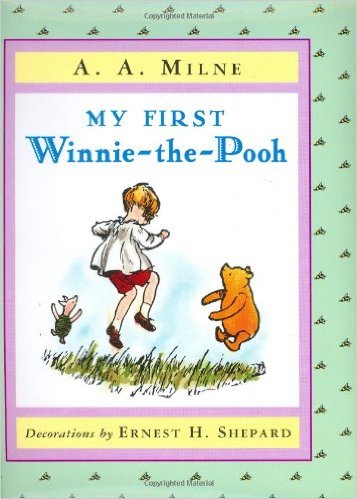
Then I came home and picked up a book I’d just bought for my daughter at our lovely local toy store, Stellabella Toys, and I cracked up.  Stellabella has a really nice section of the store devoted to good books for gifts.  You won’t find the rarest of the rare books there, being that this is a toy store, not a bookstore, but it’s wonderful for little gifts, and I often find things there that I’d overlook when I’m absorbed in the new releases at a bookstore. (You will find the rarest of the rare in toys and games there, and the best of the best, too.  If you’re in Boston, go there.) In this case, the book was My First Winnie-the-Pooh, a board book version of A. A. Milne poems with the original Ernest H. Shepard illustrations.  (I’ve linked you to Barnes and Noble just because the Stellabella website doesn’t include this, sorry!)

My first winnie-the-pooh

You’re probably wondering why all of this charming stuff about a lovely little book discovered in an enchanting local toy store would have me cracking up.  This is why:

“What’s this for?” [said Bertie Wooster]

“You recite them at the concert.  The ones marked with a cross.  I was to have recited them, Madeline making a great point of it– you know how fond she is of the Christopher Robin poems– but now, of course, we have switched acts.  And I don’t mind telling you that I feel extremely relieved.  There’s one about the little blighter going hoppity-hoppity-hop which… Well, as I say, I feel extremely relieved.” [said Gussie Fink-Nottle.]

The Mating Season, by P. G. Wodehouse, from The Collector’s Wodehouse, Overlook Press, p. 106.

You see, P. G. Wodehouse and A. A. Milne, both extraordinary book-lovers and prolific authors of their generation, had a bit of a feud.  Personally, I rather take Wodehouse’s side, but then I’m a passionate Wodehouse fan.  I even see his point about “Hoppity”:

Christopher Robin goes

Hoppity, hoppity,

Hoppity, hoppity, hop.

And so on.  (It does get better, though.)  There’s a certain part of myself I have to talk to firmly in order to read that poem out loud without unseemly mirth.  That might be Wodehouse’s fault for pointing out the funny side of it, though.

That being said, I adore this book, and I think that Wodehouse (as you see at the end of the article I linked to above) saw a lot to love in Milne’s books, too.  My personal favourite of Milne’s poems, “The King’s Breakfast,” is not in this collection, but it’s in every sense Wodehousian: nonsensical and sensible at the same time; rather idyllic, but with absurd problems.  It would fit perfectly with The Mating Season.  I’ll get back to that, but first I want to say a few words about this particular book and why I love it so much.

I grew up with Winnie-the-Pooh, of course, and with Now We are Six, and with When We Were Very Young, and so much else by Milne.  And when my mother started reciting “The King’s Breakfast” to the Changeling, who was enchanted, I realized it was high time to bring out the Milne for her.  (Granted, my mother could recite a grocery list to the Changeling and enchant her: a) my mother has a great voice for children, and b) my Changeling loves her.)  So I got a few volumes.  They’re lovely, and I only ever ended up reading “The King’s Breakfast.”  The format of the book is simply intended for an older child: Shepard’s exquisite black-and-white line drawings, smallish print, etc.  They’re just a bit hard to flip through and find the best poem for right now with a toddler on your knee.

This board book is perfect for right now with a toddler.  Larger print, a few colour illustrations (still Shepard, though, no worries!), shorter, or shortened, poems.  I do miss some of the longer ones (such as “The King’s Breakfast”) but the other books are still there, after all.  This is better for regular use right now: toddlers are all about right now, after all.  It’s great, and I’m never turning my nose up at the novelty section of bookstores again.  I’m ashamed to admit it, but I’d thought of this sort of thing as “dumbing it down.”  Nope.  The poems are the same, but the format is so much more inviting for a toddler it makes a world of difference in introducing really good stuff at the right time in the right way.  It took my excellent toy store, though, to break my habit of walking past those displays, though.  (Thanks, Stellabella!  And I love that you keep the stickers right near the books, now, too: one stop shopping.)

So let’s get back to my earlier point: that the Wodehousian pattern of disrupting the idyllic with an absurd but profound dilemma is apparent in Milne, at least in “The King’s Breakfast” (will the King get that butter for his bread?).  Yes, you get poems like “Pooh’s Song” and “Hoppity” which really are just small observations of the life of a child… and in some cases they can be a bit inane, yes, I admit.  This particular collection is largely made up of these descriptive poems, and, at their best, they are truly special: “Us Two” and “Halfway Down” are among my favourites.  There’s no plot; they simply describe a child’s very specific situation with a rather lovely precision and grace.

But take a look at “Forgiven” (granted, granted, it’s abbreviated in this collection): Christopher Robin catches a beetle and puts him in a match-box; Nanny lets it out, but helps him catch it again.  The horror the poor boy endures over this small-to-us, big-to-him matter is quite as acute as Wooster’s pain over having to read the poem in public.  It’s a little absurd, it elicits a chuckle, but an affectionate one.  It carries the very best of Milne in the sympathetic description of a childhood moment, and the very best of Wodehouse in the sweet silliness of the problem, which is perfectly and painlessly resolved in the end.

It makes me think of how I started out this post: Milne and Wodehouse are both book-lovers, and, setting that feud to one side for the moment, they do share something, I think.  That article I linked to quoted Wodehouse saying, in the end, “I loved his stuff.”  I suspect, if you caught him at a moment when he wasn’t right at a good part and just wanted to be left alone, Milne may have confessed that he loved Wodehouse’s stuff, too.

And the Changeling and I?  Well, I know I love them both, and she loves Milne already.  I suspect that Milne will simply be paving the way for Wodehouse.

Arctic Dreams

First of all: Would the person who misplaced every book I own and simply cannot find please step forward?  Thank you. I promise I will be merciful, I would just like my books to be returned where I can find them.

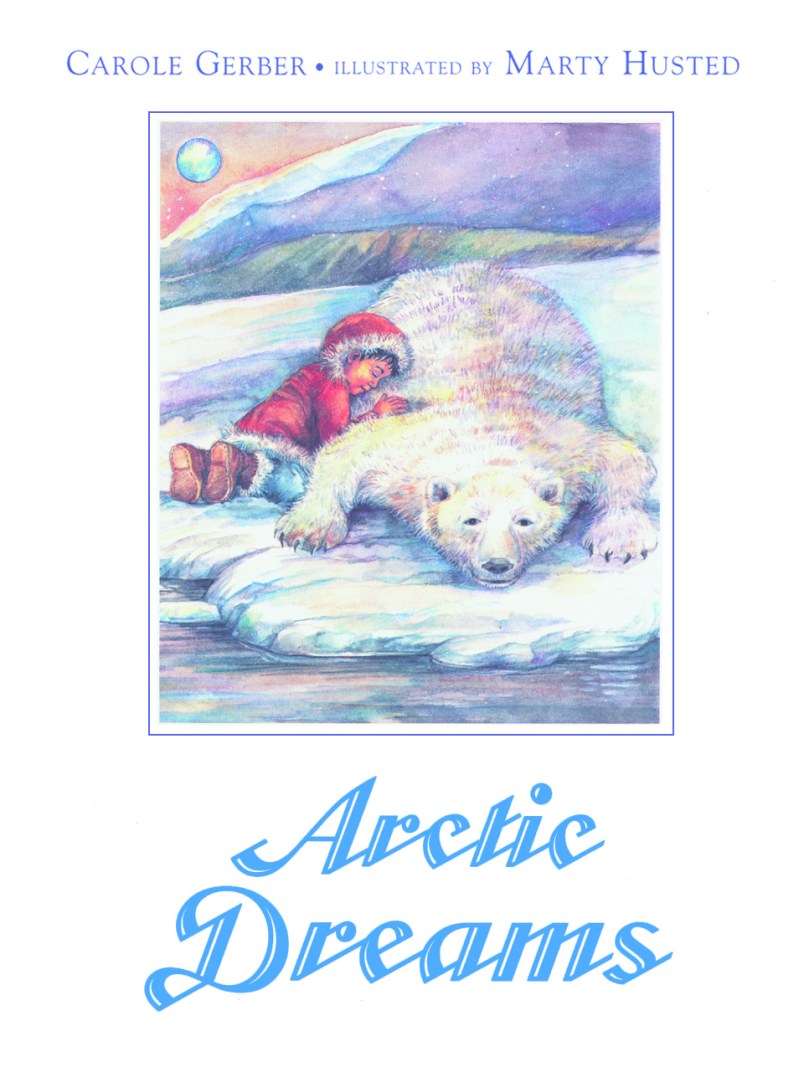
See, it goes like this: the Changeling and I get really into a book and read it all the time.  It’s usually left out on the sofa or side table because we’re probably just going to read it in another five minutes, anyway.  Then… it disappears.  Then the Changeling really wants to find the Arctic hare in Arctic Dreams by Carol Gerber, illustrated by Marty Husted, and the book is nowhere to be found.  Her lip jumps.  I quickly explain that the book will come back and can she be a brave girl and choose another book until it comes back?  She stiffens her upper lip and nods and says that there’s an Arctic hare in her animal book.  What a brave girl, thank you!  I breathe a private sigh of relief.  And then, a week later, Arctic Dreams is back, and I have no idea how or where it was.

Arctic Dreams

So, I know someone out there’s playing tricks in here, and it’s driving me up the wall.  Oooh, that’s what you want, isn’t it?  Well, the bad news is that you let me find Arctic Dreams again, and so long as I’m reading this book, it’s impossible to feel anything other than perfect serenity.  This is, I’m positive, the Buddha’s favourite book.  If we could just give every world leader a copy of this book and persuade them to read it every morning, we’d have world peace by next Tuesday at noon.  This is the book Gandhi read before he decided on his personal Credo of nonviolence.  This is, in a word, serenity encapsulated between the covers of one of the best bedtime books I really hope lots of parents know about, because, seriously, it will relax your kids, I promise.  Or, if it doesn’t?  You won’t care, because your blood pressure will have relaxed, at least.

Now, my previous standard for “super-relaxing bedtime book” was Goodnight Moon, that basic staple of the children’s bookshelf.  I wasn’t even looking for other “bedtime books” because, c’mon, I have Goodnight Moon.  This makes about as much sense as not trying lemon-strawberry sorbet because you already have a really good vanilla ice cream.  They’re both delicious, both frozen desserts, but sometimes you’re in the mood for rich and creamy, sometimes for lighter and tangier.  This book is, at one and the same time, more complex and simpler than Goodnight Moon.  Goodnight Moon is vanilla ice cream: rich and deeply loved and lovable, you always love it, you had it when you were a child and you know your grandchildren will have it, too.  It’s reliable, a little old-fashioned.  And then you stumble across lemon-strawberry sorbet on a day you need a bit more of a change, and it’s also lovely on a hot day, also wonderful for chilling you out, but there’s a bit more variety going on, and it really hits the spot.

Or at least that’s how I felt when I found Arctic Dreams.  It’s not that recent (published in 1999), but it was new to me, and it may likewise be new to you.  The text of the book is very simple, lilting and rhythmic, but the vocabulary is a bit more complex than in Goodnight Moon, partly because it draws on a particular cultural background, the Inuit culture (well, so Canadians would say– the book says Eskimos, but I was brought up Not To Do That in the Canadian school system).  And so you have a mixture of the simple, repetitive “Snuggle deep, my little one. / Snuggle deep. […]  Dream in peace, my little one. /  Dream in peace,” and textured, occasionally surprising passages such as, “Let sleep surround you as silently as a snowdrift… and cover you as softly as the fur of nanook, the large white bear.”  The gentle, soothing rhythm is still there, but I find my brain suddenly feels that soft, warm blanket of fur in a quiet snowfall.  (Fate?  Please note: I do not actually wish to be flumped on by a hungry polar bear in an Arctic snowstorm.  That sounds like a terrible, if memorable, way to die.  Memorable for everyone else, that is.  I’d be dead.)

Marty Husted’s pencil and watercolour illustrations, however, take this book from lovely and relaxing, to utter serenity.  We begin with the mother murmuring to the child in his bed, and then enter the child’s mental dreamscape, where his mother’s words and his dreaming imagination take us to world’s we couldn’t really inhabit awake.  See my above memo re: death by polar bear in a snowstorm.  However, who doesn’t want to, in some absurd, dreamy level of their mind, snuggle with a polar bear in a gentle snowfall?  How lovely!… in the dreaming imagination.

That dreaming imagination is what we see in these warm yet dreamy images (the precision of the pencils is offset by the softness of the watercolour), and it pulls your mind halfway into sleep, just like cuddling a kitty taking her nap: that sleepy serenity is contagious.  We none of us are really going to snuggle up with a group of walruses (or at least I hope we aren’t), but wouldn’t you sort of like to be on a wild rock, surrounded by the sea, roaring with the walrus?  No, you wouldn’t, says your logical mind: that would be smelly, uncomfortable, and deadly.  Yes! screams your idiot imagination. What a breathtaking experience.  “Exactly,” says your logic, dryly. “Breathtaking, indeed.”  [Huh, apparently we don’t write “drily” any longer.  It’s “dryly” now.– Ed.]  I’m not even going to go into my favourite page: diving down deep in the blue ocean on the back of a bluer whale, surrounded by orangey-gold squid and seals, and schools of silvery fish.  How gloriously impossible!

This book is dreamy in every sense of the word: it conveys dreams, draws you into dreams, and is a dream to read with a droopy, dreamy child.  Also, pipes up the Changeling, “it has so many animals!”  Yeah, that’s the only issue: you may be headed into dreamland– but then your toddler may pop up her eyes again to say, “That’s a tern!  And a puffin!  A puffin!”  Go to sleep, my little one.  Go to sleep.

The Princess and the Pony

I never do this, but before we begin, here’s two notes: (a) I have been working on getting permissions to post images for various posts.  If you scroll down, for example, you’ll see some images from The Fox and the Star (thank you, Coralie Bickford-Smith!).  Do go look: they’re lovely.  Thanks are also due to Kate Beaton for giving me permission to use images from her website today.  (b)  On Sunday, I’m going to go to Catherynne Valente‘s signing at the Brookline Booksmith where I will try not to embarrass myself.  I will then gobble up the book, probably weep because it’s over, and then try to compose my thoughts about the whole Fairyland series into a blog post.  (That might take a while.)  If you are near any of the locations on her tour, may I suggest stopping by?  Her books are wonderful.

Do you know what?  That paragraph serves as a pretty good introduction to my confession: I am such a fangirl.  I pretend not to be.  I’m not much of a one for movies or actors or anime or any of the things I’ve decided are “fan” categories.  If you don’t chase the Beatles, you’re not a “fan,” right?  Wrong.  I’m an embarrassing, melty fangirl around authors I admire.  Ask my husband how long it took me to be able to open my mouth when I met [name redacted because, God, that was embarrassing].  He had to speak up for me before I could manage to get past, “Oh my God, I’m finally meeting [name redacted] and I’m making a fool of myself!”

Well, I’m like that for Kate Beaton.  When I saw she was coming to Boston for a signing  for  Step Aside, Pops and I couldn’t go: (a) I threw things at the wall; (b) I realized it was better to be sad I couldn’t meet her than to be a writhing ball of embarrassment for whatever I said or didn’t say if I did meet her; (c) I wrote a note to the Harvard Book Store to order a signed copy and beg them to ask her to personalize it.  I am not proud of that note at all, but it got me a personalized, signed copy, with a truly lovely little sketch from Kate Beaton’s hand, and I am proud of that.  You will pry that book out of my cold, dead hands.  Death, thou shalt die before I surrender that book.  Got it, buddy?  IT’S MINE.

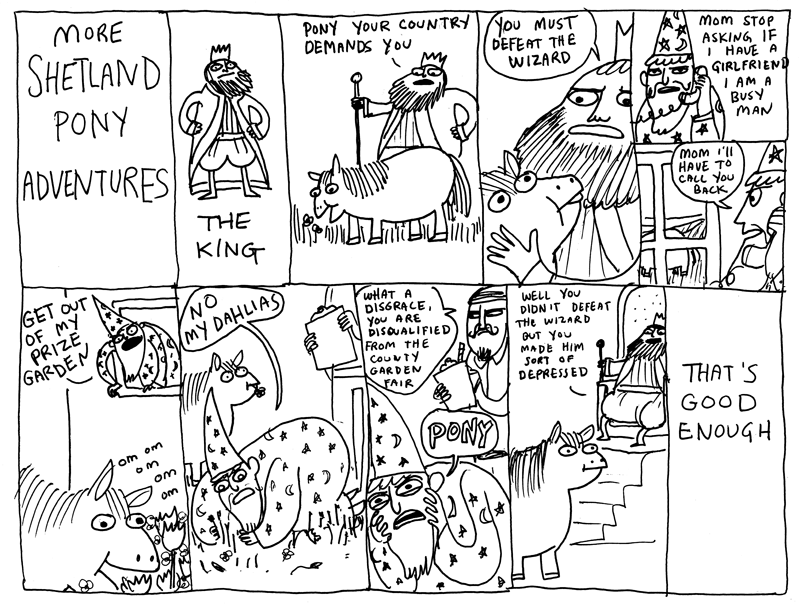
Sorry, got a little carried away there.  My point is: people, Kate Beaton is fantastic.  And… She Is Canadian.  More than that, she is a Maritimer, from Nova Scotia, and, well.  First I read her historical comics lovingly teasing my own beloved Middle Ages and I truly admired them.  Then I heard she was from Nova Scotia and, I mean, I’m from Sackville, New Brunswick, right next door, and suddenly I became the girl who begged and pleaded with the Harvard Book Store to get me a personalized copy of her latest book.  And then I heard that she was writing a children’s book, The Princess and the Pony (this link includes activity sheets for your child), about one of my favourite of her comic characters, the pony.  You can see the pony, because Kate Beaton was nice enough to allow me to post this comic, below:

Fat Pony original

That one still makes me giggle, and anyone who giggled at that will be thrilled to know that this was relatively early work, and the pony’s character has developed considerably in The Princess and the Pony, where he works with Princess Pinecone to, against all her expectations, become champions.

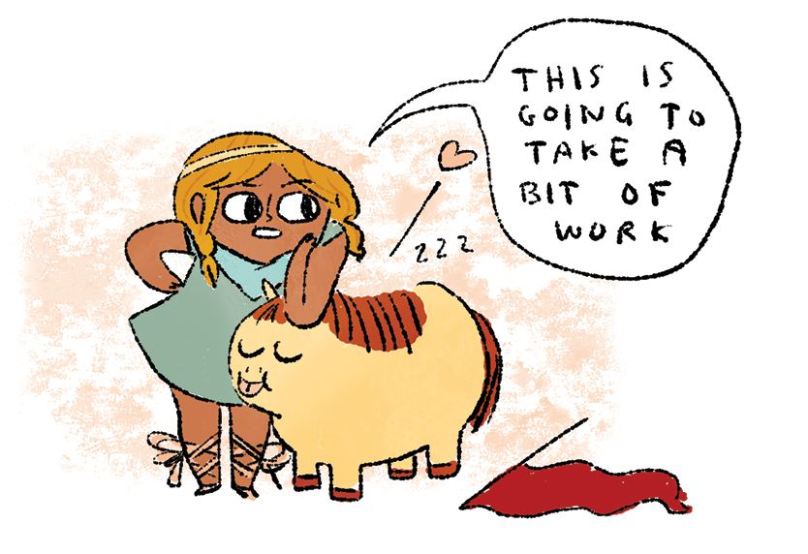
Princess and the Pony

Princess Pinecone, you see, is a warrior, the smallest (and, arguably, most adorable) warrior in her kingdom.  She’s made it very clear what she wants for her birthday: a strong, proud, noble warrior’s horse.  Instead, she gets a small, round, funny little pony.  She is somewhat disappointed, but diligently works to try to teach her little pony to be a real warrior’s horse.  The pony ambles around, rolls on the ground, and farts too much.  Princess Pinecone is glumly convinced that they will never be champions, but when the battle comes up, the pony proves unexpectedly successful in a wholly new way, and he and Princess Pinecone are unanimously awarded the prize for Most Valuable Warriors.

It’s a charming little story, but the illustrations are what take this book from “Book I enjoyed” to “Book I truly love.”  As with Here Babies, There Babies and Jillian Jiggs, you’ll find someone in here who looks like you and speaks to you, which is an aspect I love: all colours and genders are represented here.  But Kate Beaton’s style, her humour, her zest, all come through here brilliantly in characters who speak as much through the illustrations as through words.  Pinecone, seen above, is a sweet and serious girl, very invested in her interests.  Her anxiety when she first meets her pony is visible: Oh God, do I sympathize with her!  An “almost” right birthday present can be such an awkward piece of business, yes.  But the personality is what truly pulls at my heart: trying so hard to make something not-quite-right work?  I’m almost 29 and I still identify with that.  Who doesn’t?

Princess Pinecone might be the most developed character (apart from the pony, perhaps), but my Changeling and I have endless conversations about the others.  She loves to examine each warrior’s face and equipment and talk about who looks “a little sad,” “a little angry,” or “so, so happy!”  She carefully analyzes the battle, Princess Pinecone’s parents, each ice cream cone on the battlefield, and all of the weapons of battle.  The detail, in short, is impressive, both in the layout of each large spread, and in the pages bare of background detail which focus on particular characters to tell you their story.  These are the pages my Changeling can “read” on her own, and I love watching her develop the stories from the art.

Most impressive of all in that regard, perhaps, is the pony himself.  He’s a major figure (and he has a most impressive figure!), but is limited in speech.  And yet he speaks to you so clearly: his big round eyes, his funny mouth (sometimes tongue out, sometimes in), his round figure, all tell you the same thing… “Awww,” you squeal with Otto the Awful, “what a cute little pony!”  The Changeling’s eyes bulged like the pony’s the first time she saw him: “I want a pony, too!” she announced.  (OK, I’ll admit it, she got one for Chanukkah: he lives in her crib, and you can get one right here.  Cave, submit, leave me not alone in my shame.  You can also get a onesie, shirt, calendar, or mug.  I don’t have those… yet.)

I’m still not clear on this pony, I’ll admit.  Shake your head all you want, but I still analyze him: how much does he understand of what’s going on?  He is a most reserved pony.  He watches more than he speaks.  Does he know what he’s doing at the battle?  Does he know what he’s doing during training?  I suspect he’s much more clever than he lets on, but I can’t swear to it.  I’ll just have to read it a few more times with my Changeling, and maybe ask her opinion again.  Last time, I got good suggestions from her.  She thought it over, and said, “Let’s read it again.”  I suggest you do the same.

(Kate Beaton?  Thanks so much for the permission to use your images, and sorry for the fangirling.  I really love your work, in case that wasn’t clear.)

I Have to Go!

Yesterday was a warmish, if slightly windy, brisk-feeling day.  I felt invigorated, and talked earnestly about a beautiful, deep, soul-enhancing book.  Today is grey, rainy, and I feel the need for lightness, laughter, and a bit of silliness.  Or that’s what I thought when I picked up today’s book.  Then I thought a bit more, and realized maybe there’s less of a difference between yesterday and today than I’d thought.

Let’s talk about Robert Munsch— Bob Munsch, as I grew up thinking about him, because, well, he felt like a friend.  I think all Canadian kids felt like he was our friend, honestly: Who spoke for us when we wanted markers?  Bob Munsch (Purple, Green and Yellow).  Who spoke for us when we got muddy?  Bob Munsch (Mud Puddle)!  Who, always and forever, told us we were loved?  Bob Munsch (Love You Forever).  I don’t think it’s quite easy for adults to understand exactly what Bob Munsch means to kids.  I remember going to one of his storytelling tours when he came through the bustling metropolis of Moncton, NB, and I was a kid growing up in the little town of Sackville, NB about 30 minutes’ drive away (wait– in those days I think it was 45 minutes away: that was before the big highway).  I loved my little town, and Moncton was a bit scary, but Bob Munsch was coming to talk, and I was thrilled.  I didn’t get to meet him in person, but, somehow, it still felt like he was talking just to me.  His voice and personality have that quality (to hear him read, click those titles up above), and it permeates his books, too.  He’s an adult who knows how to talk to kids, and if you’re that kind of adult, you’re special.  And kids will love you.  Every Canadian kid I know loves Bob Munsch.

Americans?  Well, those Americans I know who know Bob Munsch also love him.  I can count those Americans on the fingers of two hands– um: my cousin, my aunt, my other cousin, my uncle… um…

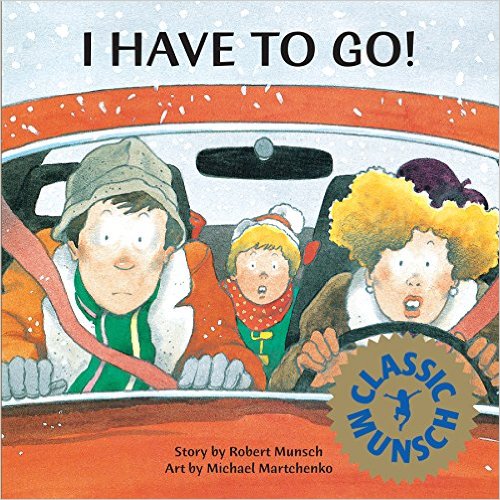
See, this is just another one of those cases where something really, really good didn’t quite cross the border properly.  And I want to tell you why it’s so good it’s worth seeking out.  The book we’re talking about is one of the current favourites of my Changeling, who is quite interested in the topic these days: I Have to Go!, story by Robert Munsch, art by Michael Martchenko. 

I Have to Go!

Do you know what?  I’m going to recommend a little homework.  Click that link, and listen to the story first.  It’s not every day that I can give you the story I’m about to read, but today I can, so give it a listen– it’s only a few minutes long.  Have you listened?  Good.  Now, here’s a secret: this is not exactly the story in the book on my desk, the one you can buy here.  That’s because Bob Munsch is telling the story, developing the story as he listens to his audience, and, in fact, you can hear the story of how the book happened right at the end.  That, in a nutshell, is Bob Munsch.  The listener, the understanding storyteller, the mediator between child and adult.

Why do I say mediator?  Well, think about another aspect of that recording– and, yeah, yeah, we’ll get to the story soon, but I want to talk about Bob Munsch right now.  Did you hear something behind the story?  The audience?  Did you hear the kids talking and sharing their stories?  I love that.  Did you hear when the kids laughed?  I love that, too.  Did you hear the adults laughing?  That’s why I’m an evangelist for Bob Munsch.  Folks: not every kids’ book out there has kid and parent laughing together through the same experiences.  Remember when my kid used up all the sheets in my house when she had her stomach flu?  I know I grossed some of you out with that.  Bob Munsch has all of you laughing at that, kids and parents both, and it gives you courage to live and go at it another day.  More than that, he gives your kid the language to talk to you: You heard those kids chanting with him: “I have to go pee!”  My Changeling does that, too… sometimes.  And when she does, I can carry her at the speed of lightning to the bathroom, and, hey, presto!  A diaper saved is a diaper earned!

What is it we’re laughing at, though?  There’s a kid (his name is Andrew in the book), his parents are desperate for him to let them know when he has to go pee, but the kid refuses.  No, no, no, no, no!  He has decided never to go pee again!  (Guys, I haven’t even opened this book yet– the words are ingrained.)  This pattern repeats throughout the tale, the parents are exasperated, Andrew is doing his own thing… and at the end, he turns the tables on the grownups, asking his grandfather if he has to go pee.  And the grandfather is not exasperated.  He listens, and he answers honestly: “Why, yes, I think I do.”  Note that, in the book, this beautiful moment is reinforced by Michael Martchenko’s illustration, showing the two of them smiling warmly at each other, holding hands, on the way to the bathroom.

There are two points I want to make about this.  First, I want to answer my own question (what are we laughing at?) and second, I want to add an observation about what Bob Munsch is teaching us.  I think we’ll see they’re related.

For my first point, let me point out how realistic these scenes are.  Andrew is being a kid, the parents are being parents.  When Andrew goes outside they “put on Andrew’s snowsuit.  It had five zippers, 10 buckles and 17 snaps.  It took them half an hour to get the snowsuit on.”  And then he throws one snowball and yells, “I HAVE TO GO PEE.”  Kids giggle, parents sigh and laugh simultaneously.  We all look at it and say, “THAT’S ME!!!”  And so we laugh, because it’s familiar.

But I think there’s something else, and that brings me to my second point.  When we say, “That’s me!”  Well, we’re also saying: “I’m not alone.”  It’s a feeling of relief.  “I’m not the only kid who wets the bed.”  “I’m not the only parent who weeps at 3 am with damp, filthy sheets and a deliriously exhausted child at my ankles.”  And what Bob Munsch is teaching us is: “It’s OK.  Be honest.  No one is completely whole and perfect.”

And that brings me to my final point: Bob Munsch has been open about his struggles with depression and addiction.  When I found out about that, a little part of me said, “I’m not alone.  If Bob Munsch has done so much, and spoken to me so much, while he’s been struggling, then I’ll be OK, too.”  Addiction isn’t a problem of mine, but depression is, and I’m humbled by how much Bob Munsch has accomplished by his openness, his generosity, his honesty.  He writes about this on his own website, in his own words, and finishes, “I hope that everyone will talk to their kids honestly, listen to them, and help them do their best with their own challenges.”  No, I’m not crying.  (Yes, I am.)

Listen to Bob Munsch, people, and buy his books.  Get them down south of the border, if you can.  We need his honesty, his openness, his warmth down here quite as much as Canada does.  We’re all people, we all need books like these.  I know my Changeling’s life will be better for Bob Munsch, just as mine has been, and I hope other kids will be able to say the same.

The Fox and the Star

I have been hesitating to write about this book for months, since before I started this blog.  Let me tell you why, before I start talking about the book itself.

I love it.  The very moment I saw the ARC at (you guessed it) my favourite children’s book shop I knew I needed it.  I didn’t just want it– it was talking to me, it told me I needed it.  I immediately placed a pre-order for it, and when I came out in November and I finally got to read it from cover to cover I have to admit that I actually slept with it under my pillow the way I used to with fairy tales when I was a kid, hoping they would get into my dreams.  That’s how beautiful this book is.  And that’s why I hesitated to write: Where do I start?  What can I say to get across its loveliness?  Am I good enough to get it across?

Then I read it with the Changeling this morning and I realized I loved it in my way and she loved it in hers, and, while the book might be one step over from absolute perfection in its own way, no one’s looking to me for the perfect blog post.  The book didn’t need me to be perfect.  All I want to do here is share, as best I can, how truly I, Deborah, love this book.  And I’ll screw my courage to the sticking place and do my best, with all my uncertainties.

One uncertainty is that I don’t know is whether it’s a children’s book.  Judge for yourself.

The Fox and the Star

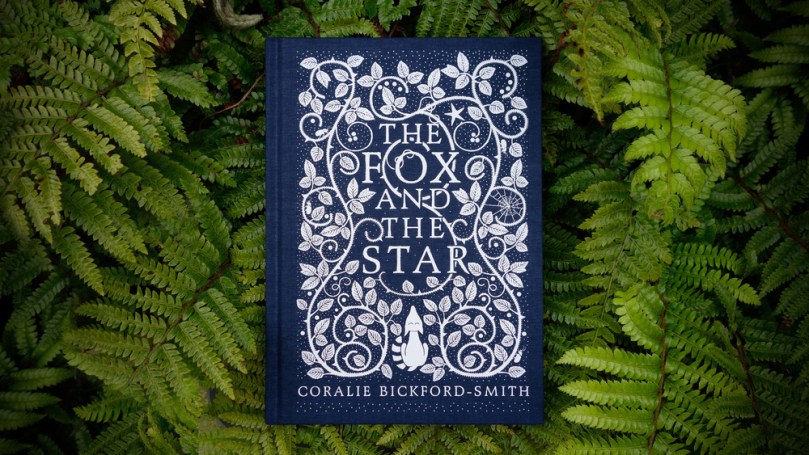
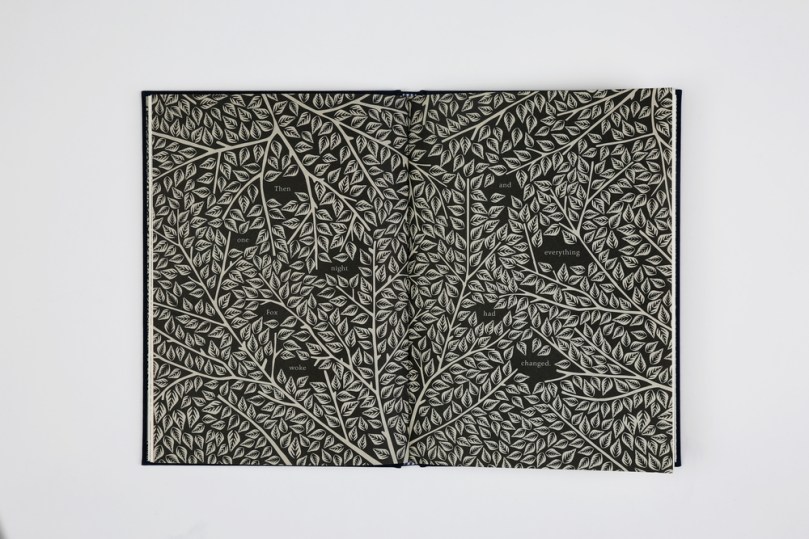
I do know that The Fox and the Star, written and illustrated by Coralie Bickford-Smith, is a work of art.  I mean that absolutely literally.  I said that with Madlenka’s Dog I stopped trying to protect it from the Changeling.  With this book, I keep it out of her reach, and when I read it with her I explain that this is one of the books I truly love and would like her to be careful about touching.  (Let me brag for a second: She’s such a good listener!  OK, I’m finished bragging now.)  The cover is beautifully designed.  I want the endpapers as wallpaper.  The illustrations are exquisite, each one lovely enough to be a print, or William Morris-style fabric (or more wallpaper– I love wallpaper).  The words, beautifully chosen in and of themselves, are integrated into the illustrations so that they make a seamless fabric.  Sometimes they’re set into the page like a tablet poised in the branches of a tree, sometimes each word is woven into the thorns of the forest, but, always, the words and the pictures suit each other.

Integration of text and image Fox and Star

And then there’s the story.  Or, perhaps, parable would be a better word.

I remember discussing with a professor of mine what the modern-day equivalent of the parable would be.  We agreed that children’s stories often work as parables: they’re stories in themselves, but often convey greater themes.  The Tale of Peter Rabbit would be a classic example.  He suggested Katie and the Smallest Bear as an even simpler and more exemplary option.  I think this book pares both the story and the themes and message so closely to the core elements that it makes an excellent example of a parable.

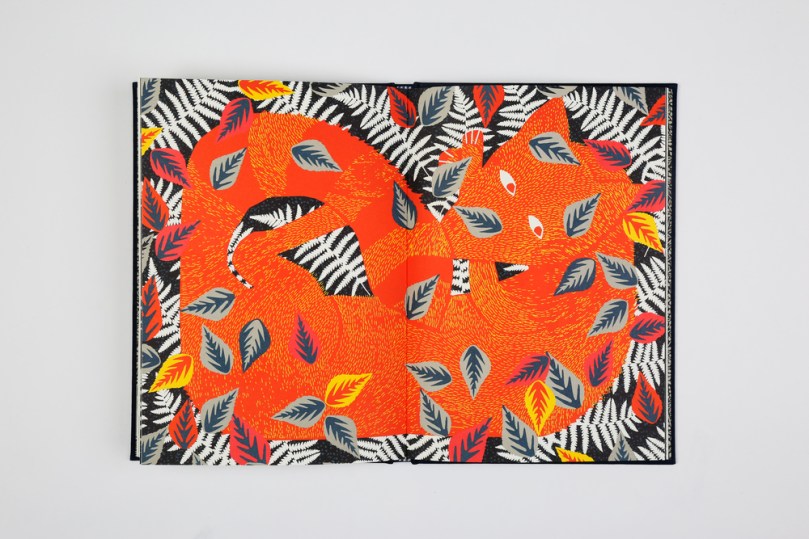
The story is about Fox and Star, and Fox’s love for Star.  The two of them, and all the others Fox encounters on his journey, are what they are, and need no other names.  Fox loves Star, his only friend, a friend he relies on for a soft glow of light at night in his dense, dark forest, where he walks only a little way from his den so that Star can light his path.  But one night he wakes and Star is gone.  (If you were reading the book, your eyes would fill with tears here.)  First, he huddles in his den, dreaming of Star’s return, lonely and scared, but finally beetles come seeking his den and Fox wakes up and eats.  Then he goes searching for Star.  He asks all those he meets about Star: the thorns, the rabbits, and the trees, but either they don’t know, won’t answer, or can’t hear him.  Finally, he comes to a lovely clearing and calls out his question.  Leaves fall, settling on the ground to tell him: “Look up beyond your ears.”  And when he looks up he sees a sky full of stars, and knows one of them, somewhere, is a star that once was his.  (If you were reading the book, not my measly summary, you’d be choking up right now.)  And Fox walks on through the forest.

Part of what scared me about writing up this book is that this is where you should say, “And this book’s message is X and teaches you Y and it’s so universal!”  I can’t do that to this book.  It does have broad, universal messages and themes and they’re beautiful.  If I put them into words it would diminish them.  To me, that’s why this is a parable: there are things that plain, sensible words can’t say.  There are things that you can only experience and feel through the interwoven, perfectly balanced mixture of words and images in this book.

I will tell you that this book came out while I was in a deep and miserable depression.  Frankly, it sucked.  It was horrible.  This was the first book I bought for myself rather than because I thought my daughter or husband would love it in a long, long time.  (As it turns out, of course, we all love it.)  The Fox’s lonely and courageous journey through a dense, dark forest, looking for beloved starlight spoke to me and got me to sleep at night and up in the morning.  It got me thinking about working in children’s books, too, because who wouldn’t love a world of books that can encompass everything from The Very Hungry Caterpillar to a book like this?  I will always love and be grateful to this book, and to the Fox’s courage.

As for my daughter?  She loves the Fox.  She loves watching the beetles crawl across the page, she loves the rabbits, she loves the leaves, but, most of all, she loves watching the Fox on his journey.  And when we come to the last page she bounces and beams: “He found the Star!  He found the Star!”  “Yes,” I answer, “he found so, so many stars!”

One day, I know, she’ll learn for herself why the Star had to go away so Fox could find so many stars– and what finding so many stars means to her, in her own words, and her own experience.  And maybe she’ll be able to tell me about her journey, and I can tell her mine.

Fox and leaves Fox and Star.jpg

Look, I don’t say this for every book, but: Go buy this one.  And let yourself cry when you read it, if you need to.  It’s too beautiful not to move you, and you’ll grow for it.  Walk through the forest, look up beyond your ears, and find all the stars.  Then tell me about it.

Note: I updated this with pictures taken from Coralie Bickford-Smith’s website with her very kind permission.  May I point out she also has a store where she sells prints?

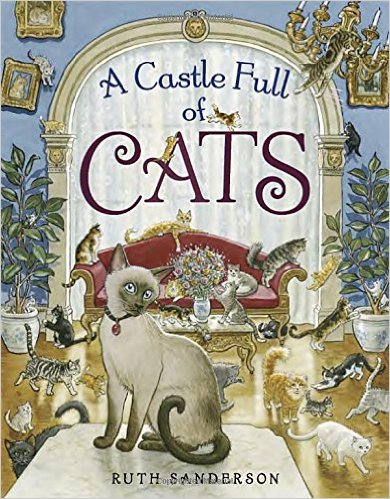
A Castle Full of Cats

While keenly aware that if I run this right after my Little Red Riding Hood post I run the risk of being “one of those cat blogs” (so sorry, Daddy), this Sunday I went to my favourite store in the entire universe again: The Children’s Book Shop.  What that means is that I came back with new material for you all.  And yet here I am writing about a book I got last time I went there.  It goes like this: when I go into a shop like that and casually pick up another copy of that book I got last time because I need to give it to someone for a gift, honestly, I do, no, it’s not just because I want to hold it in my hands at all times… well, isn’t that a sign it’s a book I need to talk about here?

Castle Full of Cats

Those who know me may say that any book called A Castle Full of Cats, written and illustrated by Ruth Sanderson gets its own post here on the basis of the title alone, but those people are wrong for the following reasons: a) If it didn’t work for me and fell flat I’d be too angry to write about it, and, anyway, I intend only to write about books I like (what’s the point of writing about books you hate?); b) Did you know there are cat books I don’t like?  Oh, there are plenty; c) Shut up, Daddy, I do so like books that aren’t about cats– I wrote about Madlenka’s Dog once.  I run my selection process here by a complex and most stringent algorithm written up in Python using processes too technical to share with you, but, to simplify it for the plebes, it can roughly be translated as such: Do I love this book oh so very much that I have got to write about it right now so help me God?  And with this book, well, when I went right into that store, ran over to the appropriate spot on the shelf and yanked it off?  “It’s… for a present,” I muttered, hugging it.  (“Maybe I should get two,” I thought.  But I resisted.  Because there was only one on the shelf and I was embarrassed to ask for a second.)  Well, when that happened I knew there was more to it than “contains cats.”  “Contains cats” will get a look from me.  It won’t get love.

What got love?  I’ll admit one thing up front: this is still a bit too old for the Changeling.  It’s not that she doesn’t sit through it or like it.  On the contrary, she really loves the pictures, poking through and naming the cats and finding the ones that look most like the ones she knows.  She enjoys it.  But there are elements of the story and illustrations which are just over her head and make this more of a book for me than for her for the moment, whereas a book like The Tea Party in the Wood spoke to both of us differently and more-or-less equally.  This one is here for both of us to enjoy, but is waiting patiently for the Changeling to grow and find certain jokes and plot points click as the months go by.  I can tell that’s going to happen.  So, we both do enjoy it, but this is largely my perspective right now.

The basic story goes as follows: A king and queen live together in a charming castle.  The year appears to be, perhaps, 1779.  I think we can assume we’re living in a parallel universe France where the tiers état is happy and satisfied and we needn’t worry about what would happen to aristocratic cats come the Revolution.  This is a calm, lovely, happy, watercolour Baroque world, one where you just want to fall in through the pages of the book, stroke the cats, and run loving fingers across the soft damasked upholstery.

But I digress: the king and queen are living happily, and the king presents the queen with a pair of charming kittens.  She is delighted, and, when you turn the page, you see the whole castle swarming with cats.  The cats know the queen adores them, and she provides them with fish for every meal, right at the table with her and the king (who would maybe appreciate a filet mignon from time to time).  She paints portraits of them, she cuddles them, and they’re happy, except… except they’re concerned that the king might not love them.  They leave him gifts, play games and frolic, but somehow they don’t seem to be able to win him over– until one day the king loses patience: “That’s it! I’ve had enough! / He dropped his spoon. / He grabbed his cane. / He marched off in a huff!”  Allow me to relieve you of your terror: He does return, but what can he do to make all well and resolve the problem in the castle so that he, the queen, and the cats can all live happily together?  Dare I tell you?

Oh, I’m awful at keeping secrets!  He brings them all presents: flowers for the queen and a big, beautiful, cuddly dog for the cats.  They’re all thrilled, and the cats are so busy playing with their new friend that the king and queen are even seen to be dining (on chicken– he must be thrilled!) by themselves.  And they all live happily ever after.

The story itself is, in a word, charming.  The cats’ behaviour is generally catlike: it’s not falsely sweet (as in every silly boardbook), and it’s not falsely evil (as in every adult book).  It’s true, and real, and translated for human readers so that we can chuckle along and sympathize as kittens investigate instruments, knock over books, and leave mice in the king’s shoes.  It’s not so ploddingly realistic as to be boring, I hasten to add, anticipating cat-lovers’ corrections: has anyone seen dozens of cats gathered at a table eating out of bowls?  Right.  But it’s realistic enough to give you that chuckle of recognition: two of the kittens hop right up  on the table to help themselves from a platter or nibble from another cat’s bowl.

All of this is rendered in gorgeous watercolour, with sufficient authentic Baroque detail to make the adult reader’s heart go pitter-pat, but with enough kittenish antics to make pet-lovers of all ages smile and laugh.  As I said, the Changeling can excitedly pore over the pictures with for ages, pointing out who “looks like Remy” and who “looks like Penny” and declaring “let’s find Guinness!”  She also enjoys the gentle, rhyming rhythm of the text.  I, for my part, secretly analyze the furniture and clothes and admire the lush textures Ruth Sanderson manages to get across with her glorious watercolours (I didn’t see any prints from this book for sale on her website, but that doesn’t mean there won’t be later– this book is pretty new).  And, of course, I love the cats’ antics and the gentle, joyous surprise of the dog’s arrival.

And for everyone, cat-lover or not, adult or child, I think the story is valuable: without didactic baggage or getting too heavy, here’s a gentle story of love, friendship, and how compromise can lead to greater happiness for all, not lesser happiness for some.  As the Changeling grows to click with more and more of the little jokes in the book, I hope that’s another note that will click.

OK, husband of mine: Now can I have another cat, and also a dog?  It works so well in the book…

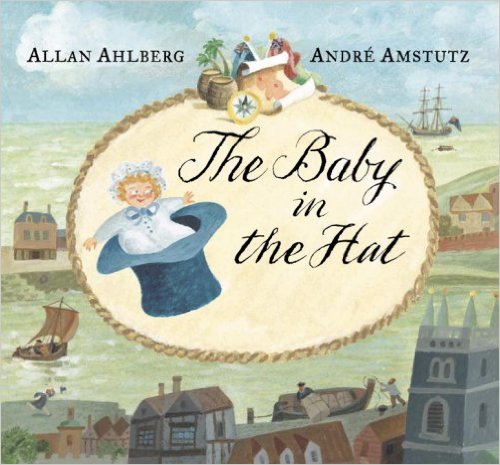
The Baby in the Hat

This morning, as the Changeling was eating a grapefruit with her customary intensity and seriousness, I popped the question: “Which books do you like best of all?”  The question was chewed over with as much seriousness as the grapefruit.  “A Bird Is a Bird,” came first, of course, but we soon got to The Baby in the Hat, by Allan Ahlberg, illustrated in gouache by André Amstutz.  “What do you like about The Baby in the Hat?” I asked.  Her face glowed, bouncing right out of that seriousness: “The ships!”

Baby in the Hat

Ah, my plan continues apace.  One day, I tell you, one day in the future, the Changeling and I will run away to sea in a tall ship and sail far and wide, see remarkable things, and return, baked by the sun and beaten by the wind, to see our old world with new eyes.  (My husband is welcome, too, I promise, but he seems to be less fond of boats than my daughter and I.  It’s the only thing about him I find truly odd.  How can you not love boats?)  Anyway, yes, I have read all of Patrick O’Brian’s books, and I love them truly, madly, deeply.  Well, The Baby in the Hat is like Patrick O’Brian on training wheels: same world, same time period, but without the, ahem, scandals, and aimed at… oh, crap, I really need to write up a post about why I’m bad at gauging age.  The School Library Journal puts this as Kindergarten to Grade 2, and Barnes and Noble says 5+.  That sounds OK to me, except the Changeling is two and a half and she loves this book with a pretty fierce passion.  And I’m nearly 29 and I love this book with equal passion.  Maybe she’s precocious and I’m a slow bloomer?  I dunno.

I have one burning question about this book: the US edition was published by Candlewick in 2008.  It is now 2016 and you’ll note that I linked you to AbeBooks above (you can also find many copies on the Amazon Marketplace and elsewhere).  You will not find it at your local bookstore.  It seems to have… disappeared.  My burning question?  Why?  My Candlewick, my Candlewick, why hast thou forsaken me?  I love you, Candlewick: why not let me buy copies for everyone, bankrupt my family, endure a foreclosure on our condo, anything but let this book go out of print?  OK, maybe not all of that, but I will say that sometimes the vagaries of the book market astonish me, and I think this book is a gem that will hopefully get itself the cult following it deserves.  Please do me the honour of allowing me to prove to you why it deserves at least a visit from you at the library, if not tear-soaked letters to Candlewick to bring it back into print if at all possible.

Let’s start with the glorious illustrations.  You’ve been to an art gallery, right?  Seen some 19th C masterpieces?  This book is not composed of 19th C masterpieces.  Instead, the vivid and charming pictures evoke J. M. W. Turner (think The Fighting Temeraire) and Jacques-Louis David, but with humour, affection, and sensitivity.  You get the wonderful ships, of course, the gently curling Romantic-era hair, the sweeping cloth and dramatically outstretched arms in battle scenes.  You also get cats chasing mice across the ship, tumbling sailors, and humorous faces.

One of the sweetest and funniest aspects of the illustrations is woven directly in with the story, however, so let’s get to that.  The story is told in the first person by the friend of the main character.  Think of The Great Gatsby, only good.  (Sorry, I know I just drowned my credibility in the stormy sea, but I stand by my position, as I stand by my dislike of The Itsy-Bitsy Spider.)  Our narrator is a serious, bespectacled youth, who grows to be a serious, bespectacled man.  Serious, as my daughter is serious in eating her grapefruit, but equally apt to break into a warm, glowing smile as the main character achieves great things: catches a baby in his hat, uses his reward money to go to London, falls onto a ship and ends up at sea, rises in the ranks as he battles pirates and the French (NB: if you don’t hum or sing La Marseillaise at this point then, I’m sorry, but you’re reading the book wrong), and ultimately returns home, a wealthy captain, to fall in love with a lovely young woman who… oh, dare I spoil the ending for you?  No, I can’t do it.  Go read the book.

But didn’t I tell you that there was some aspect of the illustration which was woven into this thrilling tale with sweetness and humour?  That comes through the commentary.  At various points throughout the story, we get little word bubbles of commentary.  At first, these come directly from our narrator, who might poke his smiling face around the edge of the page to say, “Believe me!” in a fine script, but, as our main character is swept away to sea, others take on the same role: a seagull, sailors, a mermaid in the Southern Seas– everyone joins in, and this mischievous and lovely chorus of voices brings together text and illustration in a wonderful way.  It’s a picture book, not a graphic novel (the story itself is told in plain text), but it has that same quality of interaction between the characters and the story and the reader that you find in the very best graphic novels.  I imagine, for example, that Charles Vess and Neil Gaiman would love this book.

The swashbuckling tale, the romance, the soft but vivid illustrations, the humour and whimsy– the best overall word I can think of for this book is lively.  It bounces right off the page, it makes you smile and laugh and sing martial or nautical songs and national anthems, and sends you straight to harbour to choose yourself a ship.

Ahoy there, readers!  Grab yourself a copy, and be not tardy or I’ll cut down yer hammock!  See you on deck at six bells.

Little Red Riding Hood

“Remy has big eyes!”

“The better to see you with, my dear.”

“Woofy has big ears!”

“The better to hear you with, my dear.” (transcribed from a conversation with the Changeling)

Yes, Little Red Riding Hood: it’s become automatic, hasn’t it?  It’s as much a part of our language as the King James translation of the Bible: “Out of the mouth of babes and sucklings,” “Be strong and of good courage,” and so on.  The way we use them might be, shall we say, frequently divorced from the original context, but, Lord Almighty, the Bible has permeated our daily speech to the point that we talk about our “daily bread” even when we’re on a carbs-free or gluten-free diet.

Fairy tales have also made their way into the collective fabric of our thought (sorry about the grandiose language there), but more through tropes than through language: everything comes in groups of threes; if you lose a shoe, it’s made of glass; if you kill a giant, your name’s probably Jack.  And (shhh… don’t tell God) I think I’m even crazier about fairy tale infiltration of our word-world than the Bible’s, pretty as that often is (try this: “Many waters cannot quench love,” from Song of Songs– lovely, right?).  As I said, however, what fascinates me is that while both literature groups have become so familiar to us, the Bible’s language seems to have had a profound effect on the words we use, whereas in folk and fairy tales it’s the tropes which have achieved that level of familiarity.   What I mean here is that, in fairy tales, tropes remain consistent from tale to tale, whereas language can change radically between retellings.  To put it as plainly as possible: three sons are familiar to us, but the precise words they use are not.

Let me stop you right now: Yes, I am generalizing so badly that they’re going to call me up any minute now and revoke my academic permit, I know this, so bear with me a while longer.  Also, I want to put in a few caveats here: a) I’m just musing here based on what I’ve noticed and strikes me as curious, so forgive me for the lack of footnotes or proper research; b) My credentials?  Um… well, I read a lot of fairy tales and have spent many years doing so.  By no means am I an Opie or Zipes or Ziolkowski, and I by no means claim to be anywhere near their level here.  I humbly bow to anyone else’s greater knowledge or experience.  (If you are Jan Ziolkowski?  Hey, call me, let’s talk fairy tales!)

See, I told you it wouldn’t take long, because right here is where I am immediately going to overturn what I just said about tropes vs. language by referring you upwards: Little Red Riding Hood.  Generally, I stand by what I said: there are certain patterns from fairy tales which you can casually reference almost anywhere and your audience will get you (three sons, where the youngest succeeds).  But Little Red Riding Hood is a bit different.  First of all, by no means are wolves generally bad or little old ladies generally innocent in fairy tales.  By no means is there even a clear, consistent lesson between all tellings of Red Riding Hood except, probably, “don’t trust strangers.”  Is the wolf representing creepy, predatory men you should avoid?  Or is the message to listen to your mother’s instructions?  That part isn’t so consistent.  Well, what is consistent in this story from version to version?  Or, to put it another way: What has endured in the collective Western memory of this story?*  I’d answer: the very conversation I started you out with, and the wording it came from: “Grandmother!  What big, hairy ears you have grown!”

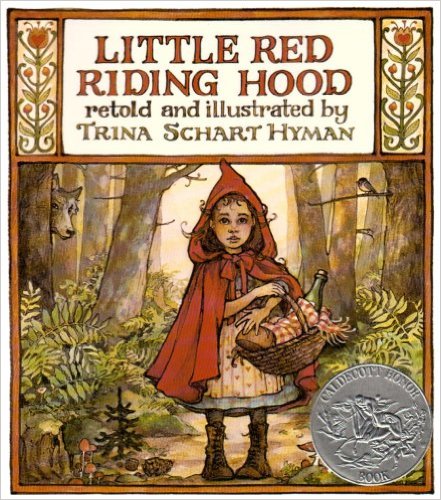
Now, I want to point something out to you.  What edition or version of Little Red Riding Hood did I just quote?  Anyone, anyone?  You in the back?  Oh, you were just scratching your ear.  You don’t know, do you?  That said, everyone recognized the line, right?  Yes, you did.  In other words, the words have made it into our memories.  Wolves could mean a lot of things: in some stories, wolves save the hero, but in this story, the wolf is dangerous.  What rings comfortable familiarity for us in this case is the wording, of all things, despite the fact that I just conclusively and exhaustively proved that the familiarity of fairy tales comes from tropes, not languages.**  OK, let me spare you the suspense and, at the same time, clear my own head of excitement: I’m quoting, and plan to discuss, Little Red Riding Hood retold and illustrated by Trina Schart Hyman.  I am here to tell you that it gets across both the weird and wonderful richness of fairy tale trope and the familiarity of language we know and expect.  These are woven together in both text and illustration as only Trina Schart Hyman is capable of.

Little Red Riding Hood TSH

Right here, right now, I’m going to apologize to my father.  He is probably reading along saying, “Hmmm, clever enough.  I wish you’d actually cite something, Deborah, but you’re doing quite well… wait, now you’re going to talk about cats?  For crying out loud, Deb, still with the cats?”  Yes, I’m sorry.  I’m really sorry, but we’re switching gears from high criticism to… cats.  Why?  Because I firmly believe that Trina Schart Hyman, in her endless genius, uses cats to excellent effect in her illustrations here: they tumble playfully, kittens and cats together, at her mother’s home; one sleek, black creature follows Red Riding Hood through the woods, just to the side of her encounter with the wolf; the grandmother has a cat who observes the wolf, while Red Riding Hood’s cat pursues the huntsman until he finally goes to check on the grandmother; and both cats joyfully greet the grandmother and Red Riding Hood once they are saved.

These cats never turn up in the text.  They are wild, walk by themselves, unacknowledged by the author, but intimate with the illustrator.  They add immensely to our understanding of the story, but never, ever in the text.  Well, I ask you: Is the wolf a creepy man or a beast?  Is a wolf bad or good?  Is an old woman in a cottage an innocent or a witch?  Is Red Riding Hood a child or on the verge of womanhood?  Is sex involved or not?***  With all these unanswered questions about this story, why not add: Are there any cats in this story?  And are the cats signs of domesticity and comfort, or of an element of wildness half-tamed?  To me, they are like words that are as familiar as our daily bread, and yet make our skin prickle ever so slightly with discomfort.

If there is one woman out there it guts me to think I will never meet, it’s Trina Schart Hyman.  She died in 2004, as I found out two years ago, and I cried when I read that.  I wanted so badly to be able to say “thank you” to her, and now I knew I never could.  It was her Snow White and Hershel and the Hanukkah Goblins I knew growing up, and I only saw Little Red Riding Hood recently when my sister gave me this book for my birthday (she knows me well).  When I read it, it felt like someone had pulled the story out of my brain and put it on paper.  Familiar and strange, knowing more than I’d known I knew, it glowed with shadows on the page (sorry, sorry, I’ll cut out the grandiloquence).

Do yourself a favour, and get yourself a loaf of new bread, some sweet butter, and a glass of wine.  Then shut the doors to strangers and friends, and quietly read this book with your cat winking at you from the shadows.

*Jeepers, can you tell I’ve got my academic coat on today?  Get me talking about language, tropes, versions, retellings, etc. and I suddenly start getting very choosy with my language!  I could have just said, “What’s familiar to us?” but I had to go all fancy and precise.

**OK, I can’t help it.  There is one other case I can think of where the wording in a fairy tale means familiarity: Hansel and Gretel, when the witch says, “Nibble, nibble, little mouse. Who is nibbling at my house?”  If you can think of anything else, let me know, but these are the only two instances which occur to me.

***The Opies say there ain’t no sex involved, absolutely not, and I’m going with them because the thought creeps me out just a bit too much.  On the other hand, a part of me suspects they’re probably wrong.  Oh God, I hope they’re right….