Apples and Robins

My basically self-inflicted finger injury (dear God, that sounded so stupid I feel ridiculous) is healing well, and I’m able once more to scatter my pearls of insight across WordPress.  No, really, you don’t have to thank me.  It’s my gift to the world.

OK, you all remember the hint I gave you in my apology for taking a day off due to an injured finger (seriously, doesn’t sound any less stupid the second time around), so this will be no surprise.  Maybe you all clicked the link and found yourselves staring at such a lovely book you spontaneously bought it.  You brought it home and loved it so much that your lives are enriched to such an extent that you’ve devoted your lives to the study of geometric forms and what combinations produce the finest robins.  Ultimately, you’ll discover that Lucie Félix (her site is awesome, so visit it!) already came up with it in Apples and Robins (originally Après l’été), which brings us right back to where we started: our book for today, which is an astoundingly simple and elegant exploration of geometry, life, and natural beauty.  It’s like if Wagner’s Ring Cycle were more, well, um, not to put too fine a point on it, but… enjoyable?  (Sorry, music-lovers, including my dad.  I greatly admire the Ring, but you’ve got to admit that it’s not all apples and robins.)
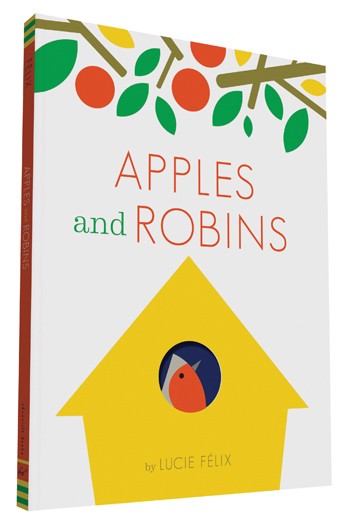
Apples and Robins

But what do I mean, and why, precisely, do I risk alienating all the Wagner fans out there?  Bear with me a moment and we’ll see if I can redeem myself at all.

First of all, let’s talk about how, once again, Chronicle Books has found a remarkable French book to bring to American eyes.  Keep doing this, Chronicle Books, and I will keep buying them.  They are so pretty.  They are so clever.  They are so smart.

Smart and clever are perhaps the first words to come to mind right after the “oooooh, pretty” infatuation abated.  (That’s a technical term right there.)  I snapped this book up in all of five seconds after I spotted the illustrations and flipped the first two or three pages.  It just spoke to me.  But I admit that I wasn’t sure it would speak to the Changeling, so it settled on a shelf for a little while, only read by me.  Then, this past weekend, I realized something which should have occurred to me before, but didn’t because I am apparently as dense as bad soda bread:

IT HAS BIRDS IN IT.

I don’t know if you’ve heard about this before, but, y’know, the Changeling loves birds.  So we read it, and she loved it.

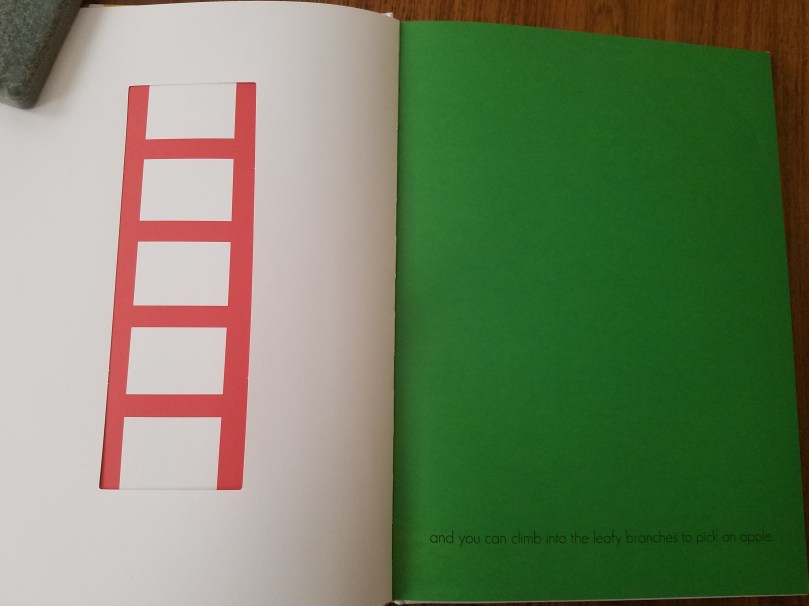
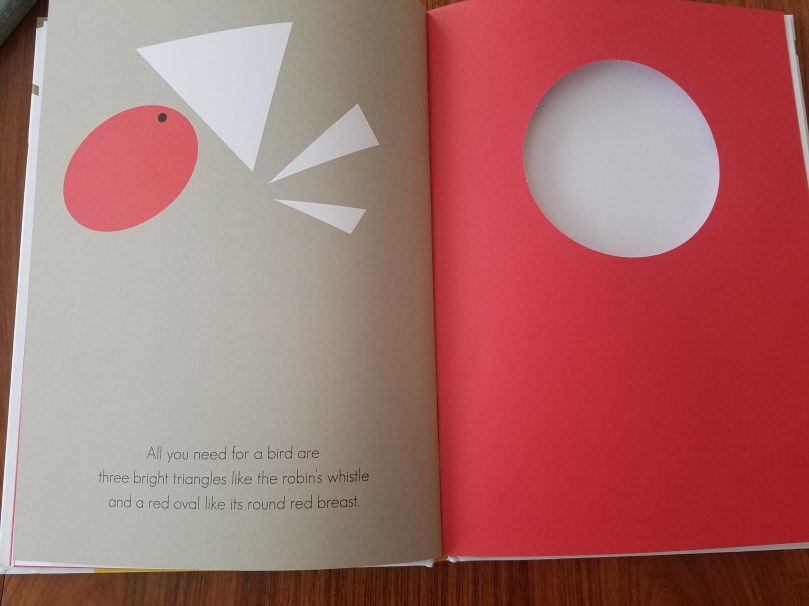
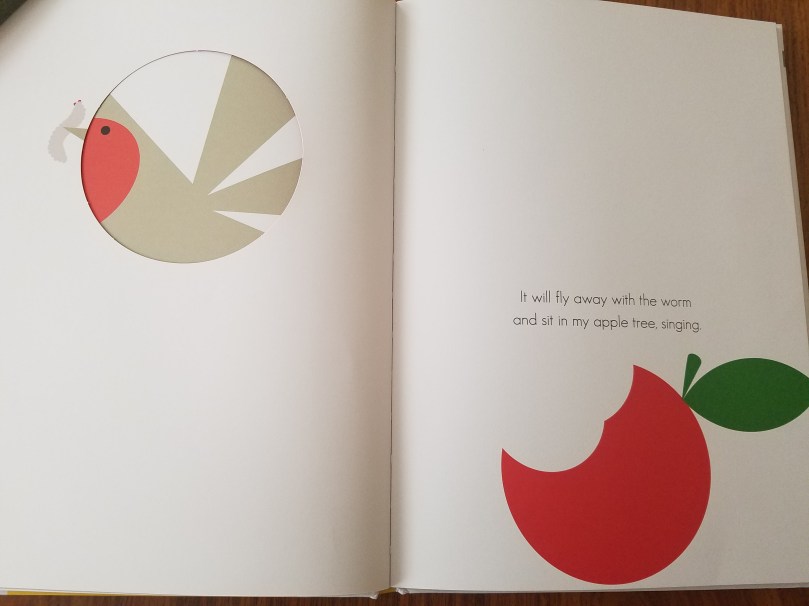
“But, wait a second,” you ask.  “Why in the world weren’t you sure that your book-loving toddler wouldn’t go for this book?”  An excellent question.  First of all, I’m dense.  Second, this really is a very, very clever book.  It’s engineered in a visually stunning way: geometric shapes on the page, when the page is turned, become apples, or a ladder, or a flash of lightning.  Here, let me show you:
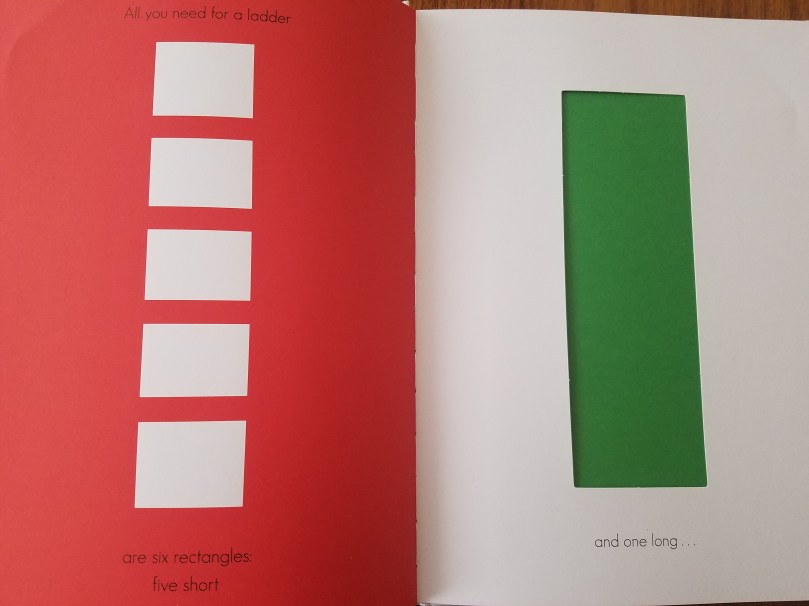
20160603_11133120160603_11135820160603_11141820160603_111431

That should give you a basic impression of the book, but the Chronicle Books trailer can really show it off:

You see how it works?  Shapes which just seem abstract and geometric become, when the page is turned, a whole new world of storms and apples and birds.  As I said, it’s smart: it’s one of the smartest books I’ve seen this year, and, being rather dense, I thought it was too smart for my daughter.

Yeah, right.  Too smart for me, maybe, but not for her.  She loves watching the transformations, and, I think, even loves the story which quietly underlies the transformations.

You have apples.  And then you have a ladder.  Next, you add the robins and a birdhouse.  Then comes the storm which disrupts the natural order.  Slowly, though, it is rebuilt.  Apples are gathered and the birdhouse is restored– and then the birds make it their home until spring comes and you have more birds, apple blossoms, and the prospect of the whole cycle beginning again.  (See?  Just like Wagner, but happier, and, well, less dreary.)

Why shouldn’t that be a story which my daughter can understand?  Because, perhaps, she’s too young to remember from season to season?  She remembers winter.  She remembers people.  She remembers almost every word of Green Eggs and Ham, and recites it daily.  So, why assume she can’t remember the season?  Perhaps I was assuming that she’d be bored because there wasn’t a more vivid story?  Well, if I was mesmerized by the changing shapes and colours, why wouldn’t she be?    Perhaps I thought that she couldn’t draw comparisons with Wagner?  Happily, being not-yet-three, no, she can’t.  But I think you can enjoy this book without being familiar with Wagner.  (Now there’s a pull quote for you!)

Honestly, I’m not sure why I thought this book was so much too old for the Changeling.  She’s a clever almost-three-year-old, and this book is recommended for ages 4-6, her usual range in books.  It’s true that she can’t track the geometric changes as the pages turn, but she does find them mesmerizing to watch, just as I do.  It’s true that she’s too young to really grasp the cyclical nature of the world and nature, but she’s also too young to know about theories of the fantastic but she still enjoys The Tea Party in the Woods.

The fact remains that I think there is one simple, poetic story in this book which can be apprehended in as many different ways as you can draw apples and robins: it’s the story of the turning year, and turning pages, and turning leaves.  It’s as beautiful as taking simple boxes and ending up with a slender ladder to get you up into greenest trees.  It’s also as fun as watching a bird pop out of a hole.  It’s a story which grows with you.

Dammit, I’m not sure how to do this book justice except to link to it again here and say this: I’m labelling this book for all ages.  I think the colours will engage an infant (just keep it away from grabby fingers or the holes will tear), but the shapes and story will engage a toddler, and the older you get the more you’ll see.

Also?  This is another one I really want to see in the original French, just to compare.

Guys, this is beautiful, and, sneak peek: this is going on my spotlight list for Monday’s monthly blog summary, you bet it is.
Apologies

Sorry for the radio silence around here!  Obviously Monday was a holiday, which I spent with the Changeling, my husband, and a whole whack of sheep (i.e. we promised my daughter a trip to a farm, which is to say the sheep and wool festival).  Today, I meant to write a post about a fantastic book which all three of us enjoyed multiple times over the holiday weekend but then an, erm, accident left my right index finger in a terrible swollen state.  Don’t ask.  Point is, typing is not fun.  I’m wincing right now.  So you’ll find out all about this book on Friday, I devoutly hope, and you’ll get the monthly round-up on Monday.  Wish my finger better!  (Finger injuries feel so damned stupid, don’t they?  But they’re nasty little beasts, they really are…)

Ada Byron Lovelace and the Thinking Machine

I couldn’t leave off my month of older picture books– or, to be more precise, thinking about picture books as they would work for older children– without going in for some of my personal passions: girls in science.  Well, let’s be more precise.  Today’s blog is all about precision.  I’m not just for girls in science– I’m a bleeding heart Canadian liberal and am for girls in whatever the hell suits them best, honestly.  I’m for liberating the humanities from the current view of them as fluffy leftovers, and I’m for seeing the hard honest edges around science: what works and what doesn’t and why we should be suspicious of the current Big Data craze.  There’s a lot to talk about in the academic world these days, and that’s why I’m for bringing girls into the conversation.

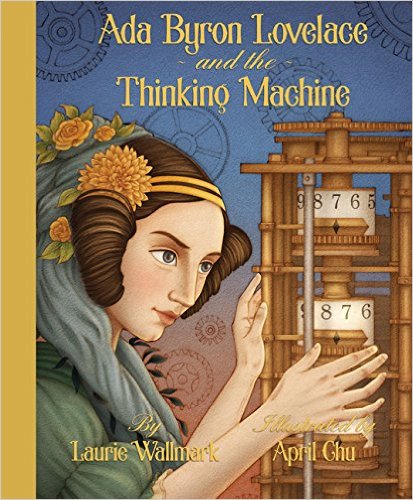
Just as Ada Lovelace was.  And this book, Ada Byron Lovelace and the Thinking Machine (credit where it’s due: for once Amazon brought up a book I wanted, so I’m rewarding it with a link) by Laurie Wallmark and illustrated by April Chu, cleverly and succinctly shows just how Ada became such a mathematician, and, frankly, why she was so very awesome.  If you do not think that Ada Lovelace is awesome already, then you will after reading this book.

Ada Byron Lovelace.jpg

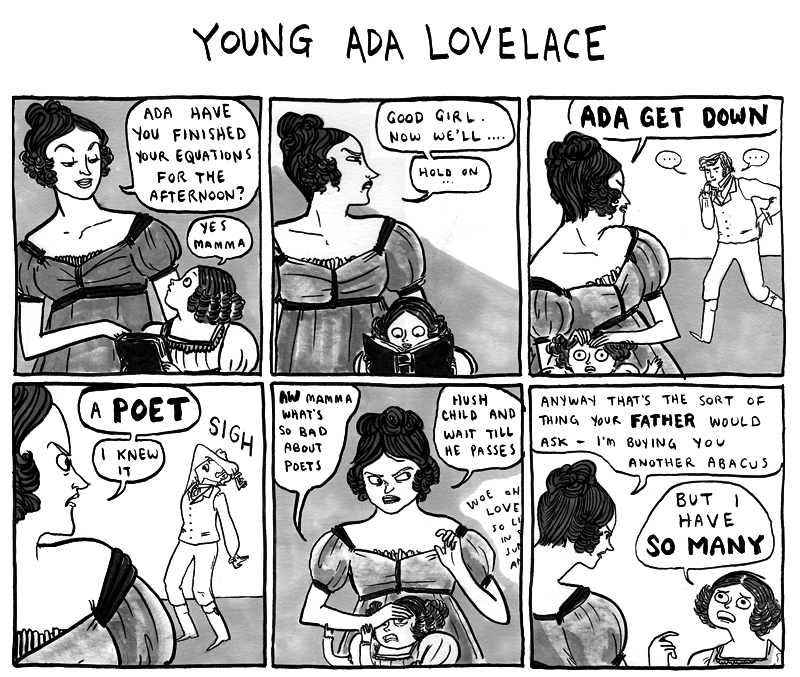
OK, OK, it has been brought to my attention by my brain that my gushing calls for explanation: I am a total fangirl for Ada Lovelace.  I adore her.  I feel sorry for everything she went through in her life, I feel proud for all she accomplished, I am a total, complete fangirl.  As for what she went through in her life?  It can maybe most succinctly be represented by this little comic from Kate Beaton (remember her?) about young Ada Lovelace:

Kate Beaton Young Ada Lovelace

That’s it in a nutshell.  It’s explained somewhat more delicately in Ada Byron Lovelace and the Thinking Machine, but Lord and Lady Byron, well, why they ever got married is beyond me, but they did, and had young Ada.  It wasn’t long before Lady Byron left with Ada, and, wanting to combat any tendency towards poetry in her daughter, she instilled math assiduously.  Lady Byron herself had an affinity for math, and young Ada caught onto it quickly and eagerly.  Despite not seeing either of her parents very often– her mother was not particularly maternal and Ada was kept far away from Lord Byron– and probably being very lonely, she enjoyed her math lessons and became quite remarkably skilled.

The defining moment for her, as is drawn out beautifully in this book, is her meeting with Charles Babbage and the moment he shows her his Difference Engine, a new and powerful mechanical calculator.

DSC_0491

Damn, I’m sorry.  It’s awfully hard to get good pictures of glossy book pages with my limited setup here.  Hey– do yourselves a favour and get your own copy of the book so you can see better!  Anyway, what you want to see here is the following:

a) Charles Babbage is talking to Ada as to a colleague.  To quote the text from the previous page: “He treated her like the fellow mathematician and inventor she already was.”

b) Look at Ada’s stance: she’s completely unselfconscious and poised.  She is unembarrassed, talking ably and intelligently to a colleague.  She sees no need to apologize or explain: she’s simply good at what she does and is doing it.  (Any jealousy you detect in my typing must be in your own imagination.)

c) The focus of the page is the machine, the work they mutually understand and enjoy and are striving to expand to the level of a true “thinking machine” (a programmable computer).

Ada goes off with her head full of ideas and continues to correspond and work with Charles Babbage.  She develops an algorithm to test his thinking machine when it will be built– which, alas, it never is.  But that algorithm is seen as the world’s first computer program.

This is why I love Ada so much, can’t you see?  She wasn’t just a brilliant mathematician.  She wasn’t meek.  She wasn’t particularly pushy, either.  She just was.  She did her thing.  She shared it, unapologetically, unashamedly, unselfconsciously… she worked and thought and worked and did her math things brilliantly.  She was herself, Ada Byron Lovelace, to the fullest.

That’s the Ada who comes across so beautifully in Ada Byron Lovelace and the Thinking Machine, and that’s why I love this book so much.  Laurie Wallmark tells her story simply, elegantly, and cleanly: I think Ada would have appreciated the precision with which it’s pared down and tidy and runs in smooth lines.  April Chu’s illustrations highlight the key moments, such as Ada’s first encounter with the Difference Engine shown above, and they do so with beauty and elegance, like cleanly written code.  Together they make a stellar team for bringing to life such an important story.

“Important?” you ask.  “Interesting, certainly… but important?”

Yes, important.  I stand by that word.  Remember we’re talking about schoolchildren here.  Remember that I said I envied Ada’s stance on that page– poised and vigorous in presenting her views, not at all worried about putting herself forward.

I’m going to start a new paragraph for emphasis here.  Quite as important as finding your field and pursuing it is the ability to pursue it with confidence and self-reliance.  Being able to do the work is one thing, absolutely.  Being strong enough to share your ideas with your fellows as an equal and being able to speak confidently and clearly is also important.  And that’s the image which comes through strongly in this book, and that is why I strongly recommend this book to everyone, male and female, from kindergarten up.  Without in any fashion being preachy, it teaches you to be strong, be confident, be smart, be competent.  Ada Lovelace was, and you can be, too.

Folks?  I dare you to read this book and not love Ada as much as I do.  Go on, try it.  Here’s the link again: Ada Byron Lovelace and the Thinking Machine

Have You Seen My Dragon?

I’m breaking my own mental rules here.  Look, no, I don’t understand how I can have mental rules about what to write on my own blog, either, but I thought that writing about Steve Light twice so quickly, and writing about an earlier book of his, too, so soon after writing about Swap! and spotlighting it in Best of the Blog so far… OK, let me clarify: I am in no way related to, affiliated with, or compensated for writing about Steve Light.  I’m just a really big fan, and, more to the point, so is my daughter.

Let me back up a little.  I love dragons.  I study Welsh literature, you know, and it sort of comes with the territory, I think.  I love them so much that, you know, I want to share them with my Changeling.  So I got books about dragons, of course!  As one does.  But she was not so sure.  Maybe they were scary.  Maybe… I dunno, let’s read I Have to Go! instead, OK?  Until I got a lightbulb moment: “The Changeling loves Swap!,” I thought, “and Steve Light is a genius author and illustrator and wrote a book about a dragon not long ago.”  So, naturally, I procured Have You Seen My Dragon? from my brilliant local bookstore, and now, every single night, the Changeling says, “Let’s read about where’s my dragon before I go to bed.”  And, here’s the thing: I’m still not bored.  And I’ve read this, shall we say, a lot of times.  I prefer not to think that I am very simple, so let’s instead go back to what I said about Steve Light above: the man’s a genius with his art and writing.

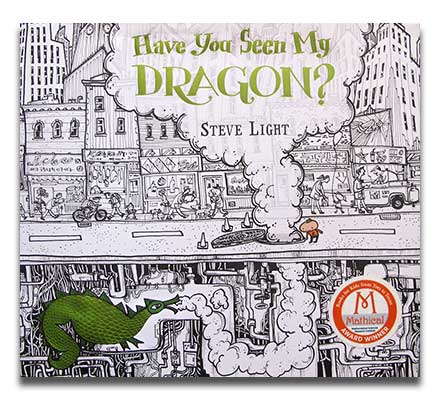
Have You Seen My Dragon

This has many of the features the Changeling and I both loved about Swap!:  The text is simple and the art is rich.  Before, I thought only about how reading the simple text worked so well for me with my daughter.  Reading the book ran along very smoothly while we picked out objects in the art from pelicans to watching for that mermaid to pop up again.

I want to look at Have You Seen My Dragon? from a slightly different perspective.  Let me emphasize immediately that it is, truly, a hell of a fun book, because I’m going to utter a word which I normally take as a warning sign: pedagogical.  This is an excellent book from a pedagogical perspective.  In other words, kids can learn from it without even knowing or caring that they’re learning.  Folks, dear and darling readers, I know and you know that reading should be fun and enjoyable and who even cares about learning except as a side-effect which happens to be awfully nice when you’re reading… but we feel that way because we’re readers, and readers have to be indoctrinated into our sublime order I mean they have to learn to love reading at some point.  Slip of the tongue there.

The point is that Steve Light writes the kind of book which enriches children, rather like another current favourite of the family, Peter Sís, and I have no idea whether it’s at all conscious in either case.

Have You Seen My Dragon? is an adventure story and a counting book all in one.  It’s got a lot going on in very few words.  Here’s the plot: a child has lost his dragon and he goes on a hunt across New York to find said dragon until– spoiler alert– he finds the dragon in Chinatown.

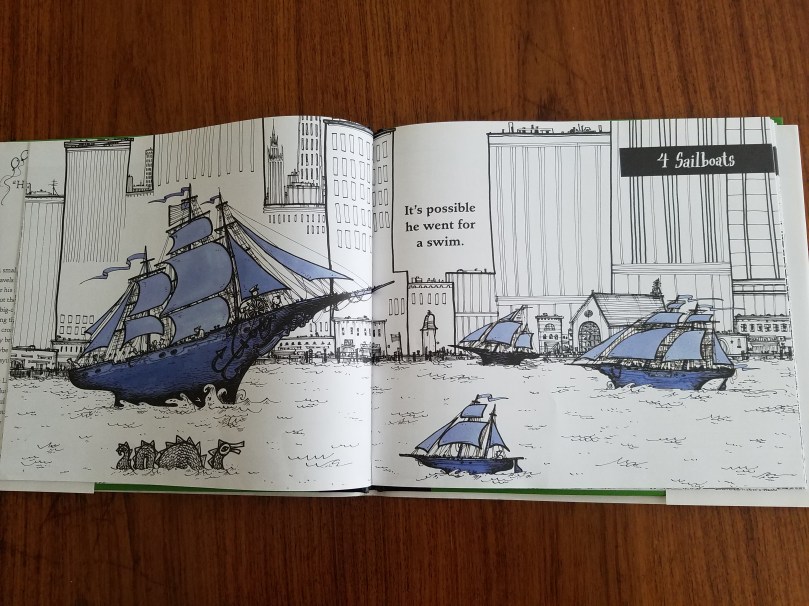
But the fun is in the illustrations.  There are two features of the illustrations which engage… OK, I was going to say “engage your child,” but it’s time to admit that I am also entertained.  Let’s look at a two-page spread here (this is the Changeling’s favourite because of the boats):

20160525_124521

Note that the page, like Swap!, is mostly black and white.  (Steve Light, among his many other virtues, works in my favourite medium, pen and ink, using excellent fountain pens.  No, I’m not biased in favour of people who love the same pens I do, not at all.)  He picks out a few elements in colour.  This accomplishes our two features here.  a) There’s the counting game: in this case we have four sailboats in colour; b) the rest of the page becomes a “hunting” game:  Where’s the dragon?  What else do you see?  I find that part beyond fun.  I fully adore how some portion of the page will always be thrown into relief by the use of colour– OK, at this point I’m just going to taunt you: buy the book, and then look for the “Castle” page (10 Cans of Paint), that’s got some of the best use of colour I’ve seen in a picture book of any kind.

That said, my favourite part of the book for me, as the adult reader, is hunting through the page for little things: the different types of people represented, the different boats, all the little things that make the pictures so rich.  I especially love watching for how the dragon is incorporated in different ways on the different pages: there’s a level of humour and whimsy to Steve Light’s art in that respect which should really be awarded a “Medal of Fantastical Nonsense.”  (I’ve got the award all planned out: the prize would be a bust of Edward Lear.)  The dragon with his giant ice cream will win child and adult hearts everywhere, I know.

I love reading it with the Changeling, of course, because watching her scan the pages for the dragon, or count the sailboats is enormous fun.  But I know it can grow with her.  I watch my poor students with their little readers, and I imagine reading it with them.  They’re a bit older than my daughter, so I imagine them counting with, shall we say, greater accuracy.  I imagine them laughing over the absurd situations the dragon finds himself in (which my daughter accepts as entirely normal, of course, because that’s the magic of toddlers).  I imagine them really appreciating the art and the cleverness of it, in other words, and it makes me want to buy a copy for each and every student in the class.

But the greatest gift of this book, really?  The best part?  Thank you, Steve Light, for giving my daughter a dragon to love.

P.S. In other news, Telemachos finally came out of hiding for close on 30 whole seconds!20160525_123403.jpg

G. K. Chesterton

First of all, my apologies for the lack of a post on Friday.  Suffice it to say that the day was busy.  Second, well…

Yes, yes, I know this is called “The Children’s Bookroom” and here I have a post titled “G. K. Chesterton,” and Chesterton wasn’t known for his children’s literature, as it were, and what the hell am I doing?

Writing about G. K. Chesterton because this is my blog and I want to, that’s what I’m doing.

The thing is, I get obsessed sometimes.  Sometimes obsession is awful.  I can fixate for ages on why I’m lazy and no-good and then I spiral into depression and it’s no fun.  That is not good obsession.  But sometimes, oh sometimes… sometimes I read something.  Something like a reference to Chesterton in a book called Good Omens by Terry Pratchett and Neil Gaiman.  And then I fixate.  “These are two good authors,” I think, “and they both seem to really like this Chesterton.”  “But,” I argue, “isn’t there a risk here?  What if he writes something sort of depressing and I’m not in the best frame of mind and…” “CHESTERTON,” I reply.  “I cannot be an educated person without reading Chesterton.  I must read Chesterton.”  “But… I’m scared,” I admit to myself.  “Says here that he wrote funny things,” I soothe myself.  “And anyway, I’m at the library and have picked up everything they’ve got by him and put holds on everything else, so, frankly, you’d better get on board.”  “So be it,” I respond, and then the introductory phase of obsessive musings is over, and the full-on obsession begins.

So it goes.  I get obsessive, as I said.  And that’s why I just spent the past two days nicking time in between playing with the Changeling and doing, you know, my actual work to read The Paradoxes of Mr. Pond, which Wikipedia tells me was Chesterton’s final collection of detective stories.  Well.  If they want to call them detective stories then I suppose no one need stop them.  I’m no Chesterton expert (yet… this bout of obsession has just begun), but I get the impression that Chesterton would prefer to have them called “anything but detective stories.”  He consciously teases detective stories, and he never, ever brings up a straight “detective story” in this collection.  In fact, Mr. Pond (who is given no first name) is not even a detective.  He is a “minor government official.”  Hm.

Yes, there’s the undoubted impression that Mr. Pond’s powers of deductive reasoning are respected by people in key positions, including his superior, Sir Hubert Wotton, but he’s no Sherlock Holmes.  Remember that Sherlock Holmes is marked by a few characteristics: a) People approach him to solve their problems; b) He’s conscious of his own powers as a problem-solver; c) He almost always solves the problem.  (I say “problem” because it’s not always a matter of deducing who the criminal was, although that’s usually the case somewhere along the line.)  In this case: a) Mr. Pond is not always being approached to solve a problem– in fact, the problem usually reaches him in a more roundabout way; b) It’s not altogether clear how aware Mr. Pond is of his own powers of deduction, since he’s a more humble and discreet sort of gentlemanly character; c) He doesn’t always solve the problem, definitely not in a timely fashion.  In fact, sometimes he resolves or explains the issue after it’s already over and done with.

So, what are we left with?  A collection of stories about a Mr. Pond, in which said Mr. Pond features heavily as the “problem-solver,” but in which he’s not always a key to solving the problem.  That’s a huge muddle if we’re expecting detective stories.  Fortunately, we’re not.  The title tells us what we’re expecting: Paradoxes.

And that’s what we get.  We get stories about paradoxes.

“That’s sort of odd,” you remark.  “How can you get stories about paradoxes?”  The same way, I would tell you, that you can get stories about golf.  I don’t know whether this is, perhaps, unfair to both of them, but then it can’t be more unfair than calling these stories detective stories, so– all right.  I’ve been dancing around this comparison long enough.  Wodehouse.  P. G. Wodehouse’s stories about the Oldest Member at the golf club.  He always features in his own stories, he’s considered slightly boring by his interlocutors, but is intensely amusing to the reader, and he always revolves around his point before coming to it.  A much better comparison, if I may say so, for our Mr. Pond than anyone out of Sir Arthur Conan Doyle or Agatha Christie.

I can see you, now, grinding your teeth.   “Just tell us about the damned paradoxes and stories, already!”  Patience, grasshopper.  I was in one room while the book was in another.  I had to get it without disturbing the new, exceedingly shy, cat in the house.  But here we are, consider the following paradoxes: “I did know two men who came to agree so completely that one of them naturally murdered the other…”; “The whole thing went wrong because the discipline was too good.”; “The government had to consider the deporting of a desirable alien and it found that the difficulties were really quite insurmountable.”

And, yes, of course there’s an explanation to each of those statements.  And I’m not going to tell you what the explanation is.  You need to let Mr. Pond tell you.  But I’ll explain this much to you: The stories are both reasonable and fantastic– reasonableness taken to the verge of absurdity, if you like– in that peculiarly English way which, yes, brings Wodehouse to mind.  And which also explains Gaiman and Pratchett’s penchant for Chesterton.  A clue like a bent poker solves the crime in the most “detective” story of the collection– and yes, Agatha Christie and Sir Arthur Conan Doyle would love it.  But would they include a clown on his way to entertain at a children’s Christmas party?  What about a  character like Peter Gahagan, who tells a story of seeing six sea serpents, each larger than the last?  And then involve the company in an analysis of why such a lie proves Gahagan’s ultimate truthfulness?

Absurdity and seriousness topple over each other in a paradox of its own kind in this collection, and it’s no wonder that, enmeshed in this type of paradox, I got obsessed.  Now, excuse me, I have a date with The Man Who Was Thursday.  Nothing need stand between me and Chesterton right now.

Jazz Day

When I work with my students at the local school, the teacher encourages me to make sure the students don’t just automatically go for the books they already know how to read– have them read something new.  I nod agreement, because this is one of those things which is so very obvious: it’s simply good pedagogy, and she’s doing her job well.  Except that I sympathize with the students on two grounds: a) the Red Rocket Readers they’re given are as boring as can be and all very similar to one another; b) I was once the kid who didn’t want to branch out from very circumscribed reading styles, and it took me a long time to figure out how to vary my reading while remaining true to my taste and myself.  And I still sometimes surprise myself.

I was stuck in the nineteenth century for a long time: Jane Austen, Charles Dickens, even Ann Radcliffe.

But my teachers and even some of my family kept trying to get me to read more modern books.  I didn’t want to.  I felt bad– I was beginning to get the impression that there was some especial virtue attached to reading modern books– but they seemed so dreary to me.  I wanted something richer, something funnier, something more elegant.  I figured out how to find that through my close school friend, who knew my tastes very well and has a knack for matching books and people: she got me onto Sir Terry Pratchett, may his memory be for a blessing.  Not exactly what my teachers were going for, but his humour appealed to me, as did his depth of knowledge: if P. G. Wodehouse were angrier and a bit wilder, there wouldn’t be much difference between him and Pratchett.  As it is, thanks be to the Almighty, I get to read and enjoy them both.

But why do I ramble about this?  It’s to show you how tastes work: you can’t force taste.  There’s no virtue in preferring one type of book to another.  I recently read part of a book which I could tell was excellent, but didn’t appeal to me.  I put it down with a sigh.  It wasn’t for me, and I regretted that.  But sometimes we encounter surprises on the other side of the spectrum.  Or at least I do.

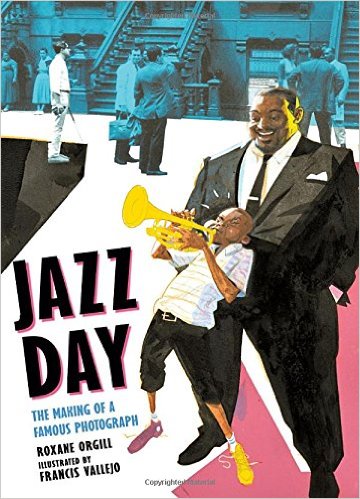
Jazz Day by Roxane Orgill, illustrated by Francis Vallejo, surprised me.

Jazz Day

I am no lover of jazz music.  The closest I come to loving jazz is in The Princess and the Frog, thank you Disney.  I love the music for that movie, but, apart from that, I’m afraid I just don’t listen to much jazz.  I’m a Classical music girl, and, as with my taste for the nineteenth century, I’m at peace with that.  That being the case, I was sure that Jazz Day wouldn’t be to my taste.  It might be good, I may be able to appreciate it, but would I love it?  Unlikely.  I put it aside, ignoring the tugging I felt.  Then I was at another bookstore, in that weakened state which proximity to children’s books always induces in me.  I saw it again.  I didn’t have much time.  I nabbed it to think about whether or not I really liked it later.  And think about it I did.  Jeepers, people, this is one excellent book, whether or not you love jazz.

It’s got jazz in it, sort of.  I mean, it would probably be cool to listen to jazz as you read this book, but it’s hardly obligatory.  I went for Berlioz instead because I had a hankering for some Berlioz.  I wasn’t struck by lightning.  But what it truly is– really and truly– is rich.  It’s full like a plum pudding.  It’s got history.  It’s got biography.  It’s got imagination.  It’s got rhythm.  It’s got music.  It’s got plenty of men and a few women, too.  Who could ask for anything more?  (Sorry, so sorry… I couldn’t resist.)  Well, if you do ask for something more, you’ll find it in the illustrations and imagination which Roxane Orgill and Francis Vallejo bring to the book in a perfect melding of fact and fiction.

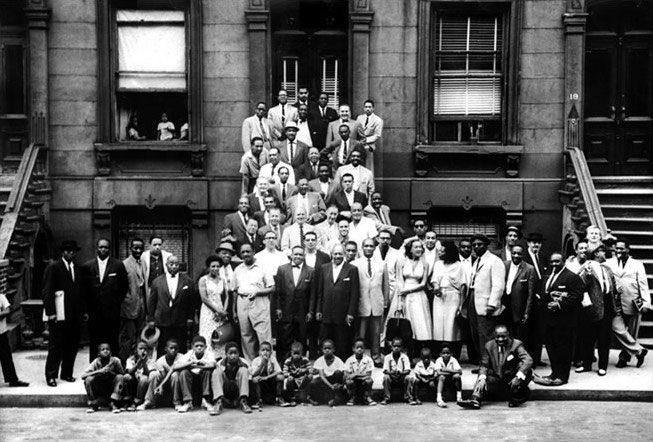
But hang on, you say: tell me a bit more about what this book is.  Fair enough.  Back in 1958 a man named Art Kane put out a call to all jazz musicians who could to show up at a certain place in Harlem, by an “absolutely typical brownstone,” as he said.  He was going to take a photograph and have it printed in Esquire to show off the glory days of jazz music.  Here’s the photograph (thank you, Wikipedia):

Great_Day_in_Harlem

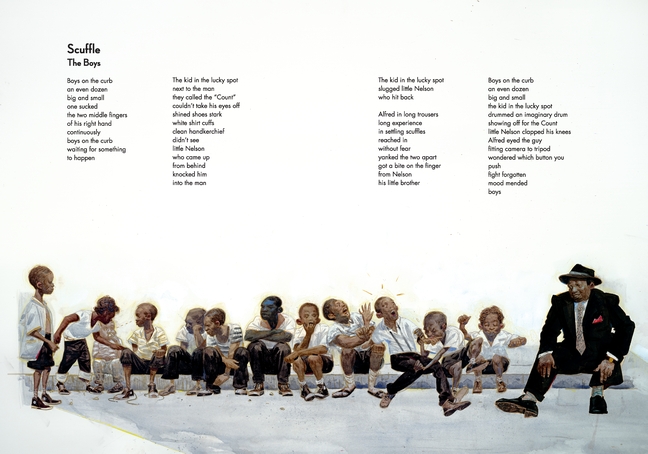
This book takes that photograph and, through a series of poems about the people in the photograph, it opens up the picture to let you inside the day: inside the history, and the clothing and the people and even the little kids who lined up on the sidewalk for a joke and weren’t shooed away.  It was only a semi-planned event: Art Kane had no way of knowing who’d show up, or how the shoot would go, or who would follow instructions.  He did little by way of shouting instructions and let people be themselves.  It’s an open, sincere, very candid sort of photograph, showing who came that day, and some of the kids who happened to be around.  The book is equally open and candid, equally sincere, and I can only imagine the kind of work that went into making it feel so semi-planned and “take it as it comes.”  Here’s an example of one of the two-page spreads, courtesy of Candlewick:

Scuffle

You can see how it’s taken from the photograph above, right?  The kids all in a row beside Count Basie, getting into a scuffle, as kids do.  There’s something ever so slightly unfinished feeling about the contours of the picture: the emphasis, they say, is on this part… we’ll get to the next portion when you turn a page or two, OK?  Fact and fiction, merging, blending.  Who knows much about that scuffle?  Well, says Roxane Orgill, if you do enough research, you can see it.  And if you read to the last pages of the book you’ll see she did plenty of research (her bibliography is most impressive).  But research isn’t enough: what Roxane Orgill and Francis Vallejo really provide is the imagination which brings that period, that spot in history to life.  You can see it, hear it, smell it, hum it as you read the poems– and, boy, do they read well aloud!– and look at the pictures.

Folks, it doesn’t matter what music you love.  It doesn’t matter where you think your tastes lie.  Give this book a chance.  Your kids will identify with the scuffling kids at the front of the picture and you’ll be enchanted by the Count or some of the other musicians– give it a chance, and see if you’re as taken by it as I am.  Let me know if you are.  I have a feeling I’m not alone on this one.

My Wild Family

What’s your family like?  And who are they like?  My father is smart and capable, and he’s good at building.  Maybe he’s like a beaver?  Maybe a bird, building his nest?  My mother is gentle and devoted to her family.   She reminds me of Mrs. Mallard.  My sister is elegant and graceful, like a swan.

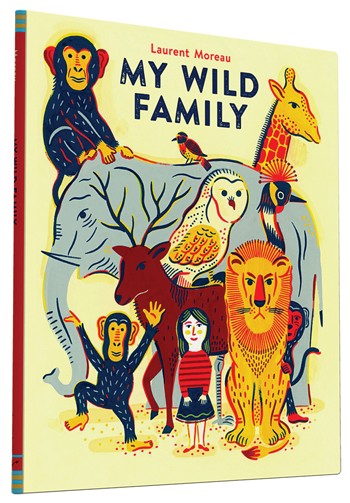
Why am I thinking of that?  These are the conversations you’ll be having after you read, and, if you follow my advice you will read, My Wild Family by Laurent Moreau.

My Wild Family.jpg

I am very curious to know more about how Chronicle Books has been getting so many excellent books from France these days– remember Who Done It?  That was a great book, too.  I want to know which editors are in charge of getting these books and getting them so nicely translated, because I want to a) send them flowers, b) have their job.  Do you ever think about how there are all of these great books out there which you never get to see because they’re in another language or another country, and then you get sad?  And then you go looking around for them?  (Ahem: Bébé Balthazar.) Well, I think I want my job to be “editor in charge of reading amazing French kids’ books and getting them translated for the English-speaking market.”  Glorious.

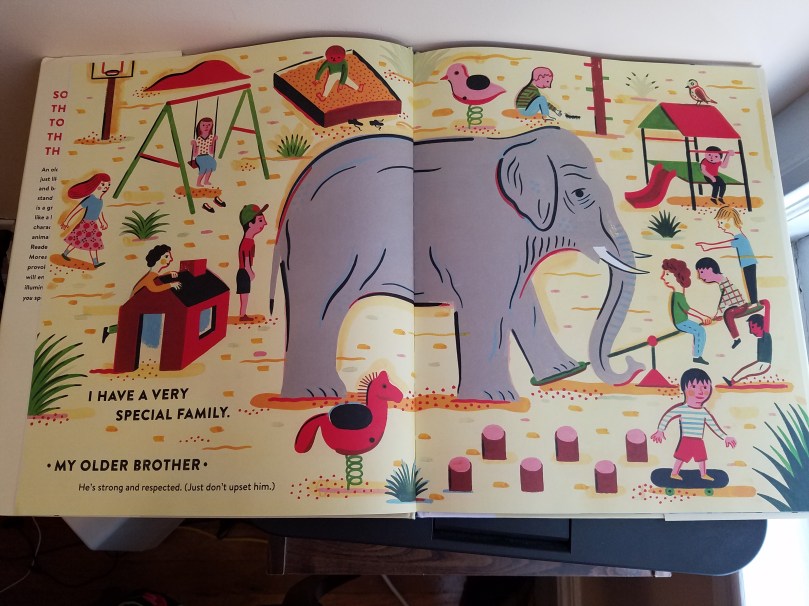
Anyway, moving on: this beautiful book is possibly one of the most versatile in age I can imagine.  It’s incredibly simple, yet rich.  Let me show you a few pages:

My Older Brother

With the Changeling, the game is to look for the one who stands out: that’s very easy with this page.  The elephant is front and centre.  It’s a little more tricky for her with the little brother (a small bird, so you have to hunt for him), and even with one of my favourite pages…

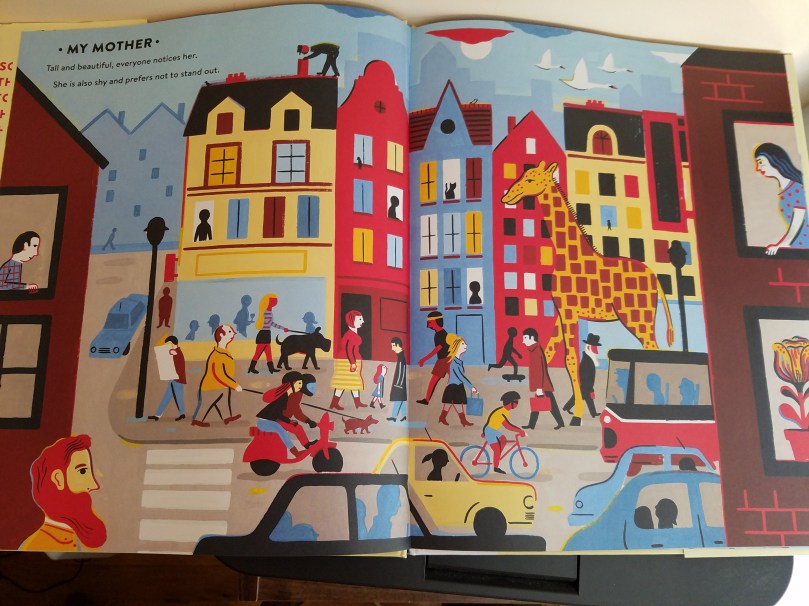
My mother

But what I really, truly love?  I really love that this is a conversation which could grow.  I volunteer with early readers, in a Grade 1 classroom.  Those are slow readers (most of them are clever kids from other countries, so English is their second language), and I can see them being very engaged by a book like this one.  The text is so simple, so very simple that some of the more advanced kids in the class could probably handle it fairly well.   The ideas, though, are so much more interesting than the ones they have to handle in their abysmally stupid little readers.

Oh, those poor kids.  Allow me a tangent.  Do you know how I know those kids are bright?  It’s because I can see their book-hunger.  They flip through the little stacks of books I give them and choose eagerly, based on the topic they think will be in each book from the cover image.  They read three or four little booklets with me, then go through the (rather good) vocabulary lists in the back.  But the books!!!  They’re based on the curriculum, they’re required reading– I don’t blame the lovely teacher at all.  But they’re so boring I’m amazed the kids can endure them.  They do, although one bright little boy explained to me how the pictures of sandwiches in them made him feel sick (accompanied by a graphic demonstration of how sick he felt).  I didn’t blame him– bad food photography of a revolting school sandwich is nauseating, indeed.  And I sit there and repress my sigh of longing to bring this one in and see whether my more advanced readers can manage it.  They could, I know they could.

What, you wonder, do I think they could get out of it?  Well, this is a book where the text is simple but the visual context gives rise to more complex ideas.  My kids are students whose language is limited but whose minds are very sharp.  I think that would make for a great match.  Take that page with the giraffe I showed you above: the mother is tall and beautiful (“Is the giraffe tall and beautiful, honey?”  “She’s so tall, tall like this!” says the Changeling) but very shy and doesn’t want to stand out.  My Changeling gets that the giraffe is tall, and she knows what it is to be shy, but she’s too little to really get how the clever illustrations blend the giraffe in with the windows in the background.  She doesn’t understand the concept of camouflage, really.  Her engagement is with finding each animal and admiring them all.  It’s thrilling for her, and an absolutely satisfying read.

My students are old enough to do two things the Changeling, clever darling though she is, is too little to do:  a) I’m positive that they could pick up on the contextual clues in the illustrations, and I’m confident that with prompting they could talk about them (i.e. understand the concept of camouflage, if not get the word just yet); b) I’m equally confident they could relate the concept to themselves (“What is my father like?  Who am I like?”).  In other words, I see this– oh, lord, there goes my imagination again.  Fine, I’ll let my imagination fly.  I see this as a great basis for a unit.  You read it with the students, maybe in small groups, so the students can see the pictures and talk about them.  Then each student gets the chance to do their own “Wild Family” picture: Here’s my father, the owl.  He is very smart.  Here’s my aunt, the kangaroo.  She loves pockets.  Here’s my adorable sleepy baby brother, the sloth.  It all requires simple language, and a bit of clever thinking.  I bet my kids could do it, and it would be so much more fun than those little pink books of deathly boredom.

This is a clever book, a growing book, and I love it for all that I see that it does with the Changeling, and could do for us in a few more years.  But what I really, truly love it for?  It’s for that lesson I dream of.  I’ll never be able to teach it, but I wish to God I could.  I know those students would love it.

And, Chronicle Books?  Tell me where to send the flowers, and I’ll do it.  Maybe a fruit basket, too.  Bringing these books to the USA merits some reward.

Too young, too old

When I was eight years old, I read The Odyssey for the first time.  I’m not saying that to brag: it’s something I ended up feeling embarrassed about a lot of the time.  Hearing “You can’t really have understood it, though” often enough will do that.  When I was nine I first read Pride and Prejudice.  Again, not bragging.  I’ve had so many hosts of awkward conversations about both of these books that I stopped really talking about them so much.  I felt too embarrassed to say how young I was when I read them, so I just shut down those topics in my mind.  But I’m boldly confessing now: Yes, I read books which were “too old” for me, and, yes, I thoroughly enjoyed reading them.  I think I understood them at a basic level.

Did I pick up on every detail?  I mean, jeepers, there are PhD theses being written right now which express views so abstruse I might not understand them today.  Obviously I didn’t understand those when I was eight years old.  But did I understand the story?  Yes.  Did I pick up on points of repetition and ask for clarification about the point of the repetition?  Yes.  (Oral recitation, I was told.  Now that caught my fancy.)

But I felt embarrassed.  I felt embarrassed because I was caught in a world of “too young” and “too old.”  The books were “too old” for me.  I was “too young” to understand them.  But, at the same time, I was reading books which were “too young” for me.  If I was old enough for novels, wasn’t I “too old” for picture books?  (Let me hit pause for a minute: Mummy, no, I’m not talking about you.  You were great!)  It seems that the world just didn’t expect people to read and enjoy D’Aulaires’ Book of Greek Myths at the same time as they’re reading Homer.

D'Aulaires

But why not?  D’Aulaires’ is a great read, Homer is a great read, and if you’re capable of reading both, then why not read both?

The problem is rooted in this fallacy of “too old” and “too young.”  I will grant you one thing: there are definitely topics which are beyond the reach of some younger readers (incest, rape, violence, etc.) and it’s important to keep these in mind when recommending books to younger readers.  I will also say boldly right now that sometimes it happens that a kid gets their hands on a book which has one of these topics in it (for me it was prostitution) and they might not know what to make of it.  That happens.  It’s OK.  I survived.  It was not my most enjoyable reading experience, but my mother was there to help explain things a bit, and I found other books which were better-suited to my age and my tastes.  And I’m glad I read that story when I did, in hindsight, because it made me aware that such things were out there.

But, “adult” topics aside, I want to boldly advocate for knocking down some pretty stupid barriers right now.  I want to point out that there are programmes for adults reading children’s literature, analyzing it, and enjoying it.  I want to point out that right here on this blog I’m a PhD student in medieval literature reading children’s books, mostly picture books, and, I think, drawing out some pretty interesting insights into what’s going on in them.  I want to point out that it’s pretty nasty to make children feel bad about what they’re reading, whatever level you think they should be going for: what matters is what they get out of it.  Your job is to help them find the meat in whatever they’re reading.

“Too old” and “too young” is a construct manufactured to foster anxiety around reading.  There’s enough anxiety out there as it is, don’t you think?  Do we really need to add anxiety to reading?  Can’t we let it be a space to safely explore the unsafe?  A space where we can securely venture forth for Ithaca?  A space to quietly rant about a man’s pride and unkindness and hope he’ll take those words to heart and grow into a better person?  We can’t do those things in real life, but we can do them in books, and think about how we maybe could get a bit more adventure in life, maybe… just maybe…  Literature can do all those things.  And, as I’ve taken pains to point out here before, children’s literature is no exception: Quackers, I maintain, has many of the same lessons as Tess of the D’Urbervilles.  

Books give us places to explore complicated topics (“Where do I belong?”) in the safety of words and closed worlds: a book is a closed system you can slip into, look around, and walk out of in safety.  The very best books, for any age, are the ones which have you leaving as a somewhat stronger, bigger, more thoughtful person than when you walked in.

The other day, the Changeling stood in the middle of our living room.  She looked around her at all the bookcases, and she said something which warmed my heart: “I like books.”  That thrilled me.  She didn’t say, “I like those books,” pointing at the children’s books.  She didn’t say she liked any specific book.  She liked books, books in general.  I hope she’ll continue to like books, and I hope I’ll continue to foster that love.

And I hope that when she’s ready to read The Odyssey, she’ll still be able to appreciate D’Aulaires’.

My rant is over, and another review will be up on Monday.  Thanks for indulging my need to get these feelings out.  (Do you have thoughts about “Too young” and “Too old”?)

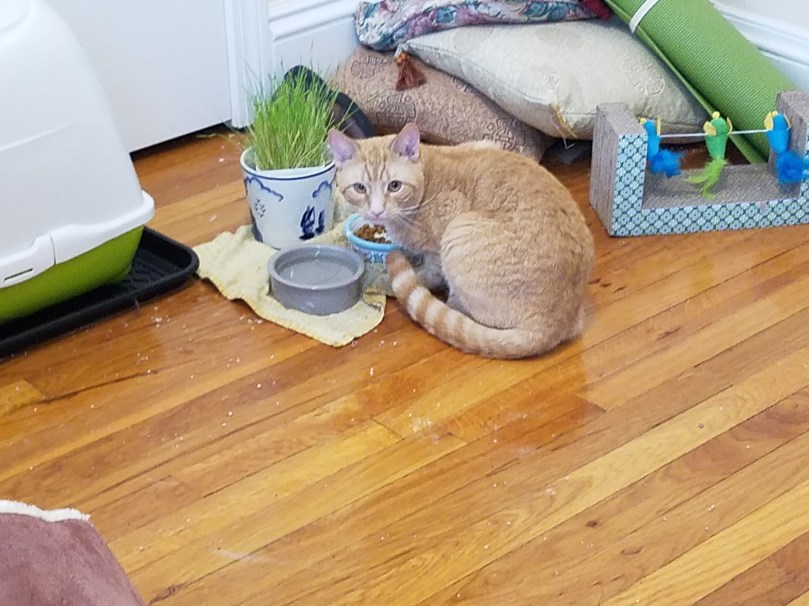
P.S. The new kitty, Telemachos, is settling in well, but still hiding.

I got a cat

I can’t possibly write anything sensible today, because I just got a cat.  I’d post a picture, but you’d only see the dust under my futon with two points of light peering out, because that’s where the kitty is hidden.  His name is Telemachos, though, because my other kitty’s name is Penelope, and he’s a stripy orange beast.  He’s hiding because he’s very shy and in a new place.  It will take him time to get used to us and come out.  Right now I’m sitting very quietly, typing away in the same room as him, trying to project the right vibes towards him: “I’m OK!  Look!  I’m just sitting here quietly, totally nonthreatening.  I’m just fine.  Don’t worry about me, come on out and explore!”  But if he’s anything like Penelope, it will take him plenty of time to get used to the place and come out, and more time to get used to us and want to play.

And that’s OK.  We all need time to hide and read and have a little quiet space around us to get used to the world.  We need a library.  Right now, Telemachos is in his library.  When he comes out, I’ll be thrilled.  But until he does, that’s where he is, and that’s fine, too.  (When he comes out, I’ll get you a picture, I promise.  The internet loves cat pictures.)

In the meantime, I’ll try to get my brain back in order and come up with a nice book for you.  Right now, all my brain can hear is: “CAT!  I HAVE A NEW CAT!”

Welcome, Telemachos.  Once you get used to us, I think you’ll like it here.  In the meantime, enjoy your library.

Update: Still under the futon, but relaxed enough so I could get this shot:

20160511_163351

Willy’s Stories

Today I started sorting through the children’s bookshelves in our house.  I put away board books which we don’t read so much any longer and, well, tried to figure out whether to put away any of the picture books, fairy tale collections, children’s novels, etc.  Spoiler alert: I found that part almost impossible.  Board books were hard enough (not all of them made it into the box), but picture books and older books?  No.  I think this problem stems from what we can call my “acquisitions process.”

Here’s how I buy kids’ books: a) If I think the Changeling will really enjoy something; b) If I really love something; c) If I think that the Changeling will enjoy something sometime in the course of the next decade.

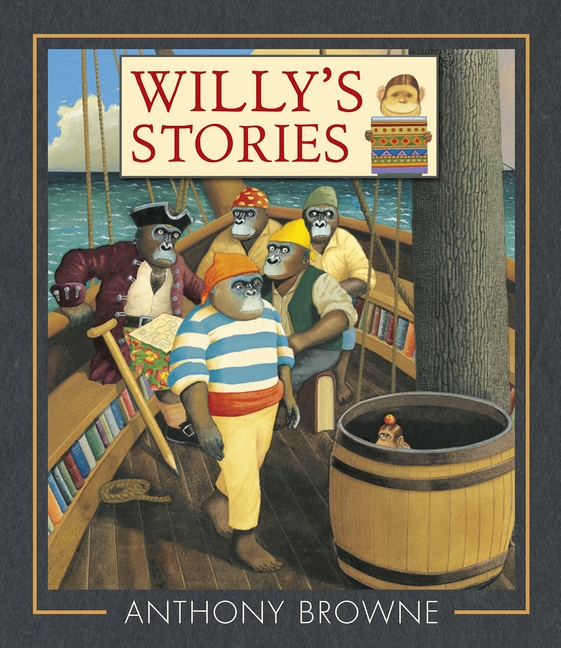
So, if I try to cull what goes on the shelf according to a principle of “what we’re reading with the Changeling right now,” that doesn’t line up with how things get there in the first place.  Frankly, I think even Marie Kondo would give up on me.  Today’s book is a prime example of a picture book I recently bought, haven’t yet read with the Changeling, probably won’t read with her for some time yet, but is definitely going to stay on my bookshelves in a prominent place.  It’s called Willy’s Stories by Anthony Browne, and I think that you and your early novel-readers are going to love it.

Willy's Stories

NB: Willy hasn’t started his literary life in Willy’s Stories, although that’s where I first met him.  Author-illustrator Anthony Browne has been writing about Willy for over thirty years now, but in the UK.  Candlewick Press brought Willy’s Stories to the USA in 2015, however, and I’m thrilled that they did.

The story goes like this: every week Willy walks through a set of apparently ordinary doors (i.e. he goes to the library), and every week he ends up in an extraordinary adventure.  Let him show you his adventures: He finds himself on an apparently deserted island until he sees a single footprint in the sand; He’s wearing a fine suit of clothes and needs to cross a stream, so he asks a merry priest for help; He goes through the doors and falls down a deep rabbit hole and sees a rabbit checking a pocket watch.  And so on and so forth, Willy guides you through your favourite classic stories and novels, books you’ll find at your own local library!

It’s a wonderfully simple idea, beautifully executed.  Each full-page accompanying illustration shows a vivid snapshot which matches the snapshot in the text: falling down the rabbit hole (book-lined shelves on all sides), crossing the stream (with an abbey made of books behind him), on the desert island (with a palm tree of stacked books).  The pictures sit right on the cusp between completely tumbling you into a whole new story and a glimmering awareness that this is a book, it’s a story, it’s not really, really happening… look, there’s a palm tree made of books!  It can’t be real.  (Oh, also, there’s a chimpanzee in a sweater vest.)  And yet… and yet… there’s Friar Tuck and Robin Hood, I’m sure of it!  It’s a lovely teasing pull.

In other words, the text and images do a truly fantastic job of emulating the feeling of total immersion in a story: You always know there’s words on the page in front of you, but you also know that you’re on a desert island or a pirate ship or are wearing a fine suit of Lincoln green as you hunt the deer of Sherwood Forest.

You might be wondering at this stage, “OK, so why aren’t you reading this with the Changeling just yet if you love it so much?”  Oh, I want to.  I may end up doing it, actually.  I can never resist sharing good books with her!  Here’s the thing, though: this book really isn’t for toddlers.  (Candlewick recommends it for 5+, and I think that’s right.)  For the ideal experience, in fact, the book wants you to have at least a basic familiarity with the stories it talks about.  Which is one of the reasons I love it so much.  It’s a picture book perfectly suited, I think, to the readers Betty Carter talked about in the Horn Book Magazine article I cited on Friday, “Escaping Series Mania.”  If you’ve read Treasure Island, you’ll love this book.  If you’ve read even a pared-down version of Alice in Wonderland or even watched The Wizard of Oz without reading the actual novel, then you’re ready for this book.  I don’t think a toddler would get it, although I can tell you the Changeling is enchanted by the pictures.

All right, you say.  So it’s aimed at kids who have already read these books, then.  So what’s left to interest them in this book?  Well, first of all, no: you don’t need to have read all the books, or even any of them– you just need to have the cultural background to get that these are stories you can find in your library.  Maybe, as I said above, you’ve only watched The Wizard of Oz, but never read it.  So then you flip delightedly through this book, enchanted by the vivid snapshots of text and illustration.  “Wait,” you think, “this is a book, too, from the library?  I should look into that…”  Or else, perhaps you’ve read Robinson Crusoe, but never  Treasure Island.  You read along through the book and are thrilled to find another thrilling adventure story.  “Wow,” you think, “that sounds fun…”  Or maybe you’ve never read any of them, but you’re old enough to have heard about the stories and these give you just a taste of them– you get where I’m going, don’t you?

My point is that this is like going out for tapas or mezze: you should be old enough to be eating more than mushed up bananas, and curious enough to give the beet salad a go, but you don’t need to have tried every single dish in advance (what’s the point of that?): you just need to have the appetite and spirit of adventure ready to sample.  And the best scenario is that you get really excited by the beet salad and decide to try to find out more about it later!  This book is a book of appetizers, and it gently directs you to the library for the full course.  I encourage you to hand it to smart youngsters ready for adventure, and remind them that the wonderful librarians of the world can give them a menu when they’re ready.