Tony

Writing about kids’ books off to the side like this, not for The Horn Book or SLJ or anyone, ultimately, but myself and my own fierce desire to deliberate on literary and artistic trends and what the finest achievements for children look like, is in many ways the ultimate exercise in navel gazing.

Except there’s a whole party going on around me.

Normally, my research looks like me sitting in a big cozy rocking chair with my Spriggan on my lap and a truly frightening number of unshelved books around. My kids are the only children’s literature people I talk to on a daily basis.

But from over here, I know that everyone is out there, and read about or communicate with many: writers, artists, editors, publishers, publicists, etc. Being me is like being at a party where everyone is chatting and you’re off to the side a bit, awkwardly wondering if you could get to talk to anyone or uh well maybe not… Maybe you’ll just stay over here. Incidentally, that’s exactly what I’m like at a party. Don’t invite me to any parties.

From my safe corner, not involved, but reading a lot, I’ve had the chance to observe books and where they come from for years. And I’m going to pay tribute here to one editor through one book.

Neal Porter is the one person I was secretly hoping to meet at NCTE but didn’t. I have admired so many books from his imprint for so long that I’d rather hoped to get to tell him so, but, frankly, given my display to Elisha Cooper (“YOU SENT ME A PANDA!”), it’s maybe better I didn’t. (I repeat: don’t invite me to any parties.)

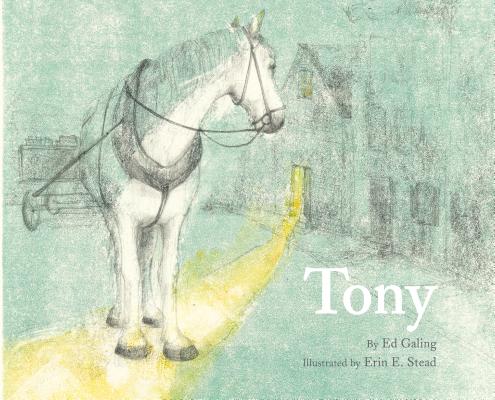
But with the news that Neal Porter is stepping back from full time to emeritus status, I want to take a moment to look at a book from Neal Porter Books and think about Tony by Ed Galing and Erin Stead (2017, Neal Porter Books at Roaring Brook Press), and about Neal Porter and children’s books in general.

Tony has been on my mind lately, and I’m not sure why. The book is slim in format, succinct in focus, and the physical object is marked by the fine details in production that characterize a book whose team understands what makes its heart beat. In a funny way, all of those are characteristics seem muted and odd in the context of picture books right now. With so many being published and printed, I often feel they’ve grown louder, bigger, and shinier. Those who know me will understand I’m paying Tony the very highest of compliments when I say that the way in which the tightness of the text gives room to allow the reader to imagine a fully realized context around the narrow text reminds me of E.B. White and Alan Garner. As for Erin Stead’s illustrations, I admire her restraint: rather than filling in gaps unnecessarily, the art reflects and warms to the emotional atmosphere.

You flip open the front cover to find a sheet of vellum covering the title page. The vellum is printed with author, illustrator, and publication info. Muted behind the vellum, you see a horse’s head in gentle but confident pencils on an almost faded background, with the name Tony beside the picture. Turn the vellum, the face of the horse, rather an old and gentle horse perhaps?, becomes more distinct. Flip the page again– “that was his name.” The title page had become the first page, you realize in hindsight.

And as you turn through the book, you realize the lower case, the ongoing sentence, the dreamlike and uninterrupted thought as page follows page, all of that is simply what the book is. The beating heart of the narrative is an unfolding, deeply inward first person description of the narrator greeting a horse who’s being driven by Tom Jones the milkman doing his rounds. There is so much we don’t know about this story– none of it remotely relevant. For example, who is the narrator? Someone who loves Tony enough to wake up for 3 am to go out and say hi to a horse. (I love horses; I cannot confidently declare that would be me.) Is Tony an old horse or a young horse? I really don’t know. Where does the book take place? In a place with Tony.

The story is so quiet. It’s barely a plot (plots are overrated, anyway). The colours are so muted– I know, of course, that the book is set in the grey light of dawn but I feel it as crepuscular anyway, and not just because I love the word “crepuscular.” There is a sense of slight sadness that I associate with endings. Maybe because the world of a milkman doing rounds with a horse and cart is one I associate with nostalgia, like Sophie Blackall’s Hello, Lighthouse? But it does feel like it’s fading away somehow.

But some things are clearly not fading away. I associate Neal Porter’s acquisitions with an unfailing commitment to getting the best of a book out. Not masses of books; good books. And when I heard that Taylor Norman had joined Neal Porter Books (at Holiday House) and saw some of the books she edited there– Tumblebaby was one– I was first intrigued and then thrilled. Here, too, were books where the inner heart of the book was thoroughly understood on the grander scale, in the finished book. And as Taylor Norman will now be Editorial Director of the imprint, I think we can safely assume that the imprint’s dedication to acquiring judiciously and editing and producing a book with care will be in safe hands.

(Side note: I believe, if I am not mistaken, that one of the earlier books Taylor Norman edited at Neal Porter Books was written and illustrated by Philip Stead, The North Wind and the The Sun. It exemplifies many of the lovely characteristics I describe above. May the sun shine on all the books she edits.)

Best of 2024, with added thoughts

I have a lot of thoughts about the past few years in picture books, in particular, as well as children’s literature overall. Some of it is very cranky, and can be broadly but mostly accurately summed up in the following wish for publishing: Publish fewer books, but spend more time on bringing each to its own best self. On the other hand, I feel powerful excitement about those books I particularly love. I hope this list will not just be a one person Mock Caldecott, but also a chance to choose some particularly good books as, for example, gifts, or even ideas for what to buy with that gift certificate you got, so I’ll add up front that this is only for 2024. Other books I’m giving as gifts include Hugo Cabret by Brian Selznick, Nevermoor by Jessica Townsend, anything and everything by Grace Lin and Sy Montgomery, and so much more. The thing about books is they don’t often expire and they can be read more than once.

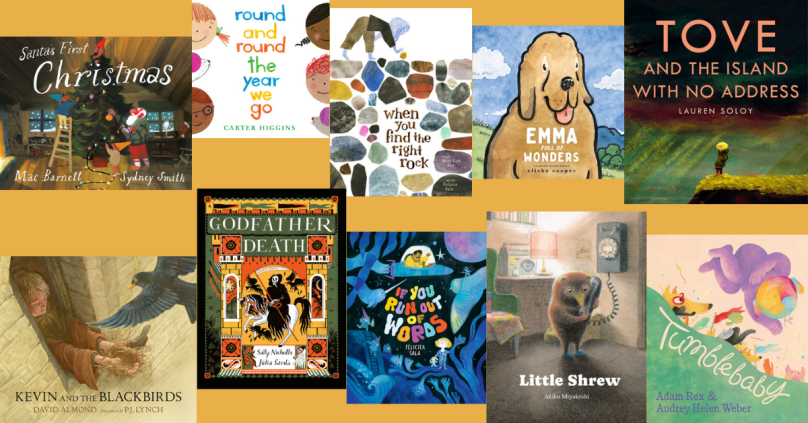
I think Tumblebaby by Adam Rex and Audrey Helen Weber might have won my Caldecott this year. Beautiful, clever, it’s a kind of Wild West In the Night Kitchen. Bracketed by the fundamental love of parents (only partly seen) for their new baby, Tumblebaby tumbles through the world, surrounded by chaos but the imperturbable, happily sleeping Tumblebaby simply tumbles through, an island of smiling snoozing calm, until Tumblebaby tumbles back home in the end. Yes, yes, there are coyotes. Yes, yes, there are bandits. Easily shocked parents will be scared, I’m sure, but this is an absolutely delightful read-aloud, and the refrains have been living in my head, occasionally making my toes tap as I murmur to myself: “Tumblebaby hi, Tumblebaby ho, Tumblebaby fly down the driveway and go…”

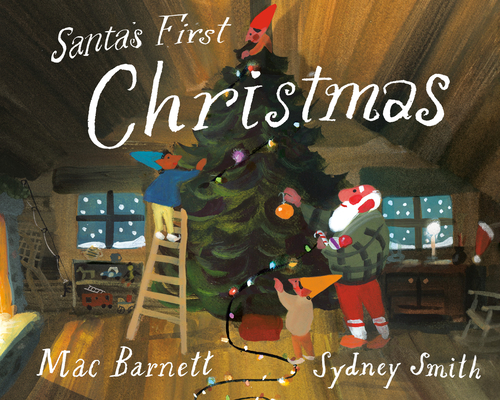
For a perfectly delightful, perfectly delicious read-aloud that will somehow make your room feel cozy, wood-panelled, with a big fireplace and deep chairs, each with a wool blanket on it… Look, I think that even if you’re in a corporate boardroom, the magic would still work for this one: Santa’s First Christmas by Mac Barnett and Sydney Smith is less a story and more a sensory experience. I love the entire premise– the elves make Santa take a day off and celebrate Christmas– but in anyone else’s hands it would have run a very strong risk of becoming arch and oh-so-funny or gooey and saccharine. Only Mac Barnett and Sydney Smith, I think, could have approached it logically, matter-of-factly, and with a warmth and kindness that gave the Christmas feast savoury smells, rich flavours, and both sugar and spice in the desserts. Enjoy this book; there’s nothing quite like it.

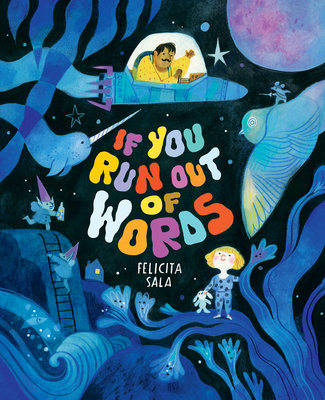
I have two books illustrated by Felicita Sala on this list, and I want to assure you this is not part of some nefarious plot to have the world taken over by Felicita Sala; this is a one-woman enterprise, so any plots are only with myself.

Written and illustrated by Felicita Sala, If You Run Out of Words is yet another fun book to read aloud– this one I’ve tested on groups with great success, but my absolute preference is to read it as the last book before bedtime to a small, cozy child on my knee, whispering the last few words with my cheek pressed against his hair and bringing everything down to a warm hug, a kiss, and transferring him from my knees to his bed. Parents will be pleased with a story about reassuring a child that in a busy world of adults talking to each other on the phone, in person, texting, communicating all the time– no, they will never run out of words for their children. Children, well. A parable: I have a Spriggan in my house who, when he needs me, will ask for “a Once Upon a Time.” And if he’s upset, concerned, or nervous, I will pull him to me and say, “Once upon a time…” and he turns his face up, eager for the story. Children, then, will simply recognize this is another form of that, an “and then what happens, what happens next?” situation. They will love the oddity and adventure.

The other book illustrated by Felicita Sala is written by Mary Lyn Ray, When You Find the Right Rock. I’m impressed by the perfect pairing of artist to text. So, what is it about kids and rocks, by the way? Remember Alfie finding his Bonting, that one rock that fits so perfectly in his hand? And, Canadians, have you seen The Rock Box from Running the Goat? Kids love rocks. And, somehow, they know when a rock is their rock, the rock they connect to. Perhaps an adult looks and says, “That sure is a rock, yes. Um, can we leave it at the park?” Do not try this, I do not recommend it. I have personally experienced the storm of tears, the despair, and the fury of a child told that maybe we should leave the rock outside. Mary Lyn Ray and Felicita Sala get it. And, honestly, at age 37, I’m starting, maybe, to get it, too. Maybe I haven’t found the right rock for myself, but I look at kids holding a rock, and turning it over, or climbing and sitting on a rock, and I just have to smile. They’re warm young things right there with the bones of the earth, after all. Also, Felicita Sala’s art– I know I haven’t said much about it, I’ve focused on the text in these two books. She can make me see the soul of a rock.

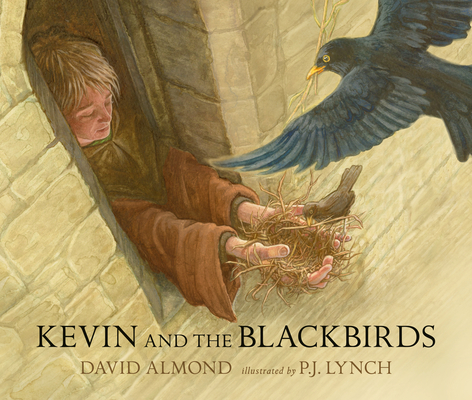
As soon as I saw Kevin and the Blackbirds by David Almond and P.J. Lynch on the Candlewick list, I went for it– well, to be honest I was so excited I clicked too hard in the wrong place and closed the open window and had a brief moment of panic that I’d never get the book now, which is simply not how any of this works. What’s most to love? David Almond is one of my favourite writers for children. He trusts them as readers. One of my favourite books of the 21st century so far is The Woman Who Turned Children Into Birds, and the idea of a story based on the Life of St. Kevin by him, with art by one of the greatest illustrators working today, P.J. Lynch, was thrilling. The story is tender in itself and deeply human. The story is old and very specific to a specific person and place and time. Through that specificity, it somehow encompasses a compassion and love for the world, each other, and for all life which enriches us all. Also, it made me dig up the Latin Vita Sancti Coemgeni because I was eager to see where it came from.

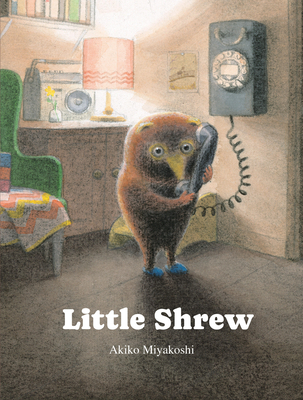
I have been a fan of Akiko Miyakoshi since… Well, this review of The Tea Party in the Woods was published on February 19, 2016. That was a while ago, wasn’t it? I think her mastery of her own form has only improved, and Little Shrew is an absolute exemplification of what Alan Garner talks of when he says the advice he received from his grandfather was never to do what the other feller could do. Only Akiko Miyakoshi could have looked at a shrew and spun this series of stories, so truthful, so humane, and so patently, so obviously, not about a human, but about a shrew. The logic of each story is perfect, internal to the book, and her art is so exquisite I fell in love with her tiny shrew with the successfully solved Rubik’s Cube. The lines capture both texture and love. Akiko Miyakoshi loves her shrew, we can tell, and so do we.

Sally Nicholls is an exciting new discovery for me. Her retelling of Godfather Death with art by Júlia Sardà is reminiscent of the best kind of storytelling, it has personal voice and character, and is absolutely uncompromising. You can’t have a story like Godfather Death, an old folktale of the most exploratory kind, the type where you feel the storyteller puzzling through every question people have asked about injustice, death, poverty, and human suffering. It has a sardonic side, but it’s not cynical. It has a rough and biting edge, but it’s full of pain and sympathy. And, against all odds, it has great warmth and humour alongside the sadness. The art by Júlia Sardà is utterly perfect: it recalls to me Mary Azarian, Wanda Gág, and Barbara Cooney, but the painterliness is entirely Júlia Sardà.

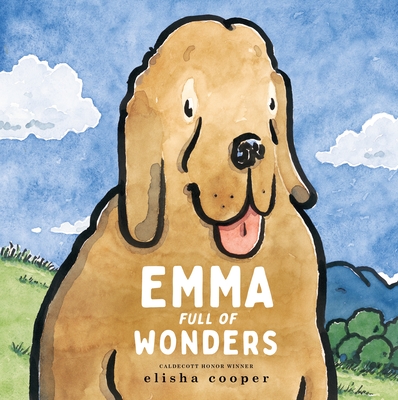
As if this weren’t already enough, I have already reviewed Tove and the Island with No Address, Emma Full of Wonders, and Round and Round the Year We Go and those links will bring you right back to the reasons why they’re good, but don’t you just trust me by now? That should all give you plenty to work with for the time being, so, in the words of Nanty Solo: Go on! Be happy. Off you fly.

Where have I been? NCTE report.

In case you were wondering: Yes, books have come out. I do, in fact, have thoughts about them. But I’ve spent more time thinking than writing lately, and some of that time was spent, usefully and delightfully, at NCTE at the end of November.

My husband is a brilliant man; this is a topic on which I feel that I’m clear-sighted and unbiased. The only people I know who are, in truth, brighter and more brilliant and more beautiful than he is are our children. And my husband said, after I’d complained yet again about something I’d read that seemed half-baked and unintelligent to me, that, in a nutshell, we need to spend more time, as a society, thinking than talking. Discourse about discourse in reaction to discourse is just too much.

That might be why I’m spending a bit more time thinking about the books than writing them up, lately, though some do get mentions in my letters to Lucy over at Twenty-Two Cups of Tea. But I also found a lot to think about at NCTE, and had plenty to talk about with other bright and practical-minded folks.

If you’ve never seen the Boston Convention Center, the place is massive, unfriendly, concrete, and, well. A convention center. If the modern trends of what is hygge and cozy and “extra” had a polar opposite, it would be the Boston Convention Center. I walked in on November 21, apprehensively rehearsing to myself that I really, truly was an English teacher (of my daughter, but still) and editor and reviewer and belonged here. And found myself facing a brisk crowd of people with glasses and sweaters, often plopping themselves down on the dull, industrial carpeting with highlighters and post-it notes to hand as they cross-referenced the literacy exam that was the huge honking convention program. These, my friends and readers, were English teachers. This was, as the kids may once have said and may still say for all I know, this was my jam. These were sensible people in sensible shoes carrying pens and highlighters. My soul swelled in the consciousness that pretty much everyone here either had a cat or liked cats, a conviction shortly proved by the three people in a row who said they either liked my dress because it was patterned with books and cats, or had this dress at home and almost wore it today, but decided on pants instead.

The only problem was that giant conference program. The place was full of sessions for teachers, and Friday there would be the exhibition hall, where I planned to poke my nose around and talk to publicists about books. Thursday I would talk to teachers, and Friday to authors and publishers. Very well, but… This place was huge.

I did the only reasonable thing. I opened the book at random and jabbed a finger. The session I landed on was about teaching literacy supported by museum visits. I had nothing better to do, and went.

I am not and probably will never be a classroom teacher again. I never was an elementary school teacher. I wish these people were my teachers, and I am so glad– so glad– this country has such a wealth of dedicated teachers who bustle like these people were doing to figure out how to do the best they can with as few resources as possible for the kids they’re teaching. The keynote of every session I was in was how to give as much literacy support as possible for as diverse a population of learners as possible. The kids discussed were frequently disadvantaged or marginalized, but the growing recognition that diverse learning needs cross every which way was pretty neat to see. And one thing that struck me powerfully was that many of the people whose sessions I attended were simply teachers from districts in, say, Bridgeport, Connecticut, not super well to do, but they’d figured out a method that worked for giving students a focal point for observation and writing about a museum artefact. It worked repeatedly, and they wanted to share. They had handouts showing what they used with their groups. They offered to share printouts and resources.

Friday was my day with the publishing folks, people I know better, but that Thursday with teachers is going to live with me for a while. The few times I mentioned rather humbly that, “No, I only have one student because I homeschool my daughter,” not a single teacher let me get away with it. “That’s teaching,” was the brisk reply.

To give an idea of the single-minded focus these teachers had on using anything and everything at this conference to the benefit of their students, I will tell you another thing about the creature comforts of the conference hall. There was a snack bar. It did not, as it were, have people there except confused teachers wondering if it was worth it to pay $4 for a bottle of Aquafina water and how on earth you did that, anyway? To get in, you scanned a credit card and hoped the Convention Center didn’t take your entire income. The gate shuddered and let you in. You walked around and realized the place contained nothing potable or edible you dared consume except that $4 Aquafina. Uncertain, you pick up the bottle and look for how to pay and leave. At that point I decided to cease dissociating, use the first person, and, timidly, ask someone else how the hell to get out with the water and without getting arrested for theft. The young teachers I was speaking to pointed up, “See the creepy cameras?” “Oooh we’re in a dystopia!” I replied, light dawning. “Yes,” the young woman agreed, “this is my new object lesson for when I teach Fahrenheit 451, and the cameras track what we get and charge us when we leave!” I nodded, agreeing it would be a good contribution to the class, and suggested she get some pictures to show the class. “Oooh, good call,” and she whipped out her phone.

We may be entering a new Pandemonium, but, thankfully, we have a wonderfully committed set of teachers working to make sure we have the context clues and skills to identify what’s going on and describe it.

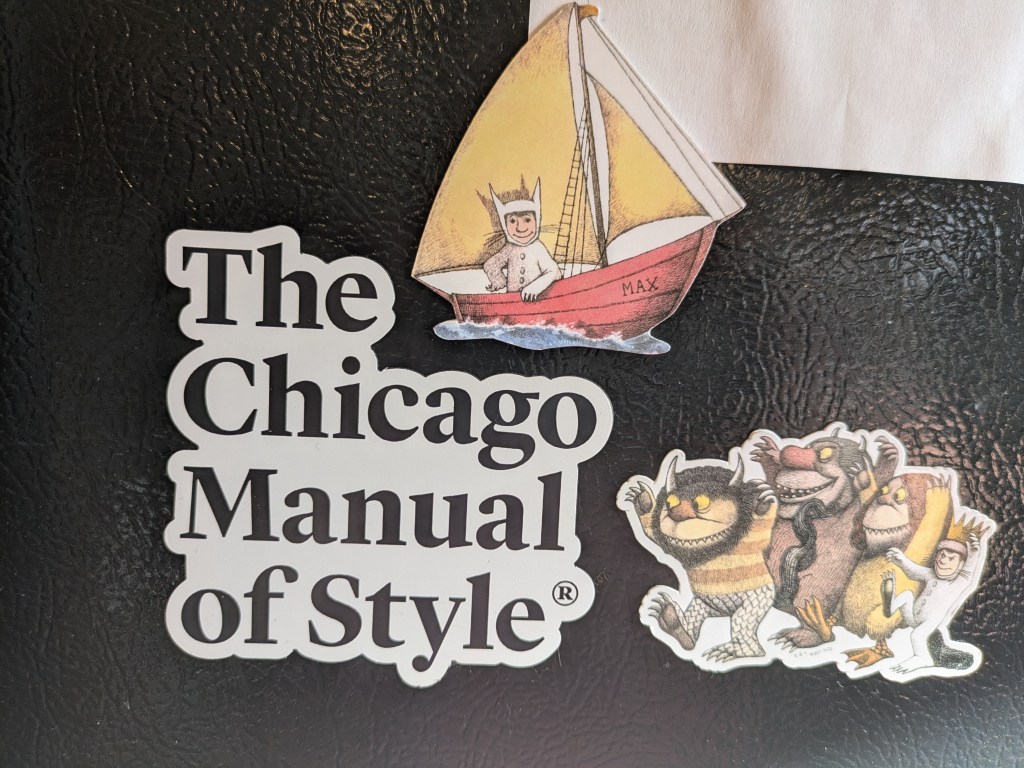
When I came back on Friday (different dress, but also cats and books) I was headed into the exhibit space, and this was a more diverse crowd. When I say diverse, I do not mean in terms of anything except “not just teachers.” Editors, teachers, publicists, authors, illustrators, publishers– and I have no idea who I am, but I was there, too. I am the kind of person who was so deeply offended that the ALA was on my conference lanyard that my first stop was at the Chicago Manual of Style booth to show my support but really, mostly, to get my hands on the fancy new edition and look at it in person. Who am I? I’m the person whose fridge looks like this:

I saw a lot of books. And people. And I can tell you, now, that there are a few books to look forward to. I got ARCs for two books I’d desperately hoped to read early, Grace Lin’s The Gate, the Girl, and the Dragon, and Brian Selznick’s Run Away With Me, which is so brilliant I wept at the end. I haven’t gotten the Grace Lin back yet. I had to give it to my daughter right away as compensation for– I’ll tell you later. I got to see Kyle Lukoff again, always a pleasure. Kyle– a writer who knows how to write, and who cares about his readers. What a mensch.

And I had one moment of enormous, fangirling embarrassment. We all know how I feel about Elisha Cooper. If there is a picture book inheritor to the tradition of E.B. White, that’s Elisha Cooper. And I saw a sticker on Emma Full of Wonders saying “Meet the Author!” I asked the lovely, lovely person at Macmillan if he was at the conference then. “He sent me a panda!” I told her. She answered, “Oh, that’s so nice,” as though I had uttered a reasonable sentence. And she checked a schedule and said, “He’s coming out of room [I forget the number] in ten minutes, I bet you could make it and catch him on the way out.” I took that as permission to run pell-mell across a conference centre and see him coming out and say, “Elisha Cooper! You sent me a PANDA!” He is, I tell you this, the most calm and gracious person the world has met, took a look at my conference badge, and said, “Oh! I do know you!” which, considering what he previously knew was that I was a name presumably attached to a person who reads his books to my kids– that was generous. And we had a lovely chat and shook hands and I floated on a cloud back to the exhibition hall thinking what a nice man he is.

Look, this was a huge conference. I may have written out my bewilderment above, but I’m an experienced reader and academic and I know conferences well. There were so many sessions that I was really lucky, honestly, to have the background to be able to scan with eyes that know and choose, correctly, which were the ones I would find the most useful. Certainly, every conference of this range has a lot of crap. And publishing is the same; many books have not reached their final, perfect form, before they’re published. Others are stellar.

I looked at the conference with eyes that sought good material and good books and good people. It was, at this season and in this time, absolutely marvellous and inspiring to find so much that is worthwhile– so many people working for literacy and aspiring to excellence.

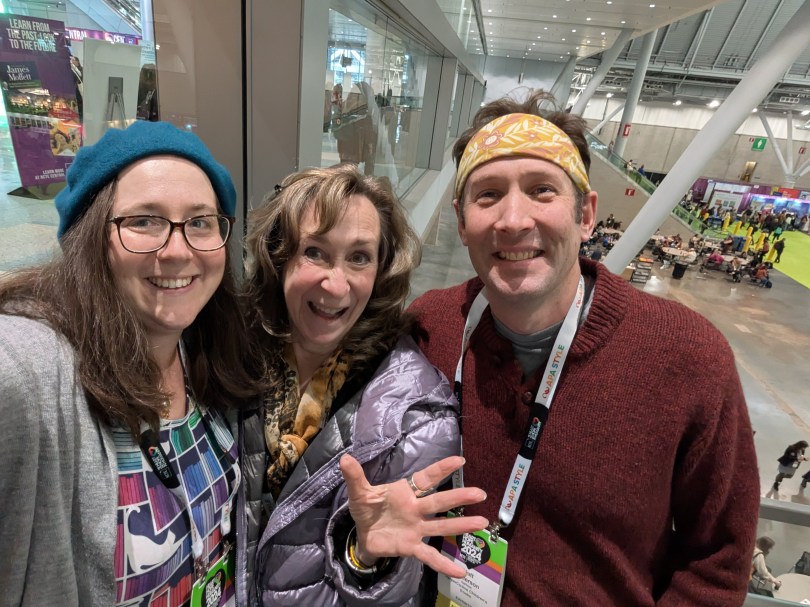
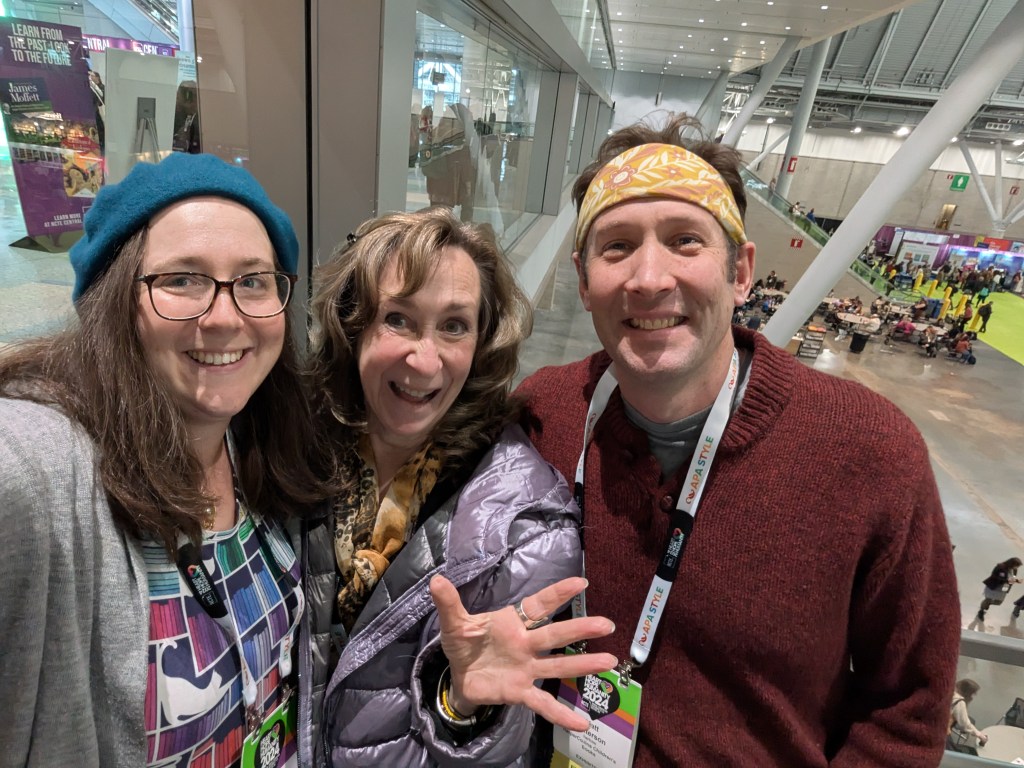
And this was the crowning moment for me. I had to leave early, for Shabbat (and telling people that– I was met only with “Oh, of course! Shabbat shalom! You know, this is something we were keeping for Saturday– take it early, ok?”), and on the way out I saw a woman whose hair I knew and beside her a bandana– was that really Sy Montgomery, my daughter’s hero, with Matt Patterson, the brilliant illustrator who worked with her on Of Time and Turtles? She felt my look and saw my badge: “You can’t be– are you– you ARE! You’re [daughter’s name]’s mother!” And then she made sure I got a photo– the only photo I think I have of people rather than books from that conference.

Between Elisha Cooper’s “I do know you!” and Sy Montgomery recognizing me through my brilliant, ferociously competent, and wildly talented daughter, I don’t think I’ve ever felt prouder or more recognized in a place where I started off so timid.

Well, I’m hoping to get out a “books I loved from 2024.” I need to talk about my beloved Tumblebaby and about Little Shrew. I need to talk about Kevin and the Blackbirds and absolutely everything Felicita Sala did this year, especially If You Run Out of Words. But if not, I want you to know that sometimes we need to dig a bit. Sort through a big conference with eyes focused on finding the kernel the Nutcracker is getting to (sorry, very Nutcracker focused in this house right now), but it’s ever so worth it to find what you’re looking for. And did I find it? I did. I found people who cared about books and literacy and kids, and that’s pretty good. They liked cats, too.

O Rose thou art sick

In the only article I allowed myself to read today, Tom Nichols of The Atlantic writes, “If I may invoke Winston Churchill, this is not the end or the beginning of the end; it is the end of the beginning.” Of course he’s correct. Complacency, despair, defeatism, and useless alarm are all acts of cowardice, and we can’t allow them to take root. However tempting. Likewise, he briskly lists a number of places people are likely to point fingers (and do so correctly), but adds that “as always, the power to stop Trump rested with American voters at the ballot box, and blaming others is a pointless exercise.”

He might have continued, but didn’t, that we ended up with this result because enough voters wanted that result. We had article after article before the election with titles like “How Is It This Close?” and the obvious answer is that people were looking at the ballot and making a terrible, terrible choice. Tom Nichols gives a strong, thoughtful, and intelligent argument for where to take things from here, and we can all get to that in an hour or two. For now, I’m left thinking:

O America thou art sick.

We’ve let in all the loathsomeness that came with Trump, and here we are. He hardly needed to campaign. We will have post-mortem after post-mortem full of finger-pointing and “what if” and “if only,” but the plain fact that the inflamed American imagination, full of fear and the desire to cast blame was awakened by this worm whose loathsomeness is destroying the American life is unlikely to make it into those articles. And yet that’s what happened at the ballot box, and that’s what so many voted for. The journalistic urge is to shy away and say, “Oh, we can’t say ‘people are just that bad, I guess,'” but people looked at 2016, at 2020, and at the ballot in 2024 and said, “Why, yes. I shall, indeed, vote for a convicted felon and abuser who with a passion for dictators and a deep-seated loathing for women and minorities.” No matter how you blinker yourself as you go to your writing, that’s what the people chose.

Are people that bad, though? I mean, if the country is that sick, is there a cure? Or should we just curl up in the aforementioned despair, defeatism, and alarm Tom Nichols warns against?

No! While we are absolutely that bad, because we did this and we’re responsible, that is exactly why we have to get up and clean up the mess we made. The precise danger is in complacency and useless alarm and finger-pointing blame. Give over those post-mortems right now, and just say, “We really messed up.”

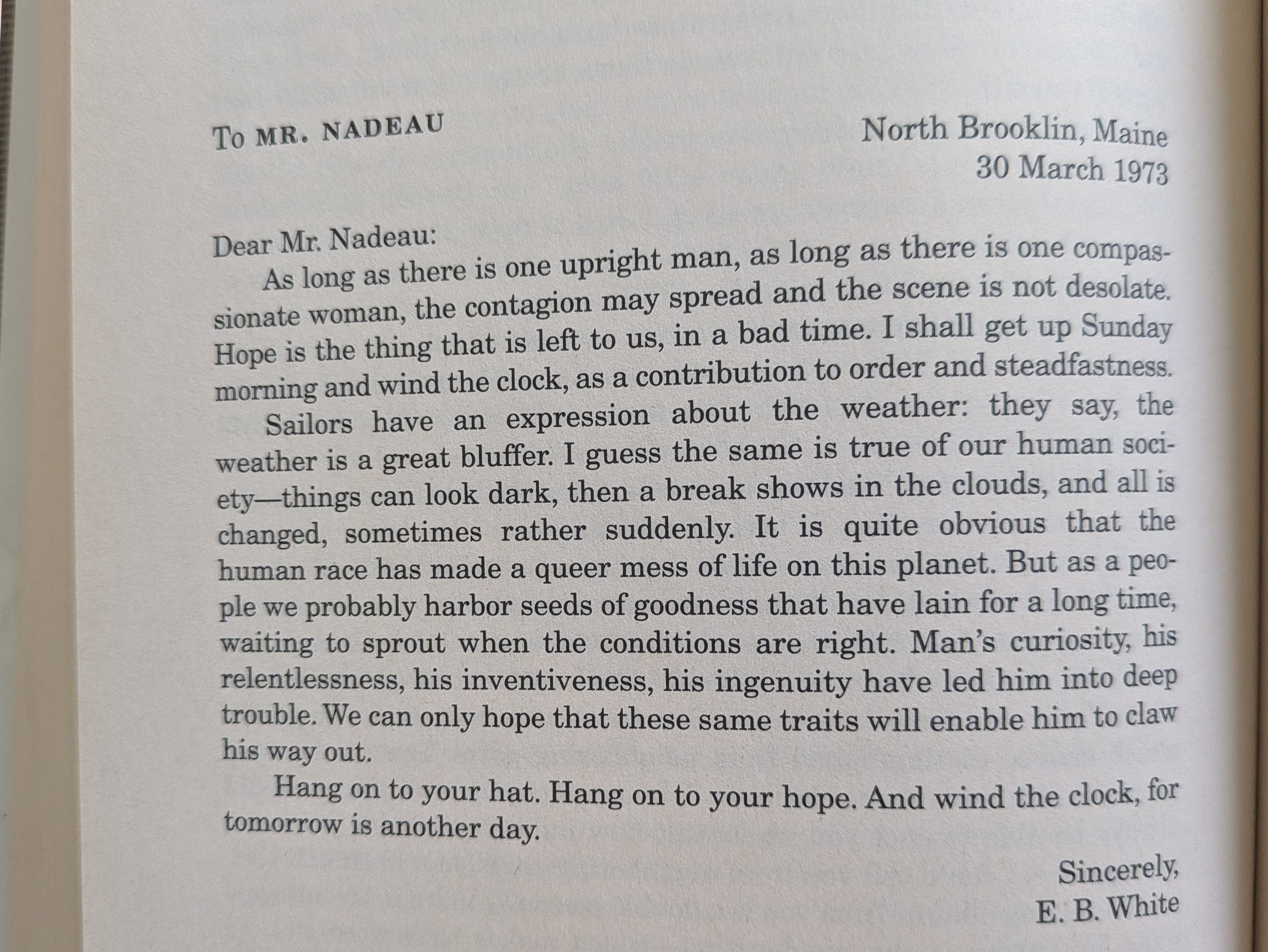
Not so long ago, I was pushed into the ludicrous position of defending American literature. I am not a fan, really. I do have my loves: Walt Whitman, Nathaniel Hawthorne, Herman Melville. But overall, as I told my correspondent, I feel that American literature suffers from a soul which is fearful of exposure. The answer, I told him, was in E.B. White, a writer of essays, but also books for children. I told him:

E.B. White was a man who wrote love letters to his wife in the office, who wanted to be certain that he expressed his trust and confidence in her and, fearing he’d muck it up by speaking wrong, would write it out plainly, simply, and sincerely. He was honest about his struggles and forthright about his principles and views. He was passionate about beauty and poetry and, as he employed precision in language to express the nebulous plainly, championed a similar precision overall. He wrote a perfect book, Stuart Little, which ends wistfully but hopefully, mid-quest, as Stuart continues his search for Margalo, the bird he loves for her purity and beauty. He was bombarded for years by concerned readers desperate to know how it ended, not realizing that the quest was the point, that the book ended perfectly. Seeking beauty is an end in its own right, and E.B. White understood this so perfectly he didn’t feel the need to explain it. He just wrote it and did it, all his life.

E.B. White is not bombastic, and he doesn’t give up, and he takes responsibility for his own wrong actions when he acts wrongly. Steadily. This is the spirit of America we need now. Someone who apologizes readily and has no trouble opening his soul because he’s confident in who he is. This is not what we have chosen. But neither are we allowed to give up, because it’s up to us.

E.B. White wrote truly. Our relentlessness and curiosity have led us astray. But if we can own up to our mess, we can, I hope and I trust, pull ourselves up, and save ourselves from worse damage to each other, to the planet, and to the country.

But I do think that honesty is the first step.

We messed up. Americans messed up because, simply put, too many among us gave in to our pettiest selves and chose wrongly at the polls.

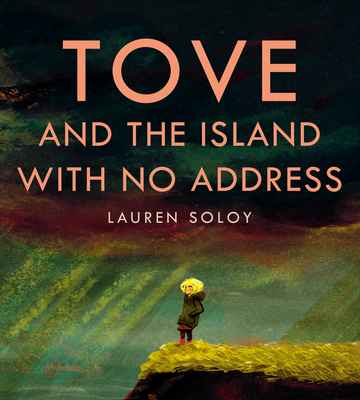
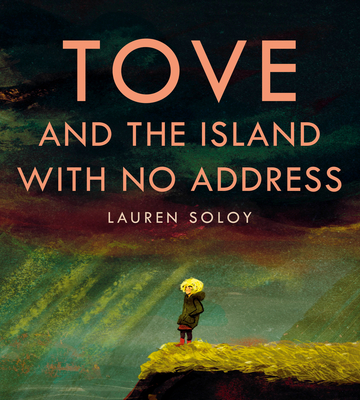
Tove and the Island with No Address

I’ve talked about Lauren Soloy rather a lot. If you listened to me right here, you already know about Tove and the Island with No Address because you pre-ordered it. And if you did, you have the book in hand, and you probably know what I’m thinking and feeling right now, which is, “What a beautiful, what a pleasing, book. What a satisfying, viscerally fulfilling, and sensory book. How on earth am I supposed to convey this to anyone?”

Let’s start with the probably category this book would be labelled as. It’s probably considered a “picture book biography.” Which is an iffy category, at best. Properly, it shouldn’t be. There are two kinds of books, of any books: Ones that are good (or achieve their potential) and ones that are not so good (or don’t achieve their potential). But there are certain types I approach with caution. I don’t mean ones like, say, romance novels, which can surely be fun and I’ve enjoyed thoroughly on occasion but it’s just not my thing for regular reading. Rather, I feel extra cautious around categories of books that, on a regular basis, I find fail to achieve their potential. A few groups I approach with extreme caution are ones listed for “social-emotional learning” and, yes, “picture book biographies.”

The problem is this. A good book needs a good narrative of some kind. That doesn’t mean it necessarily needs a perfect story arc. Freight Train, Circle Under Berry, and Le Chandail de hockey (The Hockey Sweater in English) are all books that have tricky to identify or unconventional plots. But there has to be some kind of inner cohesion to pull the book together in a tight, unified package, particularly if you want it to exceed those bounds with the explosiveness of a book that opens a portal of experience to whole new worlds beyond the space of the exquisitely smally parcel of words you set down. For example. Not that I have high standards.

You will not get boundary-pushing largeness without surgical precision in the conception and execution. It doesn’t happen.*

The problem picture book biographies face is that the trajectory the authors and illustrators often give themselves is dual: 1) the span of the subject’s life, and 2) the importance of their career. This doubleness isn’t insurmountable; in fact, it’s the same doubleness that adult biographers face and they manage it all the time. The only trouble is that it’s usually boring, likewise a trouble adult biographers face. But why would you want a shrunk down version of the life of Vladimir Putin in 32 heavily illustrated pages? To use a more appealing example, since Lauren Soloy helpfully handled these, why would you want that for Charles Darwin or Emily Carr, or Tove Jansson? They all did a lot and those details are better served in larger form. That’s not the job of a picture book, though.

If you want to give a four-year-old a lesson about Charles Darwin or Emily Carr, take the kid to the zoo or an art gallery and talk to them, listen to them, ask them questions, and listen to their answers. (For a beautiful example of having a serious and thoughtful conversation with your kid in an exquisitely rendered story which is enjoyable to read with a child, I commend you to Etty Darwin and the Four Pebble Problem, by Lauren Soloy.) If you want to read them a story, read them a story. None of Lauren’s books abovementioned will teach your child the entire history of the people in question. But they do encapsulate something particularly, keenly beautiful about them which will resonate with any reader. It will spark a feeling, a memory of an experience, or a vivid urge to experience.

“How many greens do you see?” I ask the Spriggan when we read When Emily Was Small. We count and finally he laughs and holds up his hands to the sky: “SO MANY! It’s twenty green!” (Twenty means “an unthinkably large quantity.”)

When we read Tove, I ask him what he thinks of the little girls, and so far I get different answers all the time, depending on his mood. Sometimes they’re very naughty and he wouldn’t want to play with them because they make him shy. Sometimes he thinks they’re pretty exciting. He always wants to explore the island, though, because of the myriad critters Tove doesn’t stop to see but are all around her on her excursion.

If you know anything at all about Tove Jansson and her writing, then you know that this reaction feels right for her. That this is an avenue she would be pretty peachy pleased about, and that if a kid felt like that when reading a story, she’d be pleased exactly as it was. And, therefore, I have no hesitation in thinking that she’d be thrilled that this book came from her and her story, out into the world as a Tove-adjacent book. It introduces the idea of Tove Jansson-style love of the wide wildness of an island with no name, the limits of the island only bursting the bounds of the possible, just like a tiny parcel of exquisite text can explode the boundaries of the imagination. Tove Jansson would love to know this book thought of her, and that kids reading this book today will, surely, hold one of her books tightly in hand while running across and island with no name tomorrow.

* This footnote is a holding place for the inevitable exception I think of later.**

**No, I still can’t think of one. I truly think that precision is simply necessary, I suppose. We’ll see if an exception crops up with time.

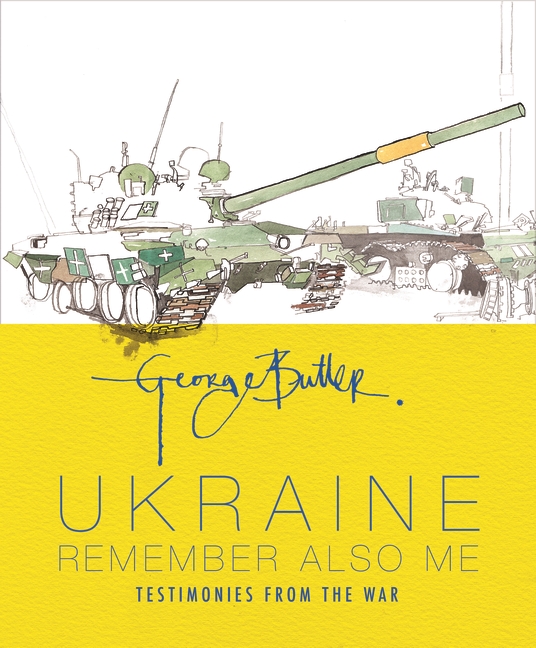
Ukraine: Remember Also Me

It happens sometimes that I receive a book for review that, for whatever reason, I might love but I hesitate over the audience. One of my go to examples, though I didn’t receive a review copy, I simply bought it repeatedly, enthusiastically, and of my own free will, is A Child of Books. I have no idea what age of child that book was for, lovely as it is. But this book, Ukraine: Remember Also Me, by George Butler (to be released October 1, 2024) strikes me as never having been for a child, though published by Walker in the UK and Candlewick in the USA. To be clear: I do not criticize the publishers or the author-illustrator, George Butler, on this point. The book is clear and succinct, crisp in its diction, unflinching in its text and art. These are all good traits for a YA text. But all of those characteristics are also good for A without the Y. This is part of a bigger conversation about the puzzling categorization of books by age– but also about what we’re willing to publish for whom.

I have not seen a really good book like this for adults, and, frankly, I’m not in the least disappointed in Candlewick or Walker for publishing it for kids, I’m grateful they did; I’m irritated that I haven’t seen this for adults. Or much else, really. I recall early in the war, as Putin’s Russia invaded Ukraine– I remember watching the panicked news coverage and sharing with friends the stupefied feeling that “you can’t just do that anymore… can you?” Of course, the fact is that Putin was doing it, but we all knew it was wrong. And the stories of real people collected in this book indicate that a whole lot has happened to real people there while many of us stopped paying attention in a stupefied panic because we had things that we needed to do, and a whole lot of that was also worthy of the response “you can’t just do that, that’s wrong.” But, on the whole, while diplomatic efforts in the USA have not ceased, the public attention has waned, considerably.

And, no, I have not seen much of what’s in this book elsewhere, even though I do try to keep up with the news from Ukraine, and I’m frankly concerned that this excellent, necessary book, being on a children’s list, which means adults are doing the buying with children in mind rather than with adults in mind– and we’re so careful about what we buy for kids, we clodderheaded adults!– well, it makes me concerned that adults aren’t going to buy this for themselves or for other adults. And, if we’re grimly honest, it’s we clodderheaded adults, we who can’t keep focus on a major, autocratic power invading a neighbouring democracy (speaking as a Canadian and American, I will note that Ukraine is a very important ally, as well), we just can’t do it.

And, maybe, just maybe, if we look at the stories of real people who have suffered brutally from serious war crimes over there, and if we can recall the dangers of the loss of democratic rights, we’ll pay a little more attention.

Yes, I understand that there is always a lot to pay attention to in the world. I, too, have a massive laundry problem and my kitchen will not stay clean. I homeschool one child and the other child is a bundle of energy, ballet, and “reactive airways.” And the world is so very full of problems. How can we care about them all? What, after all, can we do but see what’s in front os us right now?

The answer is simple: Everything is very complicated and none of us will ever do everything right. Nonsense! When did we ever start to expect perfection, simplicity, and completeness? I am a Jew, and I recognize full well that I will never fully understand the words of the Torah I strive to adhere to. I am an academic, and I still find myself puzzling over the same texts which form the basis of my PhD dissertation. I am a mother, and my children surprise me daily with ingredients I’m damned sure I didn’t put into them even though I gave birth to them and have raised them ever since. Why should we expect to be able to understand or solve every problem?

But I want to point out something from George Butler’s Introduction which I highly doubt was intentional, yet struck me with enormous force. “However,” he writes, “the themes are not specific to Ukraine. […] These are experiences shared by others I have met in Gaza and Syria, Yemen and Myanmar.” NB: before anyone shouts, George Butler was in Gaza in 2016, and I’m presuming he’s referring to that time. And, as I write that, I have to smile at the twist here– I already anticipate within that sentence that Ukraine will fade from readers’ notice, readers who are adults not children, because the word “Gaza” appeared. And I didn’t in the least want to bring that up– I wanted to point out that something else in there is interesting. He lists countries and conflicts, but the country name not mentioned is Russia. And yet Russia has a hand in all of those bloody conflicts, whether directly or in allyship with Iran. In that list, in those areas where Russia is quite interested, destabilization of democracy is the baseline, and a leitmotif is brutality.

No, I’m not here to write about how we should all hate Russia, cancel Russians, or throw out Russian art. I have zero interest in any of that. All I am noting is that by sheer power of distraction, of allowing our attention to be misdirected and our focus to be swerved, we can miss a lot of context, lose track of the themes, and, worst of all, forget our own humanity and that of others. By way of illustration, let me share one of the stories in this volume.

In Bucha, a horrific scene took place with many civilians killed in the streets or even shot through windows if movement was seen, and this story is of Mariia (age 76) and her son Oleksandr (51). Mariia’s other son, Oleksandr’s brother, Dima, was killed on his own doorstep. Initially they didn’t dare bring his body in to be cleaned and then buried, lest they also be killed, and then the people hiding in their basement begged them to leave the body there because a dead body outside was protection; the Russian soldiers saw it and didn’t go check for other people to kill. “Dima was a sacrifice and he protected them,” Mariia said.

A few days later, when the situation was calmer and it was safer to walk out, they took him in to be cleaned and then asked for permission to bury him. One helped Mariia dig the grave. Oleksandr: “Mariia spoke to them but I refused to talk to them.”

Mariia said, “There was only one of the Russian soldiers who talked to the people here. He was a young man from Siberia, which is far from here. He answered our questions. He said that he hadn’t known they were coming to Ukraine, to the war, but he thought that they were going to military training. He seemed surprised. But people asked him, ‘Did you see how many people you killed? This is not training.’ And he just didn’t respond.”

An imagination is a curse, and clear and cogent reporting is unquenchable. George Butler’s art speaks more than a photograph can, and these words straight from a mother and a brother say yet more. I can see, as I read, as I look at the art, the people and their loss. And I can see, too, the young Siberian soldier, confused and, as I imagine it, only beginning to realize the level of trauma he’s going to have to live with for the entire rest of his life, trauma stemming from the undeniable knowledge of what he’s done, of the trauma he’s inflicted on others.

And I wonder, again, why this is a children’s book, YA? And I think it’s far too complex for we clodderheaded adults and we’re too scared to face it. Only children’s publishers, Walker and Candlewick, had the courage. All I can hope is that, if you’re an adult who read this far, I may have persuaded you, challenged you, to read it and share it with other adults.

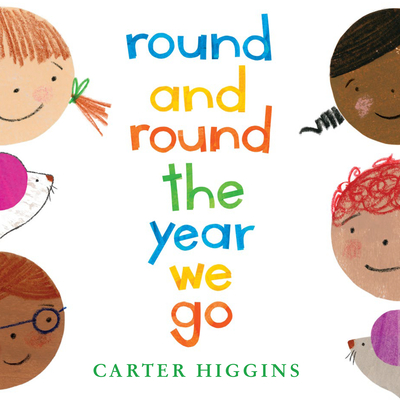
Round and Round the Year We Go

Years and years ago, when I was young and the first universities were burgeoning in Paris necessitating the development of the first form of mass manuscript production, called the pecia system– my very, very dear friend got married to a lovely man and, even though the wedding was on a Saturday and I, being Jewish, wasn’t to be relied on as a bridesmaid, she made me an honorary bridesmaid, including me in everything, because she’s wonderful like that. And as an honorary bridesmaid gift she gave me a copy of Elizabeth Zimmerman’s The Knitter’s Almanac, a beautiful book, and meaningful because she was the friend who taught me to knit. And in that book, that treats the knitter’s year as a Round and Round in its own right, it says of September that “September is the logical beginning of the year.”

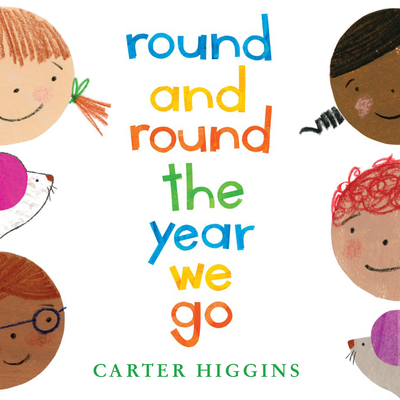
So, even though Carter Higgins’s new book, Round and Round the Year We Go, as logic dictates, begins in January and ends in December, it feels logical to me that it’s out in September, with an event this Friday, September 20 at Politics and Prose in DC– go go go if you’re in the area! And if you’re not in the area, you can do what I did and pre-order a signed copy here. And do I recommend that? Yes, I absolutely do, because that would make your little munchkin a lovely gift. It would also, by the way, make any pre-school or kindergarten teacher really, really happy for a beginning of school “thank you for getting this year off to a good start” gift, if you want to send them over the moon, or, if you’re the planning ahead sort? This is an ideal end of semester gift, something they might really use when starting back up in January. Just saying.

But it feels perfect, somehow, to see it out in September. It’s logical, perfect, and intuitive. As intuitive as each page in the book, as each turn of phrase or art.

I think my Spriggan has really grown up with a Carter Higgins book for each stage of his life. First, we got Circle Under Berry, a lovely rhythmic book that feels like you’re moving coloured block shapes or cutouts into patterns and chatting about them with your munchkin, except the book does it in a way that grows increasingly dynamic, fun, and clever, to both of you at the same time, inspiring giggles and chat along the way. The text is both conversational and lilting– perfect line flowing after perfect line with each page turn. I wondered how Some of These Are Snails would follow that act, and it somehow did, climbing in terms of what the cognitively developing toddler could handle, but without sacrificing the simplicity of form from Circle Under Berry.

Now, my Spriggan has colours under his belt, and is a fan of shapes– but tenses and time are the new puzzle. What, exactly, does “yesterday” mean and what do those names of months mean? What’s a January? It feels like only a month ago that “yesterday” was “any time in the past, generally” and “tomorrow” was “at some point in the future.” Now, in the past week or so, we’ve made another leap: “Once upon a time” refers to the far, far distant past, when once upon a time he had actual marshmallows to eat, oh those halcyon days of yore! Whereas “yesterday” is the more immediate past, when he was at daycare and was playing in the tent with his friends.

And, once again, Carter Higgins hit the nail on the head in terms of the right voice, the playful simplicity of shape and form, for this age. Some things are different: we see children playing in the illustrations, and instead of the lilting prose we have real poetry. But, still, she’s somehow keeping perfectly in synch with my Spriggan’s cognitive development (no, I do not think that’s actually on her work calendar, it’s just serendipity, but let me have this moment of glee): this is the next book his conceptual mind wanted.

But, oh my readers, oh my friends, this is what I want to tell you about this book, so hear me, hear me clearly: The poetry in this book is actually good. I anticipate that people who look at the book instead of finding the nearest kid and reading to them may be confused since the layout of the text doesn’t give away a dull iambic stanza form. It’s creative in its simplicity, like all of her wonderful books. So this book is not for a flip through in the shop, and not for a silent read; it’s for a lap or a classroom, and for that it’s ideal. As soon as a kid giggles, interrupts to repeat words or syllables after you, or excitedly tells you about what they’re going to do for Hallowe’en? The book will immediately become a favourite to you. That’s when you know you’ve got the pre-school/kindergarten hit.

And it’s oh so perfectly logical in art and text– read this out loud:

maybe hazy
maybe hot
maybe chilly
maybe not

Do you hear it? Do you? Trochaic dimeter, where the second and fourth lines, rhyming, are catalectic, meaning that the unstressed foot has been dropped to give it an extra bit of force? Oh, it’s beautiful, beautiful! The overuse of the iamb in children’s books is going to be the topic of my rant to be published in The Atlantic on the first page as soon as I can get the laundry under control and write it up. The title will be this: METRE MATTERS

Rhyme is secondary, in a kid’s book, to metre, but it is not unimportant. And what you’ll notice in Round and Round the Year We Go is that for each month the form of the rhyme shifts, because, and I didn’t quite pick up on this one until I inadvertently bothered the editor of the book (who was super sweet about me thinking I’d written to Carter Higgins, who is just the loveliest person, but I had not and was very embarrassed to be badgering a person I’d never spoken to before!), and she mentioned that they’d worked on basing the rhyme around assonance with the name of the month. A fascinating concept! It gives each month a distinct form, of course, because each month’s name varies in syllabic and accentual construction, of course– January vs May. Yes, that’s all very technical, and I highly doubt that Carter Higgins was pacing her study muttering “Auuu-gust, Auuu-gust… A trochee, after the iambic Ju-LY! But the key will be a short o sound…” And yet, not only did she do that (not just short o, also a short i– I would never have thought of that, but it works brilliantly)– but she seems to have realized that by cleverly dodging a strict rhyme and adhering to a combination of assonance and metre, she could get to the heart of August best… through some delightfully, playfully grouchy superlatives: longest, hottest, and the delicious coinage wrongest. They aren’t really, strictly, perfectly rhyming, but they feel like double rhymes, they do, and the vocalic echoes and the added nasal element of “ng” evoke the dull, sticky dregs of August in a way I’ve never seen done elsewhere.

I am utterly delighted with this book. So is the Spriggan, giggling and jabbing a finger at each page, chatting with the seasons and feeling the turn of the year in his mind and on his tongue as he develops a sense of his place in the cycle of the seasons.

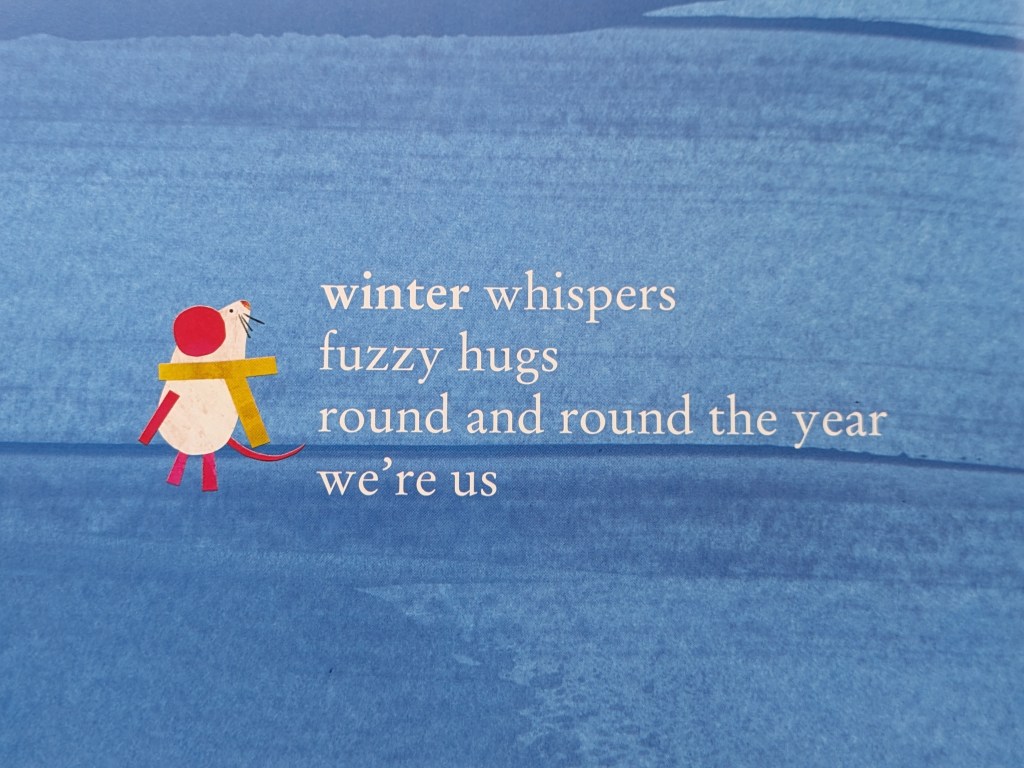
Oh, and did I mention the mouse? I didn’t? Oh– I will leave you only with this, and with a strict injunction to get yourself a copy, or request it from your library, before…

Elisha Cooper: Simple praises

Note that all links to Elisha Cooper’s books below will be to signed copies available at the Eric Carle Museum book shop, both because that place is lovely and because his signed copies are just so very lovely. He often doodles.

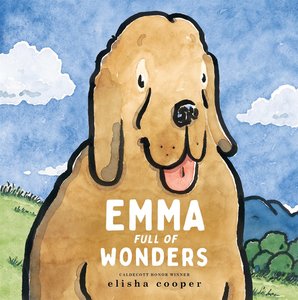
I’ve been wanting to write a review of Emma Full of Wonders since it was released, at the very least. Actually, I knew I’d want to review it before it was released, even though I hadn’t seen it. Elisha Cooper is that kind of writer, that kind of artist, that kind of creator. And, really, that kind of human being. The man sent me a postcard for Emma Full of Wonders even though (and I’m not fishing here, I’m not much for any outdoor sports) I’m not the kind of reviewer you need to woo for a book’s success. He’s simply that kind of person; the kind who, even though I’ve never met him in person, has impressed me with his humanity.

Now, I’ve been reading, in a desultory kind of way, The Letters of E.B. White, and since the Spriggan is on a passionate quest to get me to read every book by Elisha Cooper until the words and images are mutually imprinted on our inner landscapes in indelible lines and watercolours (I have no objection), I wondered whether my association of the two was just me, or have others noticed it, too? A Google search revealed, first, the true reason why I haven’t reviewed Emma Full of Wonders quite yet: Betsy Bird’s interview honestly does everything I may have wanted to. She’s so wonderful as an interviewer and reviewer I just think we’re lucky to have her. And then it turned out the mention of E.B. White Google was handing to me– was Elisha Cooper sharing a quote from him. I can’t find an older and wiser reviewer making the association, so it may all be in my head, but there it is.

And yet I still think there’s a writerly kinship there. At first I thought it was the succinctness of language, “Never a word wasted,” I said, either to my husband or myself. I did so much muttering I can’t recall what I said to whom. Then my mind brought up the much-referenced line from Strunk and, of course, White, regarding omitting or cutting or– well. Excising, in some sense, unnecessary words. As my own mind searched for le mot juste, it hit me, after quite enough years of doing my own writing that I ought to have thought this through earlier– trying to figure out what’s necessary and what’s unnecessary can be a bit of a headache, can’t it? And depends on the author and the work. And if that work is an illustrated picture book, the game changes.

It is not, simply, that Elisha Cooper, like E.B. White, is concise. There are plenty of short picture books which, at very few words, still contain many unnecessary words. Nor is it that each of these two authors takes a strong interest in the natural world. I believe the kinship between them is that each of them is keenly and sympathetically observant, relentlessly honest, and has a knack for and passionate, but quietly displayed, interest in sharing the observations of a world they see with accuracy and justness. I see this in every single picture book by Elisha Cooper I have read.

I can’t emphasize too strongly how much that means to me as a reader: I have not read a book by him which lacks sensitivity, keen observation, and a dedication to sharing those observations with honesty and sympathy.

This is a year, for me, in which I have seen more of death (and anticipate still more) than I would really like. So in reading Big Cat, little cat with my Spriggan, I was hit full force by the quietness and simple honesty of the page in which the older cat is gone: “And that was hard.” I don’t think I’ve had as full and honest a recognition of the pain of missing someone as is in that page. And it was four words and a cat. With it came the sense that he’d been there. He knew cats, and he’d seen it, and he knew people and he’d been there. And you could feel all of that in four lines and one cat on the page and one cat off. It’s a kind of magic, where he whittled away and got to the raw heart and said, “Yep, here it is. And it’s hard. It simply is.” And put that on the page.

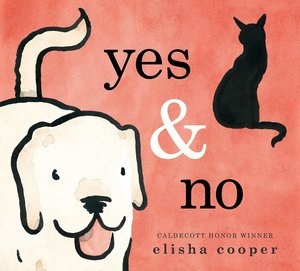
Of course, it’s not all pain! Yes & No has never failed to make every kid I read it with giggle, whether I read it in English or French. And most of the words are “yes” and “no.” There, the simplicity is in the art, and oh the full landscape pages. Oh the beauty. The nuance of a relationship– I defy you, flipping through, not to see your own relationships unfurling on those meandering paths of dog and cat. The words ebb, utterly unnecessary indeed, as the paintbrush flickers into vivid dynamics of sound and scent and the rush of a breeze across a field. Part of me, absurdly, felt that maybe I could just tumble through the page…

Of course, every variety of experience comes together in Emma Full of Wonders. Childbirth, historically and today, carries much of the weight of death alongside new life. It’s a time of pain and danger, anticipation and joy. No wonder Emma is full of so much sensation. So much sparkling wish and so many big feelings. I was quietly relieved, seeing the helping hands as she gave birth, to know that she had loving and helpful attendants to see her through.

But the thing is this: through this entire post, you hear me relating and projecting my mind and feelings through the animal characters. I think every reader, child and adult, even as we bounce out and say, “Oh! What a cute cat! We should get a cat, you know. Yes, I know we already have four…!” (for example) will also find themselves relating to the experiences of the animals in the pages. And yet– Elisha Cooper is not doing that for you.

“A lesser author would– ” is a line that’s kept playing through my mind as we’ve been, as I said, doing a lot of Elisha Cooper reading these days. The animals are adorable, for example, but the books are never cute. Emma’s puppies are the sweetest little balls of energetic joy I’ve seen and I have four cats in my house and know how to look for kitten videos on the internet. But the pared lines of the book hew to the experience of the oddness and responsibility and beauty of bringing new life, of pregnancy and childbirth, not the cuteness of babies. He shows the first puppy coming out of the dog’s vagina. Full in the middle of the page. “Daaang, he went there,” I thought in admiration. [Ensuing sentence excised for being too mean about the tendency of parents to be so blasted restrictive– oh. I’m doing it again.] I love cute animals, cute kids. I do not like cuteness. Especially in books. Children are adorable, of course. But the genius of Gyo Fujikawa’s adorable kids, for example, is how relentlessly real they are, sticky with jam, cranky and overtired, and covered in paint. These books are relentlessly real.

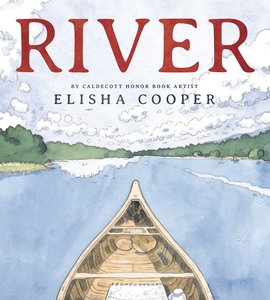
That is, I think, something that E.B. White, a careful observer of humans and animals and places, would recognize in these books. It is where the two meet, for me. Reading his letters, I found myself seeing and hearing New York, seeing and hearing Maine, seeing and hearing people– all in phrases of maybe as many as three to six words: of his little son “your tumultuous little Joe,” or of his wife “the person to whom I return,” or wistfully wishing his son were with him to hear “the lovemaking of the frogs.” I swear I could remember a letter where he joked about how he’ll take his canoe down the Hudson into New York, though of course now I can’t find it! But it brought River instantly to mind.

And then there’s the matter of pure philosophy. Because here’s the thing: I can talk about the writer’s craft, and being concise, and hewing to a point. And I can talk about what a writer might have to say. But then there’s the two together. Farm is a book that more or less pins it. The book is a whopping 18 years old, being published in 2006, [Ed. Incorrect, and I can’t believe I made such a silly mistake– the book was published in 2010, 14 years ago.] so in publishing terms it’s basically antique, but I defy all conventions! I will talk about old books!

The book starts out feeling like it might only be showing off what a farm is. (Precisely how many books of cartoony farm images showing sweet-tempered sheep and goats are out there, now? Too many.) And then we get the introductions to the animals, and the short, clipped phrases give me a feel for the rough boards of a fence and the muck on my shoes even though neither are mentioned. “Cats can look after themselves,” the invisible narrative guide says drily, as we, I imagine, walk along rough ground, leaning on rough fences.

“A lesser author would–” go into those spunky and independent cats, though. Or the cows: “What are they thinking? Are they dreaming? Who knows. They think their own thoughts.” And on we go. Impressively, for a picture book about a farm, a field (hah) so filled with horrifically saccharine books, all of which are so intrusive into the poor animals’ inner lives, giving them never a moment of privacy, the cows are left to their own thoughts, undisturbed. Until, later, they’re “sent to market.” Bye, cows. I loved, maybe, most of all the descriptions of weather. There is a storm– “And then it is over. The corn all bends in one direction as if to say, The storm went that way.” And at the very beginning of the book, we’re told that “weather must be dry for tilling. The farmer will have to wait. Weather can’t be fixed.”

The book is intensely full of challenges. There is no runt piglet about to be killed, but, honestly, there could so easily have been. There is life and death (a disappearing rooster, chipmunks, and more) and delay and the price of crops. Keen observation, the humming of life, the rhythm of reality, and muck, and beautiful views of a big sky and vast fields, and vaster questions. Clipped phrases let us into this world, so far from concrete suburban walls, with questions rumbling under tractor wheels and through named roosters and unnamed hens. Why aren’t you named, hens? What are you thinking, cows?

Elisha Cooper, like E.B. White, shows us. He lets us know he cares, that he sees with acuity and loves these creatures and fields and rivers with a passion, but he is not telling us what to think. He only wants to let us in, and he succeeds, beautifully. Looking with unguarded awe at a field with a cat and a dog ambling along, absurdly, for just a moment… I think I can go in.

Never Wait to Cherish a Life

I have written about Lauren Soloy before, though I could never write enough. I wrote about the first book of hers I knew and loved, When Emily Was Small, and about Etty Darwin and the Four Pebble Problem (I still think that’s a stupendous title), and about her illustrated version of the glorious I’s the B’y, and about The Hidden World of Gnomes. I could share her beautiful books forever– because the fact is that you’re not going to go wrong with a book she’s touched. Art and writing are always right out of her, and what she creates comes from her soul and from her skill, joined.

But I don’t think I’ve ever written in praise of Lauren. It’s an occupational hazard of talking about books: if you say nice things about the creator as a person, well, maybe that’s going to undercut what you say about the book because everyone knows that if you like a person you’ll never criticize them, right?

It’s a stupid line of thought and I’ll stop right there.

Never wait to cherish a life, I titled this, and for a reason.

It was around the first time I was chatting online with Lauren, and praising her work, that I learned she was recovering very well from, and, everyone thought, had really overcome, a round of fairly early cancer. I was very quietly happy and thrilled to watch her strength and work building back up: always exploring, posting new illustrations, often small and always vivid, of trees or flowers, and suddenly these little acorn-looking people, making me hope for gnomes… thank Lord we got those delightful gnomes! Giving those gnomes a shape and a space was the kind of lovely thing that’s distinctively “Lauren” in my eyes.

And then came the time I was hoping for, most of all: we were going to Canada, going to Newfoundland– maybe I could meet her in Nova Scotia! Long story short: we didn’t meet, it just didn’t work, and I will never not regret that. (I could say, “I should have…” but I don’t think Lauren would like that.) And, another regret, even though I nearly bought the delightful Woozles out of stock of her books, I never did post my roundup of Canadian bookshops from that trip! I still hope to. I still have the pictures. Why did I ever wait?

And now Lauren’s cancer is back, Stage 4, and hopes for “but we’ll go back– I’ll see her next time,” are in the “unlikely in the extreme” category of life plans. But here’s the thing. I could very easily, being who I am, be really angry with myself about that. Self-recrimination is part of me. But the part of me that’s thinking of Lauren rather than myself won’t let me cast blame because that’s just not how Lauren works.

And even if I’ve never met her in person, and even if I hadn’t had the lovely gift of correspondence with her, I’d still know that from her books. So why separate praise of the book from praise of the person?

Yes, yes, works have a life beyond their author, but they “do contain a potency of life in them to be as active as that soul was whose progeny they are,” says my boy John Milton, and I’ve learned a lot from Lauren’s soul, beautiful both in her and in her books. And the books are so deeply reflective of something right in her soul and spirit, so far as I’ve been able to come to know her through our chats.

Lauren doesn’t put herself forward, but she is honest. Her books are gentle enough to pass muster with the adult guardians whose hands the books must pass through to reach the real readers– kids. And yet they are direct and uncondescending. She deals with hard things. Emily Carr had a tough childhood and she doesn’t disguise that at all. Charles Darwin is a listening father, but he made mistakes. “I’s the B’y” is something else books often disguise but Lauren refuses to: joy. Every one of those elements is something adults can find really hard to grasp. We shy away from the hard stuff, sadness and anger and joy, so very often. Lauren looks it in the eye and puts it into her books.

What a gift– a gift to be cherished.

I’m reminding myself of these things now. Things can be hard and beautiful and wild at the same time, as in When Emily Was Small. You can be a good parent and make mistakes. And don’t fail to grasp joy with both hands!

And every little personality in The Hidden World of Gnomes is so odd, so strange, so entirely beautiful. The worlds of Lauren’s books are and always have been and continue to be peopled with the small, the fierce, the bright-eyed, and the wild.

I think it would be easy to do a quick “does it pass muster” reading (you know how grownups do that at bookstores and libraries?) and see the gentleness or even cuteness in her books without the soul. I call that not a bad thing; it will let the books reach the kids who have a quicker spirit and apprehend the reductiveness of Emily’s mother in scolding her, and, also Emily’s resilience in the face of it all.

But tonight I was having a little cry because I was just so gutted about this blasted cancer. And the Spriggan saw and asked why I was sad and I snuffled inelegantly and told him that my friend was very sick. And he asked who, and I said it was Lauren who made beautiful books. And I promised to read him one at bedtime.

This was the first time I had read him When Emily Was Small (he’s on the young end for it) and you know what? It struck me fully that Lauren Soloy is a genius for this kind of writing. The art almost goes without saying for Lauren; that quick flick through one of her books will show you the artistic skill in a heartbeat: thumpety-bump! In her own way, with her own skills and area of work, she has a wild yet tender deftness, capturing voice, personality, and atmosphere, equivalent in power to Emily Carr’s own.

But to give the story of a fleeting moment– not a full biography, which is often the death of picture book biographies– a moment which, in its very smallness captures an honest essence that can reflect something to the child reader, be an independent story, and also illuminate the person represented on a bigger scale… I don’t think I’ve ever seen anyone else do that quite like Lauren. Moments aren’t pushy and Lauren isn’t pushy. But when you read one aloud with a kid in your lap– that moment can change you.

And I think it’s because that’s who Lauren is. Lauren sees an acorn and the acorn tells her something. She looks at a child and sees a full human soul. And she looks at the life she is leading and says, “We all get the time that we get.” I have never seen another person use and cherish each moment of their life as they live it quite like Lauren.

If you would like to share one of her beautiful books, Canadians, I recommend you get from Woozles! They are near Lauren and I know she’d be happy if you got from them– or from your own indie. Because I love it so very much, here’s a link to When Emily Was Small from bookshop.org. And don’t forget your local library!

And please consider pre-ordering her new book coming out in October: Tove and the Island with No Address.

Update with a few links

This May has been unusually busy around the Children’s Bookroom given a lot of old things coming together, so I wanted to give a roundup of what I’ve done here and elsewhere!

An older review of mine for Hilary McKay’s Time of Green Magic was featured among other reviews over at Twinkl’s Magical Books for Kids to Beat the Summer Reading Slide. While I’ve never really understood the whole summer slide thing, I think that list of recommended books looks absolutely fantastic and am keen to check out a few of them myself, so I recommend taking a look.

I have already mentioned the review I got to write for Two New Years over at JArts, but if you click this link here, you’ll see all of my reviews there, including Aviva vs the Dybbuk by Mari Lowe, a collection of stories by Etgar Keret, and more.

Here, snug in our own Children’s Bookroom, I’ve written about an early reader, Orris and Timble, featuring a cranky rat who seems curiously well-read, and a little owl who wants to hear stories. I have written about characters in Ferris who don’t so much leap off the page as beckon you into it. And I’ve written about A Poem for Peter and how sharing stories, as Orris and Timble do, can turn the misery Olympics on its head and let us all have our say.

I never do have any idea what’s next, here in the Bookroom, because it all depends what’s published, what mood I’m in, and whether a child elsewhere in the house decides to spill my coffee beans on the ground or starts to barf, but since the past few weeks turned out to have so much going on, I just wanted to make sure that anyone who cared could find what they wanted on the shelves, as it were.