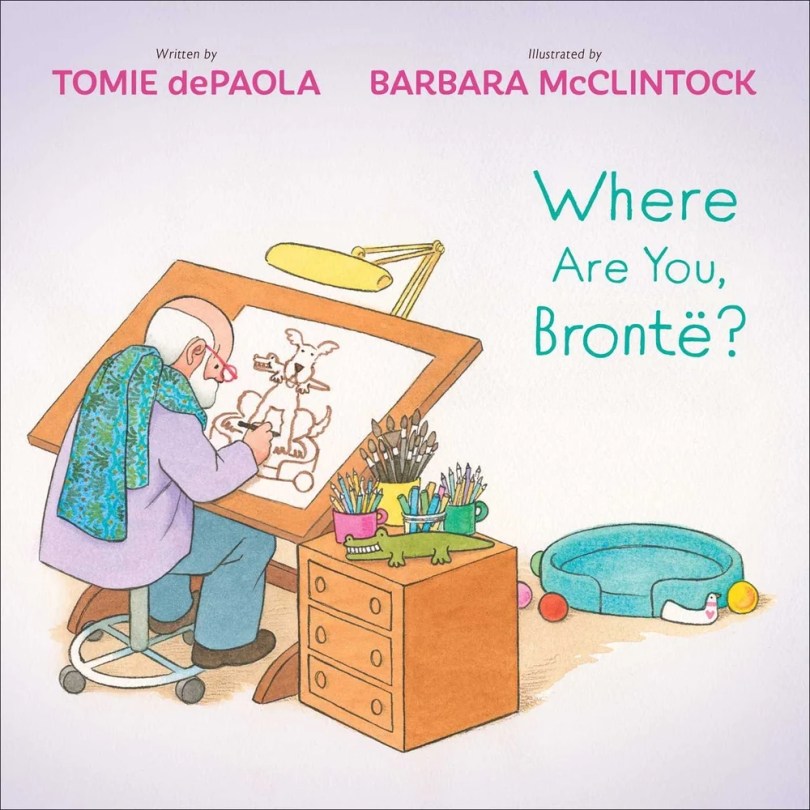
Where Are You, Brontë?

When Tomie dePaola died, he left behind a world of loss.

When Tomie dePaola’s dog, Brontë, died, Brontë left behind a grieving Tomie.

And, so, when Tomie died, he also left behind a manuscript, spare and simple, about loss–but also about memories.

That manuscript was sent to Barbara McClintock, one of the finest artists of our days, to be illustrated and released posthumously: Where Are You, Brontë? by Tomie dePaola and Barbara McClintock (pre-order at that link and you can get a copy signed by Barbara). Given that it deals with Tomie’s death and bereavement, losing his beloved dog, the manuscript naturally carries a lot of extra feeling in our own bereavement– the loss of a beloved author, illustrator, and human being. (Frankly, I’m struck with a panoply of feelings that have nothing to do with the beautiful outcome: I’m relieved here. The book had the potential to be turned into a soppy, tear-jerky mess of fluff that would probably have made Tomie dePaola gag. In Barbara’s hands, we are safe: we have every nuance of honest sentiment and no false sentimentality.)

Loss is a funny beast. It feels physical, like a real yank of something integral away from you. No matter how intact your body may be, it feels less. A family friend recently died, and with it came a wash of memories: some about other friends lost, others about visits with my friend and his family, others about times that may have been technically unrelated but felt emotionally linked. I found myself making crème caramel for a reason that was not exactly related, as such, but kind of was. Anyway, it resulted in crème caramel, so it’s not like I’m going to complain about that. Memories go with loss. Jews sit shiva after a death, a seven day period of gathering around the bereaved and listening and sharing stories. Many cultures and faiths have memorials, funerals, and other customs involving sharing memories and stories– consider vigils and wakes, for example.

These memories feel tangible. They are an evocation of a person’s presence. It’s almost like the gap of physical loss is filled, something like a phantom limb in our spirits, until our minds are reconciled to the absence.

On every page of Where Are You, Brontë?, Tomie dePaola is present, and usually Brontë is, too. The book is incredibly simple. The repeated question, “Where are you, Brontë?” is asked, section by section, with a few lines of text building up to an overall answer. The early spreads show Brontë’s arrival, and how he settles in, sleeping with Tomie, playing with toys but never destroying them, and working his way into Tomie’s books. As time goes on, Brontë becomes an adult, and then an old, blind dog, but maintains his joyful spirit until the end, when he has lived every day of his life and is now gone; and, of course, Tomie is sad. We see him looking at the dog bed with only a toy and no Brontë. The food and water bowls, empty, with no Brontë. Having breakfast at the kitchen table, and no Brontë around, only an empty collar. Those two spreads are the only ones with no Brontë, but they sting, keenly. There’s a page turn, then, and we see Tomie on a solo walk, his face lighting up as he sees a rainbow and his eyes catch Brontë in the clouds, and all those memories from all the way through the book flood back to the reader’s mind (or at least they did to my mind) in that moment: “But then I knew you were right here.” Another page turn: Tomie draws beautiful Brontë, whose memory endures. As, of course, each adult and aware reader knows, Tomie’s memory endures in his own books, from the earliest to this one.

And that’s when the children’s librarian I showed my review copy to rushed out of her office with puffy eyes and said, “Oh my goodness this book needs to come with a YOU WILL CRY warning!” (Sorry!!! I really thought you knew the backstory of this book, or I would have warned you!)

Now, here’s the hard part: Barbara’s job wasn’t to reflect that rich layering of death, memory, and endurance, of both the dog and Tomie himself. It was to illustrate a very, very simply written book for children left by an author whose style was well known to be deceptively simple. The effect of how she did this was layered, rich, and covered a gamut from the beautifully simple picture book all the way to provoking tears in children’s book lovers in their library offices. But the actual, real task was to do a good job of illustrating a simple manuscript, and that must have been absolutely agonizingly difficult. And Barbara aced it.

I can tell you how I know she aced it. I read the book to my very convenient 4-year-old on hand, my Spriggan, and he loved the book (and kindly comforted his sniffly mother at the end). He wasn’t in the least distraught because it was such a nice book! We enjoyed it together very much, as every book to be read aloud should be enjoyed, of course. That is the goal, for the adult and child reader to enjoy the book together, but each in their own ways. In this case, that job was a really tall order because of the demands presented: a) illustrate a simple book with simple art, b) for a child, and the child will only have the context of the book itself, c) for the adult reader, who will have a lot more context about the author, and expectations to go with it.

You see, Tomie dePaola’s illustration style was described as folksy and simple. What that means, from everything I’ve read, and I recall a particularly colourful anecdote from Trina Schart Hyman describing an attempt she once made and certain colourful language she deployed along with crumpled pieces of paper being tossed around, is that it’s torturously difficult to replicate. When I close my eyes and call to mind Barbara McClintock’s art, I always see delicate flowing lines (think of another “where” book she illustrated, Adèle & Simon) that are more closely akin to Trina Schart Hyman’s than to the simple, broad lines of Tomie’s Strega Nona.

Simon’s drawing of a cat is very good. I think Brontë would like it, and Tomie would, too.

So, choosing Barbara with her lovely lines and keen eye for children for this job was absolutely genius. She would take the job seriously, reverently, even. Her respect for Tomie dePaola is total, and that means that her respect for the picture book (also demonstrated over a long career of brilliant books) is also total. She would have her own expectations, but ignore the expectations of adult readers when they competed with the all-important child; by doing so, she would take that manuscript and make a beautiful book. And so her art brings the words to the book to life not as Tomie dePaola would have done it, but as Tomie as a character in his own book of life, illustrated by Barbara McClintock. Barbara as illustrator and artist, who loves picture books by people like Tomie, knows when art is active and when art is illustrative. She imbibes elements of his style in grateful and graceful homage, but does it in her own way, with the breath of life only an artist doing her own work can do. There’s a little mouse I’ll let you find who appears in her wispy fine lines, simple but perfect, popping up in the broad folksy grasses, evoking a curious Barbara exploring a world of Tomie’s making. I can tell, on every page, that she worked with love, awe, and enjoyment.

And I read it, snuggled in bed with my own tiny boy, and we read it with love, awe, and enormous enjoyment– and, in my case, with damp eyes and a sniffly nose. I got patted on the head and given a hug and a kiss. It was fine– better than fine. I hope you’ll enjoy it, too.

It’s a bit like falling into a picture book world, thinking about all we’ve gained from all of these creators over all of these decades.

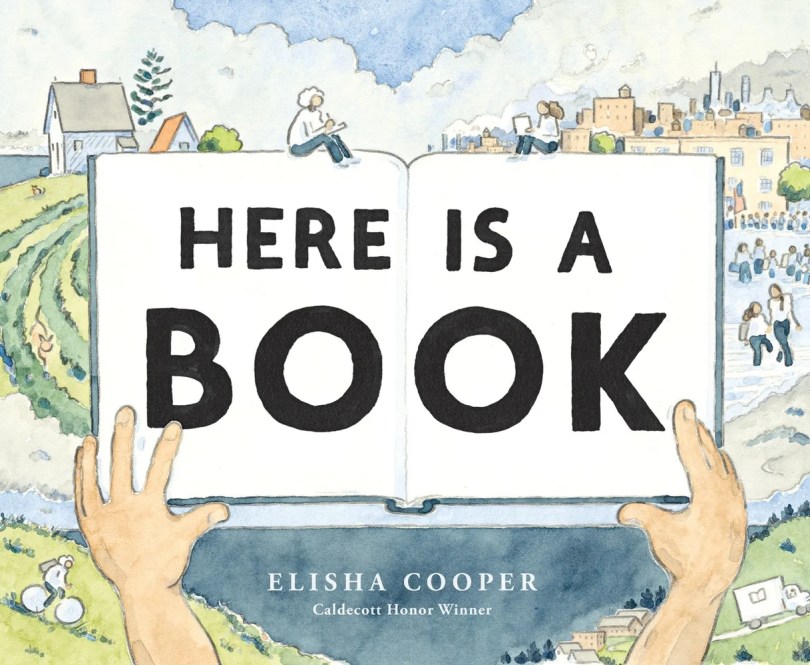
Here Is a Book

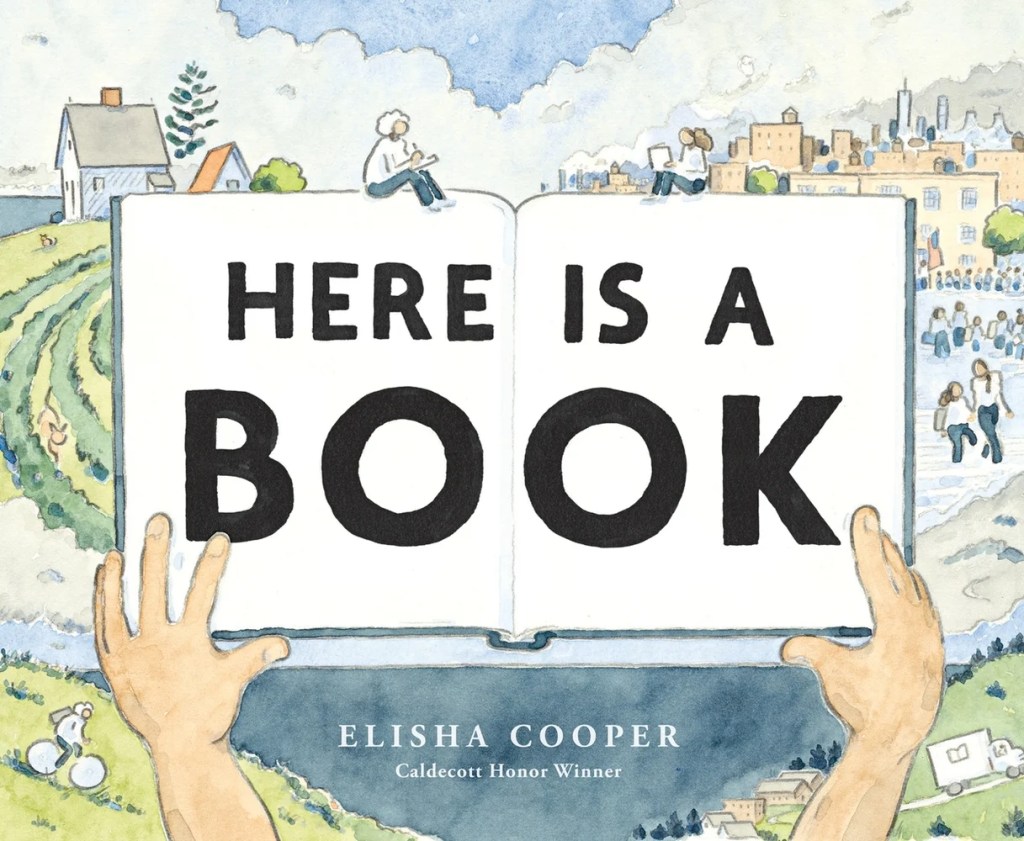
There is a grand total of one thing that I don’t like about this book, which is that styling the title in writing is a little irritating. Here Is a Book is what makes most sense, but then you have two tiny words beside each other “is” and “a” and one is capitalized but the other isn’t. But “is” can’t be left lowercase because it’s a verb, which just doesn’t sit well. Naturally, Elisha Cooper can gleefully duck this by elegantly clean typographic layout in all caps. Book designers, editors, art directors, authors– they have all the options. The reviewer is stuck thinking, “Are you doing this to us on purpose, Elisha?” (NB: This isn’t just Elisha Cooper. I adore Jan M. Ziolkowski’s clean and thoughtful book, Fairy Tales from Before Fairy Tales. But why is “from” lowercase but “before” capitalized? Why?) Elisha Cooper is a tease. Like, say, when I was at the book event for Sergio Ruzzier’s elegant beauty of a book, Bianca and the Butterfly, all hopped up on book fumes, and Elisha whipped an early author copy out of his bag, showed me, and wouldn’t let me so much as touch it. Kindly observe this cover which he showed me and didn’t let me touch.

But it’s ok, I don’t hold a grudge.

Not for longer than a century, anyway.

What, exactly, is a book? And how do you make one? What does it hold? How do you end up with a title and how do you format or style it?

Books about books and book-making aren’t a new idea, and they are, as is typical, extremely variable in quality, to be polite. I’ve written about some which are good or brilliant. I’ll let you search, if you want to, but I looked up some of my old reviews and wrinkled my nose at my prose, so you’ve been warned. I still think the best of them is This Is Not a Picture Book! (NB: Styled as such in most databases, though it is now sadly out of print, but the cover cleverly formats it in the French style: This is not a picture book! just like a normal sentence. The Brits do that, too. It is by far the best way.)

This is not a picture book! (going against the herd there) channels the feeling of vulnerability or anxiety about facing a new and potentially dangerous type of book and turning that into cautious exploration of uncharted territory, exciting and unexpectedly beautiful. Children have that as they gain literacy skills, learn to parse words, or find themselves navigating a page without pictures. I get that feeling as I open a book in a language I haven’t yet mastered– right now, Italian. The feeling Sergio puts on the page is visceral and, even as I choose to get that hard book, I still feel the duckling’s anxiety and rage as I face a page that, somehow, inexplicably, doesn’t make immediate sense to me. (Note to self: It doesn’t make sense to you because you haven’t yet learned to read it with full confidence. That takes time. It’s exactly that simple.)

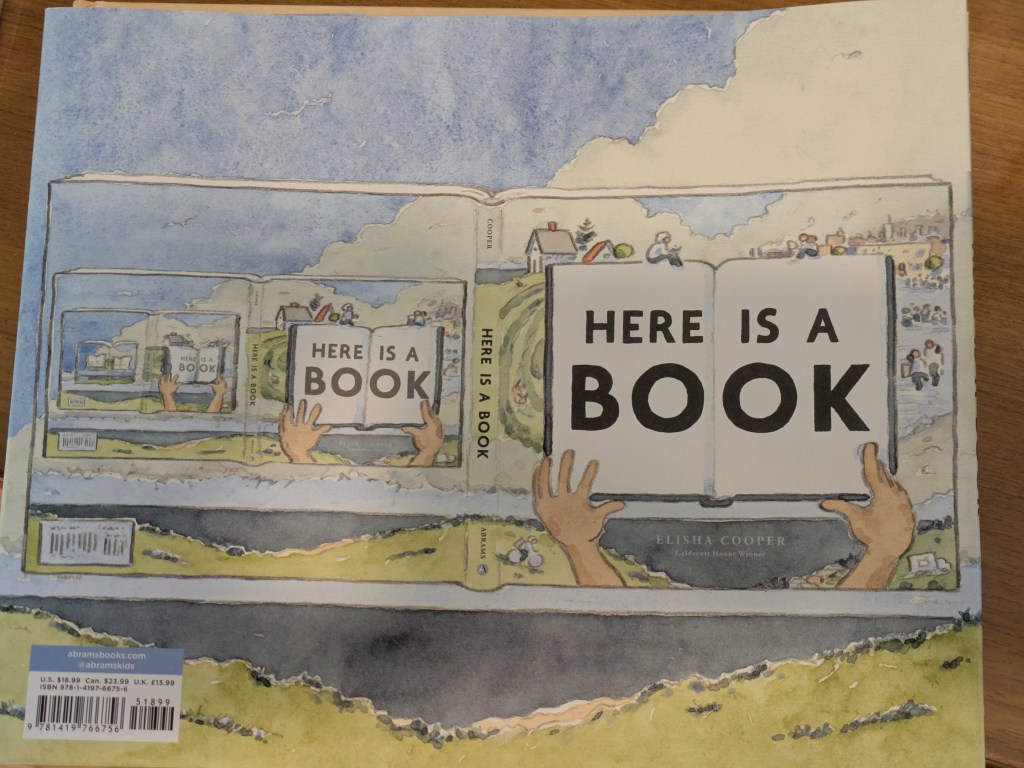
Elisha Cooper’s new book, Here is a book (hee hee), places itself with more detachment, but is, fascinatingly, a portal you fall into. Look at the cover: a book on a book. Look at the back cover, now.

With his usual brilliant humour, he shows on the back exactly how, though apparently we are getting a detached, bird’s-eye view of the book-making process, we will really be tumbling through the pages of the book, landing in the artist’s studio, meeting the editors, and, as we take the book from the library, emerging into our own chair, holding the book we made with the artist at the end. Only she is the one who made us, the readers, in a very real way. Or maybe not, I don’t know. Let’s look under the dust jacket and start again.

Isn’t it pretty? There are more languages on the back, but you can find those when you buy your own copy. Let me just show you one little thing. The eye searches for patterns, and we see a gradual fade from red on the right to blue on the left, except… it’s not quite so. So, if you’re me, you start tracking languages. Those are also mixed. Wait, green is — no, also pops up and out. Integrated, yet sorted. Rhythmic patterning, with mischievous pops of the unexpected. The very cover (on and under the jacket) is telling us what to expect. A serious, rhythmic book describing the book-making process, but unexpectedly humorous and immersive. [Publicist, take note: the preceding sentence is your pull quote.]

We, the readers, flip it open to see a beautiful landscape. The eye takes in a soaring sky and lovely house. We likely miss the quiet, solitary figure sketching. Until we flip to the title page, where we are suddenly looking at the sketchpad with the hands holding a pencil exactly where our hands would be if we were sketching. We are in the place of the sketcher. Page turn. We pull back, and see: “Here is an artist, looking.” The artist isn’t just looking, of course. She is sketching, and we see the sketches flowing up, to the left, drifting seamlessly behind and away. The effortlessness is part of the landscape of the book. It is the poetry of the text, the metre of the art. [That is the kind of thing I feel passionate about, write, but makes a bad pull quote for a publicist.] Page turn. Beat. “And look, here is the artist’s garden” and the stanzaic structure emerges: “made with sun, rain, dirt, shovels, seeds, and love.”

Paragraph break for me to point out: contrast the effort of the garden with the apparent effortlessness of those sketches drifting left and off the page. But the rhythm is smooth and almost whimsical on the tongue. A list of things you use to make a garden, that’s all.

Page turn, next stanza: “And here is…” You see, here, that the opening of what I’m insisting is a poetic structure was the line: “And look, here is the artist’s garden.” That began with an imperative: “look.” Our attention is commanded. We are outside, looking in. But then the structure quietly takes over with “here is” and we walk with the artist wherever she goes. We go into her house and see the cat and the bread and the family. The list of nouns on this page culminates in “warmth,” a lovely match to “love” in the garden. It was Daniel Donoghue who casually mentioned to me in grad school when we were reading Beowulf that good lists build to the last, important beat in poetry. This holds true here, and though Elisha softens the “BAM” of that beat to more of a “bop” by extending the list length, the repetition makes it very clear that those culminating words, stanza by stanza, spread by spread, are absolutely core. Soon enough we are in her studio, where the list is topped by “wonder.” Love, warmth, wonder. This must be a lovely place to live, and we slip happily into the armchair with the artist, and pat her cat.

The next stanzas are linked and color, rhythm, and teamwork take us to the completion of the book’s development until it goes to a printer where the list of elements that make the book culminate in “time.” The finished, printed books, which we haven’t seen because the artist showed us sketches but won’t let us touch them, are trucked over hills and valleys and we watch the tantalizing progress through layers of fog, forests, rocks, bears, and (bop) beauty. The truck is still going along, tantalizing us with its travels (which we remember started with an artist simply looking) across a country ribboned with rivers (have you read Elisha Cooper’s River?) and so much more including (bop) adventure, until we travel with that truck into a city soaring with a list including (bop) grit.

That was the one that really made me blink with delight, by the way. I hate grit. I hate it getting into my eyes when there’s wind. I hate gritty realism in literature. Why is realism always gritty? Can’t it be delicate and whimsical? A butterfly is as real as a rock! But as our nouns went from beauty and wonder and adventure to grit, I thought of the other meaning of “grit,” namely “courage.” If I hadn’t been reading aloud, I would have laughed, but as it is I grinned at my sleepy Spriggan, who laughed back to me as I turned the page. Those books were finally delivered to a school library and a student took her library books home, so, finally we are back in a home, back with a new friend and new eyes, not the artist, now, but with her reader. The reader’s home is built with bricks and mortar and structure and her kitchen is filled with vegetable soup and two cats and humor. Her room is overflowing paper and pencils and days and nights and wonder– again.

The last two spreads take us full circle in a closing stanza of such fabulous capaciousness yet impeccable specificity that I’m leaving it to you to discover everything except one particular point: all those culminating “bop” beats? They pull together, with all their nuances of definition (grit, wonder, structure) into the last list of all.

The book is quite as immersive as This is not a picture book! even with the apparent detachment of that bird’s-eye view, which deceptively tumbles into a portal, as though that bird swooped into a rabbit down the rabbit hole, leaving me exclaiming, “Curiouser and curiouser!” as I turn the pages again and again and again.

Elisha Cooper, you are a blasted genius. I liked the pandas on the artist’s studio wall.

Run Away With Me

The book would have been perfect at any time, in any age. Despite the nicely labelled dates (example: Saturday, June 7, 1986), it doesn’t feel stuck on any day of any month of any year. And this book is a not insignificant part of why I thought I’d really, really better go to NCTE back in November. I knew Scholastic would be there, and I just desperately wanted to see if I could talk to someone about how I could wheedle a review copy. Well, they just handed me a copy (and then I lost the card of the lovely person who gave me the copy, so I can’t email her this review– I’m bad at this! Sorry, lovely publicist.), so that part was easy.

What’s not easy is writing about it. I read it and my heart swelled and twisted so I wanted to cry. I made my husband read it. I re-read it. I tried and tried to write, and swore, and threw out drafts.

It’s difficult.

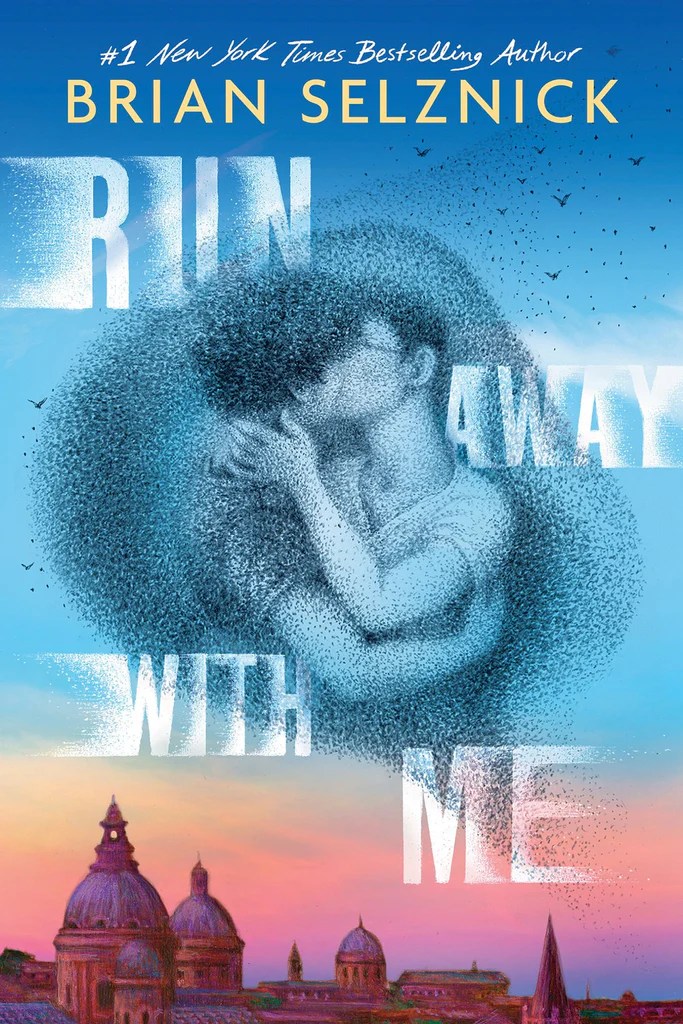
Danny, whose voice we hear for most of Run Away With Me, Brian Selznick’s new masterpiece (order from that link to Books of Wonder and you may get a signed copy), also struggles to speak sometimes. Angelo is the more loquacious of the two friends, young men finding each other in Rome. Angelo is the storyteller, but Danny, in his quiet way, elicits stories from Angelo and shares his own.

There is a manuscript, too, which is hidden and found, and the manuscript is in itself a hidden text, the secrets painstakingly unfolded by Danny’s mother, a paleographer.

Oh, yes, that’s right. There is paleography. My one potential quibble: the rare book librarians I know do not currently use white cotton gloves in handling books. Would they have in the 1980s? It’s certainly possible. I feel like Brian Selznick would have covered that in his extensive research. He’s such a thoughtful, careful creator. He doesn’t push books into being before they’re ready. He is eloquent, but not overly wordy. Like Maurice Sendak. Like Margaret Wise Brown. Like Sergio Ruzzier. Brian Selznick crafts his manuscripts deftly and considers them with care.

I flip through my heavily read and creased ARC of the book, and marvel at the work that went into each image and passage. Brian Selznick’s draft work must be art in its own right. I know it without seeing it.

But each of these elements shows the beauty of the silence between the words. As usual in a book by Brian Selznick, much of that silence is visual art, and much of that visual art is an unfolding mystery: connection, misdirection, and brilliant bridges across time and space. Is that one of the boys, maybe Angelo? No! That’s an angel in the church! Wait– no, the angel is Angelo? Or–

The text draws further deft lines between these links, and no I’m not going to explain any of the above, about Angelo or Danny or paleography or the angel in the church, because to do so would wreck your experience in following the delicate strokes of pencil and text, from scene to scene, drawing and description, music and flowing water.

Of all of Brian Selznick’s books, I think this may be his greatest masterpiece to date. I felt a strong pang of recognition in his depictions of aching loneliness and longing for beauty.

“They always seem lonely to me,” I said. “The obelisks.”
“They are lonely,” he answered, as if the objects themselves had been telling him their secrets.

Even when they have each other, Danny and Angelo are aware that the days are ticking down to separation. But Angelo has already told Danny: “To have had a friend,” he said. “Even for a short time. That’s important.”

I think this book will be a friend to many of us.

Back to The Wall

In November 2017, I wrote a not particularly good but, I recall, intensely felt post about The Wall by Peter Sís. I recall the fear and agitation of the time vividly, and, of course, not much has changed. Some things have, of course, but, ultimately, what I see and hear swirling around me is a kind of misery contest of who is the first under attack: “It always starts with–” fill in the blank with your pick of women, LGBT+ folks, racial minorities, the arts, the intellectuals, the judiciary, or what have you. Historically, it all does start somewhere and with something and someone, I’m absolutely certain, but depending on what “it” is and where you set the goalposts, that will always shift, and–

Truly, it doesn’t matter, because it has already started, and here we are. Trying to figure out when and where it started is, I submit with a marked lack of humility, futile. At this point, we simply need to stop hiding, stop obfuscating, and say: We are living under the shadow of a new fascism.

Instead of blindly running around trying to warn that this is leading somewhere bad, please consider that it already is very bad and that fracturing into splinters of arguments over who’s most under attack is absurd while there’s what Jeffrey Goldberg of The Atlantic called “a Mack-truck-size breach” of security regarding war plans being discussed on Signal. EOs against law firms are putting a damper on lawyers, and while everyone loves to joke about sleazy lawyers and quote Shakespeare out of context, please recall that lawyers with the Department of Justice were methodically, thoroughly, and competently investigating and prosecuting January 6 insurrectionists, a fair number of whom had histories of violent conduct. These lawyers, who were upholding our rule of law and shoring up the integrity of our democracy in the face of an angry government, were fired for the very nature of their work, and the insurrectionists were pardoned.

Thus: this is a growing wave of totalitarian conduct.

And here I am, back to The Wall. And thank God Peter Sís created this masterpiece.

I don’t know a single person who has not, to some degree or other, been affected by this rising totalitarianism. My entire home country of Canada, for example. But also: teachers under scrutiny, scientists facing lost funding, friends with jobs lost or going to bed wondering if they’ll have a job tomorrow, or the biography of the guy who constructed the Sunday crossword noting that he just lost his job as a management consultant for federal agencies in Washington, DC. The maelstrom of chaos is, of course, deliberate, but comes into focus when seen not as a first step but as an accomplished act: totalitarian regimes are not clearly organized, they are incompetent, and discuss war plans on Signal.

I had been thinking of The Wall often, since I see the entire world through a lens of art. Literature, visual art, music: this is how humans have always processed our experiences, of course. The picture book is an ideal medium because it is so limited that the great creator is forced to hone the experience to a synthesized visual and verbal package with the rhythm of a poem when read aloud. I don’t mean that it must be in verse; rather that page turns create the marks of beats and accents of a poem. An ideal picture book works with that rhythm and the constraints of the page and format to distill an experience into a felt experience.

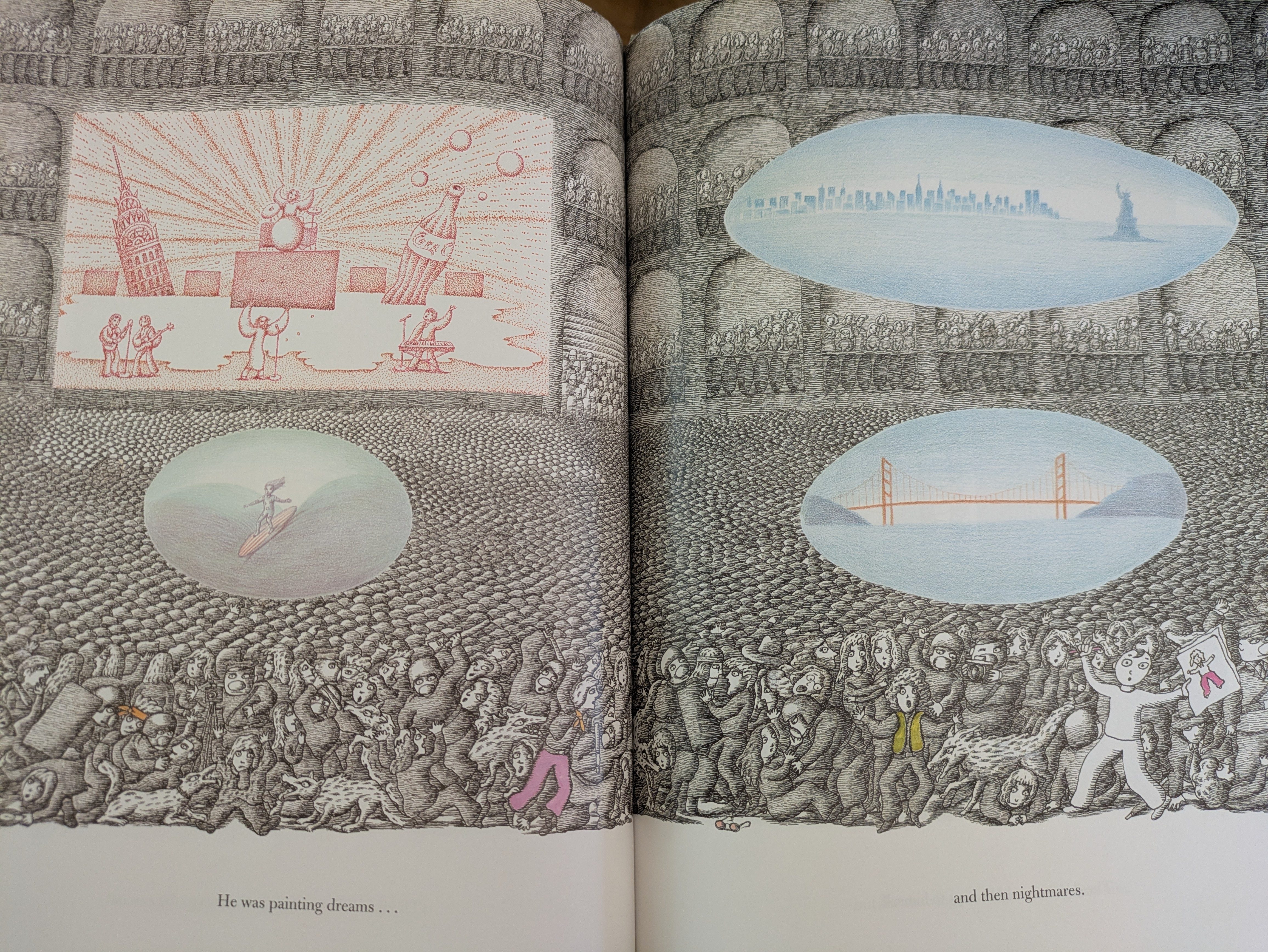
In The Wall, Peter Sís distills growing up under oppression, finding a secret voice, hiding it, and with wave on wave of growing pushes towards liberty from the Soviet regime, finally coming to freedom.

I pulled it from the shelf while fears for Ukraine rose in me, intending to read it to myself or handing it to the Changeling to read with me. She’s 11, and feeling this political climate more keenly than I’d like, but I think every parent has that uneasiness. I did not expect the 4-year-old ballet-loving, twirling Spriggan to ask me to read it to him. I had just heard about the Kennedy Center takeover; on our frequently watched DVD of Swan Lake with the Spriggan’s adored Angel Corella as Prince Siegfried, the performance is on the stage of the Kennedy Center and it opens with a clip from the dedication of the Kennedy Center. My love of the performing arts has deep roots, and one of the joys of my nuclear family is that my husband and children and I all share this taste. So that was back of my mind as we read The Wall.

This is not a book for a 4-year-old, and while he found it interesting and said he liked the art, he very sensibly went to look for other books by the same author that were more at his level, which are thankfully easily available on our shelves. One of my deepest objections to education in schools today is the rush, rush, rush away from picture books, but this is a book for older children, older classes, and families and teachers. It is perfect and it is beautiful, but classrooms and education haven’t kept pace with Peter Sís’s genius and tell children to grow out of picture books by the time they can read to themselves. And yet Grade 7 and 8 should read this.

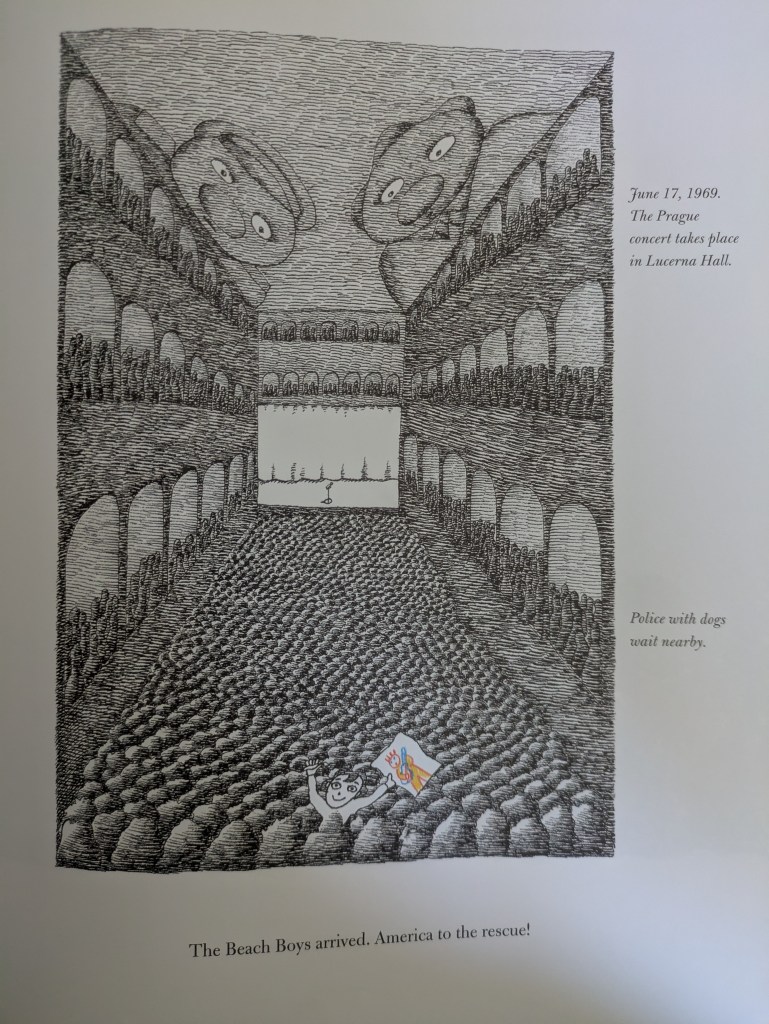
America to the rescue! I broke down a bit on that one.

We are back to The Wall, and I can’t say what to do or how to function, but I would like to recommend: a) Cohesion rather than competition; b) Read good books, including this one; c) Don’t obscure reality. It doesn’t start with anyone; we are here.

Finally, some words from Jeffrey Goldberg when asked if he feared retaliation: “It’s not my role to care about the possibility of threats or retaliation. We just have to come to work and do our jobs to the best of our ability. Unfortunately, in our society today—we see this across corporate journalism and law firms and other industries—there’s too much preemptive obeying for my taste. All we can do is just go do our jobs.”

Let’s Be Bees

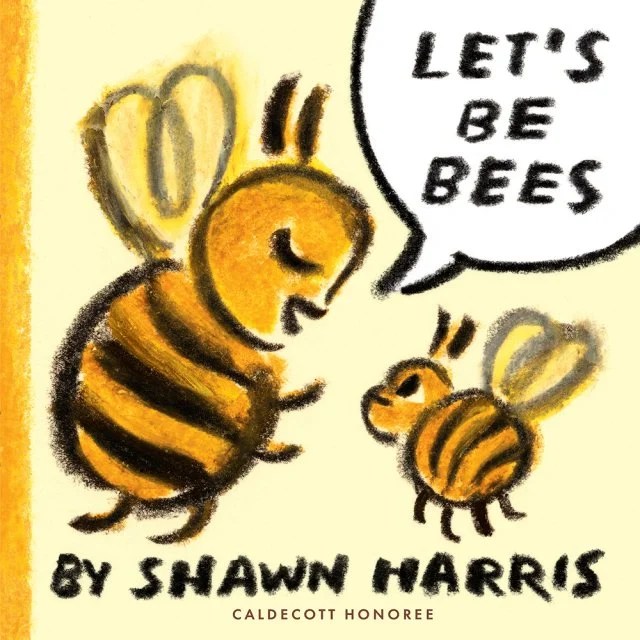
“I FOUND MY CALDECOTT PICK!” I shrieked on the way into my husband’s study and I think he was in a meeting but let’s pretend he wasn’t. I was excited.

I had been a bit apprehensive about Let’s Be Bees. I will confess: I was wrong.

I adore Shawn Harris for his whimsically odd approach to picture books, for breaking with orthodoxy in a rather Ruth Krauss-esque way: in Have You Ever Seen a Flower?, the child shouts “HELLO” just to listen for an echo, and something about it reminds me of the jubilant page: “Yell, ‘Good morning, big fat world!'” in Roar Like a Dandelion.

And I keep somehow being nervous with Shawn Harris titles before I see them. I think it’s the presentation of simplicity that deceives me; will it be too empty? I cannot emphasize strongly enough that this is sheer stupidity, probably trauma induced from reading too many breathlessly inane titles about loving the whole world. Shawn managed to write the only book with a tiny pink unicorn that made me laugh and that doesn’t make me foam at the mouth and that I have even gotten as a gift for multiple children.

NB: I routinely lecture adults about the taxonomically incorrect unicorns in books and the media these days. Like, you know, hot pink unicorns. I pull out history books and demonstrate that these are not accurate based on documentary evidence. That Shawn could create a pink unicorn I grudgingly like is nothing short of gobsmacking, and I need to trust to the truth:

Shawn Harris can be trusted with simple books.

You see, not everyone is good enough to do simple well. Above, I compared him to Ruth Krauss, famous for, among others, A Hole Is to Dig. She did something simple and brilliant: she listened to kids. In reading her books, often illustrated by Maurice Sendak, who matched her in his acute and sensitive level of observation and respect for children, one has the sense of tumbling into the world delineated there. The logic is intensely obvious. It cannot be imitated, however, because Ruth Krauss is the one who did the work. She was the observer. Any imitation is going to be cute and coy and patronizing, and I will feel like feeding the offending book to an angry hippopotamus. For example.

Shawn, like Ruth Krauss, does the work. In this interview with Betsy Bird (shared by a friend– thank you, Macy!) he says this thought was the starting point: “Well, that was fun becoming a flower— now I want to be everything else on earth.” That thought catapults straight into the mind of a 4-year-old, and I live with one. Yesterday he was a beaver and a black swan. Usually at different times.

I’ve seen his books described as “weird,” and from an adult perspective, I totally agree. It is absolutely bizarre to have a spread that’s bloodred, just bloody. But we had a guest over who cheerfully told us about his 7-year-old child nemesis who wiped her bloody finger on his cheek to prove to him that she really was bleeding, ok, you stupid grown-up? Blood is visceral, she felt it, she needed him to feel it. And Have You Ever Seen a Flower? really gets that. In Let’s Be Bees, it feels weird to a grown-up to be anything but human, because we’re pretty convinced that’s who we are, see? My experience of 4-year-olds leads me to believe that their species identities are entirely fluid at all times, and the book feels natural to read with one. They move with the shifts. We need a little push to our less elastic brains. It’s a little odd, see.

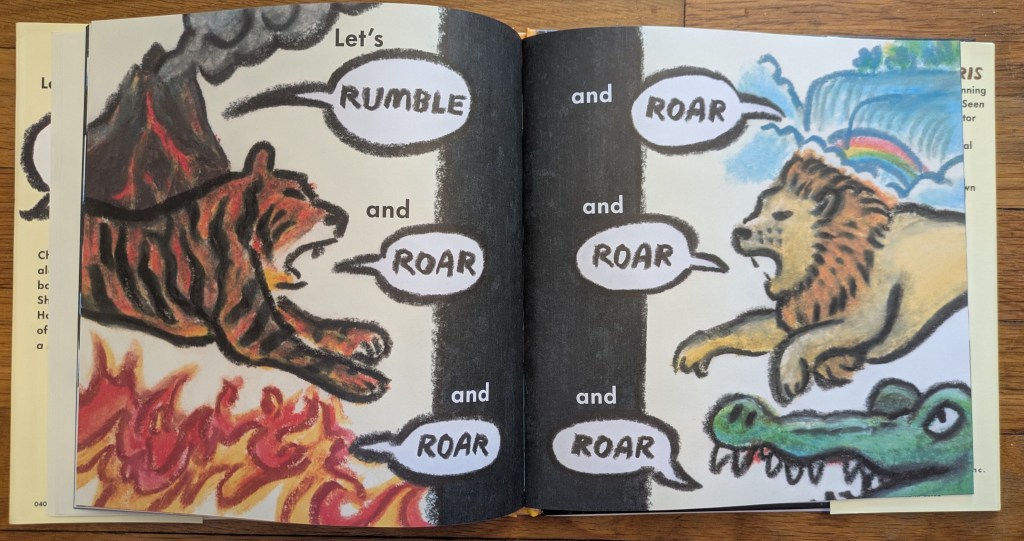
Look, I’m too wordy. Let me share my Spriggan’s perspective. He wasn’t really feeling like a tree the day we read it, and my attempts to get him to rustle were met with indifference. But we came to what I’m thinking of as “the ROAR spread” and he had a lot to tell me.

“Mama, you read it wrong.”
“What?” I was surprised, a bit, because so far I thought he couldn’t quite read yet, and usually he trusts me to get the words right in books.
“That isn’t a fire.”
“Uh…”
Allow me to show you the spread:

I really, really thought that was a picture of a roaring fire there on the bottom left, so I just kind of stared a bit. I do that an awful lot when a kid is telling me something, because, frankly, I’m so often at a complete loss until I get more clues. (To be honest with you, I think Shawn must be a lot smarter than I am; he seems to get it.)

“Mama, that’s a Firebird. Firebirds don’t roar.”
“Oh! What does the Firebird say?”
He thought. “…tinkle tinkle?”

He didn’t speak with conviction, and I was, I confess, pleased to have stumped him. He’s advanced a few other suggestions, but mostly he thinks it’s important to know that they have Golden Apple trees. When he’s a Firebird, he carries his own tree with Golden Apples around with him, so that’s a Firebird, do we really care what they say? He doesn’t– the Firebirds he knows are from the ballet, and don’t talk, they flutter their wings and pluck Golden Apples from the tree and they’re delicate but stronger than Kotschei the Deathless.

The genius of this book, and it is absolutely genius, it is serious genius, is that it is delightfully weird to the adult reader, and it is natural and delightful to the child reader. It’s a book to read together as a lap read, but it would also work as a classroom read. And I particularly love the cozy framing of it, so gentle, as an adult reading to a child– reading this very book, in fact. That gentle set in image frames the whole experience as a read-together, and puts the adult in the position of entering the child’s world. It is the adult saying, “Let’s be bees.” That imagery puts us, as adults, in the child’s park, and we are joining them in their logical centre.

For children, so often pushed to join us in ours, this is a rare experience. Ruth Krauss gave it to them, Sergio Ruzzier does today, and so does Shawn Harris. I think he’s great. And, Shawn, sorry I ever doubted you.

Let’s be swans!

And this book? This is it. This is my Caldecott pick.

Side note: I must give enormous thanks to the editor, Taylor Norman, for sending this for my Spriggan (who is a Black Swan today), and who dealt with my enthusiastic messages with forbearance.

A World Tour of Beloved Book Shops: Part 2

I was going to move on from Canadian book shops after my first post focused exclusively on the wonderful book shops of Atlantic Canada, right over here. I want to talk about other book shops I love– ones I’ve visited in the UK, in France, and in Israel, for example. Instead, living in the USA as a dual-citizen, Canadian born, I’m frankly revolted by the tariffs President Trump is threatening, month after month, to force down the throats of just about everyone. Canada, neighbour and ally and my home for most of my life, has a massive 25% Sword of Damocles– well, a knock-off version, signed in gold Sharpie. I don’t like cheapness, bullying, or poor taste. I am proudly snobby, a stickler for excellence and high ideals, and I’m giving you the names of friendly Canadian book shops with brilliant taste in books, and I’m sprinkling in authors and titles along the way.

With links.

If Trump wants to spread economic chaos, which he does, I encourage you not to do what he wants. Don’t panic, don’t go into hysterics. Be annoyed, call reality what it it; to say it’s anything but bad and dangerous is untruthful, so say the truth. Every good book is truthful. But panic is nonsense. So go forth and calmly buy the best books you can from the best shops you can, give books, spread literature, spread art, and buy Canadian books from Canadian shops if you possibly can. Here’s where to go, here’s what to buy, and here’s information on why.

I already told you about my very first childhood book shop, Tidewater Books. My first children’s book shop, though, was Mabel’s Fables in Toronto, a beautiful shop I love dearly. I had my first job interview there, too. It was frankly ridiculous of my even to apply since I had basically zero availability, but they gave me an interview, listened to me, and made me feel absolutely amazing. They had a cat, named Mabel, of course. It was, for most of my middle and high school years, a friendly and welcoming place. I remember the first time I sold another customer, confused parents, on a book, and I felt so great, and the bookseller just smiled at me even though I was sure I was a complete weirdo stepping on his turf. He made me feel like I was just another potential bookseller, which, at that point, was all I wanted: to be someone who shared books.

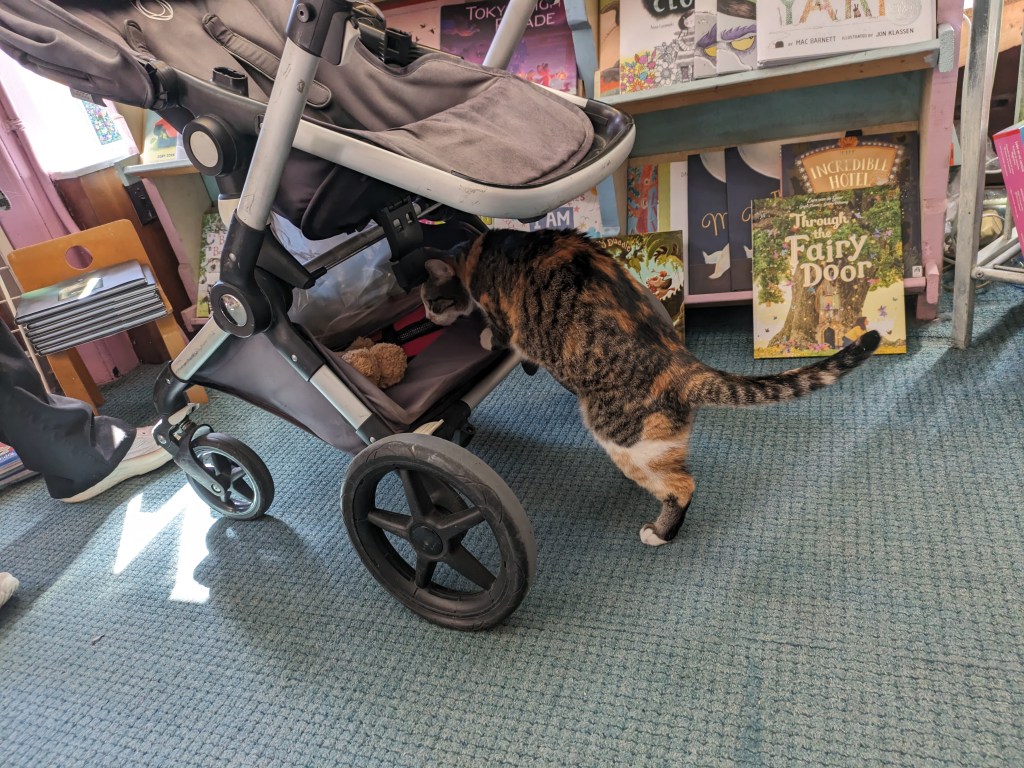
Almost unbelievably, that’s the place Mabel’s Fables still is. When I took my kids to Toronto last time, I nearly had to drag the Changeling (now 11) out the door back to her grandparents’ house. Later, while she was busy in an activity, the Spriggan more or less said “Mabel’s Stables” (that’s what he calls it, and the bookseller smiled at him and said it was an excellent name, probably better than Mabel’s Fables, because, well, it’s an amazing place) over and over, sometimes wheedling, sometimes soft and sad, sometimes petulantly, until we took him back. Bliss reigned as soon as he was back in the shop. “Mabel’s Stables,” he said contentedly. I made sure to leave a lot of those The Hidden World of Gnomes by Lauren Soloy there for others to buy, among their other fine books, mostly because they had more copies than I could carry. I would have taken Mabel, but she didn’t get all the way in the stroller…

The booksellers are brilliant, they know their stock, and they have fantastic taste. And did I mention they have a cat? They do, as many places do, have toys now. Like Woozles, they have added them to the stock, but not allowed the store to become a gadget place with books. They are relevant, creative, and artistic. The keynote of the stock is inspiration and creativity, and books, books, books are what the place is about.

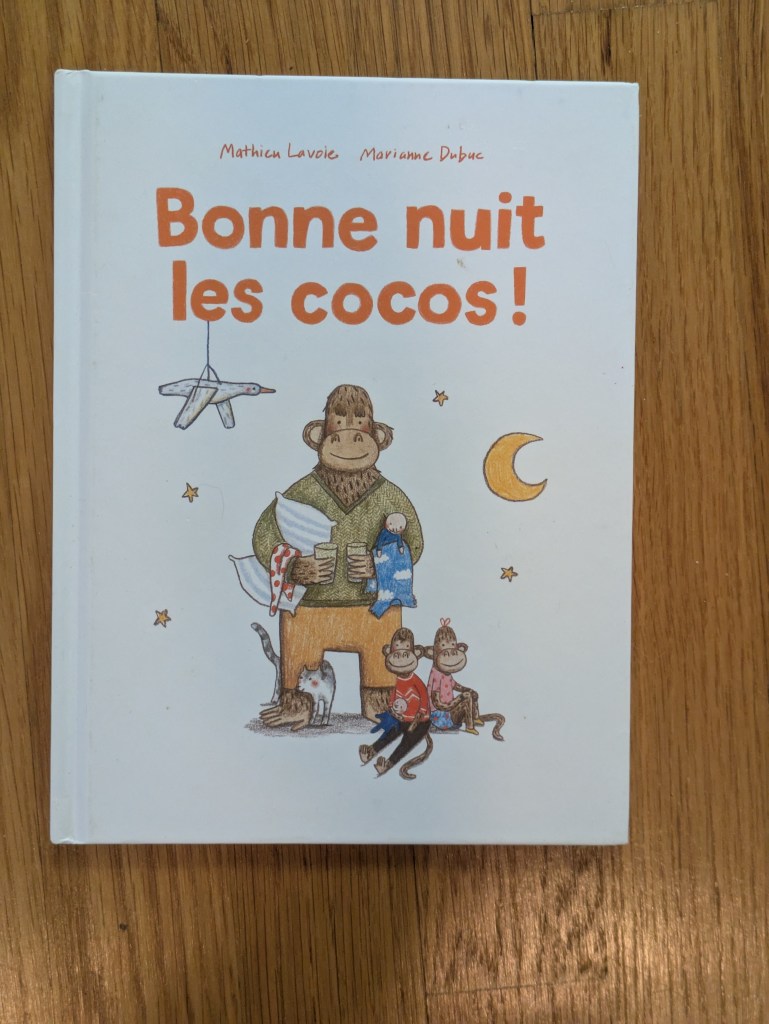
I am a very, very big fan of lovely French children’s books from lovely French book shops. I do a French storytime at my local library once a month and it’s pretty much the absolute highlight of my month that doesn’t actively involve my own children. I don’t recommend French books that often because I don’t have many French readers. But I can’t pass over my beloved Quebec, and if you have any wish to get French language books, Librairie Le Port de tête is a lovely spot where my husband got me really great books, some fascinatingly old and out of print and some new, and then they got stolen with our car. I’m never, never getting over that. I had to miss out on a trip to Montreal and the books he got me were stolen. At a good Quebec book shop, you can get French-language literature from Canada and France, both. I love Marianne Dubuc, Roch Carrier, Isabelle Arsenault, and more. But you can also get, for example, all the Gabrielle Vincent Ernest et Célestine books. You miss out on a lot of wonderful books if you only read one language…

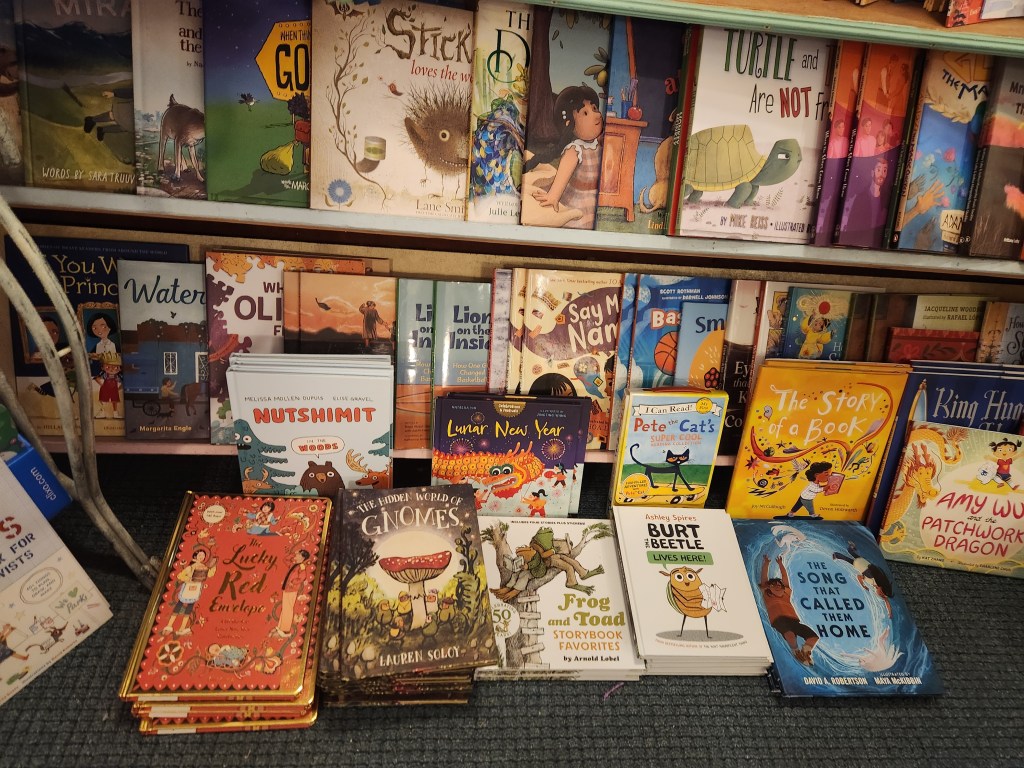
One of the things about Canada is that it’s massive, it really is just so very, very big. This year we got to visit my wonderful friends in Victoria, British Columbia. From my childhood address on Squire Street in Sackville, New Brunswick to my friend’s house in Victoria, it is 5, 609 km. But if you did decide to visit Tidewater Books and then, on a whim, drive for three days to see what the book shops on the opposite coast are like, I would recommend visiting Munro’s Books, which, in addition to having a staggeringly beautiful selection of literature, has a reputation for treating its employees extremely well. They stay for a long, long time, and, therefore, are keen and educated readers, know the stock, know the history of books, and can recommend not just what’s top of the frontlist, but the best books for you, the reader in front of them, right there and right then. I have never left without being impressed. This last time, I got to observe them helping another friend who was looking for a book for her child who is autistic and keen on animals. The employee listened closely and produced a few books that were just right. The Canadian literature is plentiful, from classics by Robert Munsch and Phoebe Gilman (I continue to think that The Balloon Tree is a staggering example of a debut picture book) to more recent titles, with a particularly fine collection of Indigenous literature, including David A. Robertson and Julie Flett’s On the Trapline, a stunning example of a book that speaks truthfully to an enormous range of ages and peoples. I’m always so excited in there that I never seem to take a proper picture of the place. I guess they need a cat for me to take pictures of, like Mabel’s Fables…. But someone doing their face-out book placements shares my taste, clearly…

And did you know– Sydney Smith up there– he might live in Nova Scotia, but there his books are, facing out, and that one’s in a collaboration with an author from California, mind you. Sydney Smith is one of the greatest Canadians living, and that’s a hill I’m prepared to die on, so please go forth and buy his books. Share them. And say, “This is what Canada has to offer the world.”

I’ll share book shops from other countries, too, very soon. But I’ll let you browse these, first.

Uri Shulevitz: In Memoriam

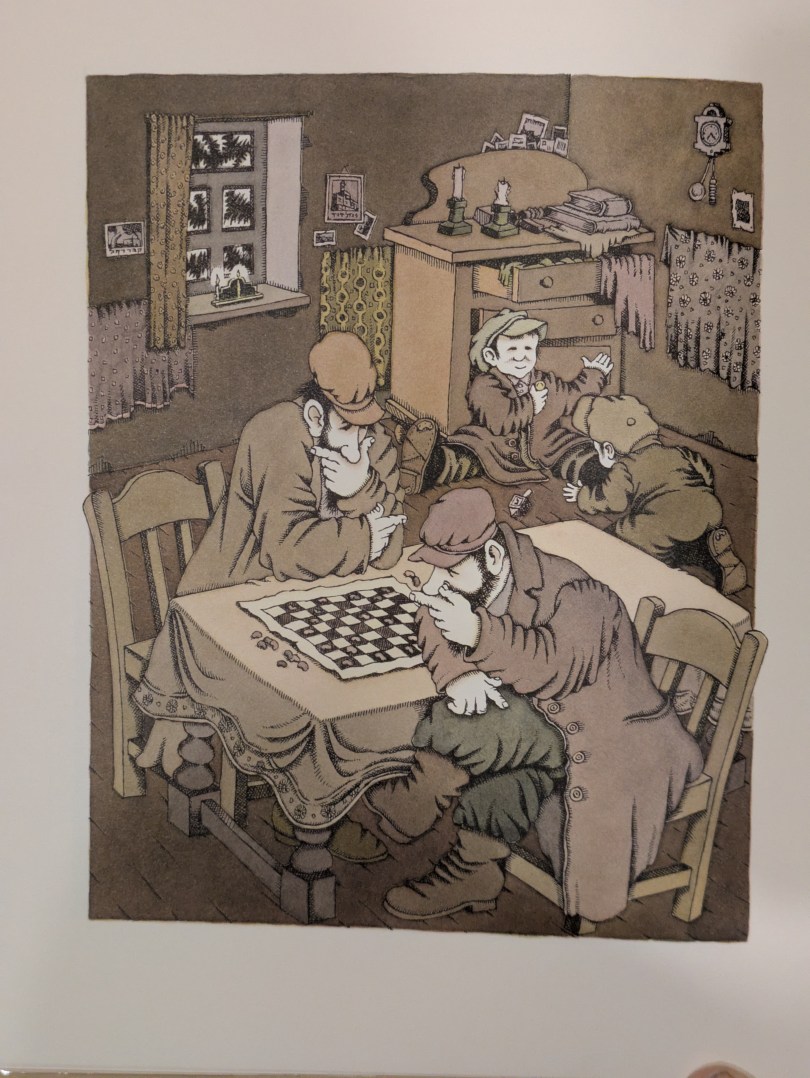
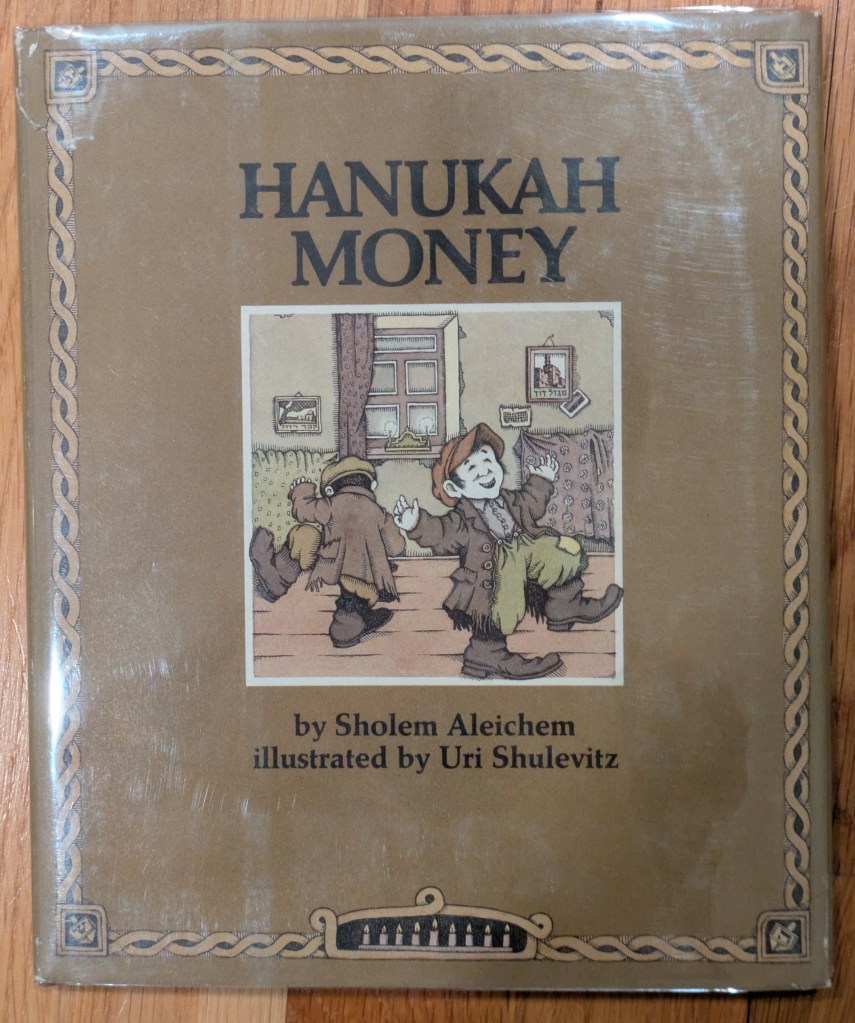
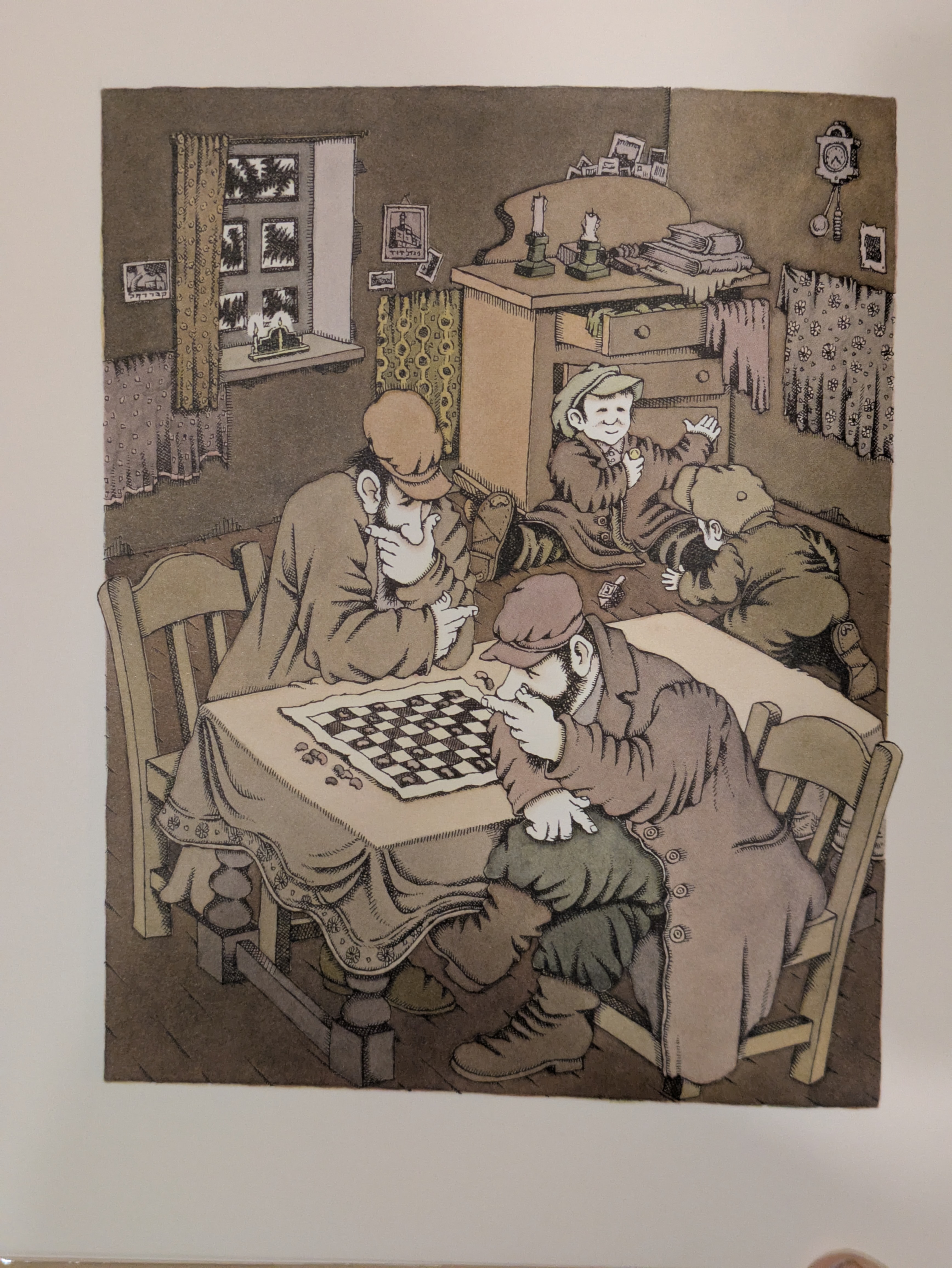
I did not grow up with the usual Uri Shulevitz books: Snow, for example, I only saw when I was older. The book I associate most strongly with Uri Shulevitz is not his beautiful, Caldecott Medal winning, The Fool of the World and the Flying Ship, and it’s not the more recent How I Learned Geography. All of those books are beautiful. They showcase a range of his talents. But the one I know best, the one from my earliest memories, has no glowing colours and now beautifully rounded story arc. It’s deliberately rough and deliberately awkward. It’s drawn with attention to detail, masterful skill, and a loving respect for each figure in the book, each character, each article of clothing. And these figures are often a bit ugly, the clothing ill-fitting, everything feeling somewhat exaggerated, a bit of a caricature, the oddity capturing, underneath, a deeper truth.

The book is Hanukah Money by Sholem Aleichem, the art by Uri Shulevitz deftly leaping to catch the meaning of each word, draw it forth in sepia tones, and highlight how, in this story, this book, this scene from the Old Country is gone. It was once, perhaps, a reality, though the deliberately folktale like character of the book casts it into fiction. Once, people lived in shtetls; it was a product of injustice but it was a way of life for many Jews. That ended. It was another injustice. And, after the Shoah, through which Uri Shulevitz lived, well. The people were murdered, the way of life they led was gone.

The folktale quality, the fiction, the funniness, all carries a terrific pathos, a massive discomfort which bothered me terribly as a child, because I sensed something was wrong. If you’d asked me, I probably would have said that it wasn’t pretty.

No, it’s not pretty. Because it’s beautiful. It’s full of odd and funny uglinesses, and it’s art of the very highest register.

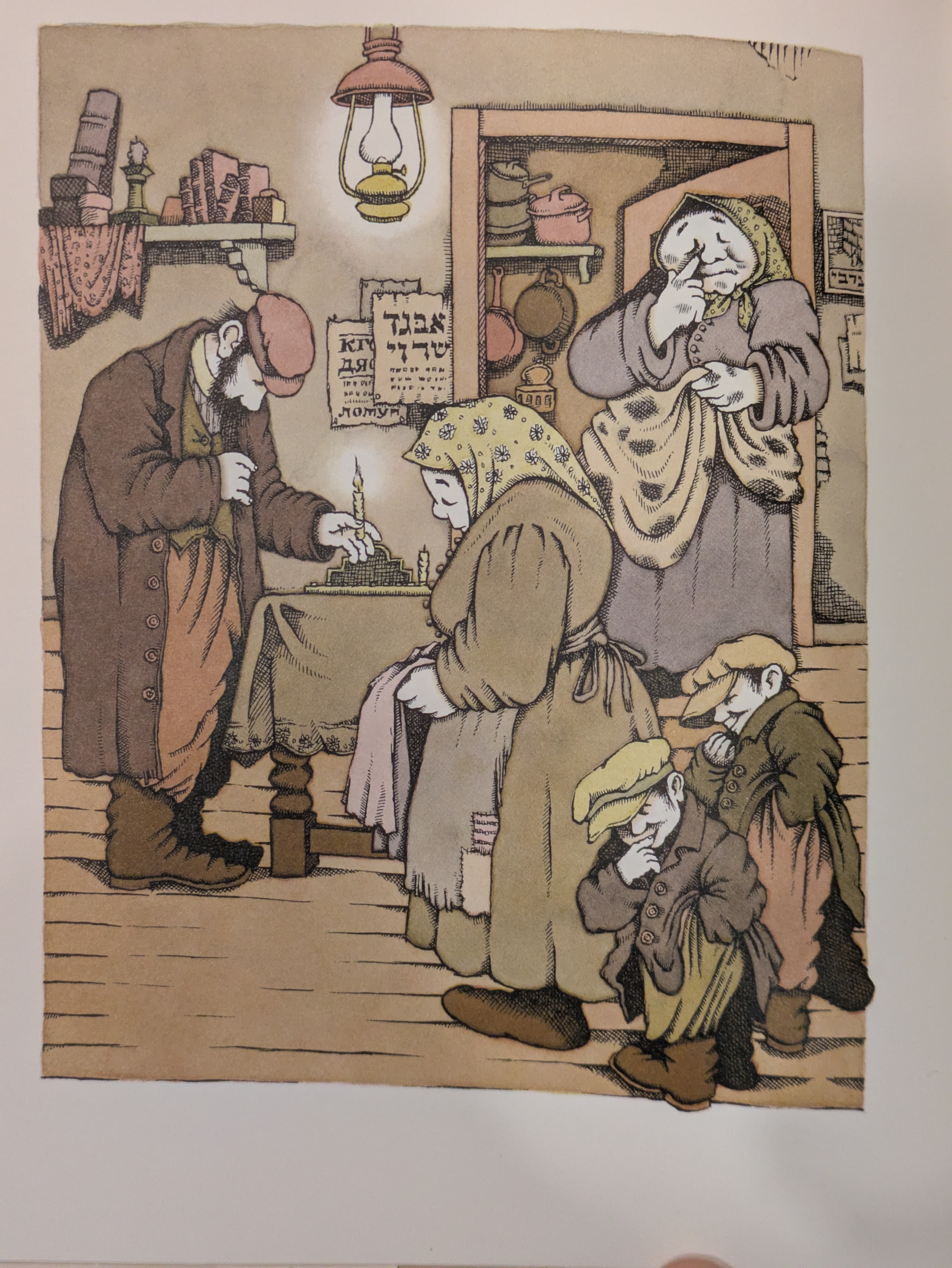
What a bizarre combination. How astonishingly strange, a beautiful book of awkwardly unattractive bits and bobs and people! But what comes through in this pathos, this sadness, is love and celebration. Uri Shulevitz is honouring these beautifully odd people who led such hard lives in such an unjust world which gave them so few chances. He takes that folkloric quality and with tender respect renders each person with careful humour, a delicate fineness of lines and shading. The children are handled with particular fondness, but the funny little scene when Aunt Pessl calls to deaf Uncle Moishe-Aaron captures so much in one page that I feel a little smile creep over me every time I look at it. How often has that wife yelled to that husband, barely a foot away? How often has he grumbled? How often have those kids looked on, thinking nothing of it, really, just waiting for some Hanukah money?

What comes through is a very deep sense of honesty, of artistic truth and integrity, and of dedication to giving life to this bygone world, cruelly robbed of life. When you look at Uncle Moishe-Aaron, he is wearing ripped and torn clothes, carefully patched, in a ripped and torn world, carefully restored in these pages.

The world, now, feels ripped and torn to me. There’s a gigantic, gaping hole where Uri Shulevitz was. His work is monumental, but when you look at it, so much of it feels like these moments in Hanukah Money: small moments, odd people, treated with gentleness and respect. The Fool of the World is a strange boy, and his parents barely notice his going. But Uri Shulevitz dismisses the brilliant older brothers as they walk right out of the fairy tale, and, per fairy tale tradition, we walk with the last and the least. But something struck me, in reading it to my Spriggan: the music. The Fool of the World is always singing. We sing with the Fool of the World, and the art sings, too.

The world is ripped and torn. We Fools of the World can be odd and imperfect, awkward and ill-fitting. But Uri Shulevitz taught us to honour even the uglies, even our last and least with deftness and care, with attention to detail, with loving lines and respect for each patch on a worn out coat. We may be hurt, but we should find our companions and sing together. Put a map on the wall and dream of difference, of possibility, and of each other, with singing colours and harmonized oddities.

I don’t think I’ll ever stop thinking that the loss of Uri Shulevitz is a gap in the world. One more gap in a list that feels far, far too long by now: Lore Segal, Tomie De Paola, Eric Carle, Kazuo Iwamura, Ashley Bryan, Lois Ehlert, Jerry Pinkney… I am struck by how many names come to me so very quickly, each a very keen pain. But I am grateful for what Uri Shulevitz gave us through his life and his years of dedicated work: beautiful art, respect for those who were diminished, and honest love for even the last and the least. Let us not forget that he chose to create his exquisite work for children. Let’s carry on doing just that: giving only the best and the most brilliant art to our children.

Kazuo Iwamura

I think most of those who read my words here are Canadian or American, and I wonder… Have you heard of Kazuo Iwamura? The two countries where I met his books were not on this continent; I met him in France and in Israel. I fell in love with the kind of precipitousness one associates with romantic comedies, but to me evokes the openheartedness of children. He caught me right in the raw heart of my childhood delight in watching squirrels and mice. Beatrix Potter, Jill Barklem, Leo Lionni all understand this, and so did Kazuo Iwamura.
So when I saw an announcement through Librairie nordest, one of my favourite book shops in Paris, that Kazuo Iwamura had died on December 19, 2024, I cried, and then I looked around and was astonished to see that few people on my continent seemed to have noticed. And I thought for a second and realized that I’d gathered his books in French for my French storytime (I read to little kids at my local public library once a month and it is my absolute favourite time I spend do anything for kids who aren’t mine), but getting them in English had always been a little harder. (Many of his books, but not all, have been produced in English by NorthSouth, distributed by Simon and Schuster.)

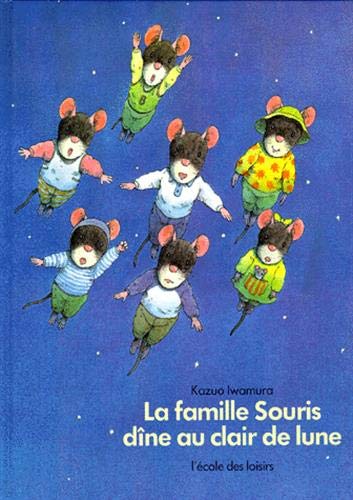
So I feel like it rests with me to share a bit about the wonders of his books and try to encourage you to find a few, in French or English or Japanese or any language at all, really, to read to yourself or with a child. I like the English and French translations, both, though the French voice comes through with a particular pep and vigour, so I think he must have had a particularly excellent translator there. Truly, though, the engagement of the art, which is of such a breathtakingly beautiful quality, is so high, that the words serve as a guide to the art, like one of the rope ladders or pulleys that his little mice use to climb up to the treetops for a lunar picnic one night of the year. You can reach that lovely meal in the moonlight regardless, but it’s very nice to have the words to guide you there.

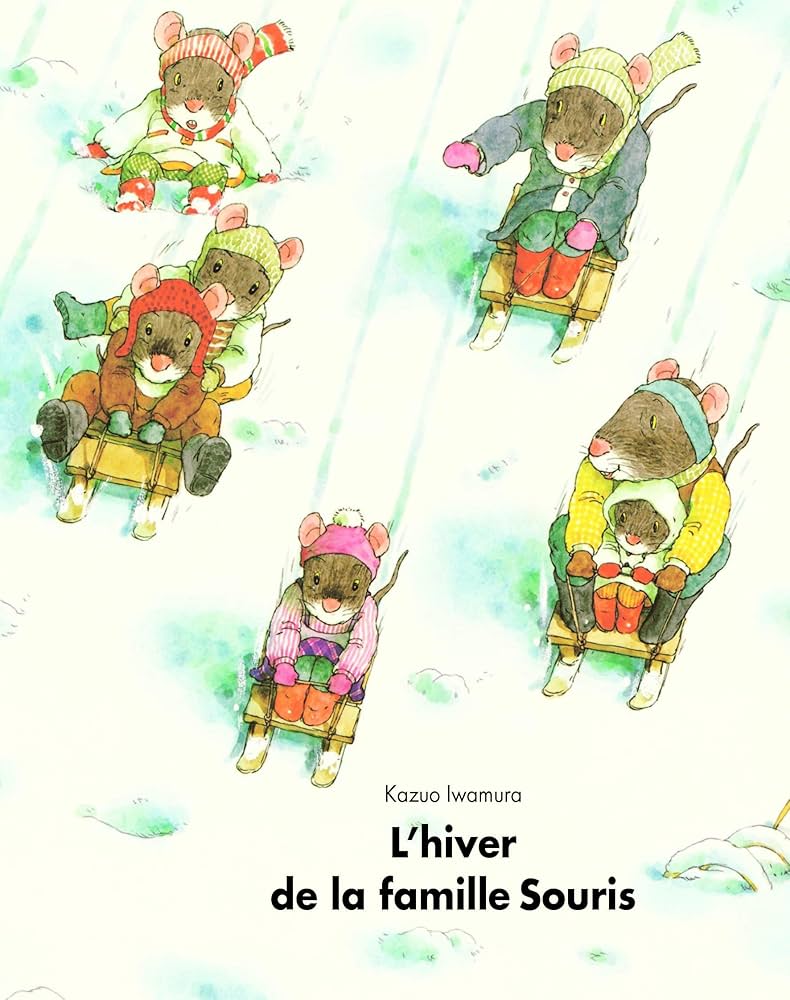
What is a Kazuo Iwamura book like? One of the ones I’ve read most often, both to the children at the library and to my own little Spriggan at home (he doesn’t know French but loves being read to in French), is L’Hiver de la famille souris (The Mouse Family in Winter). Has it been translated into English, too? I actually haven’t checked. I wonder if a British publisher may have done these. But the first view of the mouse family is not outside, and not in the snow. They’re cozy at home, making things. Some are cooking, others are woodworking, the little ones are playing or helping in those ways that small children play or help in the “getting under everyone else’s feet” method. It’s delightfully real. And after everyone enjoys a snack and a game they go outside. They play in the snow, the adults as well as the children. Then they go home.

That is it.

The environment, the atmosphere, the full family involvement and engagement, are all exquisite. There’s a sense of tranquility and a sense of mischief. There’s a bit of bickering. There are mishaps. They’re all in the context of generally good-natured interactions, and they aren’t reported immersively. That is: you certainly get dialogue, but the effect is at a distance, like watching a slowly developing fresco on a long passageway, as the mice go along from moment to moment and you’re walking along the mural, watching their day unfold before your eyes. The immersiveness isn’t in the characters but in the entire scenario, the landscape and the world.

This is how his forest resembles Jill Barklem’s Brambly Hedge or the Lake District in Beatrix Potter’s stories.

I find enormous comfort and huge joy in flipping through his scenes, and thinking that there was a man in this world who threw himself into art this beautiful and of such a high level for the sake of children. He built a museum for children and picture book art, too, the Kazuo Iwamura Picture Book Museum of the Hill in Nasu-Karasuyama. I can only imagine its beauty, because anyone who spent his time putting such tender care into the art he made for children must have created a museum with equivalent dedication and attention. I want to leave you with a quote from a recent interview he had with NorthSouth Books: “I’m convinced that it’s really essential for children not only to have top class picture books but also to become familiar with the real world of nature.” Thank you, Kazuo Iwamura, for giving children the top of the top class in picture books, and ones that are a window onto nature, and surely make them wish to go out and see it and feel it with all their senses. I will visit you in your books.

Board Books: Jon Klassen and more

I was about to begin this post “I think that you’d have to be living under a rock not to have heard of Jon Klassen’s new board book series,” and then I paused. I reflected. I think that sentence says everything you need to know about me. If I’ve learned one thing in my years on this planet, it’s that, inexplicably, people don’t pay attention to children, and to things pertaining to children. I find this infuriating. So, while I was thinking, “Oh, everyone out there knows that Jon Klassen has made a board book series, I’m sure,” it turns out that, as a matter of fact, that assumption was incorrect. I am here to correct this problem. Please meet: Your Farm, Your Island, and Your Forest. The very titles, to me, gently but very definitively orient the books and the read-aloud scenario around the child.

I do not normally think of Jon Klassen and “inexorable” in the same sentence (I have not met him, alas, but he seems gentle and lovely), but he inexorably leads the reader to put the child first, and allows the child to play in these worlds as the prime mover of their own space. It seems (based on, I want to say, if I remember correctly, some Instagram posts on the Candlewick account, but you’ll have to dig it up yourself) that he was inspired in making these by felt books where you could arrange shapes to create scenes and stories. Not only did he have these growing up, but his mother has these sets (designed by him, made by her, I believe) for sale, because an insanely talented creator like that clearly gets his skills from somewhere! Jon Klassen’s mother seems amazing, I’m just saying.

You can easily imagine, looking at those simple, cleanly designed shapes, moved around and organized neatly on the page (each shape is introduced on the right side of each spread, then tidily placed on the left), a child picking up a tree or a rock and placing it somewhere. As an adult, you beam inside thinking how nicely behaved that child is. Then, reflecting for a minute, you probably acknowledge that at the end of the game it’s all going to get thrown in the air and the pieces will be scattered. A cat might chew on one of the felt shapes. But this? This is a board book. It stays put. It is calm, it is organized. And the gentle amusement, the chuckles we get from those shifting eyes, all come to a close with the beautiful rising moon, making these ideal sleepy-time books.

The loveliness of the atmosphere calls to mind Taro Gomi’s gorgeously balanced, occasionally mischievous board books. One of my favourites is Little Chicks in which the chicks run and move and– whoops, there’s someone to avoid!– until they’re safely all the way home. There’s a quietness, an atmosphere that rounds out the “start, middle, end” structure rather than relying on an overly engineered plot or a scene squashed helter-skelter into cardboard pages. Well, that comparison is clearly not by happenstance because in the NYT piece I linked above, but am linking to again because it’s better worth reading than this but not as well worth reading as the board books themselves, Jon Klassen cites two board book influences: Taro Gomi and Sandra Boynton. (Sandra Boynton: if you’re reading this, send me a note, because I have so many questions for you about The Going to Bed Book, a work of literary genius.)

If you’re a board book connoisseur, you will instantly be intrigued because those two are very different one from the other. You will also be impressed, because they are, simply and bluntly put, the best creators at this format.

Board books are hard. I will up and say right now that even Jon Klassen (and I love Jon Klassen and am angry he’s not yet received the Nobel Prize for Literature) did not get himself added to Sandra Boynton and Taro Gomi as “the best at this format” in my personal pantheon. He’s pretty damned close, though, because his method in this series and his approach to the format as a whole are both brilliant. He centres the child and forces the reader to accord the child the attention and agency of building a world. The feeling of reading these with a child on your lap is perfect love. Further, he gives a span to the book not by cramming a plot that’s too big and unwieldy for a board book (a common error) into the cardboard pages, but by giving each the natural arc of a day. Simple, natural. The absolute best of the trio, to my mind, is Your Forest because of the ghost. My co-reader adored that ghost and was so satisfied the ghost came out at night as promised. Every book creator should keep promises with the attention of Jon Klassen.

And why does he do that? Because Jon Klassen respects his readers, these small ones as well as the older child. I love these books, and I think he even has room to grow as a board book creator if he has a mind to. And one thing that satisfies me in my deepest heart, the soul of my soul, is that I know that if he doesn’t think he’s got another board book to share, Jon Klassen will not squeeze one out. Like that felt book above, like the places he hands to the smallest children for them, like the bear seeking his hat– Jon Klassen takes the quality of what he produces seriously.

He admires the witchery of Sandra Boynton; I admire the craftsmanship of Jon Klassen. And both of those creators admire and attend to the genuine readership of their non-reader audiences. They respect babies, toddlers, and children. I think we all should.

A World Tour of Beloved Book Shops, Part I

This is getting out of hand. Last summer, I went to book shops of New Brunswick, Nova Scotia, and Newfoundland. I swore to myself I would write them up when I was back. Except, of course, what happened is that I sprawled in an exhausted pile, panicked because my parents were coming in five minutes, and then started a school year– and never wrote. This year, we went to the UK, and I got approximately… well. I got every single Mog and Alfie book I saw that I didn’t already own, plus a few others.

The ultimate situation is that I have a whole lot of book shops I want to talk about, and, even beyond that, I want to pay tribute to what book shops can do, what purpose they serve.

For the record– because I know I have a reputation, I really need to give a disclaimer– I’ve actually been to book shops in my life that disappointed me. I’ve even been to a children’s book shop that felt to me like it lacked direction and curatorship standards. It was pretty, but far too big, had an adult book section (presumably so that adults could see themselves represented because it’s hard to feel marginalized as an adult in a kid’s space, I guess?), and the shelf talkers from the staff lacked substance and seriousness. I don’t recommend book shops that don’t meet my standards any more than I recommend books that don’t meet my standards. These, below, are all book shops I love.

What is a good book shop? What makes visiting a book shop special? And why, if you’ve been to a book shop yesterday, might you still be interested in going to another one today? And why not just go to the library?

These are all questions I’ve been asked– the latter questions usually less politely than that, usually by my father, back when I lived at home. Dad, for the record, the foundations of my house are fine and I give books away almost constantly. So there.

So let’s talk about good book shops.

My first book shop growing up was Tidewater Books in Sackville, New Brunswick, a store that’s now moved from its original location and, through various twists and turns in shops in the town, now has a large gift section, but it’s still owned by Ellen Pickle and it’s still going strong. I remember my first solo purchase there: a pen with purple ink I thought was just the most sophisticated thing I’d ever seen. And I remember the last book I bought there before we moved to Toronto– my own paperback copy of Pride and Prejudice. Nostalgia can be a positive or a negative. I miss the old storefront, but I’m so glad the shop is still around, and that it still features local books prominently. The space is friendly, Ellen Pickle has good taste which informs the selections, and the store is engaged with the long story of the Maritimes. When I was there, the window display was filled with local Indigenous stories for National Indigenous Peoples Day. I have a feeling that, even if I weren’t so emotionally attached to the very name of “Tidewater Books,” I would still find a book to love on any visit.

The two other big revelations to me on that trip were Woozles and Running the Goat. I was already in something of a long-distance relationship with both places. Woozles was known to me, of course, as the oldest children’s bookshop in Canada, but, more to the point, as the quiet label on the website says, it’s “a place for and about children.” Perfect. If children aren’t the point, it’s not at Woozles. As it should be. The place is open and cheery with a ton of wonderful art from local children’s book artists, some of the greatest, on the walls– the problem with writing so long after the fact is that I can’t remember them all! Lauren Soloy, Jon Klassen, I think Matthew Forsythe and– I can’t recall, I remember spinning around going “and LOOK! LOOOOOK!” a lot. My Spriggan, who was smaller then, fell passionately in love with the Very Giant Clifford plushie and the train table. My husband may possibly have stared at the counter at checkout and quietly asked if they had a box we could carry the books in. It was a bit of a situation. The local authors section– think of signed books from Lauren Soloy (with her charming doodles) and Sydney Smith who does the most beautiful miniature art in each volume he touches– more or less went home with me, but I’m sure they’ve restocked by now. The toy section is thoughtful and in no way overwhelms the books. I have mixed feelings about toys in book shops, but this section feels like it belongs there and enhances the “intelligently kid-oriented” atmosphere rather than simply caving to the inevitable drive towards merch rather than books. Above all: the booksellers! They are smart. They had a sense of what books my kids needed in about five seconds flat and, after quickly assessing the situation, let us do our browsing as well as offering thoughtful suggestions. They did not overwhelm us. I miss and will continue to miss my own beloved Children’s Book Shop forever, and this was a kind of stinging balm: a reminder of everything I loved, while also making me grateful that other places of equal quality, equally focused on providing children with good bookish spots, are still around. “What makes a good book shop?” Those smart, thoughtful booksellers go a long way towards answering that question, to my mind.

I put far too much thought into whether to put Running the Goat before or after Woozles. After all, we went to Woozles after Running the Goat. But there’s a pleasing orderliness to the provincial sequence of New Brunswick, Nova Scotia, then Newfoundland. And, finally, I wanted to go from general book shop to children’s book shop to publisher with a shop.

Because if you’re looking for a distinctive shop, a shop that embodies everything simply impossible to get or experience through an online monstrosity that named itself after a part of the world it’s massively contributing to destroying, for example, I can’t think of anywhere more representative of the best in books than Running the Goat. I’ve written about the books they publish before– I’ll link to Urchin by Kate Story, but if you search “Running the Goat” in my archives you’ll also find Andy Jones’s Jack books, for example, and many other fine stories. Marnie at Running the Goat has a very quick eye for what’s distinctive, what’s clever, and, in particular, for the strand in a story that keeps you sitting waiting with the tiniest tension for the end… and which, in that twist that feels so very much like a “told” rather than “written” story, gets resolved with an audible grin that leaves the reader (or, hopefully, audience) in a chuckle. The newest story that does that for me? Dan Yashinsky’s The Golden Apples with suitably twisted art by Ekaterina Khlebnikova is the narrative you may find yourself retelling even when the book isn’t to hand, and yet you just know that Dan Yashinsky would be thrilled to feel he’d taught you a story to tell.

And when you visit the shop, you will find yourself feeling that folkloric world is simply the world you now inhabit. Grey roads, greenery, odd tufts of plants and flowers and shrubs and lots of trees. Why wouldn’t a fox come along for a chat? May as well. And after travelling a while down the road, houses thicken, and maybe there’ll be someone who can tell you how to get East of the Sun and West of the Moon if need be, why not? May as well. And then over that hill that might be a cliff you see the fog rolling off the water towards you. And here you are at Tors Cove (in the UK, I think especially the west of England, coming from the Welsh, I think– tor is a type of promontory or rocky height or cliff, and I’ve often wondered if Tors Cove relates to that), home to Running the Goat. By the time you’ve spotted the sign, you may be thinking that this, yes right here, this is where you’ll find a Wise Woman, possibly with a feline familiar, who can direct your quest. Why not? May as well. You would be correct. This is where Marnie is, and she’s wise and has a cat named Millie and she will show you how her amazing printing presses work and can she give you advice on where to go in the area? That she can. Can she suggest a book to enliven your waking hours and animate your dreams with puffins and laughter? She can do that, too. And can she chat with you and your kids and then send you off armed for adventure along the foggy shores? Yes.

If you’re seeking a book, I’m sure you can get one from Marnie. But the real, true reason to go to Running the Goat is to find your steps wandering towards an adventure you didn’t even know you were having. Running the Goat is a Newfoundland fairy tale.

Deep breaths– I think I’m going to call this Part I and stop right here. Final note: I’ve been writing this off and on for months. If you’re in the USA reading this? I’m going to very grumpily recommend that you make a purchase or three from any of the places abovementioned right now. ’nuff said on that point, from your extremely put out and deeply book-loving writer and reviewer with dual citizenship.