
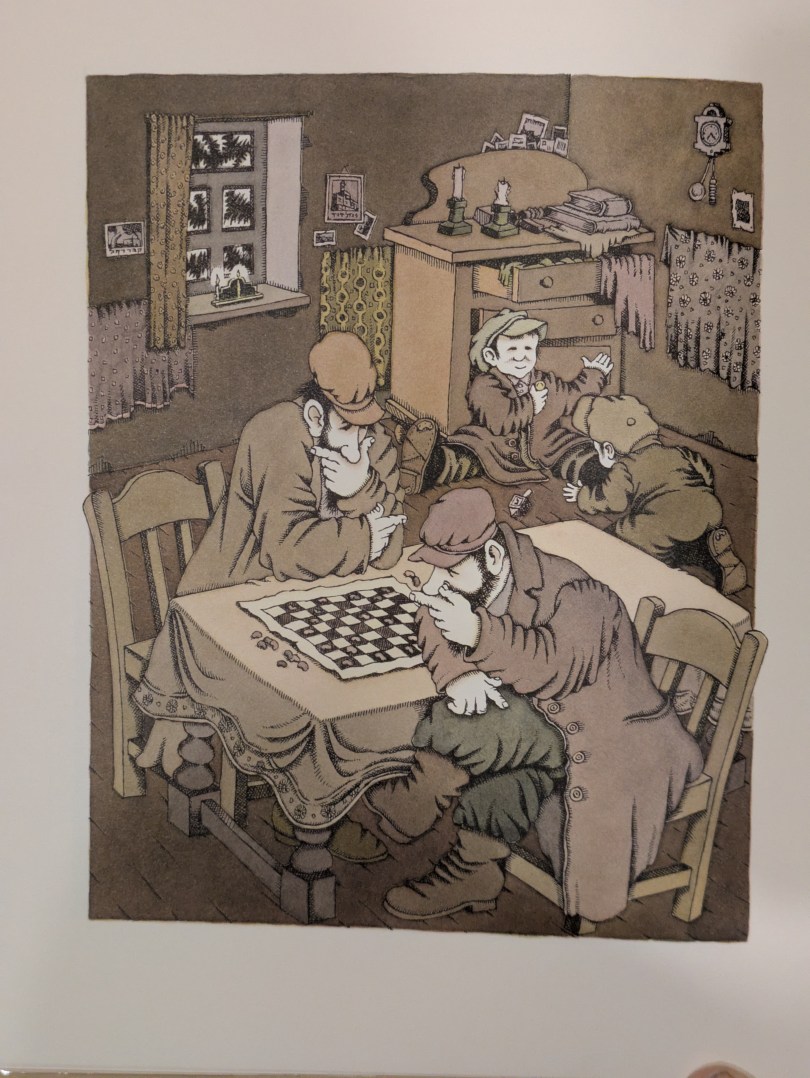
I did not grow up with the usual Uri Shulevitz books: Snow, for example, I only saw when I was older. The book I associate most strongly with Uri Shulevitz is not his beautiful, Caldecott Medal winning, The Fool of the World and the Flying Ship, and it’s not the more recent How I Learned Geography. All of those books are beautiful. They showcase a range of his talents. But the one I know best, the one from my earliest memories, has no glowing colours and now beautifully rounded story arc. It’s deliberately rough and deliberately awkward. It’s drawn with attention to detail, masterful skill, and a loving respect for each figure in the book, each character, each article of clothing. And these figures are often a bit ugly, the clothing ill-fitting, everything feeling somewhat exaggerated, a bit of a caricature, the oddity capturing, underneath, a deeper truth.
The book is Hanukah Money by Sholem Aleichem, the art by Uri Shulevitz deftly leaping to catch the meaning of each word, draw it forth in sepia tones, and highlight how, in this story, this book, this scene from the Old Country is gone. It was once, perhaps, a reality, though the deliberately folktale like character of the book casts it into fiction. Once, people lived in shtetls; it was a product of injustice but it was a way of life for many Jews. That ended. It was another injustice. And, after the Shoah, through which Uri Shulevitz lived, well. The people were murdered, the way of life they led was gone.
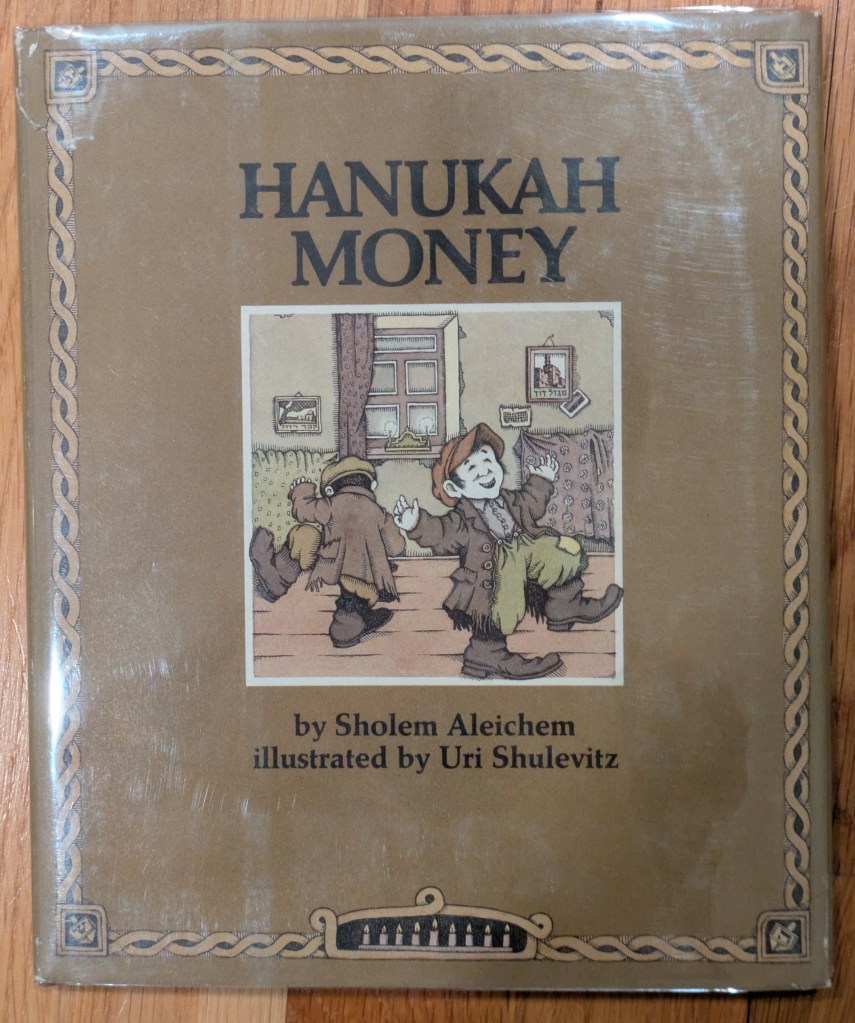
The folktale quality, the fiction, the funniness, all carries a terrific pathos, a massive discomfort which bothered me terribly as a child, because I sensed something was wrong. If you’d asked me, I probably would have said that it wasn’t pretty.
No, it’s not pretty. Because it’s beautiful. It’s full of odd and funny uglinesses, and it’s art of the very highest register.
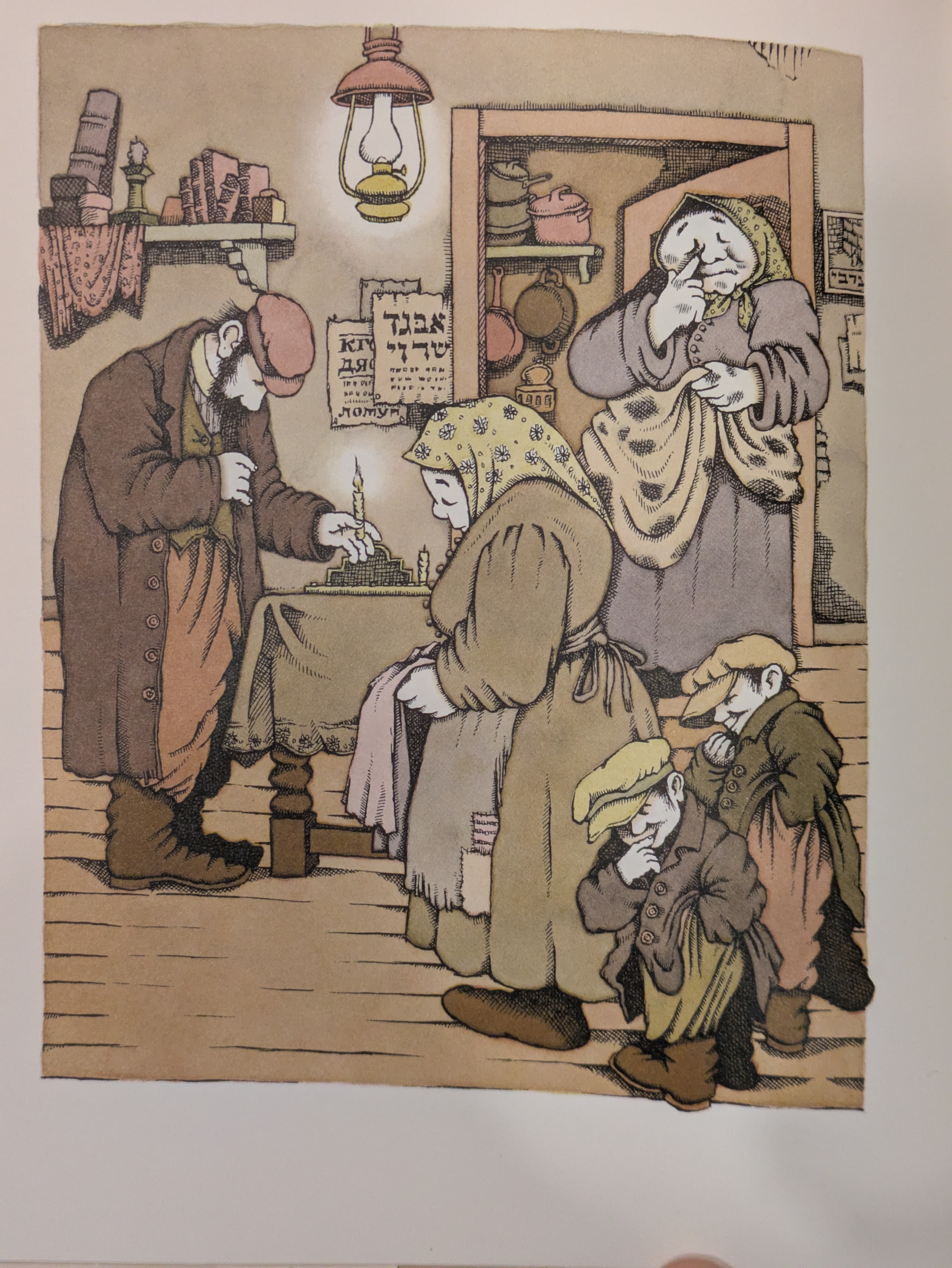
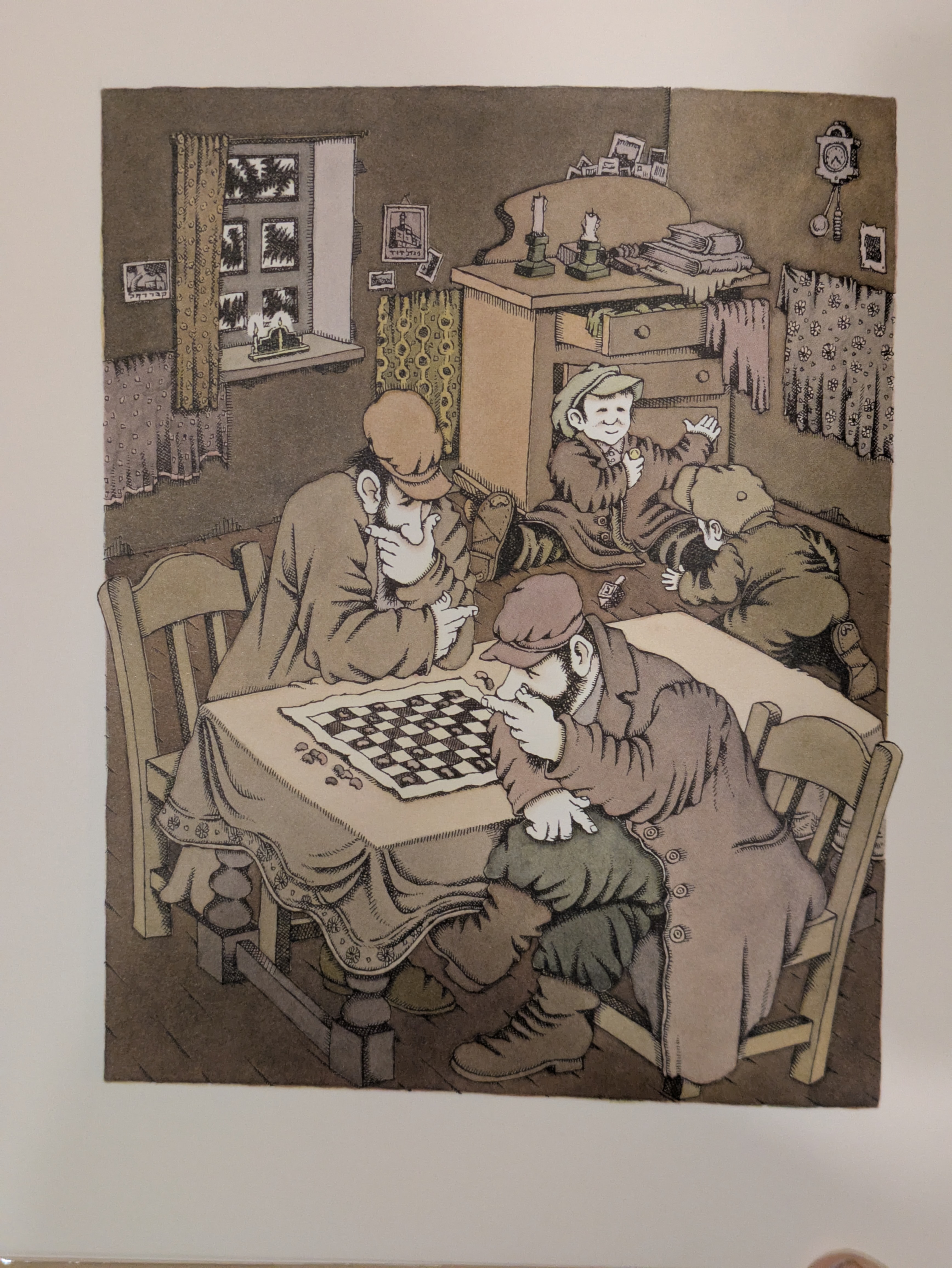
What a bizarre combination. How astonishingly strange, a beautiful book of awkwardly unattractive bits and bobs and people! But what comes through in this pathos, this sadness, is love and celebration. Uri Shulevitz is honouring these beautifully odd people who led such hard lives in such an unjust world which gave them so few chances. He takes that folkloric quality and with tender respect renders each person with careful humour, a delicate fineness of lines and shading. The children are handled with particular fondness, but the funny little scene when Aunt Pessl calls to deaf Uncle Moishe-Aaron captures so much in one page that I feel a little smile creep over me every time I look at it. How often has that wife yelled to that husband, barely a foot away? How often has he grumbled? How often have those kids looked on, thinking nothing of it, really, just waiting for some Hanukah money?

What comes through is a very deep sense of honesty, of artistic truth and integrity, and of dedication to giving life to this bygone world, cruelly robbed of life. When you look at Uncle Moishe-Aaron, he is wearing ripped and torn clothes, carefully patched, in a ripped and torn world, carefully restored in these pages.
The world, now, feels ripped and torn to me. There’s a gigantic, gaping hole where Uri Shulevitz was. His work is monumental, but when you look at it, so much of it feels like these moments in Hanukah Money: small moments, odd people, treated with gentleness and respect. The Fool of the World is a strange boy, and his parents barely notice his going. But Uri Shulevitz dismisses the brilliant older brothers as they walk right out of the fairy tale, and, per fairy tale tradition, we walk with the last and the least. But something struck me, in reading it to my Spriggan: the music. The Fool of the World is always singing. We sing with the Fool of the World, and the art sings, too.
The world is ripped and torn. We Fools of the World can be odd and imperfect, awkward and ill-fitting. But Uri Shulevitz taught us to honour even the uglies, even our last and least with deftness and care, with attention to detail, with loving lines and respect for each patch on a worn out coat. We may be hurt, but we should find our companions and sing together. Put a map on the wall and dream of difference, of possibility, and of each other, with singing colours and harmonized oddities.
I don’t think I’ll ever stop thinking that the loss of Uri Shulevitz is a gap in the world. One more gap in a list that feels far, far too long by now: Lore Segal, Tomie De Paola, Eric Carle, Kazuo Iwamura, Ashley Bryan, Lois Ehlert, Jerry Pinkney… I am struck by how many names come to me so very quickly, each a very keen pain. But I am grateful for what Uri Shulevitz gave us through his life and his years of dedicated work: beautiful art, respect for those who were diminished, and honest love for even the last and the least. Let us not forget that he chose to create his exquisite work for children. Let’s carry on doing just that: giving only the best and the most brilliant art to our children.
 The Children's Bookroom
Lovely obit, Deb. Did we have any of his books?
LikeLike
We definitely had Hanukah Money. I don’t remember that we had any others, but I would ask your nearest and dearest about that.
LikeLike