
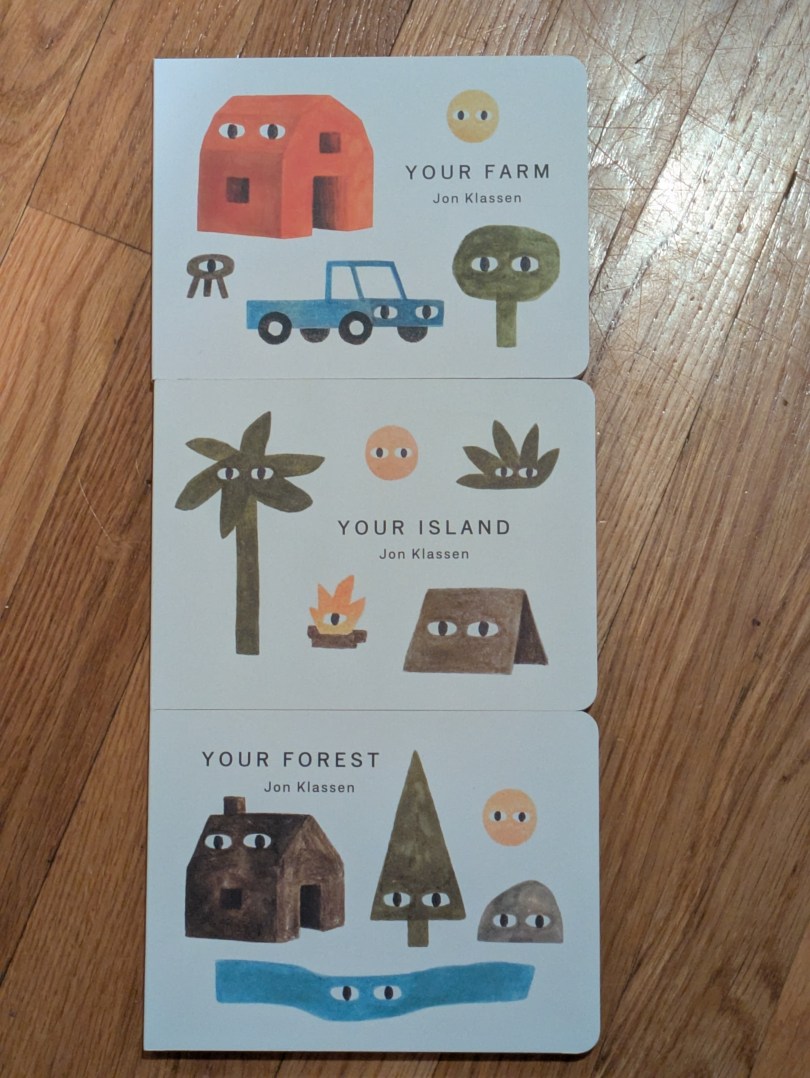
I was about to begin this post “I think that you’d have to be living under a rock not to have heard of Jon Klassen’s new board book series,” and then I paused. I reflected. I think that sentence says everything you need to know about me. If I’ve learned one thing in my years on this planet, it’s that, inexplicably, people don’t pay attention to children, and to things pertaining to children. I find this infuriating. So, while I was thinking, “Oh, everyone out there knows that Jon Klassen has made a board book series, I’m sure,” it turns out that, as a matter of fact, that assumption was incorrect. I am here to correct this problem. Please meet: Your Farm, Your Island, and Your Forest. The very titles, to me, gently but very definitively orient the books and the read-aloud scenario around the child.
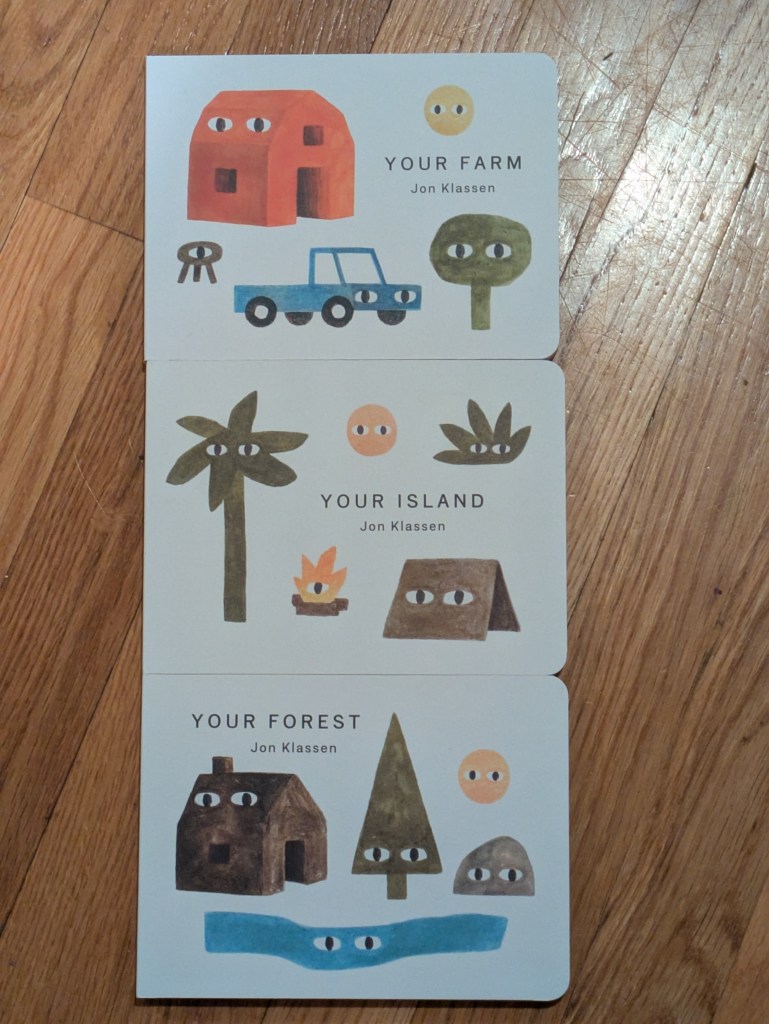
I do not normally think of Jon Klassen and “inexorable” in the same sentence (I have not met him, alas, but he seems gentle and lovely), but he inexorably leads the reader to put the child first, and allows the child to play in these worlds as the prime mover of their own space. It seems (based on, I want to say, if I remember correctly, some Instagram posts on the Candlewick account, but you’ll have to dig it up yourself) that he was inspired in making these by felt books where you could arrange shapes to create scenes and stories. Not only did he have these growing up, but his mother has these sets (designed by him, made by her, I believe) for sale, because an insanely talented creator like that clearly gets his skills from somewhere! Jon Klassen’s mother seems amazing, I’m just saying.
You can easily imagine, looking at those simple, cleanly designed shapes, moved around and organized neatly on the page (each shape is introduced on the right side of each spread, then tidily placed on the left), a child picking up a tree or a rock and placing it somewhere. As an adult, you beam inside thinking how nicely behaved that child is. Then, reflecting for a minute, you probably acknowledge that at the end of the game it’s all going to get thrown in the air and the pieces will be scattered. A cat might chew on one of the felt shapes. But this? This is a board book. It stays put. It is calm, it is organized. And the gentle amusement, the chuckles we get from those shifting eyes, all come to a close with the beautiful rising moon, making these ideal sleepy-time books.
The loveliness of the atmosphere calls to mind Taro Gomi’s gorgeously balanced, occasionally mischievous board books. One of my favourites is Little Chicks in which the chicks run and move and– whoops, there’s someone to avoid!– until they’re safely all the way home. There’s a quietness, an atmosphere that rounds out the “start, middle, end” structure rather than relying on an overly engineered plot or a scene squashed helter-skelter into cardboard pages. Well, that comparison is clearly not by happenstance because in the NYT piece I linked above, but am linking to again because it’s better worth reading than this but not as well worth reading as the board books themselves, Jon Klassen cites two board book influences: Taro Gomi and Sandra Boynton. (Sandra Boynton: if you’re reading this, send me a note, because I have so many questions for you about The Going to Bed Book, a work of literary genius.)
If you’re a board book connoisseur, you will instantly be intrigued because those two are very different one from the other. You will also be impressed, because they are, simply and bluntly put, the best creators at this format.
Board books are hard. I will up and say right now that even Jon Klassen (and I love Jon Klassen and am angry he’s not yet received the Nobel Prize for Literature) did not get himself added to Sandra Boynton and Taro Gomi as “the best at this format” in my personal pantheon. He’s pretty damned close, though, because his method in this series and his approach to the format as a whole are both brilliant. He centres the child and forces the reader to accord the child the attention and agency of building a world. The feeling of reading these with a child on your lap is perfect love. Further, he gives a span to the book not by cramming a plot that’s too big and unwieldy for a board book (a common error) into the cardboard pages, but by giving each the natural arc of a day. Simple, natural. The absolute best of the trio, to my mind, is Your Forest because of the ghost. My co-reader adored that ghost and was so satisfied the ghost came out at night as promised. Every book creator should keep promises with the attention of Jon Klassen.
And why does he do that? Because Jon Klassen respects his readers, these small ones as well as the older child. I love these books, and I think he even has room to grow as a board book creator if he has a mind to. And one thing that satisfies me in my deepest heart, the soul of my soul, is that I know that if he doesn’t think he’s got another board book to share, Jon Klassen will not squeeze one out. Like that felt book above, like the places he hands to the smallest children for them, like the bear seeking his hat– Jon Klassen takes the quality of what he produces seriously.
He admires the witchery of Sandra Boynton; I admire the craftsmanship of Jon Klassen. And both of those creators admire and attend to the genuine readership of their non-reader audiences. They respect babies, toddlers, and children. I think we all should.
 The Children's Bookroom
Deborah,
Your observations are so wonderful. I always learn when I read your reviews. Thank you!
Susan
LikeLike