
First thing, before I hop into the review for this page on this day– I have another review up somewhere else, and I’m more than a little pleased with it, so I’m linking here: a review for Two New Years by Richard Ho and Lynn Scurfield over at JArts, a book I reviewed separately here! My review at JArts is a happy reflection on how JAHM and AAPIHM share the same time.
Now, over to Ferris! I wasn’t going to write about another Kate DiCamillo so soon after writing of my love for Orris and Timble, mostly because I didn’t want to seem like a total Kate DiCamillo fangirl. And then I thought… Well. The public has a right to know the truth. I pledge my allegiance to Answelica the Goat.
Some authors and illustrators are just like that for me. And why not? When there’s a new Sergio Ruzzier I rush to find out what the new oddness will be, and I have never once not wanted to revisit his characters endlessly. Kevin Henkes will always, always have me say, “Oh yes, that’s true!” in surprise at some simple view I would never have thought of without his gentle direction. Grace Lin’s deftly painted beauty merges stories so that I get the urge to step right in the way I used to want to walk through the looking glass. And so on.
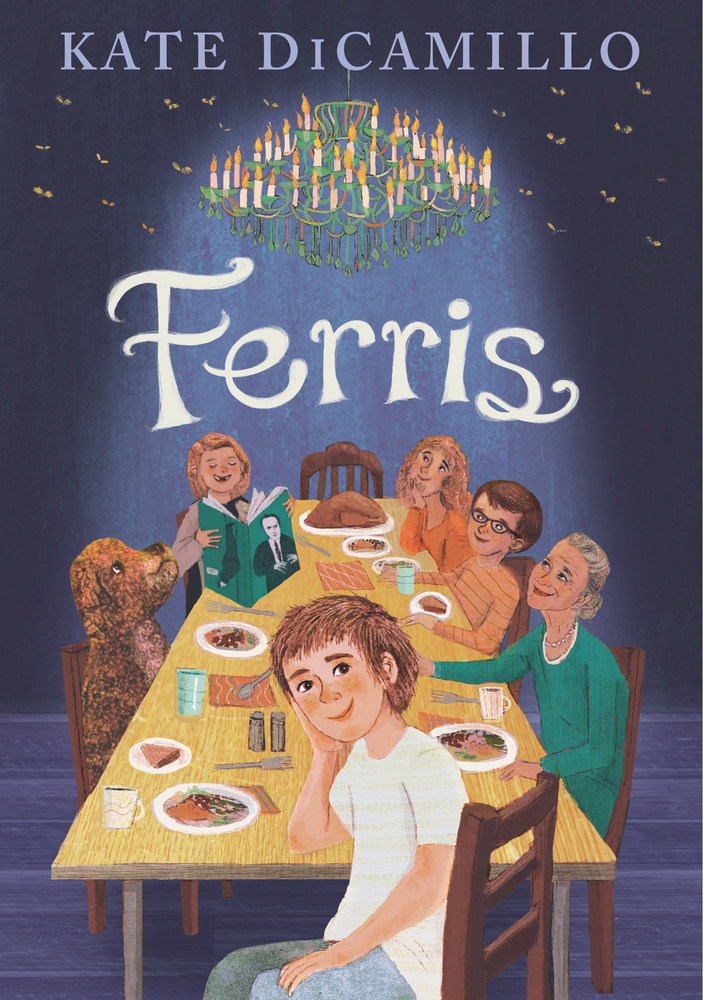
Kate DiCamillo’s Ferris had me surprised I couldn’t just look up and talk with Charisse or Billy Jackson.
When I wrote about Orris and Timble I spent way too much time talking about signposts, and how elegantly Kate DiCamillo doesn’t use them, and honestly I could have done a better job there. So I’m trying not to repeat that error in talking about her casts of characters, and yet– I’m not fond of how we talk about characters these days. They’re so often either “fleshed out” on the one hand or bland and two dimensional on the other.
Kate DiCamillo does a fantastic job of building characters who leap to life in your mind as humans, just humans. Each is different because each was a human being. And she wastes precisely zero words on telling you anything about them.
Being frank, I have no idea how she does this so elegantly, so deftly. The only other author I can think of who tells you so very little about a character and yet gets you so invested in them is Alan Garner.
You may or may not know what high praise that is from me. I can’t for the life of me write about his books, because they’re so perfect in themselves there’s no point in writing about them. It’s all in the books, and every attempt at writing anything further is useless.
Kate DiCamillo’s characters will have things they do, certain external traits or hobbies. Billy Jackson plays piano, Pinky wants to be on a Wanted poster, and so on. And yet each character has a full inner life, a soul and depth of their own that defies any wordy definition, so she just doesn’t bother with wordy definition. We, the readers, feel and apprehend that full inner life, that soul and depth, but it isn’t defined exhaustively in words on the page. Why bother?
We know that she knows that character. She knows each human in her book so fully that we, too, know them. And we love them, as full humans.
I have no idea how she achieves it, exactly, but she does.
And so, no matter how ready you may be to dismiss a character early in the book, I’m sorry to say that each of them will grow on you. You may think, “Here! This is the person I get to dislike!” Dreadfully sorry, no. As each character explodes into your mind with a human soul, as you see that they’re neither fully good nor fully bad but fully human, flawed and frail and ultimately lovable, you will be unable to cordially loathe them. The best I was able to manage was thinking, “I don’t think I’d want to get coffee with THAT character, but I get what they’re going through, at least.” (And, no, she doesn’t painstakingly spell out that “learning to empathize will help you be a better person!!!” either. She trusts you to learn or fail to learn.)
I can feel a certain impatience from anyone reading: “Right so you’ve told us that one character wants to be on a Wanted poster and another plays piano. But what’s the book about? What age group is it for? Who even are the characters and what do they do? Is the book realist, fantasy…? Can I put it in my social-emotional learning unit?”
You’re asking awful questions! Sit in the corner until you can do better! None of that matters. I have no idea what the book is about. It’s called a middle grade novel, and my end of Grade 5 Changeling loved it so much and dropped yoghurt on my review copy because she wanted to reread it and it’s a horrifically disobedient nuisance. (She is wonderful and you can’t have her, sorry.) Use it in any unit you like, or just give it as a birthday present to every single human you know, which is my personal advice. I’m planning on buying the Brookline Booksmith out of stock this afternoon.
What are books ever about? I have no idea, and I certainly have no idea with Ferris. The book will make you think, make you feel, and if it doesn’t tear your heart open to let you appreciate the richness of what humanity is made of a little more… That’s absolutely not Kate DiCamillo’s fault.
I really don’t know how she does it, but I know that I’m entirely grateful she does.
 The Children's Bookroom
[…] curiously well-read, and a little owl who wants to hear stories. I have written about characters in Ferris who don’t so much leap off the page as beckon you into it. And I’ve written about A […]
LikeLike
[…] about, simply forgotten about, or given up on most MG or YA novels I’ve read or started since Ferris, which, of course, I adored. This isn’t universal, of course. I’m deeply invested in […]
LikeLike