
Full disclosure: both books in this post were ones I got as review copies. Mind you, I’d already pre-ordered A Spider Named Itsy by Steve Light, and as for Two New Years by Richard Ho with art by Lynn Scurfield? When it was offered to me I couldn’t reply “yes, please!” fast enough. Some books you just get a feeling about.
If you know anything about Rosh Hashanah, the Jewish celebration of the new year and the anniversary of the creation of the world, you’re probably looking at this pair of books in bafflement: “New Year, that I understand… but spiders? Itsy? Is she meshuggeneh?” Well, I mean, yes I am crazy. But also I’ve got a very good point, so please pay attention.

Steve Light, first of all, is a genius. Let’s just get that said up front. Also, he’s one of the nicest people out there and towards the beginning of the pandemic he sent my daughter a picture of a wombat he drew along with a notebook for her to sketch in. The wombat is framed on her wall and the notebook is full of scribbled pictures, embedded in a mass of other scribbled notebooks.
I remember that now because that period of the pandemic was hard for everyone. We were uncertain, scared, and the book industry was hard hit. The big, robust, fun animals Steve Light was drawing at the time were as different as could be from his swift, lively, delicate yet strong ink drawings of little bugs in A Spider Named Itsy, a style familiar from his vivid and energetic art in Swap! and Road Trip!. At that point in the pandemic, we needed to play, to feel we could be strong and still have fun and climb up the waterspout again.
A Spider Named Itsy asks and answers questions with incredibly compact text and proportionately exuberant art: What prompted Itsy to make that climb? Was Itsy alone? What’s the end of the story?
The words are sparse, sticking as much as possible to brisk, active language: “Need a new home. But where? There! Must get going! Wind is blowing!” What need for articles and pronouns? None! (Added benefit: while the flap copy does provide he/his pronouns, no need to tell the kids that, and they can build characters as suits them. But I have no idea whether that was deliberate– it just feels natural to the sprightly nature of the text to keep it trim, forward moving, bustling onwards.) Itsy climbs up and up– along with other bugs escaping dangerous earthbound conditions. Once up, they’re all washed down. And, working together, held together by Itsy’s strong webbing, they finally make it up to create a new web home, and enjoy a meal together as friends.
The story is so much fun to read aloud. My Spriggan has asked me to read it several times, and every single time, a crowd of other children has drifted around us. The Spriggan is a few months shy of three years old, and the Changeling is ten. The other audience members have covered every age between. And every single time, without exception, someone starts singing the song at the end. I challenge you not to. More than once, also, the older kids started comparing finger motions: “I do it this way, because that way you get all eight legs, you see?” “But my way is more of a fun pattern on the way up!”
Which is the point, of course. Going up again, and maybe having fun on the way. In every life, we all know, we get washed down the waterspout. The pandemic has been a biggie– and though we like to pretend it’s done with, for many people the challenges persist. (I write feelingly: my brain fog is not over and done with though Lord knows I’d like it to be washed down the waterspout, over the hills, and far away!)
Steve Light, the creator of that fun wombat in the depths of a painful time, is just the person to show us, as we face a new year, how to get up, persist, and climb that waterspout again. He doesn’t do it gloomily. He doesn’t preach it. He sticks to the verbs and skips over any flabby text.
But if you want commentary, look at his art. Do you see those little bugs with all their worldly goods strapped to them? The first time I saw them on his Instagram account, before I held a finished book, they evoked a memory. In the runup to publication, he elucidated, and it clicked: the Dust Bowl. I wasn’t imagining things; it was pretty direct. If you’ve ever seen pictures of families during the Dust Bowl with all the goods they could pack strapped onto a Model T, looking for somewhere, some way, to survive, grimly picking themselves up and climbing again, those sturdy, busy bugs will look familiar.
And yet it’s neither patronizing nor depressing; the fact is, Steve Light is telling a truth in this book. It’s not easy to pick up and start again. It’s why, on Rosh Hashanah, we come together, we blow the shofar, and we reflect and think and pray. We celebrate, and we are also looking forward to the very serious work on Yom Kippur, when we repent and think and plan changes. This is not in any sense a religious book, but to me it evoked a spirit of the honest, hard work, the introspection without navel-gazing: you have to think, yes, but you must also pick up and do the work. Kids are really, really good at that. Read this with a kid, and you’ll find yourself laughing, singing, playing, and also ready for a new year and new work.
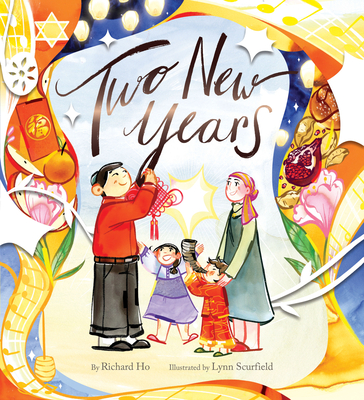
Two New Years by Richard Ho and Lynn Scurfield is an entirely different, and, to me, entirely new kind of book. The closest I can think of, in narrative style, is the Canadian classic Le Chandail de hockey by Roch Carrier and Sheldon Cohen. The text is much, much shorter and simpler, but, like Roch Carrier, Richard Ho isn’t pretending to be a kid as he describes his dual world, the Jewish and the Chinese: “My family celebrates two New Years,” he tells us, and he’s not talking down to us, adult to kid, and also not using a fake child’s voice. The text is simple, direct, and plainspoken. The art, too, is unpatronizing and evocative of the richness of two traditions. Perhaps my favourite spread is one of the adult Jewish woman (representing the mother of this family) in her headscarf and wearing a magen David necklace on the left page, holding hands with her husband, wearing a kippah, on the right page. Behind her is a papercut in the style of Jewish artistic tradition, while behind her husband (who looks a great deal like Richard Ho!) is a Chinese style papercut. (You and your kids can have fun picking out the symbols in the art– I love the dragon, of course, and the sheep.)
What I particularly love is exactly that interleaving: like Roch Carrier, Richard Ho keeps it slow, simple, not pushing a “beginning, middle, end” narrative. (Please imagine a rant here about the enforced necessity of a story arc in every single book. I don’t feel like writing it right now, but thank any deity you please that Richard Ho ditched that for this book!) In an odd way, while A Spider Named Itsy is brisk and active while Two New Years is slow and gentle, they share a compactness. That compactness is a shedding of anything ancillary. Two New Years allows the reader to look at the illustrations and build the characters of the family members behind this lovely spread of rituals and tradition: Who’s making and enjoying these foods, the challah and the dumplings, all of the varieties of fish? Who are the bubbies and zaydies, the ma mahs and yeh yehs? We imagine, but aren’t told.
One particularly special moment for me was seeing the mother in a headscarf and the family at an Orthodox synagogue, just like mine, in a book shared with Chinese culture. I’m a proud Ashkenazi (that’s of Eastern European tradition) Orthodox Jewish woman, and the mother of a child whose earliest favourite author was Grace Lin. I love to see Judaism sharing a page with other traditions, and this is one of the few examples I’ve seen where it’s done with unpretentious simplicity, honesty, and beauty.
(I’m never one for much backmatter, but I have to admit I really liked it this time– the author’s note was particularly beautiful and the visual glossary is exactly the kind of thing my Changeling loves.)
So as we head into the new Jewish year, that will be the year 5784 in the Jewish calendar (but you have to wait until February 10, 2024 for the Lunar New Year, which will be the Year of the Dragon), think about trying out these two books!
 The Children's Bookroom
[…] Heritage Month, so I think everyone has to be extra special celebratory about Richard Ho’s Two New Years, just saying.) Now, there’s a big whomping chunk of Jewish American Heritage that a huge […]
LikeLike
[…] for Two New Years by Richard Ho and Lynn Scurfield over at JArts, a book I reviewed separately here! My review at JArts is a happy reflection on how JAHM and AAPIHM share the same […]
LikeLike