The Wonderful Pigs of Jillian Jiggs

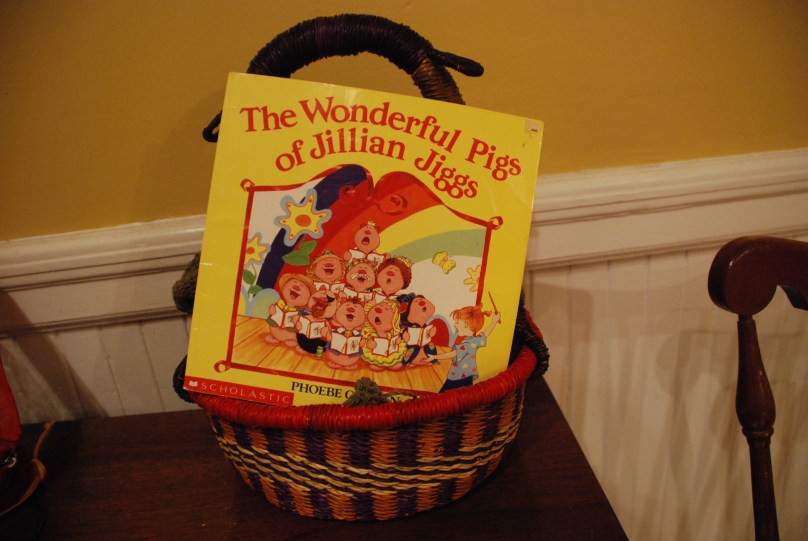
Today is most unusual in this little corner of children’s book blogging.  Normally I choose books to write about by a carefully honed algorithm of “oh, this book’s great, I really feel like talking about this one!”  Yesterday, Annabelle inspired me.  “Yes,” thought I, “she’s so amazing!  Who’s another kick-ass female protagonist in children’s books?”  And my absolute favourite, bar none, popped right into my head: Jillian Jiggs.  There are a number of books about Jillian Jiggs, but the one that was easiest to hand today, and which I truly believe best illustrates her as a kick-ass female protagonist is The Wonderful Pigs of Jillian Jiggs, written and illustrated by Phoebe Gilman.  Note that I linked you to AbeBooks, because that’s the easiest place to get it these days (oh boy, anger’s bubbling…).  Here’s the Scholastic Canada page, but how you actually order it is a mystery to me.  You basically can’t find it in the United States (growl…), and if I don’t stop myself right here I’m going to end up using language most unsuitable for a mild-mannered blogger of charming children’s books because holy fuck why is it so hard to find this book south of the border?  Someone, please, get to marketing this book pronto or I may have to start a cross-border march: “Bring Us Jillian!”  (Note that these are pictures from my camera, since it’s hard to find good pictures online.)
DSC_0455

OK, let’s start off by thinking about those words “kick-ass female protagonist.”  I want to be clear right here, right now: I’m not talking about a trying-so-hard didactic book about how “a girl can do that, too, you know!”  That’s boring and insulting to everyone.  Of course a girl can “do that, too” (except in exceedingly specialized cases inappropriate for children’s books), and I don’t admire patronizing dreck.  I’m talking about a good book: a book which is about a kid who has crazy ideas, follows through on them, grapples with challenges, and comes out triumphant.  Her name is Jillian Jiggs, and I love her.  I love that she’s a little bit crazy and thoughtless (what kid isn’t?), I love that she reminds me of some of my favourite people rolled into one (crazy ideas like my sister, bubbly like my best friend, problem-solver like another one of my friends…), and I love that she cheerfully pitches into her projects head-first because what could possibly go wrong?  I love that she acts quickly and faces consequences later– and there are consequences, because this is life.  I love that she is, in every way, a real child, but maybe does some of the things we dream of, as children, but don’t quite dare to do.  When I was little, I know that I dreamed through Jillian Jiggs, much as I did through Pippi Longstocking, later.

So, what are her crazy ideas?  Well, one day, Jillian Jiggs cleans up her room (wonder of wonders!), and, in the process she finds a jar full of buttons that look just like the noses of pigs.  She makes little pigs out of tights and plans to sell them.  She makes all kinds of little pigs, in all kinds of outfits– lady pigs in old-fashioned lace, vampires, pirates, and babies.  She even names them!  (Oh, you know where this is going, don’t you?)  She and her crew (her little sister and her friends, Rachel and Peter) gather all the pigs and march down the street to sell the pigs.  Her customers line up with dimes in hand, ready to buy her entire stock… and then crisis hits: Jillian Jiggs loves her pigs.  How can she sell them?  But the mind of the truly creative entrepreneur finds a way!  How about selling a how-to lesson, instead?  (Seriously, someone get Craftsy on the phone with Jillian Jiggs!  This could be big…)  The disappointed and angry customers (and Phoebe, genius that she was, shows you the whole range of emotions on those little faces) become happy customers, and everyone’s satisfied.

That’s the basic story, and I think you can see how plucky and creative Jillian is.  But that doesn’t nearly get across the exuberance and joy of the book: that comes through the lovely rhyming  couplets, Phoebe Gilman’s extraordinary art, and the unspoken message, reinforced by a tutorial at the end, that you can do it, too.  Go on, give it a try!  Even without being able to understand the tutorial page, my Changeling announced that she wanted to make a pig, too: Jillian’s excitement is palpable throughout the book, the gleam of the next great idea fairly bounces from page to page, and it inspires you without ever directly instructing you to be inspired.  How about a doctor? or robots! or maybe a princess.
DSC_0460

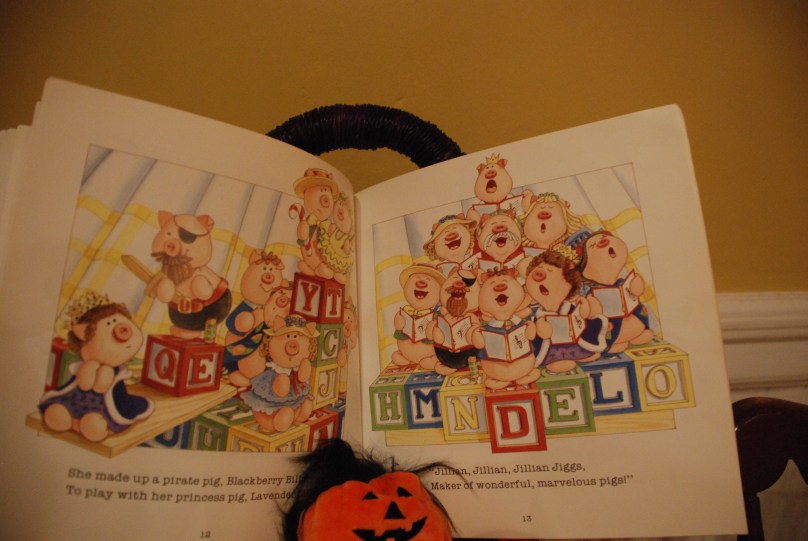
Each page murmurs quietly, “How could you dress a pig to get that idea across?”  And then the illustrations fill in the gaps: the stub of a pencil becomes the pirate’s wooden leg, while pipe cleaners make robot antennae.  Anything is possible in the world of “Jillian, Jillian, Jillian Jiggs,/ Maker of wonderful, marvelous pigs!”  And, you know, she gets caught up in her own work, too: “She might still be sitting there, sewing away,/ Except Rachel and Peter came over to play.”  We all love the pigs.

OK, scroll back up and read those lines aloud.  Then tell me: doesn’t that feel and sound good?  The whole book is that fun to read, especially when you get to do Jillian’s voice: “‘I simply can’t do it.  It’s over. I’m through…’/ Then all of a sudden she knew what to do./ Step right up, friends! Have lots of fun!/ Sew your own pigs! Learn how it’s done!'”  And, with that, Jillian takes her disappointed customers and turns the situation around.  (Note that, as with Here Babies, There Babies, you and your child should be able to find someone who looks like you at some point in the book; it just reflects life honestly, without making a fuss.)  A very successful startup, run by a creative and charming CEO, indeed, and one of Canada’s foremost proponents of the textile arts.  I love it.

I don’t know if I even think this is the very, very best of Phoebe Gilman’s books.  I have a special soft spot for Grandma and the Pirates, and for The Balloon Tree, and the original Jillian Jiggs book is fantastic, too, and then there’s the one book which did make it south of the border: Something from Nothing.  How to quantify which is the best?  Oy.  Look, give me a break, I am but a humble kids’ book blogger.  Another day I’ll write about another of her books, and then you can amiably argue over which is better– I sure as hell don’t know.  But, right now, while I was thinking about Annabelle, about tough girls who can go for it and do great things?  Jillian’s pig project reminded me a lot of the first day I sat down to write here for the first time: “Hey, here’s an idea!  Let’s go for it.”  And I hope the Changeling will have her own moments of “Hey, why not?” too.

Oh, and don’t let me forget– I need to rustle up some pig components.  I don’t think I have any spare tights in the house…
Extra Yarn

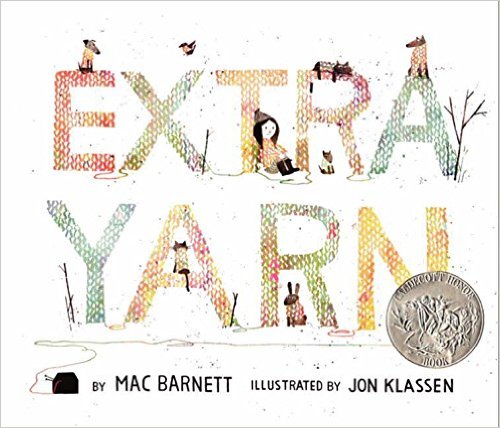
I have a friend.  Not just any friend; I hope we all have a fair few friends.  But I hope everyone also has a friend like my friend: when I was pregnant, this friend brought me a baby present.  This present was a book, which is already a good start.  The book was called Extra Yarn, by Mac Barnett, illustrated by Jon Klassen.  What this demonstrates is that my friend Knows Me, with those uppercase letters used consciously.  It’s wonderful when people provide you with good and useful things before you have a baby– soft blankets, sturdy burp cloths, pretty clothes.  It’s lovely, and I’m touched and grateful.  But when someone looks around and says, “Deborah would not want to bring her baby into a house without a charming new book about yarn and knitting for that child,” then?  Then you know that you should make that person the executor of your will (thanks, lady!).

Extra Yarn

Have you ever knit something?  Let me tell you: there’s nothing quite so terrifying as the moment when you’ve been knitting merrily along, feel your ball of yarn, and get an “uh oh…” feeling, as in, “That feels a bit… small?”  Maybe you weigh it to see if you have enough left.  Maybe you knit faster, trying to outrun the yarn.  Maybe you knit more slowly, on the basis that “haste makes waste.”  But there’s nothing like the sinking feeling when you’re sure, oh so sure, your yarn is going to run out!  But way on the other side of the spectrum is the placid security that comes with an assurance that you’ve got Extra Yarn.  Maybe enough for a matching hat?  Or matching socks for your baby?  You feel peaceful, at ease, even a little smug.  And that’s the peace we see in Annabelle, one of the most confident protagonists I’ve ever had the good fortune to meet in a book.  Let me tell you: I want to be Annabelle when I grow up.

The story is one of the most engaging I’ve written about here: Annabelle lives in a colourless town, but one day she finds a box filled with yarn of every colour.  She knits herself a sweater, but has extra yarn.  So she ends up knitting sweaters for everyone she knows.  Then for the animals, then for buildings and cars, and, through it all, she never runs out of yarn, she just carries on placidly knitting.  It’s a knitter’s fantasy.  Then an evil Archduke comes and steals the box!  Only, when he gets to his castle, he opens the box… and it’s empty.  He throws it out the window with a curse, but the box ignores the curse and goes back where it was always meant to be– with Annabelle.

I think this marks the first time I’ve written here about a book where the plot and character were the driving force in what made me fall in love.  (OK, yes, and the yarn.)  Annabelle, throughout the book, runs into mild to forceful opposition.  And yet she never talks back.  She never whines.  She never raises her voice.  She never caves.  She just carries on knitting.  You can see in Jon Klassen’s wonderful drawings: her face maintains a slight smile, and perfect repose.  To put it in a somewhat more blunt fashion, she shares John Scalzi’s Christmas gift from this year (I promise you want to click the link).  When her friend Nate laughs at her sweater, she says, “You’re just jealous,” and knits him one, too.  That shuts him up.  At school, her teacher scolds her for distracting the other students with her colourful sweater, so she just knits them all sweaters, too (and, I hope, teaches Mr. Norman a lesson– dude, don’t tell your students “You can’t.”).  And when the Archduke tries to buy her beloved yarn, she just calmly turns him down, over and over again, and sends him away.  As my sister would have said when she was little, Annabelle is a “big strong girl.”  More than that, she’s tough.  She’s resilient.

And that’s where I truly love this book.  Annabelle is the model here.  The adults don’t teach her; she teaches them, if they care to learn.  Some of the adults she meets are fun and give you a good chuckle (“Mr. Crabtree […] never wore sweaters or even long pants, and […] would stand in his shorts with the snow up to his knees.  ‘No sweater for me, thanks,’ said Mr. Crabtree.  So she made Mr. Crabtree a hat.”), but more often they’re minor obstacles.  I’ve mentioned Mr. Norman, the teacher who tells her off for distracting the class by quietly wearing her sweater, and who, when she proposes to rectify the situation by knitting everyone sweaters, expostulates, “Impossible!  […]  You can’t.”  Annabelle doesn’t answer back; she just does it.  And as for the spoiled, petulant, domineering Archduke?  Annabelle quietly carries on doing her own thing, sticking up for herself, and the yarn chooses her in the end.  He throws a temper tantrum, but she just carries on carrying on, and is happy.

This is just a story about a girl doing her knitting.  From Annabelle’s perspective, I think the world around her is just full of big opportunities and minor nuisances.  I picture her, if the book were turned into a movie (Oh my God, Mac and Jon?  Can you make that happen???  This would be such a good animated short!), occasionally sighing, or flashing that slight smile at Mr. Norman as she casts on a new sweater.  Perhaps the Archduke would elicit so much as a little shrug, as thought to say, “Dude, just leave me alone, OK?”  But her focus is on what makes life fun for her, not on the nuisances, and, in the end, she gets more of what she pays attention to: knitting.

The Changeling took to this book immediately.  “Read me Extra Yarn,” she’ll beg.  Or she’ll add it to the pile of books to take with us when we travel.  One of my very favourite moments was when she took it over to my friend, now her friend, too, and clambered onto her lap.  “Read it to me, please?”  And, as they went through the book, the Changeling did what she always does: “And she knit a sweater for the doggie!  And that’s a cat!  I see a bunny, and a bird, and is that the birdie’s house?  They all have sweaters!”  It’s enthralling.

I love seeing her admire Annabelle’s handiwork.  I hope, as she grows up with Annabelle, she’ll also learn just to do, and keep on doing, awesome things, no matter who tries to persuade her that she can’t or shouldn’t.  Just go for it, kiddo!

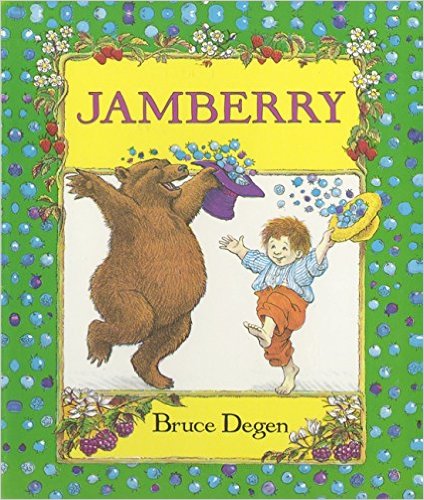
Jamberry

Do you ever get something in your head and end up chanting or singing and dancing your way around your empty house, possibly scooping up your poor, defenseless kitty in the process?  Don’t worry, I won’t make you answer that.  But I will reveal the full depths of my own embarrassment: for me, this morning, it was Jamberry, written and illustrated by Bruce Degen (I link to Porter Square Books, the marvellous, well-curated store where I bought my copy).  After reading it to the Changeling a few times this weekend, I couldn’t get it out of my head and spent the morning dancing around the living room, stumbling over Calico Critters, and swinging my patient cat through the air while chanting: “One berry/ Two Berry/ Pick me a blueberry!”

Jamberry

This was when I had a “click” moment.  I should know by now never to doubt my mother when she makes a remark about a children’s book, but when she compared Here Babies, There Babies to Jamberry I confess that my thought was, “Really?  I mean, they’re both rhyming stories, but so is Jillian Jiggs, for example, and, well, I just don’t see it.”  But after I read Here Babies, There Babies to the Changeling last week we spent a few days, as usual, chanting about babies in the most random places.  “I see a baby!” the Changeling would call from her stroller.  “Here babies, there babies…” and off she’d go.  That’s when Jamberry ever so gently started to nudge my brain again.

Then the Changeling started to play “going under the bridge” as she ducked under her stroller handlebar.  “And over the dam,” I went on, “Looking for berries, berries for jam!”  Next thing you know, we’re in full-on Jamberry mode: we read it a few times, and our natural mode of discourse seamlessly moved from Here Babies, There Babies to Jamberry.  We speak in berry rhymes (Merry rhymes, fairy rhymes, prattle in berry rhymes!  Sorry, folks, that one wasn’t even any good, was it?), we sing strawberries, we dance in meadows of strawberry jam… um, I mean in the living room.  It’s jubilantly moved in and taken over.

What is it about these books?  Why do they take over in a way that other charmingly rhyming books don’t?  There are lovely rhyming books, such as Each, Peach, Pear, Plum or Jillian Jiggs, books I desperately want to write about here.  They entertain when you read them, and then nestle nicely back onto the shelf when you’re through.  They don’t take over your tongue and make you dance in your sheepy pyjamas for the next day.

Partly, of course, it may be a question of metre: Jamberry‘s initial dactyls (“One berry/ Two berry/ Pick me a blueberry.”) rumble along like a folk dance to a drum, but then swap out for longer lines, most of which end with a bouncy stressed syllable: “Under the bridge/ And over the dam/ Looking for berries/ Berries for jam.”  This slight shift sweeps you along with the canoe in the picture, and if you don’t find yourself swinging your child on your knees?  Well, that probably means you decided to swing your child in your arms instead, right?  Right?  You’ve gotta move with this one, you really have.

And that’s because this little story here isn’t about the story.  Like Here Babies, There Babies where the emphasis is on the babies around you, not on a specific tale, Jamberry does have characters and a plot of sorts, but the emphasis is elsewhere: on jammy jubilation.  I don’t think I’ve ever read it without laughing at least a little at one point or another.  The beat and the song of it, the increasingly zany pictures, the berry-stained fingers and mouths, and the sudden urge to grab a pail and find some berries… well, that’s what this is about.  You read it and feel celebratory.  You read it and feel warm sun and sweet berries.  You read it and sing.  You read it and dance.

Oh, and there’s also a boy in there, and he meets a bear and they pick some berries.  Not really sure about how the bear has a hat, but he seems like a nice bear.  And I think that maybe CPS should check on the kid’s family because he seems to be seeing elephants skating on raspberry jam, which is, in my experience, unusual.

You see?  This is not a book where you should, as it were, focus on the story.  Sing it, move to it, dance your kid around to it– but, for the love of God, check your logic at the door.  (Which is, of course, where it differs from Here Babies, There Babies, initially leading me to doubt the wisdom of my mother.  That book feels intensely real, leading its own singsong verses to blend into the world around it.)

I’d add one last note here: Jamberry‘s fantastical celebration of berries is so very zany, so ebullient, and so jubilant that it really has a tendency to break through barriers and take over.  As I said, it takes over language and makes you hum it over and over.  It makes you use words like “ebullient.”  It also takes over seasons.  It might be February (albeit a very warm February), but it feels like June when you read Jamberry.  It’s really the polar opposite of Moominland Midwinter, which, as I noted feels like the epitome of winter.  Moominland Midwinter I only ever feel like reading when it’s starkly, icily, snowily cold.  Jamberry?  It makes February into June and has me wondering where I can get strawberries that taste like something.

What does the Changeling think?  “Berries for jam!” she cries, flinging her hands up.  Does she eat jam?  No, absolutely not.  Never, ever, ever.  (She won’t touch ice cream or candy, either.  I’m thinking of asking the doctor if she’s OK, and what else we can use as bribery.)  But she does love the pictures, and she does love the words, and the animals, and berries.

So, what can I say?  Even if you don’t have a kid handy, get out your copy, and start dancing at your own Jamberry bacchanal!

The Tea Party in the Woods

I sometimes wonder if other people grew up in families with a favourite time period.  Ours was the Romantic period, I often think.  Let me explain: I don’t mean that my family’s house was furnished in a particular way (although our living room furniture is lovely) or that my parents dressed us in replica 19th C clothes, or that they dressed up.  They’re very practical, sensible people and would raise their eyebrows at the suggestion (or will send me a caustic email if they read this).  What I mean is that living in our house was an immersion course in love of the Romantics: there was an awful lot of Romantic music and literature around, and I grew up knowing that if you were talking about the “fantastic” in Romantic literature then there are certain rules or keys to look out for.  My favourite was always that when the fantastic episode was over, it could almost never have happened… almost, except that there might be one sign which would raise doubt: a rose in the wrong place, for example.  Did it, or did it not?  (Hey, if I got this wrong, Daddy, you can correct me.  After all, I never studied this stuff, I just grew up hearing you talk about it!)

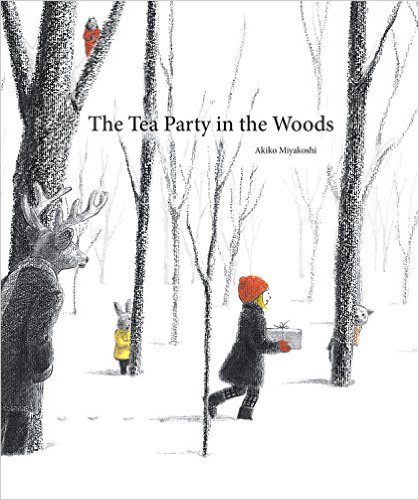
The Tea Party in the Woods, written and illustrated by Akiko Miyakoshi could almost be a starter story in the fantastic.  Almost, except that it defies adult expectations.  This book, the other Kids Can Press book I found at the Harvard Book Store, is translated from the Japanese, with the English edition edited by Yvette Ghione and Katie Scott.  It is beautiful to read, and beautiful to look at.

Tea Party in the Woods

The story goes that a girl, Kikko, realizes that her father has left the house without the pie he meant to bring to her grandmother.  She runs after him with the pie only to realize, at last, that she has followed a bear, not her father, and has ended up at a strange tea party of animals in the woods.  In her rush, she had crushed the original pie, so the animals provide her with a new one assembled from the tea party, and guide her safely to her grandmother’s house.  The illustrations are all a soft, dreamlike black and white, with pops of vibrant colour in Kikko’s red hat and mittens and yellow hair, as well as occasional red and yellow sparks among the animals.

Any adult reader, educated by the experience of reading Alice in Wonderland, watching The Nutcracker, or just spending five minutes talking to my parents, would go in with certain expectations.  The animals are evidently a quasi-dream sequence: maybe they are there, maybe they aren’t!  We know this because the soft, charcoal-like dreaminess of the forest tells us that we’re in for dreams here.  Of course this is going to be your child’s first book about the fantastic and she’s going to learn the rules of that type of story.  (Let me note that the Kids Can Press page I linked to above even says, “The ambiguous ending — in which it is not clear whether Kikko imagined the tea party or if the animals simply disappeared back into the woods — provides a terrific opportunity for children to weigh in on what they think happened.”  I think it’s lovely that they let parents think that!)  Well, the thing is that Kikko is very clear at the end about what happened:

“You’re never alone in the woods,” Kikko answered, smiling.

She was sure her new friends were listening.

I love that ending, fiercely and passionately.  She knows what’s going on.  This is no Alice waking up and having a curious dream.  This is no poor, messed-up Dorothy.  Kikko is confident, she’s clear on what’s happened, and she’s moving forward, smiling, surrounded by friends.  She shares her red and yellow with the animals in the woods, and they all share the dreamy black and white.  Kikko, the animals, your children reading this–all of them know the rules here: what you think has happened, has happened.  Don’t doubt, don’t be scared, it’s fine.  The bear is a bear, even if he is wearing a coat and hat.  The parents?  We’re the ones at sea.  We, lured on by years of reading ambiguities and dreams, expect doubts, distrust straightforwardness.  Kikko surprises us, and I have never, ever been happier to be surprised.

I thought this was going to be a lovely, sweet book.  I expected a fairytale tenderness and shyness, maybe with just that special tinge of the strange and fantastic.  I got that, but I got something more: I got a confidence in dreams and reliance on the fantastic which I hadn’t experienced since… oh, I don’t know.  I guess maybe I had that when I first heard La symphonie fantastique?  Before I got really sick of the second movement when 96.3 FM in Toronto played only the second movement every single day of the week, blast them.  In any case, The Tea Party in the Woods restored a sense that strange things really can have happened for sure, that children really can rely on their senses– and that sense and nonsense aren’t so far apart.

What’s really special, though, is that reading it with the Changeling made it so clear that we were each reading with our own, very different, experiences.  I noticed no surprise in her: talking bears aren’t so unusual, and so she went along with Kikko very happily, and the whole thing made sense.  Her only concern was in accurately identifying every single blasted animal in the book, and there are a lot of them (note to parents: maybe spend some time looking up the animals first so that you can answer questions readily and actually get through the story in under an hour); she didn’t mind about the ending at all.  I was the one who felt surprise.  I was the one who had my world shaken up.  She was on solid ground, among her own kind.

That’s a special moment to experience, watching your child’s confidence while you learn something.  This book puts the power in the child’s hands, and that?  That’s truly fantastic.

Itsy Bitsy Spider

Do you hate Itsy Bitsy Spider as much as I do?  The boring, slightly droning, melody, the pointless story, and, well, not to put too fine a point on it… the protagonist, an eight-legged beastie?  Not that I’m particularly scared of spiders.  My sister always was, but I was the one who killed the spiders: Deborah Spider-Slayer, you might call me.  In point of fact, I’d say that I have more cause to be afraid of spiders than she does, because if there were a conference of spiders (ick), then they’d probably look at me, with the blood of countless innocent spiders on my hands, and instantly slap a price on my head, while they’d never give her a second glance.  But the point is: no, I’m not really scared of spiders, I just don’t like them, and if you make me sing songs about them over and over again I may want to throttle you.  The YouTube videos are the worst– watching these stupid cartoon spiders which are supposed to be cute (nice try, people) scuttle around… they make me itch.  Itch to plant my fist in the computer screen and stop that tinny music, that stupid spider, that… pardon me.  I hate those videos.

Which is why I completely and totally adore Itsy Bitsy Spider by Richard Egielski.

Itsy Bitsy Spider.jpg

This book takes a boring song about a freaking spider and, to my frank astonishment, makes it charming.  What differentiates it from all of those trying-and-failing YouTube videos?  Oh, and believe me, believe me, I have done the research here.  I have sobbed my way silently and patiently through “the purple itsy bitsy spider,” “the pink itsy bitsy spider,” and even, God help me, “the blue itsy bitsy spider.”  They are not cute.  I’m sorry, Changeling, I know you like them, and you somehow even like the song without the aid of any additional media, but on that point our taste differs– sharply.

But Richard Egielski takes what I consider to be unpromising ingredients in the extreme and comes up with something frankly beautiful.  What does he do?  He makes a pop-up book.  I know, I know: I don’t like the song, I don’t like spiders, so why would I want it in a touchable, moving, 3D form?  Well, there’s the one major advantage of the book: you don’t have to hear the melody at all… until your kid learns to sing it by herself, that is, but at least even then it will be more pleasant to hear her than a tinny electronic rendition on YouTube.  Even so, I wouldn’t have expected to like a 3D spider wriggling out of a book, but it turns out that I was delighted to be surprised.

It’s not easy to define exactly how Richard Egielski’s Itsy Bitsy Spider works but the YouTube videos (in my view) fail, because it all comes down to illustration; the text and melody, of course, remain the same, and they are, again of course, a dead loss.  Illustration is the only real variable at play, and one easy way out is to say it’s all a matter of taste.  The Changeling likes the videos, right?  So maybe they’re actually OK and it’s just that they’re not to my taste.  OK, sure, that’s a valid point.  A totally valid cop-out if you want to take it, I say cheekily.  But I think there’s a real difference between the two types of illustration at play here, and not just of quality (the difference between a Caldecott Medalist who’s paid to do good work and whichever poor uncredited artist animated those videos), but of conception.  Egielski put immense powers of imagination into developing a whole world for this little song, and the videos really just want to, as it were, make it cute.

Shall I illustrate the point, as it were?  Well, take a pen.  Draw a circle with a smiley face on it.  Add eight straight lines around it, and one straight line going up.  Colour it your favourite colour.  Congratulations!  You’ve made your very own Cute [Insert Colour Here] Itsy Bitsy Spider!  Richard Egielski, by contrast, clearly sat down and thought out a world as nuanced as Tolkien’s Middle Earth.  (Perhaps I exaggerate slightly.)  The spider is a little creature who lives in a world which is much larger than he is (a toddler can relate), and his friends are the other little creatures of his itsy bitsy world: beetles and dragonflies and so on.  Ordinary objects to us (cans, tea pots, and salt shakers, for example) are large to an itsy bitsy spider, so they become schools and shops and homes.  The creatures are dressed charmingly for their peregrinations around the town: top hats, canes, and bowties on an elderly beetle, and caps and overalls for our little protagonist.  One charming fellow gets a waistcoat: I approve.  The detail lends character and substance to an otherwise vapid story.  And the sturdy pop-ups?  Dear Lord, they’re charming.  Our little innocent climbs up the waterspout to “peek-a-boo!” (the Changeling says) from the top.  His mother is knitting a web behind the window to the side.  The rain unfolds downward, showing clouds above, each face on each rain drop individual in character, and then the itsy bits spider truly cascades out of the spout on the next page.  It’s almost dramatic in feeling, and the setting is, again, vivid in detail and texture.

I can’t say that the book has made me like the song, but it has made singing it with the Changeling much more pleasurable.  Of course, she has to sing the whole song for each page (Dear God: please let her learn to sing it verse by verse with each page speedily in our days, Amen.), but at least there’s plenty to look at and a world to learn as we slowly leaf through.  Compared to the lackluster dramatizations on YouTube, the genuine drama of learning a small creature’s life, world, and story is charming and almost exciting.

I still don’t like spiders, itsy bitsy or otherwise, and I’d still rather hear the Changeling sing almost anything else (well, maybe not “The Wheels on the Bus”), but I consider this little spider a buddy, and he has nothing to fear from Deborah Spider-Slayer.

Here Babies, There Babies

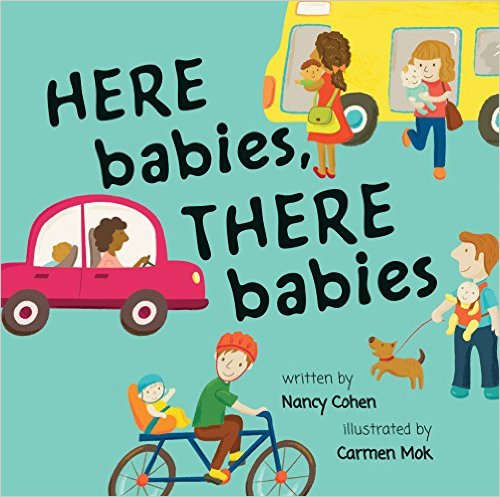
I recently learned that a former colleague of mine, a good friend, had just had a baby girl.  I was thrilled; this is a young woman who will make a wonderful mother, and I wish her and her new family all the best.  If you’re the sort to believe in auras, then I’m almost positive that the cloud around my head would have looked like fluffy pink bunny rabbits and woolly lambkins with baby kittens purring on their backs as I walked over to my dresser drawer and pulled it open.  A new baby!  Then I sighed.  Darn, I was down to only one copy of Here Babies, There Babies, by Nancy Cohen, illustrated by Carmen Mok and I needed… let’s see: there was a birthday present coming up, and then another two new babies (second babies in the family, so even more important), so that makes four total.  I decided to order four copies so I’d still have one in reserve.

Here Babies There Babies.jpg

To express myself more plainly, Here Babies, There Babies is one of my go-to baby present books, particularly for parents expecting a second baby.  But first, a note: Yes, I do know the author, Nancy Cohen, quite well.  In point of fact, I think she’s seen me crawling around in diapers, although I don’t remember my diaper days with particular clarity.  That said, I knew her both as a family friend and as a wonderful children’s librarian.  I knew her as my mother’s collaborator when they rewrote children’s stories as little plays for us to act out.  I knew her, basically, in her role as Person Who Knows About Kids’ Books.  She and my mother had, and have, a lot to talk about in that regard, and are probably jointly responsible for the sinking foundations of this house as I fill it with ever-increasing numbers of children’s books.

So, yes, I do know and like her.  I also happen to really, really like this book– more importantly, the Changeling really, really likes this book.  And I want to think about why we like it so much that it has rapidly became a book I need to have to hand in my dresser the way I need flour in my pantry.  I mean, really, this is what they need at the grocery store, right?  Imagine being able to call your husband and say, “Yes, I’m down to two eggs, so please get another dozen and a big bag of flour.  Oh, and a few potatoes, and I’ve only got one copy of Here Babies, There Babies, so could you get another two of that?  Thanks, see you at 5:30, then!”  Aren’t grocery stores supposed to stock essentials, after all?  If they can branch out to light bulbs, why not kids’ books?  While I’m dreaming, they could start putting all the cheese in the same place and stop putting the eggs where toddlers can reach them.  (I can never go back to that grocery store again.)

Wait, we were talking about the book, right?  Well, here’s the thing.  The book is exactly like that.  It’s about life: life with babies.  Babies are part of our ordinary life and the world as it is, even if the people who stick poles precisely in the centre of the sidewalk so that there’s no way that the leanest of umbrella strollers could possibly fit around them don’t see it that way, and this book crystallizes that very basic concept into simple rhymes and soft, lovely images.  We start by opening up to a slice of a street: we see babies and toddlers in a few different locations (café, bus, bike) and are told that babies are everywhere: “Here babies, there babies/ See them everywhere babies.”  (Read that aloud: the charming lilt you hear and feel continues through the book, and really is that lovely to read throughout.)  Then it gets more specific as we watch babies in various common places: stores, libraries, strollers, one reading stories with Daddy, two taking naps… and then back to the bird’s-eye view of town seeing babies everywhere!  The premise is absurdly practical and simple, and one I honestly haven’t seen in any other book: we live in a world that includes babies.

If you’re a small child, particularly a child in a very adult world (I speak feelingly: we live near Cambridge, MA), you may well want to see yourself as part of the world you live in, and a book like this is a great way to do that.  It just tells you that you belong: you belong in the grocery store, you belong on the street, you belong in the café, you belong in the town!  (As a parent, I can sometimes use the reminder, too… yes, I am allowed to have my child in the café with me, thanks.)  The pictures are a perfect accompaniment, showing babies from tiny little ones to toddlers, babies in carriers, strollers, cars, bikes, etc.  Boys or girls of any race should be able to find themselves and their families in here.  It’s a lovely mirror of the text: we live in a world that includes babies, all babies– oh look, here you are, too!  A word of warning on that point, though: I was, as usual, flipping through the book I was writing about here to think about the interaction between illustration and text, and I kept pausing to sigh, murmur about the cuteness, and basically feel my heart melt over and over again.  For female readers: I don’t think this book can induce ovulation, but I’m also not 100% sure it can’t.  Studies so far are inconclusive on that point.  For all readers: if your heart doesn’t melt at any point as you read this book then you may want to check your pulse– are you sure you’re alive?

Before I stop, I just want to highlight a couple of points already mentioned.  First, the lovely rhythm.  That rhythm makes it fun to read aloud to extremely young children, rocking in a chair while they coo at the pictures.  It also makes it fun for older toddlers, 18 months and up.  The Changeling loves to engage with the text: she recites it, she also builds on it: “Babies in the bath!  Babies play with ducks!”  And so on.  It’s a simple rhythm, but lively, and it’s one of the first books which got the Changeling playing with adding to the text that was there already.  (Dennis Lee’s Alligator Pie is also good for this… another Canadian, too.)

The second point I wanted to bring forward was why I so frequently give this as a gift to parents expecting a second baby.  As I said, this is the only book I know which has its basic message that we live in a world with babies.  It’s just natural to have babies around!  That’s our world.  I think that’s a great concept for first babies to get used to when they’re expecting the next one to come along.  This is our world, a world with babies… and soon we’ll be adding one more.

This is a book I’d love to see around more.  It’s from Nimbus, a Canadian publisher, and if Kids Can Press could just give them a few tips on getting their books onto those nice displays at the Harvard Book Store that would be fantastic, thanks so much!  You’ll note that I, unusually for me, linked to Amazon up there.  That’s because it really is the easiest way to get this one, but do call up your local bookstore and ask them to order it in.  Ask for three copies, because you just don’t know when you may need an extra one.  And ask them to stock it because there really are babies everywhere, and it’s good to talk about that.

A Bird Is a Bird

Dear Reader, do you ever get the feeling that you couldn’t recognize a hint from the universe even if it sent all the birds of the worlds to crap it straight onto your head?

First thing this morning the Changeling reminded me of my promise to take her to the museum today: “To see the snowy owl!”  I wrangled her into her clothes (the owl dress) and tried to think about a book to write about when we got back home.  After the museum (she begged for a sheet of bird stickers at the shop) we met her daddy for a snack at the lab: “And I saw the cardinal and the puffins and Great! Blue! Heron!  It eats fish!”   (And what was I going to write about?)  As an extra treat, the Changeling and I went to paint pottery!  She wanted to paint an owl.  (But what to write about?)  At home from our packed day, we had a nice supper, then story and bedtime.  The Changeling wanted A Bird Is a Bird, and as we snuggled before bed she listed all the birds she’d seen that day: owls, cardinals, tanagers, buntings (she asked me to sing “Bye, baby bunting”), herons, pelicans, puffins…

I left her room, slumped in a chair, and my husband rubbed my shoulder.  “I just can’t settle on a book to write about today, for some reason,” I complained.  “Write about A Bird Is a Bird,” he said promptly.

Oh.

A Bird Is a Bird.jpg

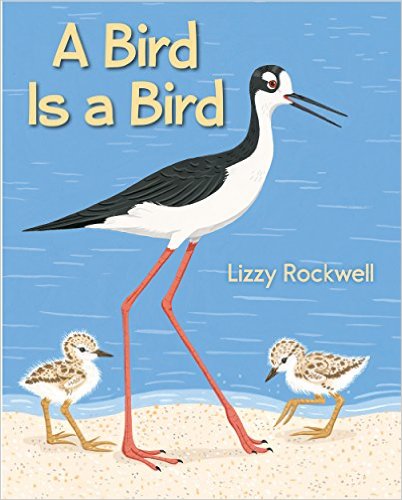
Birds have really become part of the fabric of our days, and have been for so long at this point that it’s small wonder I didn’t really think of A Bird Is a Bird, text and illustrations by Lizzy Rockwell, in the same way that I don’t often think about my dearly beloved bathtub. Let’s see: I knew this was a book as essential to the Changeling as The Joy of Cooking is to my kitchen from the first moment the Changeling jubilantly snatched it straight from the hands of our brilliant children’s librarian (God bless all children’s librarians) who was saying, “Oh, if she likes birds…”   It just fit.  I’d bought our own copy before the book was due back to the library.  That was nearly a year ago (the Changeling wasn’t yet two years old), and it’s been rare that a week has gone by since then when we haven’t read this book at least once.

The same question comes to mind with this one as with Mr. Postmouse’s Rounds: is this a natural history book, and, if so, what makes this different from all other natural history books?  In this case, the clear answer is, yes, it’s a natural history book.  It doesn’t have a fictional narrative arc; its purpose is evidently to educate the young reader about birds; it’s plain, straightforward natural history.  There’s no whimsy here, not even a hint of the fantastic.  What distinguishes it from others is the more interesting question.

In this case, I think it’s a rather subtle point: the sheer, quiet pleasure the book takes in talking to you.  This book could have been written for my Changeling.  She’s a quiet, passionate sort, and takes her interests very seriously.  A Bird Is a Bird loves birds, and really, really wants to tell you about them in a careful, logical and very precise way.  The Changeling likewise loves birds, and sits (wriggles?) as a disciple to receive the book’s teachings.  We start with a general framework (“A bird may be tall.  A bird may be small.” p.5.), and build to more specific points: birds have beaks, wings, and start out in eggs.  But then what about the platypus, or flies, or snakes?  What is it that’s truly specific to birds?  Feathers!  (Bounce! goes the disciple.)  As I said, there’s no fictional narrative arc to carry you through this book, but the arc is there, nonetheless, and it builds slowly and steadily to its logical climax: Feathers!  It’s remarkably clear, satisfying, and, the word I keep coming back to, precise.  This is a book which will teach you that delightful feeling of satisfaction in fact-based research.  If you like building blocks of discovery, and think it can be beautiful, this is the book for you and your child.

The logic and precision are exactly why this book has lasted so well: even a year ago, the Changeling was able to keep up with the limited prose, and the exquisite, clear illustrations (Audubon, eat your heart out!).  These past few months she’s been able to see the link between the birds she sees at the museum and the birds she sees in the book.  In fact, she associates the two so strongly that she asked why they didn’t have A Bird Is a Bird at the gift shop (excellent question, oh Harvard Museum of Natural History!).  I expect that in another year, if she remains interested in birds, she’ll be able to pick up on some more complex details, perhaps the differences between males and females, since she was already pretty excited to see “Mr. and Mrs. Mallard” in here.  I don’t see this being a book for a particularly limited range of ages.  The publisher recommends it for ages 3-7.  Well, as we’ve seen you can go younger (we started reading it at 18 months, for the record).  I’m no expert at the older range there, but I’d say 7 sounds about the upper limit I’d expect.  (Caveat: I’m terrible at thinking about age limits for books.  Maybe I’ll write more about that another time.)

There’s one more thing I want to emphasize here: I’ve come back a few times to dwelling on how lovely this book is, and how serious it is.  I’ve seen a number of natural history books out there for children which either have illustrations which could belong in Nature, Science, Cell, or Scientific American.  They’re, well, scientific.  Often they’re photographs or photo-realism.  There’s absolutely nothing wrong with that, of course– it’s science!  The books are often excellent and the illustrations suit them perfectly.  But I can’t say they speak to me, and the Changeling doesn’t seem to find them so stimulating either.  Others, often pitched towards younger children, have cartoon-like pictures.  They’re also fine, even if they aren’t particularly precise.  They can be very cute.  They don’t do much for me, either, and none have had staying power with the Changeling.  This one, though, is simply beautiful.  The illustrations are lovely, accurate, and take the reader seriously.  The reader, here represented by the Changeling, responds by taking the book and the subject seriously.  I plead, falling on my knees, for more children’s science or natural science books to take both the subject and the audience seriously, and to try to convey the natural beauty of the topic with both sensitivity and accuracy.  In short: why the hell can’t more science books be pretty to look at, dammit?

A Child’s Garden of Verses

I stood somewhat blearily, staring around what I assumed might still be my house, somewhere under there, and wondered: “Is there anything good about having an entire family subject to a violent stomach virus at the same time?”  After some thought, it occurred to me that I hadn’t actually cooked a meal in a few days.  Yeah, I like cooking, but since the thought of food made me– excuse me, where’s the washroom?  And the smell of food– sorry, gotta run.  And if I’d had to cook for anyone else– oh, gosh, give me a sec.  Point is, when all of us had the same feelings about food, it was just as well that we could leave the kitchen to its own devices while we spent our limited energy on the laundry.  (Open House Announcement: Come Over And Throw In A Load!)

Being who I am, of course, the other upside to what we’ll romantically call “my illness” (barf, barf, barf) was a wave of nostalgia which rose as the tide of nausea began to recede.  “Nostalgia for what, precisely?” I hear you ask nervously.  No, no, not for barf– I’ll leave that particular brand of nostalgia to my parents (sorry, Mummy and Daddy).  The nostalgia I feel is for, well, for R. L. Stevenson’s childhood frailty, when you come right down to it.

Did you grow up with A Child’s Garden of Verses by Robert Louis Stevenson from Chronicle Books?  If not, are you aware that you need to go to your parents and school teachers and sit them down and tell them that while you know they meant only the best for you, you’re very sorry to say that you think they committed a serious parenting and educational flaw?  Because this is one of those books that I give to new parents like other people give– wait, what do other people give?  I think people gave us clothes and things.  Someone gave us a diaper pail but we already had one and, frankly, even the most, erm, digestively-active baby only needs the one and trust me I have experience after this weekend… but I think I’ve cycled back around here, just like Friday night’s meal did– gosh, sorry, folks.  Let’s make up for it with the lovely cover:

A Child's Garden of Verses

The point, and, vaguely delirious though I might be at the moment, I do have one, is this: when I was growing up, I had one picture of illness in my head.  Go and fetch your copy of A Child’d Garden of Verses— the Chronicle Books one, mind you, I don’t even know why that other one is on your shelf, do you?  If you don’t own it (see note above regarding parenting flaws), click on that link above and order it, or go to your local bookstore and make sure that they know to stock it for just such emergencies.  Your local library should also have a copy, so you’re now entirely devoid of excuses.  OK, now open it to pp. 28-29, “The Land of Counterpane.”  We can all pause for a moment to choke up together.  That is what illness, or at least convalescence, looks like to me, and that’s what I mean by feeling nostalgia for Stevenson’s childhood frailty.

I know, I know– heck, we all know: actual, real-life sickness looks like several loads of stinky laundry, sleepless nights and half-hour naps during the day, and electing just to not wash your hair tonight because, hell, there’s only a few more hours before dawn anyway and she’s just going to barf again tomorrow, so may as well try to sleep now and wash it out tomorrow, right?  (Sorry, everyone, really, so sorry– I promise I do bathe regularly at ordinary times.)  Actual, real-life sickness looks like losing count of how many times any of you threw up (we’ll go with a nice, discreet “several times, I believe”) and figuring out how to unstick a frozen window on the coldest night of winter so far because, by God, it was necessary, all right?  That’s what sickness looks like, feels, like… smells like.

But don’t we all, just every once in a while, feel a tinge of nostalgia for a nice romantic “illness,” or, well for convalescence, that period after the worst of it but before you’re fit for the real world again?  Don’t you sometimes whisper, “Dammit, I could use a sick day… like when I was a kid and someone just looked after me.”  You’re not thinking, “Oh, I wish I could barf six or seven times in a row, I can’t remember what number I’m up to.”  You’re thinking about nice, cuddly things, right?  Maybe an extra pillow or a fluffy blanket.  Well, what I remember is my mother’s voice reading me “The Land of Counterpane.”  I know we read plenty of other poems from this book, and I know we read them at ordinary bedtimes or ordinary days.  I also know it was one of the books I sometimes sort of snuck from the high shelf to just look at the pictures and touch it even though I was supposed to make sure it stayed really nice and clean because it was one of the books my mother really liked (sorry, Mummy, I was really bad at leaving your nice books alone, and I totally get it now that the Changeling’s around).  But when I look at my copy, I remember delicate, watercolour-like childhood convalescence, the kind that never really happened, but that we all experienced for just that moment when your mother’s nearby, and her voice is reading to you quietly while you sip something you don’t normally get, especially in the middle of the day (juice or Coke or that elusive “just something nice”), and you’re contemplating the possibility of a nap, or maybe, maybe you can get another story first?

Now I read these poems (“poemos,” she calls them, in toddler-lingo) to the Changeling.  I read them when she’s well, I read them when she’s sick, I read them when she’s tired, I read them when she’s alert.  I read them in Aruba, I read them in Toronto, I read them in Boston.  These get read all the time.  I never tire of them, and neither does she.  She flips to exactly the pages she wants: “Rain,” or “Read me ‘Nod.'”  Or whichever she wants.  The Changeling knows them well, and she makes her own choices.  Sometimes she bargains for another one: “We’ll read just two, OK?”  Then: “How about one more?”  And I have no idea how she’ll come to remember them– maybe when she’s on the swing, or maybe when she’s looking at the stars.  Whichever of dozens of perfect childhood moments that maybe didn’t really happen, but which we all experienced in that one, crystalline second at the top of a swing, or when the wind caught your breath, or when you’re propped up against a pillow with your mother beside you… those moments which Stevenson captures with a perfection which brings you peace, even when you’re going to throw in yet another load of laundry.

(If anyone’s going to the store, could you grab me another thing of detergent, please?  We’re almost out.)

Moominland Midwinter

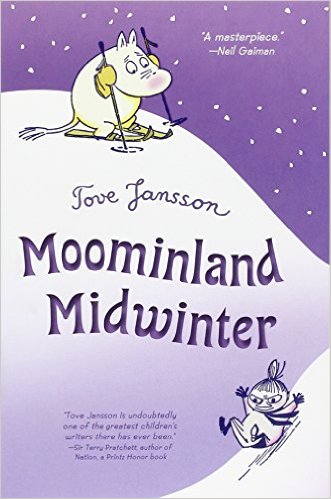
It’s cold today.  That means I’m getting nostalgic.  One winter way back in the antediluvian days of my childhood my sister found a book, read it, and gave it to me.  This was not an unusual event, but this is a book that stuck with us both even though no one else seemed to have read it: there was a creature called a Moomin who woke up from hibernation in winter, we remembered.  We liked it a lot.  And it didn’t feel like a kids’ book, precisely.  Somehow the book disappeared soon after that (that’s one of the annoying things about having a lot of books– sometimes one gets lost in the shuffle), but since I always hate stories that leave the reader fretting about what’s going to happen next I’ll let you in on the secret right now: I did find it again, and it was called Moominland Midwinter, written and illustrated by Tove Jansson, and ultimately I was to read it with the Changeling, who also liked it.  There, now you’re set and can read on with assurance.  It’s a happy ending.

Moominland Midwinter

The years passed, I moved to Boston, got married, and got pregnant, and found the Children’s Book Shop in Brookline.  I walked in, and they had Moomin pictures on the wall.  I knew I’d like this place.  They had Moomin books on the shelves.  I fell in love.  And I, well, I bought them all because, you know, would you want to bring a new baby into a house with insufficient Moomin books?  Of course you wouldn’t, that would be irresponsible parenting, right?  Right.  I’m so glad we agree on these points.  Also, don’t you agree that all obstetricians should be located right near well-curated children’s book shops, and, if they are, that’s obviously a sign that all visits to the obstetrician should be followed by trips to the book store?  You do?  Why, I knew we’d get along!

Well, thus began my annual impulse to reread Moominland Midwinter whenever the weather got very, very cold or I hit the first big snow.  When very wintery weather hits I start to think about the Moomin family, sleeping away the winter in their house in Moominvalley, and Moomintroll’s eyes opening to the dark, snowed-in parlour.  I think about the winter creatures he meets, the Lady of the Cold, and his growing friendship with Too-ticky.  I think about his initial fear of winter, and his growing comfort with that alien world of snow and darkness.  I hear Too-ticky’s patient voice in my head saying, “Take it easy,” and then I hunt up the book wherever it’s migrated to since last year.  (I honestly try to organize my books, but they move around anyway.  It’s hopeless.)

And so this year it finally got snowy and cold, and I curled up and opened my book.  Then a head of slightly tousled curls popped up.  “What’s that book?”  “It’s called Moominland Midwinter.”  There was a scramble and then someone was on my lap and the curls were tickling my nose.  “Read it to me.”  I thought for a moment, because Moominland Midwinter is really not aimed at toddlers, but it goes against my principles not to read to children when asked to do so, and, besides, the worst that could happen would be that the Changeling would scramble down again, so where was the harm?  And, most of all, I was curious to see how the book would work when read aloud.

Well, what do you know?  It’s a beautiful book to read aloud.  The occasional pictures act as little landmarks for small children, or just points to engage them (“Start here, with Little My.”), and you’d better be prepared to get a small foot lodged between your ribs whenever one of Tove Jansson’s brilliant drawings pops up and someone shouts out “oh, is that Too-ticky?”  And all those character voices you’ve been hearing in your head as you read to yourself?  It turns out they’re really fun to say aloud.

As I’d expected, the conversations are perfectly paced and sing along.  What I’d been more concerned about were the paragraphs of meditation, poetry, or simply exposition in between those conversations.  To my surprise, they engaged the Changeling almost as much as the conversations.  Perhaps it was because they’re accompanied by those little illustrations which show what’s going on, but I’d also credit the pace and rhythm of the prose.  The meditations can be quite lyrical and lovely.  Try reading this aloud, for example:

“One flake after the other landed on his warm nose and melted away.  He caught several in his paw to admire them for a fleeting moment; he looked toward the sky and saw them sinking down straight at him, more and more, softer and lighter than bird’s down.”  (Moominland Midwinter, pp. 95-6.)

Exposition moves in its own way: rapid and clever, or in almost philosophical detail, depending on what the characters and plot demand.  Always, it’s fun to share aloud.

How did the Changeling take to it?  I asked her, because I was still a bit surprised that she’d sat through it, one chapter a night, and wondered how much she’d taken in.  She loved the characters, and told me she particularly liked Too-ticky (“Too-ticky says ‘take it easy!'”), Little My, and Moominmamma.  But what do I think really clicked with her?  Well, it’s winter right now, and I don’t think I’m the only one who feels the seasonal appeal.

This morning it was really cold, and I was trying to get the Changeling’s mittens on (I feel a great rustling across the world, as though millions of mothers suddenly dropped their heads into their hands and moaned in recognition).  I was trying to get across that it wasn’t just chilly, it was cold, and she really needs her mittens today, and an idea popped into my head: “Do you remember in Moominland Midwinter when the Lady of the Cold comes?”  “Oh, yes.”  “Well, it’s a cold like that today.  A big cold­.  That’s why you need your mittens.”  I won’t say she didn’t grumble, but there was a definite click, and those mittens did go on.

Moominland Midwinter, as I said at the beginning, really doesn’t feel to me like a kid’s book.  It didn’t when I first read it, years ago, and it doesn’t now.  It’s a seasonal book, a winter book, and it’s there for anyone who’s ready to just tumble through into winter.  It distills winter, it shares winter, it talks with you about cold and snow, blizzards and ice, and about that first moment at winter’s end when the wind changes and you sniff the hint of the beginning of spring.  The Changeling might be a toddler, but she’s a toddler who’s learning all about winter, and Tove Jansson is talking to her, too, through all her voices of winter: Too-ticky, Little My, and Moomintroll and Moominmamma, too, who are just discovering it along with us.  If you’re feeling wintery, bundle up in your warmest clothes, head over to the bookstore (look near your obstetrician’s office, you may find a great one) and ask for Moominland Midwinter.

The Queen’s Hat

When my parents came back from a visit to England, they brought my daughter a very silly book.  A charmingly, absurdly, delightfully silly book.  I love my parents, and the Changeling, my husband, and I all love giggling through The Queen’s Hat, written and illustrated by Steve Antony.

The Queen's Hat

Here’s the story: it’s a sweet little tribute to the birth of Prince George, as the Queen puts on her favourite hat to pay him a visit, but the wind sweeps the hat off her head and she has to chase it all through London until it falls right onto the new baby prince.  Celebratory tribute?  Yes, all right and, as such, it’s a nice book.  But what makes it something more than that is its whimsy.  It’s also a gleeful, unabashed romp through all the top spots in London.  It’s fun, that’s it, and it doesn’t try to be anything other than pure, whimsical, giggly fun.  It’s like running through the sprinklers while eating cotton candy, and I love it.

So, what makes it so much fun?  Well, like Swan, the text is spare and the illustrations are packed.  In this case, though, the text is there to give you fun sound effects: “Swish!  Woosh!” and drag you recklessly all through London: “and all through… London Zoo… and all along…”  If you’re like us, your kid will have no idea about most of these places (although it’s a nice intro to them, I guess), but you’ll get a little rush of glee when you see the lions at Trafalgar Square or flip the book to accommodate the length of Big Ben.

The fun really comes with the sound effects and the pictures, though.  The illustrations are energetic but spare, with a muted background and brightly limited palate for the foreground.  Each page has little details to watch out for: the Queen’s men help in the pursuit, but lose hats and shoes along the way.  Can you find the sock?  A servant joins the chase, bearing a tea tray which remains miraculously intact throughout– where is he on each page?  The Queen is accompanied by a corgi!  Can you find him?  What’s he wearing?  Do you like dogs, too?  And so on.  These keep you busy hunting, page by page.

The Changeling and I enjoy this book at almost exactly the same level, which is a genuine pleasure: sure, I have a better knowledge of London and I know the backstory, such as it is, to the book.  But, in the end, that’s not where the book’s success really comes from.  It comes from energy, detail, and all the opportunities to gleefully hunt through the book together.  Her favourite page is London Zoo, where she finds and names as many animals as she can: “Pelican!  Let’s find the puffin.  Is that a tiger?”  And on most other pages she gets excited about finding the hat and the corgi.  The end of the hunt, for her, is finding the baby and touching his fingers.

This isn’t a deep or brilliant book, but that’s exactly where its brilliance lies: it knows where to stop.  Too much more about the Royals would have resulted in dull pandering.  Too much more of a story would have been boring.  Steve Antony hit precisely the right balance of landmarks for the adults and treasure hunt for the family, and that’s what makes this book such a fun little adventure, just like a spontaneous Sunday trip to the ice cream parlour.  Have fun!