The Marvels

Sometimes I get this feeling with a book, right from when I see the cover, that it’s somehow saying, “Pick me up.  Pick me up.  We’re going to go places together.”  I got that with The Fox and the Star and The Girl Who Circumnavigated Fairyland in a Ship of Her Own Making.  The Marvels, written and stunningly illustrated by Brian Selznick (that link has some great resources), is one of those books.

Marvels.jpg

I first saw it while I was chasing my daughter around the Children’s Book Shop on a trip, trying to convince her to put down something or other.  I stopped dead at that beautiful blue-and-gold cover.  Look at it.  Now imagine it in real life, with a deeper blue and the texture of embossed gold.  Scholastic went all out with this one, giving it a beautiful feel: it’s not the Folio Society, but it feels like it wanted to hint at what the Folio Society might do.  I’m a sucker for beautiful books.  I picked it up, but the price tag was a bit too high for something bought on impulse while I was trying to keep the Changeling from destroying a store full of books, and since it’s a book for young adults and older I couldn’t hand it to her, so I put it back.  Later, I gushed about how pretty it looked to my husband, who promptly bought it for my birthday.  Yes, he’s wonderful, and he’s my husband, and you can’t have him (unless you’ve got some really good Folio Society books on offer).

It turns out judging a book by its cover is, in this case, an excellent way to go.  Beauty and mystery are what it projects, and beauty and mystery are what you get.  “What are these marvels I’m being promised?” you whisper as you open the book.  “What’s that ship?  Wait, are those illustrations?”  You quickly glance at a few, then go back to the beginning and look more carefully– the illustrations are telling you a story.  You slow down.  “Good grief, look at these pencils, look at the depth and detail!”  How old they look, you think, they really evoke that 18th/19th C period in which the book is obviously set.  You follow the story until you reach the crisis, flip the page and– you see print.  “But,” you reason, “maybe he’s going to continue the story that way.”  You’ll miss the pictures, though.  And then you read, and, “What on earth is going on here?  Where are the characters I knew and loved?  Who is this?  Why are we in the 20th C?”

All of these and more are questions I will not be answering.  I wouldn’t even answer them for my husband (who nearly snatched the book away while I was reading it, the rat, but I got him to wait and he gobbled it up right after).  I definitely won’t ruin the experience for you, my darling devoted reader.  Now, I’m not normally one to complain about “spoilers.”  I seek out spoilers.  I desire them.  I will regularly read the end of a book before the beginning so I won’t have to be tormented by questions and can instead focus on construction and style.  That works beautifully for Dickens, for example.  It doesn’t work for puzzles and mazes, though, and this book is both a puzzle and a maze.  You have to follow it from step to step or it doesn’t work.  You need to ask these questions: “What are the marvels?  Where did the pictures go?  Where’s the magic?  What are the answers to my questions?”  The book draws these questions from you.  It’s not a thriller, and it’s not teasing: it draws those questions out seriously, deliberately.  It whispers: “Trust me: it will come clear.”  And it does, I promise.  The 672 pages aren’t even a long read, believe it or not, since the pictures occupy a lot of space and tell so much so quickly.

“Great,” you ask me, and I can hear the dry tone in your voice, just so you know, “So what can you tell me about this book, then, apart from the fact that it’s a pretty puzzle?”  Well, I’m glad you asked.  First of all, aren’t you glad to know even so much?  That’s enough to get me to pick up a book.  Second, I want to tell you about the effect of the book, the impact on the reader: in sum, the experience of reading it.  I gave you a hint of that above when I gave you the chronological list of reactions I had when I read it myself, but we can do more than that, don’t worry.

I mentioned beauty about a thousand times so far.  Let’s talk a bit about beauty.  Do you like beautiful things?   Beautiful worlds?  Do you care that the book itself is beautiful?  Then, frankly, stop reading this and go get the book, because the book is for you and I don’t know why you’re waiting (unless you’re trying to corral an excitable toddler– I totally get that).  But while you’re off at the library or bookstore, I’m going to keep writing.  Don’t let me keep you.

From the very first illustrations, this book is telling you about beauty as an immersive experience: that’s why I can’t tell you more about the book’s story, in fact– it demands total immersion and wouldn’t make sense at second hand.  But I’ll try to get across a bit of the first few pages: first, you see a ship in the distance, and as you get closer you see that she’s called Kraken, and a child, a girl, is tied to the mast, trapped.  A dragon approaches and the child’s eyes grow wide, her mouth parts, terrified.  A dog leaps at the dragon from below, and then you see her eyes soften– an angel, sword in one hand and lantern in the other, is descending to save her.  Then, on the next page, you see the playbill and the audience of sailors on the ship.

The child’s total immersion in the play, the complete and willing suspension of disbelief of the child actor, pulls you along.  You, too, believe everything, and maybe feel a bit let down, just for a page, when you realize it’s a play, that the marvels are somewhere on another page.  But then curiosity takes hold, and you move along further and further: the play was very beautiful, the dragon was remarkable, and you do love ships– what’s next?  Oh no!  A shipwreck!  But then… and you’re swept along, swept up with the beauty of each drawing, of the characters’ faces, lovingly rendered in those shaded pencils (the affection Selznick has for his characters is palpable), swept up by the courage and beauty of the story.  Until, moving away from ships and theatres, you end up in modern London, and a whole different style of beauty.  Now you have the beauty of verbal descriptions rather than illustrations, but also another type of beauty, and this is perhaps the most essential to the book: the beauty of merging words and illustrations.  How do the two parts of the books fit together?  Can they be reconciled, or will it remain forever a mystery?  And you read on, eagerly threading the two together, running into dead ends, and finally, your heart breaking with the beauty of the story, you see how they do fit together.  And when you do, you realize that it’s not about magic and marvels, it’s about something deeper: love and beauty, and love of beauty.  Without love of beauty, the worlds can’t be reconciled, and no one will come out satisfied, and unless you love beauty, too, you can’t be reconciled to the story, either.  But, if you’ve gotten so far in the book, it will have persuaded you to love beauty, and you will come away feeling rather exalted by the story and the images.

I hope you’re not here reading these words– I hope you’re already out at the library or the bookstore, experiencing them instead.  But I can tell you this: I’ve already marked this out as one of those books for my Changeling when she’s older.  In the meantime, I’ll keep it to hand, and make frequent stops by the Marvels myself, I think.
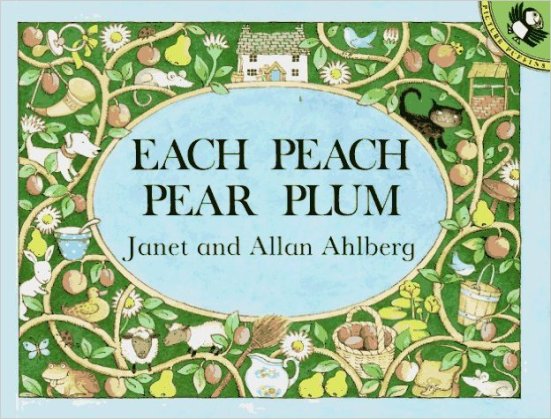
Each Peach Pear Plum

“Oh, immortal classic!” exclaimed an English professor of my acquaintance when I mentioned Each Peach Pear Plum, that perfect concoction of flaky, tender crust written by Allan Ahlberg, with a luscious plum filling drawn by Janet Ahlberg.

Each Peach Pear Plum

I don’t even remember how my copy arrived in our house.  Probably from my favourite children’s book shop, but, let’s be honest, it could just as easily have grown up as naturally as those little sheep sprouted in the lower left corner of the cover.  Some books just show up and always seem to have been there.  “Oh, immortal classic!”  Indeed.

I was reminded of how naturally this book just merges into our lives when visiting my cousin and her son this weekend.  I think we were the ones to give them Each Peach Pear Plum— unless, of course, it just sprang up in the house one day.  I can claim no credit.  Either way, her son is now a year old and has already loved the book deeply for a few months.  I remember it was the same way with my Changeling.  It was the same way with my niece, too.  My daughter and niece continue to love it, and my niece would call for “Pehpum” regularly at around 18 months.  And nary a one of us is bothered by multiple readings; we are all happy to read it once or twenty times.

Here’s what I’ve spent an awfully long time trying to understand: I absolutely get why we love the book.  Cinderella and the three bears and the wicked witch?  It’s such a fun and clever story about all of our favourite stories!  All of those stories our children definitely didn’t know before a year old!  And yet– they genuinely preferred this book to many others ostensibly aimed at their age group.  We were all really glad to have the book in board book form because it was cuddled and flipped through by clumsy baby hands.  I get why the Changeling, a great lover of Cinderella and Jack and Jill, enjoys the book now: she loves finding her favourite characters.  But let’s think for a minute about why this book might be so appealing to even the tiniest of humans.

You know, here’s where I wish I could let you into my head: I want to share some of my cross-referencing with you.  Remember when I talked about Cat Valente before?  Her Fairyland series and Six-Gun Snow White?  I believe I gently intimated that you should drop everything and read them.  She has a passage in The Boy Who Lost Fairyland about changelings and how they recognize certain patterns, certain stories, look for certain quests.  If you’d read that, you’d connect it with watching that earliest process of book-love as much as I do.  I don’t want to go into it too much here because I do still plan to talk about Fairyland at another point, but, without wanting to sound too much like a crazy romantic, I found myself nodding as I thought about how there were certain books which seemed to have an immediate attraction for my daughter.  Each Peach Pear Plum was one of these.  And, yes, yes, sure, we were going to read it anyway– if you want to be cold and logical and suggest that we indoctrinated her you can go ahead and think that.  Make your grocery list at the same time.  But I do think there was an attraction, a recognition of “this is for me!” there.  Don’t you get that with certain books?  Then why shouldn’t a child?  The question I want to think about is what creates that attraction, and what is it in Each Peach Pear Plum that makes such a strong attraction for so many children?

All right, let’s start with the easy answer: that luscious plum filling Janet Ahlberg provided by way of illustrations.  Aren’t they glorious?  On the one hand, they’re so accessible: simple lines, teddy-bear figures for the three bears, clean round faces.  On the other hand, they’re so rich in detail: just look at those climbing tendrils all over the cover!  If William Morris had decided to draw a children’s book, it might have looked like that cover.  Such a clear, regular pattern, so full of detail, but with strong lines and bright colours.  Everything about it declares that those pictures are for children, but there’s a lot to look at without being too cluttered.

And what do the children notice from the first?  The animals.  As soon as she could talk, my daughter would climb on my lap and flip through, page by page, describing every single animal along the way: dog, sheep, cat, birds, frog… every single animal.  (I didn’t mind because, well, I do love animals, and, also, there was so much else to look at along the way.)  There are animals everywhere, and they look so cuddly on the page.  Of course the tiniest children would love them.

But I think, rich and satisfying as the plum pictures are for children, they wouldn’t be so attractive without that flaky and tender crust supporting them: the words.  “Each Peach Pear Plum/ I spy Tom Thumb!”  Oh, I know there’s no exclamation point in the book, but just you try reading it without an exclamatory ending.  Did you try?  Did you succeed?  Probably not.  If you did succeed, you can go back to your grocery list, and don’t forget the dish detergent.  It bounces along, stressed syllables all in a row like Mary’s pretty maids in the nursery rhyme, and you need a triumphal ending.

Here’s what I noticed really early on, though: that next page?  “Tom Thumb in the cupboard/ I spy Mother Hubbard”?  Kids get the “Tom Thumb” link.  They really do, from a very early age.  I won’t tell you how early I think it goes, because I have no evidence and the children can’t tell me, but I’d be very unsurprised to find out it went earlier than most of us might suspect.  I’m not saying they understand the links, but they can definitely hear and recognize it: they get it, to a degree.  They get the picture links.  They get that the characters they see and hear about early on all come together at the end.  That’s exciting, like a first puzzle, or a little maze they solved.  I think they love following the characters’ quest to that plum pie– that’s what I think.  I think it’s their first introduction to fairy tales through the very best medium for fairy tales: the hunt, the search, the quest!

No wonder our little changelings thrill in recognition to this book.  It delineates their own process in life: first we live, and then we strive.  In this case, we strive, we quest, for plum pie.  I wonder what our kids will strive for?

The Snowy Day

Yes, I know we’ve only just talked about Ezra Jack Keats, but today we woke up to the last snow of winter and the first of spring, and I thought, well, this is my last chance to talk about this book this year.  Let’s go for it.  Also, who doesn’t like talking about Keats?  So, here we are: The Snowy Day (you can find lots of good activities and resources at that link).

The Snowy Day

When we talked about Peter’s Chair, my main point was that Keats leaves a lot up to the reader: in the interest of honesty, he leaves a lot of feelings and connections for readers to investigate on their own, putting the power in their hands.  This is wonderful for younger readers, of course, who all too often have motivations and feelings explained to them in painstaking precision.  Keats leaves it to them to sort out feelings on their own, while giving them the openings to do so in a particularly useful context.

The Snowy Day shares all of these excellent qualities, but the emphasis of the book is, I think, on something a little different and a little more simple: the context.  The whole layout and premise of the book is so simple, so lovely, so perfect, in fact, that I almost have nothing to say apart from “just look at it,” but I’m me, so I never quite have nothing to say.  I’m so sorry about that: I will never have nothing to say about children’s books.

And yet Ezra Jack Keats’s genius is in what he doesn’t say, isn’t it?  He doesn’t tell us, for example, that Peter is excited to see the snow.  That he’s fascinated by the shapes his feet make in the fresh snow on the sidewalk.  That he’s a little surprised by the snow falling on his head when he hits the tree with his stick.  He doesn’t say that Peter’s a bit disappointed he can’t join the older boys in the snowball fight.  Or that his games with the snowman and snow angel were fun compensation for that disappointment.  He doesn’t tell us that the snowball melted in Peter’s pocket, or that his dream reflected his sorrow and worry at the snowball’s disappearance.  He doesn’t tell us that Peter was jubilant when he found that snow was falling after all.

He doesn’t tell us any of that.  The only feeling of Peter’s he tells us is that he is very sad when his snowball is gone.  (And, of course, not telling anything else about his feelings gives particular force to that moment.)  That’s a lot not to tell.  But we know it anyway.  How?

Context, context, context.  Context everywhere– and, by way of conveying that context, some of the most glorious children’s book illustrations known to mankind.  How many children, I wonder, have coveted that red snowsuit with the peaked hood?  I know I did, and I know my Changeling has asked for it.  I’d wager we’re not the only ones.  Vivid details like that bring Peter’s world so perfectly to life that, as I said when writing of Peter’s Chair, we feel like we can walk right through the page and feel quite at home in Peter’s world.  In Instructions, by contrast, there are rules you’d need to learn, dangers to avoid– in The Snowy Day, you’d simply join Peter on his snowy walk, admire your footprints in the snow, and relax in a warm tub of water at the end of the day.  There’s no detail left unexplored, and never so much detail that you can’t leave your own mental imprint on the book.

It should be boring, this abundance of minute detail.  By rights, we should all be begging for sweet release as we look at a kid walking down a snowy sidewalk.  Oh, wow, right?  But we’re not, because we’re with Peter.  We see everything as he sees it: once again, Keats is providing us with a very precise context.  In this case, we have Peter’s eyes and Peter’s mind as he walks down the street, and we find him a completely sympathetic perspective on winter.  When we read as children we think, “Yes, that’s exactly what it’s like,” or, “Now I really want to make a snow angel!” or, of course, “I want that red snowsuit.”  (Someone tell me: why has no one produced this red snowsuit?)  Reading as adults, we wistfully relive those days, and shovelling doesn’t seem so very arduous as we envision that little red peaked hood. (OK, I admit: I still want it.)

In other words, we get to borrow the complete experience, not just watch it.  Instead of being boring, the details are all so very personal, so very human, that they almost feel 3D.  It’s odd, because the illustrations are all on the cusp of flatness: they aren’t quite flat, since Keats uses lovely shading for the snow, for example, but they don’t anywhere near approach the perfect artistic realism of A Bird Is a Bird, or the lush romantic precision of Instructions.  There are large blocks of flat colour here, and they should, again, feel boring.  They should feel unrealistic and blah.  Except that they don’t: they give us just enough to know what we’re seeing without being distracted by foofaws and trills (much as I adore foofaws and trills, mind you).  And this is where I get to the point where, as I said above, I feel like saying, “Oh, just go read the book and you’ll see!”  But that’s not my job: my job is to explore the experience of reading, and why it’s so beautiful.  And so.

The experience goes something like this: You open the book, and see a child looking out his window.  You’re right behind him, catching the curve of his cheek and the excitement in his parted lips, so your eyes follow his to the snow.  I always feel like he’s just gasped, or perhaps murmured, “Oh, wow, snow!”  From that moment, you’re synthesizing that excitement with the description of where he’s going next.  His arms are slightly outflung, his legs apart (you see from the picture), as he leaves the house and sees the snow piled up very high (as the words tell us): the picture shows mild amazement, the words tell us exactly what he’s looking at.  We feel sympathy with him: how very high the snow must seem to a little boy!  And we feel that sturdy stance: in order to make tracks through snow you do have to fling out your arms and part your legs to maintain balance, don’t you, especially when you’re little?  And so you go, throughout the book, merging words and pictures.

It’s all in the details.  It’s all in the context.  It’s all in the precision, here.  What Keats gives you is so carefully chosen, and yet he never gives you too much extra: just enough for realism, just enough to focus your attention on what matters– and always giving you those nice blank spaces to write your own experience.  He gives you two dimensions on paper so that your reading can build the third dimension, inviting you in through the folds in the book’s binding.

That’s where I’ll be going this afternoon with my Changeling; I promised to read it to her when she got back from daycare.  Maybe you’ll join us?

Instructions

Have you ever noticed that one of the best and worst parts of coming back from a trip is the mail?  On the one hand, damn, there can be a lot– and a lot of recycling.  Sifting through the chaff to get to the good stuff can be a drag.  But on the other hand, sometimes the good stuff can be so good.  What I’m saying, yes, is that I got some of those books that you can pry out of my cold, dead hands when we came back from South Carolina.  No, not just that: you can fight past the ramparts of the fortress I will have erected to preserve my personalized, signed copy of Instructions, written by Neil Gaiman, illustrated by Charles Vess.  DSC_0659.JPG

Wait, you care more about the front cover than to see the personalized signature that is mine and belongs to me and did I mention it’s mine?  Well, I get that, because Charles Vess’s art on that front cover is glorious.

Instructions

Good grief, isn’t that lovely?  You probably want to reach right in and open the book.  If you don’t already have a copy, though, you’re out of luck, except that that Harper Kids put together a beautiful trailer for this book.  I’m going to help you out here: do not run a search for “Instructions trailer.”  The results you get will not be friendly to someone in search of a piece of children’s literature.  I made that mistake so that you don’t have to– you’re welcome!  Instead, here’s what you’re looking for:

I hope you watched that.  Neil Gaiman reads it aloud beautifully, and you should get a good sense of what’s going on with both the art and the text.

And what is going on?  Why did I feel the need to write to the staff at the Jean Cocteau Cinema and beg them to beg Neil Gaiman not just to sign a copy of Instructions to me, but to please, please personalize it because it would make my life just a little more complete?  (And they did ask him, because they’re lovely people, and he did it, because he’s lovely.  Thank you, Jean Cocteau Cinema and Neil Gaiman!)  I would say that to me this poem provides the distilled essence of everything I love about fairy tales, and synthesizes it with my daily life via the one thing common life and fairy tale adventure truly have in common: instructions.

When you’re a child, the first thing your parents really try to teach you is obedience: “Yes,” “No,” “Eat this,” “Don’t touch that,” “Come here,” “Sit down.”  Even the most loving parents, even the ones most invested in giving their child a sense of autonomy and authority over their own body and their own lives, or even the most indulgent parent– well, I challenge you to find me even one parent raising their child without saying at least that common list of instructions.  We all hear instructions growing up, all of us.  We learn obedience to instructions, and we learn rebellion against instructions, and we learn to question instructions, and we learn, as Neil Gaiman wrote in my book which is right beside me right now, “follow instructions.”  Well, fairy tales do the same thing.  Find the Fountain of Life, but when you get there, don’t use the golden dipper: you must use the old tin dipper full of holes instead.  Don’t let the peddler into the house.  Keep to your midnight curfew.

In common life, we see consequences as we grow up: If you touch the hot stove, you’ll burn your fingers; If you don’t come here, you may be picked up wriggling and screaming and be plopped in your crib for time out; If you don’t sit down, you may fall off your chair and catch a nasty bang on your thigh, poor thing.  In fairy tales, disobeying instructions often makes the action happen: It’s only the third son who has the sense to obey instructions and pick up the tin dipper; Only when Snow White lets in the peddler does the prince find her; Breaking the midnight curfew brings the prince after Cinderella.  A broken instruction leads to trouble, and to excitement.

So much for the instructions we’re given, but what about the instructions we learn ourselves?  You know the ones: You’re told not to touch, but you learn what you can touch, and when, and where to hide with your stolen chocolate.  You also learn who to share it with, adding a hug to the chocolate if they’ve been hurt after falling off that chair.  These are the ones Neil Gaiman and Charles Vess truly bring to life.  You’ve probably broken an instruction.  You’re probably on your journey of excitement, perhaps your quest.  What are the rules now?  What are the instructions we really need to know?

We start with the rule which we probably broke:

Touch the wooden gate in the wall you never saw before,

Say “please” before you open the latch,

go through,

walk down the path.

This is a brilliant opening.  Touching that wooden gate is probably breaking a rule somewhere– it would be much more sensible to stay quietly at home, don’t you know?– but it’s how you start your journey.  Saying “please” is important: politeness is important, perhaps even more so in fairy tales than common life.  Then you have to go, you have to take your path– you have to start your journey, my friend, and see it through until the end.

This is a sampling of the types of instructions you’ll find in the book.  There are real fairy tale instructions, such as: “Eat nothing,” since we all know what happens if you eat, Persephone and Eve.  But, on the other hand:

However,

if any creature tells you that it hungers,

feed it.

If it tells you that it is dirty,

clean it.

If it cries to you that it hurts,

if you can,

ease its pain.

Which is only an instruction you can learn by experience– and yet is one of the most important and classic taught by fairy tales: Stamp out the fire to save the ant, and it will bring the last seed; Feed the wolf and the bear, and they will come to your aid.  And yet, is it just a fairy tale instruction?  Don’t we all learn this in life– or learn to harden our hearts to what we know to be true?  Isn’t this how we learn to distinguish the hero from the villain in story and in life, basically?  In this case, Charles Vess shows us in his illustration, one of the most sensitive and lovely in the book, that our fellow on the journey heals the cat, and the cat becomes a faithful companion.

Which brings me to Charles Vess.  Do you remember when I talked about Stardust a while ago?  I believe I mention him as being one of my favourite authors working today.  His style is wholly different from Coralie Bickford-Smith‘s beautiful William Morris-esque work, another of my favourites.  While her work is very structured, very formal and patterned in the Arts and Crafts style, Vess’s is romantic, very organic, soft and lush in texture.  There are little surprises waiting for you: “eyes peer from the undergrowth,” says Gaiman, and Vess makes sure they do, on many a page.  You can feel the folds of the traveller’s clothes,  the warmth and coldness around the twelve months’ campfire, and the wind ruffling the animals’ fur as they ride on the back of the wise eagle.  Just as the words of the poem encapsulate the lessons of every fairy tale you’ve read, the illustrations are packed with references, both in subject and in texture and feel.  I can’t think of a better choice of illustrator for this particular book, not even Arthur Rackham could have done it as well, and I can’t say better than that.  (Have we talked about my crush on Arthur Rackham?  We’ll get there.)

There’s something I particularly love about reading this book with the Changeling.  To her it’s all new, but to me it’s all old.  She hasn’t yet read all of the fairy tales which are distilled in this poem, in these images, but I grew up with them.  She is reading first what I read last.  I’ve written before about how I love experiencing things together with her for the first time; this is a case of having precisely different experiences together with her, but each is beautiful.  She gets the freshness, the mystery of a journey as yet unexplored.  I get the sense of a journey in progress: I’ve read those stories, and now I’m following my own journey.  I love the thought of reading it together when I’m approaching the end of my journey, she is on her journey, and perhaps she’ll have a child beginning her journey.

And so I think we’ve come to the end our journey here.  We’ve followed instructions: we talked about instructions you’re given and instructions you learn to follow.  We talked about how they are true, not in common life or in fairy tales, but in common life and fairy tales; how, in effect, this poem unites the two.  And we’ve seen how they play out, in colour and texture, in Charles Vess’s illustrations.  So I’ll leave you with Neil Gaiman’s most famous instructions, and his last instructions:

Trust dreams.

Trust your heart,

and trust your story.

Once you have?

And then go home.

Or make a home.

Or rest.

And from me?  Take that journey, and always follow the instructions you’ve learned, the ones you know to be true, while you’re on your journey.

Giant: or Waiting for the Thursday Boat

This is a very Canadian one.  It’s Canadian in so many ways because it’s written by Bob Munsch and illustrated by Gilles Tibo and the story is about Ireland, the original homeland of so many Canadians, or ancestors of Canadians today.  That’s why I’m writing about it here today, on St. Patrick’s Day.  I want to give a little bow to the day, and so, to do honour to the saint, I’m writing about the giant who fought with him and the child who gently mediated between them, as told in a book you’re going to have a hard time tracking down: Giant: or Waiting for the Thursday Boat.  (That’s an AbeBooks link for you– the easiest place to find this book.)

Giant

This is a perfect St. Patrick’s Day story: it’s not preachy or silly and there’s no bloody huge shamrocks anywhere in sight.  Instead, it’s a story about knowing who you are, understanding others, and getting along with each other.  St. Patrick isn’t perfect in this story– except that he’s a perfect saint.  The giant, McKeon, isn’t perfect, either– except that he’s a perfect giant.  And, in the story, they have to learn this, about themselves and each other, and, once they do, they can be reconciled.

But what is the story?  I’ll give you an overview since it’s so hard to find, and St. Patrick’s Day is the perfect day for storytelling, anyway, as I think Synge would agree.

McKeon, the giant, has gotten angry for the first time in his life.  St. Patrick has been throwing the snakes, elves, and other giants out of Ireland, and they were McKeon’s friends.  McKeon decides to confront St. Patrick, and off he goes.  St. Patrick puts up church bells, and McKeon tears them down, until one day all the church bells are gone and St. Patrick warns McKeon that God is angry and will be coming on the Thursday boat.  So McKeon goes to wait for the boat.  First, a little fishing boat with a little girl in it comes in.  McKeon asks the girl if she’s seen God, because he wants to pound Him into applesauce.

“I’ve never seen God pounded into applesauce,” said the little girl. “I think I’ll stay and watch,” and she sat down beside McKeon.

Well, I think you know who she is, don’t you?  But McKeon doesn’t.  So, then three other boats come in succession: each bears a man richer and more powerful than the last, but none are God.  McKeon is disappointed, but the little girl tells him,

“Mr. McKeon, […] it looks like God is not going to fight.  You’re the world’s best giant and even God would have to agree with that.  Why don’t you stop pounding people and go back to being friendly?”

Well, McKeon agrees, since he never liked being angry, anyway.

The next day the little girl tells him that St. Patrick has gone to heaven and is throwing out all the giants and elves and snakes and filling the place up with church bells.  McKeon picks up the little girl and jumps into heaven.  He lands right beside St. Patrick and starts throwing out church bells.  St. Patrick is upset, and starts running up to the biggest, fanciest houses he can find in heaven, looking for God.  McKeon points out that the smallest house has an angel out front, and suggests they go there to complain about each other.  They go in, and find– you guessed it, right?  Yes, the little girl, sitting with all the elves, giants, and snakes.  And then:

She looked at them and said, “Saints are for hanging up church bells and giants are for tearing them down.  That’s just the way it is.  Why don’t you two try getting along?”

And they all agree to that.

It’s a great story.  More importantly, the emphasis is on the story itself, and on its characters, not on messages or Irishness or anything else which would distract from the greatness of the story.  This book has all the qualities of the best novels without in any fashion compromising its accessibility to children.  Most striking is its subtlety.  It never goes into any religious issues, but they’re there: “I’m just doing what God wants,” St. Patrick tells McKeon– ooh, boy, big can of worms!  It never says that the little girl is God, but it’s pretty clear she is: I remember being so proud of myself for recognizing that when I was little.  It never says whether McKeon or St. Patrick is right— and we never do know.  They both are.  Neither is.  And that open question is the whole point: we don’t always have to know what’s right, but we should try to get along despite our differences (remember when I said this was a really Canadian book?).

That’s big stuff to hand to a child.  But, as I said, the book is accessible.  Bob Munsch’s writing is at its best here: open and clever and honest.  You can see that from the quotes I embedded above.  But what really helps with this book’s tone and accessibility is the art.  Gilles Tibo, who used airbrush painting and coloured pencils in this book, is a genius at his work.  He combines precision and subtlety in equal measure here, echoing the story perfectly.  The lines of his work have vigour and precision– look at McKeon’s jaw in the cover above, or at the rugged line of the tree trunk.  But the misty background, or the nubbly texture of the characters’ clothing, or the light-and-dark play of the apple leaves, all show a certain relaxation of rules: when is this book taking place? what is the law here? what is religion here? what is right here?  The art echoes the story, again without preaching: by showing, not telling.  And it does it all with engaging colours and figures and apples and fish, so that even my toddler knows and loves the pictures.

I was so happy to find a copy of this book so I could read it with my Changeling on St. Patrick’s Day, but on reading it again I found myself thinking that I should read it more often with her.  It’s fun, it’s engaging, but it’s also smart and beautiful and has good things to say.  And, frankly?  I enjoyed reading it as an adult.  So, child or not, maybe try to get your hands on this one, if you can.

Feathers: Not Just for Flying

I am delighted to report that we have all made it back from South Carolina in one piece, and that apparently I know how to use the post scheduling thingamajig on WordPress.  (Also, my computer recognizes “thingamajig” as a word, but not “WordPress.”)  And now that we’re back I can tell you that yesterday the Changeling and I were on a farm, Old McCaskill’s, both of us nearly out of our minds with glee.  There were sheep (Dorset, if you’re like me and would want to know), chickens (Buff Orpingtons, again, the sort of thing I like to know), ducks, goats, horses, cats and dogs galore (including a Border Collie and two Great Pyrenees), and probably more I’m forgetting right now.  We were in hog heaven– oh, there were pigs, too.  Anyway, we nearly got our fill of animal company, by which I mean we agreed we wanted to go live on a farm and my husband nearly had to drag us out of there.  (He liked it, too, but didn’t want to end up with a farm in Cambridge, MA, I think).

Also, a baby duck had just hatched and Kathy, who runs the B&B and helps run the farm, let us hold her– well, my husband was too chicken, if you’ll forgive me the pun, but the Changeling and I did.  I was so proud of how gentle the Changeling was.  I took the new duckling first, feeling the prick of tiny feet, watching the bright little black eyes take in the world (it’s amazing that such a tiny, new bird really does take it all in), and stroking the soft, brand-new neck.  Then I taught the Changeling to lay her own small hands open almost flat together and take the tiny bird in her own only-just-not-a-baby-any-longer hands.  It really was a special moment.  It was both of our first time actually touching a bird, and, given our love of birds, having that first experience together was something to tuck away in my memory and cherish.

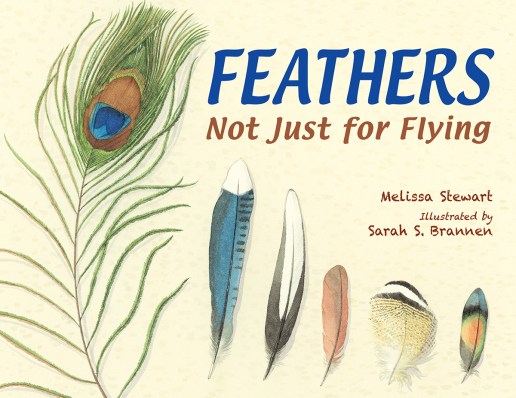
Unsurprisingly, by the time we were ready for bed that night the Changeling requested A Bird Is a Bird and we’d already read a new favourite in our house, Feathers: Not Just for Flying by Melissa Stewart, illustrated by Sarah Brannen.  (By the way, you’ll find good teaching materials at that link under “Downloadables.”)

feathers-hires

You remember how we found Feathers, via the not-unaccustomed route of our children’s librarian and our children’s book shop?  Well, it’s proven popular: it hasn’t had the time A Bird Is a Bird has had to completely meld into our daily lives, but the Changeling has already mentally aligned the two, she loves Feathers, and, as the readers, we parents welcome the addition to our bird-oriented repertoire.  What I noticed, though, was that we felt a particular intimacy in reading these books after having held a bird in our own two hands.  I found they went from being pleasant, interesting, useful books I enjoyed with my daughter to being actually exciting.

I’ve already said that Feathers is excellent if you’re looking for a book to follow A Bird Is a Bird, but I can also tell you that it’s a beautiful book in its own right, particularly if you find yourself with a child who has just found out that her love of birds is really exciting when she’s touching a bird’s feathers with her bare hands.  The book’s style is finely balanced between an old-fashioned naturalist’s notebook (think of Stephen Maturin in Patrick O’Brian’s books, or, if you insist on reality, of John James Audubon) and a child’s scrapbook.  Each page has a broad description of a feather’s function in large type as a title: “Feathers can shade out the sun like an umbrella,” for example.  Then it gives the naturalist’s notes on a particular bird which uses that function: the tricolored heron (illustrated on the facing page in a large, beautifully detailed watercolour) lifts its wings to shade the water so it can find fish and frogs more easily.  Ah, like an umbrella?  The page adds little paper umbrellas, the kind you get in your drink or for favours at a child’s birthday party, to the scrapbook.  Wouldn’t a naturalist provide a closeup of the heron’s wings?  You get that, too.  A frog?  Wouldn’t a child giggle and add a picture of a frog?  You get that, too.  It’s all there, but all done with those gentle, precise, and lovely watercolours: both Sarah Brennan and Melissa Stewart took their job seriously.  Each page appeals to the child, but doesn’t talk down to anyone.  My toddler knew she was being talked to, not being talked at, and if you work with children at all you know that they can tell the difference.

As a parent reader, I loved the style.  I loved the vintage feel of the book (emphasized by the yellowed backgrounds, like old paper) and how each page is laid out differently, really like a scrapbook.  Some pages show clippings being “taped” in (Sarah Brennan is good at her job– have you ever tried to draw a page being taped to another page?), but others show a framed large-scale painting of a bird, for example.  There’s freshness whenever you turn the page, but it always has the feeling of flipping through something a bit old-fashioned… only with bright little details like a sunblock label (for how feathers can protect a bird’s skin from the sun), or seeds trailing out of a photo of a bird feeder across the page.  In other words, the layout is consistent in its vintage feel, it takes its job seriously, it takes the reader seriously, and yet, brilliantly, it doesn’t take itself too seriously.  I love a book with a sense of humour, as does my daughter, and this one does.

Altogether, the result for the reader is fun and beautiful, but also extremely useful.  Reading it for the first time with my two-and-a-half-year-old, I didn’t go into the full, rich detail this book provides: I read the headings, gave a brief summary of how it applied to the bird in the picture, and we looked at some of the pictures.  (Note that these facts were easily skimmed at a first reading; that’s evidence enough of good, clear writing!)  That was enough for her for the first, impatient reading.  On subsequent, more leisurely, readings, we’ve read each paragraph carefully and found a lot to talk about.  In other words, this is what I think of as an “elastic” book: it’s very malleable to the needs of the moment.  I love that adaptability, and what’s most exciting is that it’s obvious it suits a wide age range and should be useful for a good few years.

I want to end by saying a word about non-fiction books here.  I’m a fiction girl, and I always have been.  (Hey, when I had to think of a naturalist, my first thought was Stephen Maturin, not Audubon.)  I don’t remember loving many non-fiction books growing up.  But this bird adventure with my daughter is bright and exciting for me: I’m discovering so many fun, readable, and informative non-fiction books with her, which is enriching both of our lives a great deal, and Feathers is definitely one of the best.

I’m looking forward to getting outside with our book this spring and summer.  I want to look at birds and talk about what the feathers might be doing.  I think you might enjoy doing the same thing with your child.

Peter’s Chair

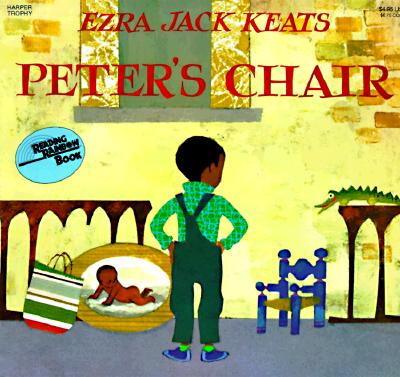
I love Ezra Jack Keats– jeepers, who doesn’t?  This year is his hundredth birthday, and I knew I wanted to write about him at some point.  Snowy Day is a favourite around here, and I thought I’d do that.  But then we didn’t have very many snowy days this winter, and a lesser-known, although still well-known and wonderful, story of his became the flavour of the week in our house.  I’ve been very happy to read it over and over again for two reasons: a) I love it and, of course, the writing and art stand up to rereadings; b) I’ve been finding it a tough nut to crack, in terms of the in-depth philosophical and theoretical analyses to which you’ve all become so accustomed from me.  The book is Peter’s Chair, written and illustrated by Ezra Jack Keats (our copy was selected by the toddler Changeling all by her very own self at Porter Square Books, a favourite around here).  And let me say up front that Ezra Jack Keats is the author and artist I most revere for the truthfulness and honesty which permeates his work.

Peter's Chair

You know, normally what you all get from me are the private thoughts I’ve worked up about children’s literature over the years, often drawn out of me by conversations with my daughter, who’s often much more perceptive than I am; her emphasis on flight in Swan, for example, recently impressed me.  In this case, I was struggling: I knew I loved this book madly, I knew I was ready to talk about that, but I didn’t know where to start and my Changeling was in bed.  Desperate, I asked my husband what most struck him about the book: “Its sense of place,” he immediately said.  (Why don’t I ask him more often?  He’s smart, that guy.)  I was mulling that over, when I got into a conversation with my mother about Keats: “You know he was Jewish,” she casually mentioned.  I was struck dumb (a rare event), not by the newsflash, but by the fact that I’d loved his books so deeply, found them so true and honest, and had never bothered to learn about him.  I never knew he’d changed his name, for example, in reaction to anti-Semitism.  Let me save you the trouble: read here about his fascinating life and the work he did and bridges he built.

I suppose this unfamiliarity was partly because, in a rare turn of events, these were classics I didn’t read often growing up, except for Snowy Day (how I longed for a red peaked snowsuit!).  The others, including Peter’s Chair, I’ve enjoyed finding with the Changeling more than I can say.  I’m almost grateful not to have read them before so that I could have the wonderful experience of reading them for the first time with my own child, discovering them together, and, in some cases, together with my mother.  One day last summer we were visiting my parents and went to the library with my mother.  While there, my mother found lovely videos of the books animated and read aloud (look for the Weston Woods link on that page).  We watched them together, and the memory is one I’ll treasure for a long time, I can tell you that.  My daughter was kneeling on the ground in front of the sofa, mesmerized by the snow falling around the little peaked red hood we all three knew and loved so well.  I sat behind her, occasionally touching her soft, curly hair (Her: “Stop it!” Me: “Sorry, bunny.”).  And that’s the day we first found Peter’s Chair.

So, well, you could say the book has a pretty special history for me.  But there I was, still learning a lot about it before I wrote this.  And that, to me, perfectly encapsulates the book: even one reading gives you such a strong sense of familiarity with the characters and Peter’s world, but even multiple readings leave so much to ferret out.  And that’s what I mean when I say that Keats is truthful and honest.  How often have you sat with an old friend, chatting away, and then had your mind totally blown away when they say, “I grew up there, you know,” or, “I dated him once,” or, “I’ve been struggling with depression for years.”  “Oh, wow,” you think: “I had no idea.”  That experience is exactly the one you’ll have over and over again with these books.

In this case, we see Peter’s home, his treasured possessions, his beloved dog, his warm and loving family, the new baby coming into this environment– and the hurt it engenders in Peter.  We see him hurt that all of his baby furniture is being repainted for his baby sister, Susie.  We see him being shushed as she sleeps.  We see him finally find his old blue chair, and his decision to protect his last little piece of babyhood (perhaps sense of self?) as he packs a bag to run away with Willie.  Finally, we see him discover that his old chair’s too small, and we see him go back home.  But what are his feelings?  Why does he leave home?  What finally makes him go back home?  When he does go back home, why does he tease his mother by pretending to be behind the curtains, but then jumping out from behind the chest?  What makes him finally decide to repaint the chair for Susie?

Oh, yes, these are honest books, books which give you a place, give you people, and give you such perfectly human representations that you don’t always know the answers to your questions; a rare virtue.  This perfect incompleteness comes through both in words and images: Keats’ use of collage is just beyond perfect, and it perfectly complements his collage of words.  Not every conversation is complete, and, by definition, every piece of the collage is individually incomplete.  And yet, built up together, he creates a vivid world: he gives you enough to tell you who people are, to give you a really strong sense of their home, and to make you feel like you could walk right through the pages and be at home.  That’s his genius: he teaches us, adults and children together, that you will never know everything about anyone’s feelings or motivations, but you can still appreciate them and be friends.  And all that without ever preaching at you.

What do I think about the answers to my questions?  I don’t want to tell you too much of what I think.  The whole point of the story is to think it through while sitting with your own Changeling on your knee.  But I’m not as strong a person as Keats, so I’ll tell you I enjoy watching Peter take charge.  He feels powerless, I think, supplanted by his sister: hurt that she’s getting his place.  When he leaves, he gets a breather, a chance to realize that he’s still his own person and can make his own place.  He chooses his place behind the chest instead of the curtain, teasing his mother.  He chooses to sit in an adult chair and repaint his little chair for Susie.  He becomes his own person deliberately, instead of by default: a decision we all have to make again and again, as Keats himself knew full well.

His genius is in showing us that.  “Show, don’t tell,” we’re always told when we’re writing.  He doesn’t tell us that.  He shows us how.

I’m so glad that I’ve still got so much more of him to discover.  Whoever you are, however much Keats you’ve read, I know you have more to discover, too.

The Secret Garden

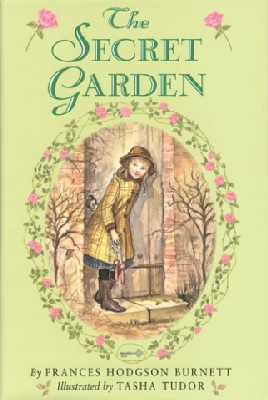
Do you remember long, long ago when I was talking about seasonal books, back in the context of Moominland Midwinter?  Well, I have many seasonal books– do you?  I have one for Christmas and one for fall, although, oddly, I can’t currently think of one for summer.  But my springtime reading is the strongest, the oldest, the most persistent: The Secret Garden, by Frances Hodgson Burnett.

Secret Garden

In one sense, it’s perfectly obvious, isn’t it?  There’s Tasha Tudor’s iconic cover page right there, and you can see the early roses clambering around the barely waking garden, with Mary looking prettier than she has any right to look based on the description in the book.  And yet, what strikes me as I read it this time around is how early in spring I always feel the urge to read this book.  I don’t read it when the grass has sprouted anew or the flowers are budding or blooming; I read it when I make that first trip to the hardware store to replace the wrecked or disappeared pruning shears from last year.  I read it when I pause and see the seed display and impulsively snatch up a few packets.  I read it when I frown at the ground, so recently covered by snow, now covered by the winter’s trash, and think, “Dear God in heaven, we’ve got to clean that up.”  And that got me thinking about the book and its relation to the seasons, and, in turn, what that means to the book.  (Hey, if you got that I just drew a little circle of arrows with words, and that makes it sort of a cycle, and the seasons form a cycle, you win my undying love.)

Let’s think about the plot a bit: there’s a girl, Mary Lennox.  I have no evidence that she’s from the British branch of the family which won’t acknowledge the breakaway American branch, Lenox, which emigrated to America and started selling china, but neither do I have any evidence to the contrary, so I choose to believe that.  (I’m terribly, terribly sorry.  Now you’ll never be able to unthink that.  I do apologize.)  The British branch always did the Right and Proper thing, and so Mary’s father shouldered the White Man’s Burden and went off to India while her aunt married a man of excellent property, even if he was (gasp or horror!) a hunchback, and therefore lived at lovely, gloomy Misselthwaite Manor in Yorkshire.  Your guess is as good as mine as to why we’re supposed to care that he’s a hunchback, but I feel awfully sorry for the fuss everyone made about it.  No wonder he suffered from depression.

Back to Mary: her parents might be very Right and Proper, but they’re simply awful parents and neglect her so badly that I always want to step through the pages and give them a talking-to.  It’s to nobody’s surprise that with no example of good behaviour and no example of how to love, she doesn’t learn to behave well or to love well.  She’s lonely and sour and I want to give her a big hug.  It’s sad to say, but the best thing to happen to her is when her parents die and she’s sent to England to learn how to love.  That isn’t how the book puts it, but it’s kind of obvious, isn’t it?  The first person to smile at her properly is Martha, the maid, who looks after her a bit.  Well, Mary starts to like Martha.  The first person to care enough to entertain her when he didn’t have to is the robin.  Mary loves the robin.  The first person to go out of his way for her sake and be himself with her, care for her, and take an interest in her interests is Dickon.  And she loves him.*  And of course there’s darling, curmudgeonly Ben Weatherstaff who’s a pea from her own pod: feigning uncaring while truly caring a great deal for her.  (My favourite is still the robin, personally.)  All of these people teach her enough about love so that when she finally meets Colin she is capable of caring for him, and by caring for him she teaches him that he’s really important.

Let’s pause for a parenting lesson for a moment.  You may be saying to yourselves, “Did Deborah say he needed to be taught he was important?  But, Deborah, are you sure we’re reading the same book?  The boy was like a prince, a Rajah, remember?”  And how often do princes or Rajah’s truly have anyone caring about them, or feel that they are important in and of themselves?  Colin needed someone to say, “You’re so important I want you to be alive and healthy.  I care about you.”  And Mary needed someone to say, “Your happiness is important to me.”  As soon as Dickon and Martha and the robin did that– and each helped the other, of course– they came to life.  Let that be a lesson to you: find your child and say, “I love you.  You’re important to me.  I care about your happiness.”  That won’t spoil them, but neglect will.  I say this from a whole two and a half years of flying by the seat of my pants, so you know it’s true.

And there we are.  Two children who had been alive long enough, but were like dormant seeds, sickly in storage.  They got soaked for a bit to perk them up: one in the Yorkshire rains, the other in salt tears from his anxious hypochondria.  Then they went out in the sun and woke up.  They grew, they stood strong, they came to life.  And so did the gardens around them.  But here’s the thing: they needed to start in that dirty stage: the clean-up, getting their hands dirty, softening the ground, overcoming their tantrums and stumbling into politeness.  That’s where spring starts, really.  You need to do the ground work (get it? get it?) before you can reach the flowers and the prettiness.  You need to tell the ground and the seeds that they’re important.  You need to feed them.  You need to get your hands and feet dirty and do a bit of pruning.  And you need to do this regularly, every year.  After all, back when he was married Archibald Craven had been awake, but then he shrivelled up, didn’t he?  Why yes, he did.  But in the fall, a late bloomer, he woke up again, because he’d figured out he was important: Mrs. Sowerby told him he was.**

Every spring I need my own reminder, is what I’m guessing, and that’s why I read The Secret Garden again.  Oh, it has its flaws (I do feel bad about the emphasis on poor Mr. Craven’s hunchback, and I wish that we saw more of Dickon at the end), but it tells us all that we deserve our own bit of the orange, to extend Mrs. Sowerby’s metaphor.  It tells us we deserve to be alive and happy and healthy.  It tells us that we matter.  And it always gets me out of doors, getting my hands dirty, and feeling hopeful for what the spring will bring.  I never know which flowers will be the prettiest, but they all get their bit of earth, and that’s what matters.

I should be in South Carolina when this goes up (I hope my scheduled posts work), and will be feeling a bit like Mr. Craven, seeing a new part of the world and finding new beauty spots.  I hope you’re enjoying your early spring wherever you are, and be sure to tell your garden you care about it, OK?  Get your rake and your spade and get your hands dirty.  Then go inside, wash your hands, and find your own spring reading.

*So, my pet wish: I think that Mary and Dickon or Mary and Martha should end up together, but I know the class distinction would be a barrier.  But this is later in the 19th C so maybe Mary will come over all rebellious and reject social norms?  It would be weird for her to end up with Colin, anyway.  But I think that’s why Frances Hodgson Burnett quietly cuts Dickon, and even Mary, from the story towards the end, don’t you?  Maybe they’ll run away to the Lennox branch of the family!

**Wait, wait!  Is there a Mr. Sowerby?  We never hear of him, do we?  What if Mr. Craven and Mrs. Sowerby get married???

Ages and Why I don’t mention them often

Today’s a bit of a departure from the norm since I won’t be talking about a specific book so much as a theme: Ages.  Not the Ages of the World, but the age to which a book might, in general, be best-suited.

As a bit of background, I was nine years old, I think, when I first read The Odyssey.  I snuck it from my mother’s study, if I remember correctly.  It’s a fair guess, anyway.  My mother and I have an ongoing war of who’s stolen more books from whom.  (Mum, I swear I cleared all of yours from my room on the last visit, OK?)  The point is, I didn’t ask anyone if I could: I just went and did it, and loved it.  I read it through, images in sepia colours coursing through my head (probably due to that classic faded orange cover of Richmond Lattimore’s translation).  Let me quickly add: no, of course I’m not saying I understood it at the level a college student might, much less Lattimore himself.  That said, I was happy. I just went and did it without asking questions or permission or even thinking whether I “should” or “shouldn’t,” and I enjoyed it immensely.  I was on a Classical mythology kick, and this was one of my discoveries.

Sometimes this approach failed.  I remember reading a story which, as an adult, I know was about a vulnerable young man, homosexual, who hired an escort to pose as his girlfriend or fiancée (I forget which) when he went home to visit his parents.  I completely, 100% missed the entire plot when I read this story at age ten, perhaps.  I remember my poor mother coming up to me, cautiously asking if I had any questions.  I think I said something like, “It was sort of an odd story.  I’m not sure I got it.”  She nodded, and said she thought I might like this other one better (which I did).

My point?  I’m the world’s worst person to ask about the age to which a particular book is suited.  I have general mental guidelines: novels are not for toddlers.  (Except, apparently, Moominland Midwinter?)  Picture books are not for adults.  (Except I write this blog, so, well.)  But God bless people like my mother, who always knows the appropriate age for a book.  “Is Charlie and the Chocolate Factory good for Grade 2?” I ask her.  “Well, I’d normally say Grade 4, in general,” she replies.  How does she know these things? I marvel. (Answer: years’ experience as an excellent English teacher, probably.)

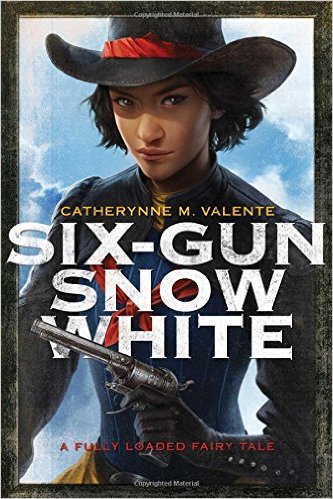
But let’s think about some books which are normally way out of the age range I seem to have fallen into for this blog.  I’ll roughly arrange them from “OK for younger age” to “Not for children at all ever.”  I was just at Cat Valente’s book signing for her last Fairyland novel.  While there, they had her book Six-Gun Snow White for sale.

Six-Gun Snow White.jpg

Of course I bought it.  I love Cat Valente.  This is a wonderful book.  It’s the story of Snow White as set in the Wild West.  Snow White’s father is a silver baron, her mother was a Crow woman who was effectively forced to marry him.  When the young wife dies soon after Snow White was born, the man, Mr. H, remarries, taking for his new wife a blonde New England woman who mockingly names Snow White for what she will never be.  You can tell from this brief overview two things: a) This is a fascinating book and you should read it; b) This book has some themes which do require a certain amount of age and experience: implications of sexual exploitation, racism, violence, blood, psychological manipulation.  These aren’t light topics.  And yet there’s little by way of anything actually graphic going on, so you can, to an extent, engage at your own level.  I’d have been a bit embarrassed by it until university, but I was shy of violence and sex in books.  Maybe most high school kids could handle it?  After all, if you can handle The Turn of the Screw, this should be fine.  (In fact, my fellow students were fine with every aspect of The Turn of the Screw except for the somewhat high-level language– they’d have preferred this, I think.  Maybe high schools should take note of it!)

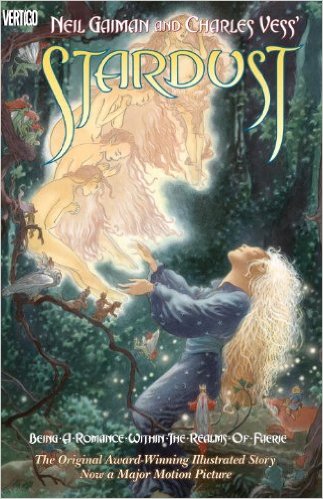
What about illustrations?  How do they play into this game?  Stardust by Neil Gaiman, illustrated by Charles Vess (one of my favourite artists working today) is about at the same level as Six-Gun Snow White: there’s one tiny swear word, one sex scene, and themes of slavery, sexuality, violence, and murder.  Throughout the book, a witch is trying to catch a star who has fallen to earth in the shape of a girl– and the witch wants to cut out her heart.  And yet, the whole thing is as delicate and lovely as a falling star.  The violence is muted. The sex is gentle and hardly noticeable.

Stardust

Well, who is this aimed at?  I’d say it’s aimed at lovers of fairy tales (same for Six-Gun Snow White, of course, but that’s more of a Western, in some ways).  If you love the delicacy, beauty, and brutality of Grimm and Perrault, you will love this, too.  But maybe you have to be a bit older to understand that.  Again, I think high school kids should be able to read this, but it depends so much on taste.  I’m glad I waited, for my part, until I was 28 and had a better appreciation for the structure and artistry of the book.  I’d have been too nervous about the (limited) sexuality when I was in high school (“Am I supposed to be reading this?” I’d have wondered) to enjoy the beauty of the book.  And yet I strongly suspect that there are those who could read it even younger, at even 11 or 12.  (NB: Don’t take this as advice.  We’ve already established I suck at this.)

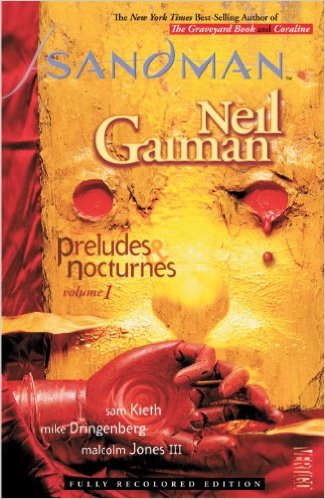
Those who know Neil Gaiman probably think first of his seminal graphic novel Sandman.

Sandman

What about that?  Most people tend to think of it as older– there are lots of high school students who are obsessed with it, but I didn’t embark on it until very recently (I’m almost 29) and, once again, I wouldn’t have been a happy camper reading it in high school.  There’s very explicit– and graphic– violence in these books, although they’re not books about violence.  That said, I’d say the violence would be more of a concern for me in handing it to a youngster than the sex in this particular series.  Nevertheless, as with Stardust and Six-Gun Snow White, there are themes which could make a kid feel less alone, better grounded: for me it would have been the mythology and fairy tales, which both feature heavily in these books.  That said, someone encountering their own sexuality would find a place in this series.  So would anyone of any colour.  So would anyone simply feeling a bit lonely, a bit of an outsider, or, perhaps, coping with some weighty issue from their past, which is a major theme in these books.  Would those benefits outweigh strict “age-appropriateness” rules?  I’d need to know the kid to gauge that, for sure.

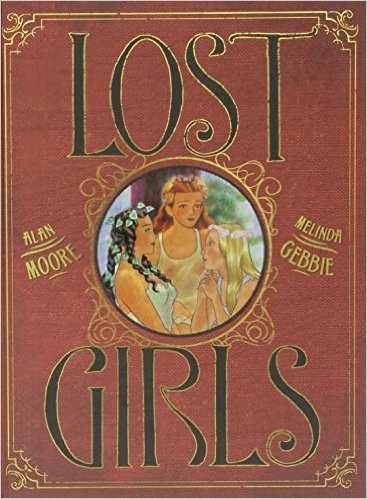
Let’s crank it way up here: Neil Gaiman’s friend Alan Moore wrote an equally cult-famous graphic novel, gorgeously illustrated by Melinda Gebbie: Lost Girls.

Lost Girls

Once again, we’re drawing on literature traditionally associated with children, but this is erotica.  Make no mistake: we’re talking about explicit sex, drawn with the grace and beauty of a George Barbier painting.  We’re talking incest, rape, and drugs, so do be careful of what works for you in your reading.  The theme here is dealing with three lost girls: Alice (Alice in Wonderland), Dorothy (Wizard of Oz), and Wendy (Peter Pan).  Alan Moore takes it that each has unfinished sexual trauma from their youth, and he draws them together in pre-WWI Austria to sort out their traumatic pasts, share their stories, and grow to feel more in control of themselves, their bodies, and their lives.  It is a beautiful book.  Never, ever, ever show it to a child!  Find it, as I did, in your own time and place and way.

What do we take away from this?  All of these books draw to some extent on stories we read with kids.  In fact, all of that stuff (the sex, violence, brutality) is there for the kids to see, if they’re ready, right in the Brothers Grimm, right in Perrault.  These books play with those themes to greater or lesser extents.  Am I saying “therefore hand these older books to younger kids”?  Absolutely not: I note right here, as above, that I, the girl who read The Odyssey when I was 9, wouldn’t have been ready for any of these books until university.  I might have handled them, but I did way better reading them at an older age.

My point is that ages for book-reading are highly personal.  I have deep respect for my mother or anyone who’s good at gauging the right general age-audience for the right book.  Myself, I read too widely and wackily too young to know what was right for what age, and I lack any experience as an adult to rectify those impressions, so I’m not good at that.  But what I can say is that we all mess around a bit: so much of reading is trial and error of taste, and age plays into that, too.  For parents, I’d say we make things up a lot in parenting, and finding the right books for our kids is part of that.

What do I do by way of a guideline, if I don’t watch age too carefully?  I watch the books.  Books find other books.  Notice that above I chose four very different, very related, groups of books.  Anyone who likes one of those will probably enjoy any of the others.  Or not, but it’s worth a try.  You could easily grow from one to the other as you get older.  Or you could enjoy them all as an adult. Or you could ditch them and read The Fox and the Star or The Tea Party in the Woods instead.

After all, it’s your choice what you read!

(NB: In this blog I note my daughter’s age and how she responds to books.  Make of that what you will– I don’t want to mess you up by giving a “wrong” age group.)

Little Bear

Today is one of the days I get to keep my Changeling at home.  I feel a bit guilty about how happy this makes me, but not much.  She’s normally in daycare, among kids her own age, happily learning how to communicate with them, “do bunny-hops,” socialize, and “do jump-jacks.”  While she’s gone, I diligently work.  I even enjoy the peace and quiet and how the floor will stay clear of Calico Critters after I put them away.  (I decline to comment on how long it takes to put them away and whether this is related to any dressing of tiny panda bears which may or may not occur.)  My days working alone while my daughter’s off with her own age group are often fun and rewarding for both of us.  It’s a good arrangement.  And I miss her.  I miss her voice.  I miss occasional feelings of frustration as I patiently wait for her to sort something oh-so-simple out, and more frequent explosions of amazement at how adept she’s become at something (like identifying a blue jay in a tree today!).  So, when I do get her at home, I’m thrilled.

And I have a book to share with you, courtesy of the Changeling.  “What book should I write about?” I asked her.  She thought seriously.  (She always thinks very seriously.) “A Bird Is a Bird,” she suggested.  “That’s a wonderful book!  I already wrote about it, though.  Can you think of another?”  She sorted through her mental library and turned up… “Little Bear.”  “Thank you!” I said.  “What a wonderful idea!”

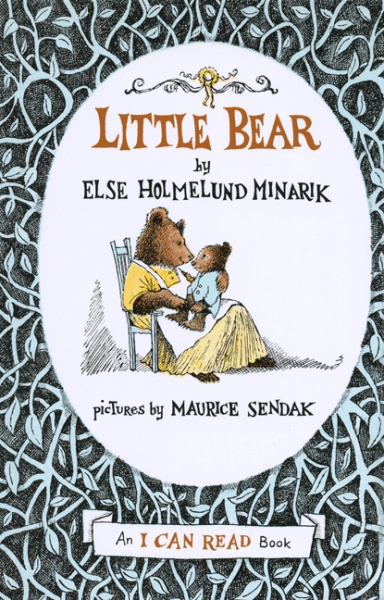
Little Bear

And so, here we are.  Little Bear, by Else Holmelunk Minarik, pictures by Maurice Sendak, is one of the first books my Changeling selected herself at the Children’s Book Shop.  I’d say most of the books I talk about here fall into two groups: a) the very new; b) the Canadian or otherwise “hidden” classic.  I rarely get to talk about books we all read, and all will read with our children and grandchildren, and so onward through the ages, amen.  I need to thank the Changeling for giving me the nudge and permission to talk about some of these really good books– the ones which are popular for a really good reason.

The difference for me, of course, is that you all know what I’m talking about.  Instead of trying to give you the feel and texture of an unfamiliar story, or pinpoint the big idea of a book you probably haven’t read, here I am in new territory: we’ve got something we all know, so what can I tell you about it?  So I’m going to shift focus to the reading process.  These books, after all, are all about the process– the process of reading with your child.  Sometimes the Changeling likes to sit on the floor while we read to her, but that can’t be done with these: “These are lap books,” I tell her.  You have to read these together, as a partnership, so I’m going to tell you all about these books as a partnership.

“Books?” you query.  “But you said… Little Bear, not Bears or Little Bear Series or…”  Ah, yes, fair point.  As I said, I’m talking about these books as a partnership.  When my daughter says “Little Bear,” she means all the Little Bear books.  And that’s one of the great things about this series I want to draw attention to here.  In general– and there are major, major exceptions to this rule, so I’m making an easily-punctured generalization here– young children’s books tend to be singles whereas young novel-readers expect series.  I’m talking Each, Peach, Pear, Plum vs. Harry Potter here.  That is: when a picture book author starts a book, my impression is rarely that they’re planning from the first to start the Curious George franchise.  They wouldn’t mind if people want another book with Babar in it, but it’s a bit different from a 7-book series proposal.  Very generally speaking.

So, for young readers like my Changeling, who are used to getting very contained books (Annabel lives in Extra Yarn, not elsewhere), it’s exciting to get your first taste of books where the characters go on to live out more adventures in a number of books.    You meet a little bear cub who’s cold and goes through all kinds of clothes before settling on his own fur coat, and you want to know more about him.  Well, it turns out he likes to visit his grandparents (Little Bear’s Visit), and he misses his father and looks forward to seeing him when he comes home (Father Bear Comes Home) and he really, really loves mermaids (likewise in Father Bear Comes Home).  My Changeling loves to stand there with all the books in front of her and make a choice.  (I will note that she has a very similar response to the Harold books, which makes sense; it’s a similar structure and dynamic.)  Often she heads straight for the story of Mother Bear and the Robin (from Little Bear’s Visit), but sometimes she prefers a mermaid story (Father Bear Comes Home), or “Birthday Soup” (Little Bear).

The choice rests with her, and that’s the genius of this series.  They’re constructed around getting kids interested in reading, and every element works towards that: of course there are the glorious illustrations by Maurice Sendak (which are minutely examined on a near-daily basis in this house), and there’s the simple, repetitive, but not at all boring text.  Of course there are the stories themselves: the topics are familiar (hiccups, pets, birthdays), but the stories are adventurous enough in being set out of our world, in a warm parallel plane inhabited by animals rather like us.  Yes, these are all very successful elements.  But the gentle structure of being almost a series, where you’re learning to engage with a character and care about him and his family and friends as you move from story to story, getting pulled into a whole world– that’s something I haven’t seen remarked on (I  may simply have missed it), and after reading these stories over and over again with my daughter, it’s something I’ve learned to notice and greatly appreciate.  I’m not saying these books are a gateway drug to the big series out there right now– anything from Little House to Harry Potter to Cat Valente’s Fairyland and all the others out there.  I’m not saying it’s like that.  No, I’m not saying that.

I am saying it’s wonderful to watch my child learn to engage not just with a particular story, but with a character and a world.  In other words, to learn to engage with how a story’s made, what a book really is: world and character and words.  All of those elements that go to make a novel, and to make a series.

These books aren’t a gateway drug to series at all.  They’re a gateway drug to reading in general, to books with more complex groups of characters, and richer worlds.  And, sorry, Nancy, we aren’t saying no.  We’re saying: “I love this so much I want my Emeh to write about it.”  Now, that’s getting kids into reading.

P.S. She said she’s going to write about another book all by herself.  A book about stories, she said.  I’ll keep you posted.  Can you tell I’m happy I have my girl home with me?  (Not that I’m sorry she’s been taking a good nap!)