Borrowed Black

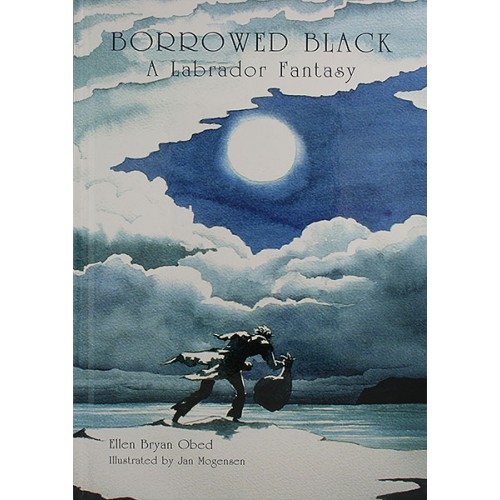
There’s a silly, lovely little book I was going to talk about today, but then my daughter stole it and took it to daycare with her.  I can’t blame her: it’s a fun book and it made her happy about going to daycare.  But I was left one book short and had to come up with another book for today.  As I stared at my shelves, looking for another silly, lovely little book, I felt a pull in another direction.  It’s been windy lately, here in Boston, and I guess the wind pulled one idea out of my head and blew another in: let’s talk about Borrowed Black: A Labrador Fantasy, poem by Ellen Byan Obed, illustrated by Jan Mogensen.
Borrowed Black.jpg

This is the opposite of silly loveliness, although it is definitely a beautiful book.  There’s silliness in here, there’s fun, but at the heart of this book is wind, and if you come from my part of the world, Atlantic Canada, then you know damned well that you’d better take the wind seriously.  Ask my mother about driving in the wind there sometime.  I suspect that there’s a reason she loved this book so much (and I learned about it from her, growing up), and I wonder whether part of it wasn’t an underlying feeling that “if you say the wind can do it, then I believe it!”  What I’m trying to say here is that if there’s one part of the world where it makes sense to harness the wind to provide power for the rest of the world, Atlantic Canada is probably your best candidate.  And wind is a pretty integral element of the story of Borrowed Black.

You know what?  I don’t use the word “favourite” very often when talking here.  I love so many books so much that I’m pretty much La Coquette des Livres; if I’m not with the book I love, I love the book I’m with.  And I’m very comfortable with that kind of coquettish streak in my book life (I assure you it doesn’t extend to my family life).  So I don’t bother much with throwing around preferences.  But I’m entirely comfortable saying this: in the world of poetic narratives for children, Borrowed Black is, bar none, my favourite.  I love many of them, but there’s only one that nestles in the deepest recesses of my heart, and it’s this one.

Why do I love it so much?  I think it’s because it gives, with every word and every stroke of Jan Mogensen’s beautiful monochromatic watercolours (all blues, relieved judiciously by white and black), the impression that it’s telling an old story– something as fundamental to Labrador as the ocean and the rocks.  And yet, at the same time, it’s completely original: a fantasy, not a folktale.  Ellen Bryan Obed tells the story of writing Borrowed Black on her website: apparently she wrote it when she was twenty-two years old, and with very little revision, and adds, “It was as if it were not my own, that I was penning a story that had always been.”  And that is distinctly the impression that comes across from the book for me, that “it had always been.”  Rocks, ocean, and wind.

Borrowed Black is a Labrador creature who makes himself from bits of the land and sea around him, held together by the wind, which is part of his heart: “He had a borrowing wind for a heart/ That held him together, each small borrowed part.”  But his greed for more makes him a menace: he borrows the very moon from the sky, smashes it to the ground, and buries it deep in the ocean.  Then he sleeps through dark moonlessness until rescue is at hand in the form of a boat in the back of a whale. This boat belongs to Cabbage Captain and his Curious Crew, including Mousie Mate and Sinky Sailor “who was happy and round,/ Who always was laughing without making a sound.”  The quiet humour which slips in here is a welcome relief from the spookiness of Borrowed Black, and Mousie Mate quickly becomes a favourite as he slips into Borrowed Black’s shack and steals the wind.  Pursued by Borrowed Black, Mousie Mate bravely challenges him to show where the moon lies: “Tell us, Borrowed Black, where the moon pieces lie./ You’ll not have your wind ’til the moon’s in the sky!”  Borrowed Black is forced to agree, but the wind can’t mend the broken moon.  So the wind stays in the sky with the moon, and “as night turned to day…” Borrowed Black falls apart and is gone forever.

And here’s where the folkloric feel to the book really comes through:

To this very night on the Labrador
When you stand and watch on the tall, dark shore,
You can see cracks in the moon round and high
And the silver it left on its way to the sky.

And fishermen say if you follow the trail,
You’ll come to the boat in the back of the whale.

OK, let’s take note of a few things here: a) This is a children’s story, with Mousie Mate and the Curious Crew– there really is genuine fun and silliness here; b) This is a spooky story, with Borrowed Black’s glowing eyes and creepy thievery; c) This is a creation myth, explaining some aspects of the world as it is around us– the cracks in the moon, and the trail of light it leaves on the water.  All of these things are true.

But there’s something more: it’s a home story.  It’s rooted in its own place so very deeply that I, who also grew up in the Atlantic provinces (New Brunswick, though, not Newfoundland), feel a sympathetic thrill when I pick it up.  I was desperate for my daughter to love this one, and, even aged two when I first introduced it, she did.  (She also loves wind and snow and takes ice-cold baths.  She’s a Maritimer at heart, that one.)  She had us reading it to her again and again, so often that I’m actually labeling this as an “All Ages” book, even though it’s probably aimed at an older audience.  Clearly some children will enjoy it very young.

I wonder whether I’m the best person to review this one.  It’s so very personal to me, so very much a part of my home and my roots and my background that I almost feel too close to have perspective.  But, then again, I watch my husband reading it with my daughter, and the two are engrossed.  They’re smiling and spooked and delighted.  They love it.  And this is what I think: you don’t have to be Greek to appreciate the Odyssey, or English to love Joseph Jacobs’ retellings of English Fairy Tales.  So, too, you don’t need to be from Atlantic Canada to know a good story when you see one, and this one is, truly, fantastic.

It’s a fantasy, and a fantasy that knows it’s home.  Let the wind blow you in for a visit, but maybe bring a good hot cup of tea with you.
Vincent’s Colors

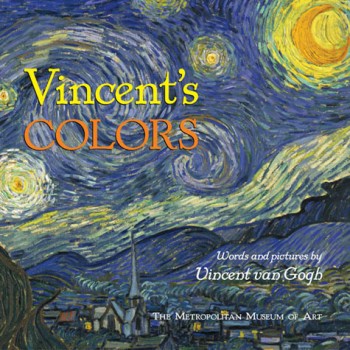
There are some books out there which really and truly are good for all ages.  Usually when I see a book marked as being for “children of all ages!” in a review, I mentally append, “Please don’t feel stupid for enjoying this as an adult.”  Now, personally, I never feel stupid for enjoying these books as an adult; instead, I spend my time over-analyzing them on my blog.  So, when I say that a book is for “all ages,” this is what I mean: I think that you can go as young as you like with this book.  I think that once your kid is interested in looking at books and listening to words, you can give this book a try, and I think you’ll get something out of it at the same time.  The Fox and the Star was one of these: I found it meaningful, and I think my daughter would have enjoyed it at even a younger age than she is now (two-and-a-half).  Well, here’s another one for you: Vincent’s Colors, words and pictures by Vincent van Gogh.  This comes to us from the Metropolitan Museum of Art and Chronicle Books, and it’s so pretty that it should be marketed as “baby’s first coffee table book!”

Vincent's Colors.jpg

The basic concept is simple, but, Lord, it must have taken a lot of work to get just right.  The book presents a series of van Gogh paintings, each accompanied by a brief description of the painting taken from van Gogh’s own letters to his brother, Theo.  Doesn’t that sound lovely?  Let me ruin this for you: I bought this in a rush of excitement from the Chronicle Books website (NB: that website is dangerous and beautiful, like a kind of modern day fairyland), but the reason I bought it was because I was somehow expecting some series of deep, abstruse, inspirational descriptions.  I don’t know, something like: “Here I attempted to capture the shades within shades which permeate the redness of the cap– that whole new spectrum within RED, can you not see it?– and which matches the spectrum of the spirit…”

God, I’m sorry I inflicted that on you.  Please forgive me.  Moving on: I’m so very glad that van Gogh wrote better than that, and that Chronicle Books and the Met decided to pair his beautifully concise descriptions with his lush and vivid images, because they taught me something about how adults, children, and van Gogh himself see and describe art.  To spoil the suspense, let’s just say that adults like me maybe try to see and say too much (quelle surprise!), whereas van Gogh, in these pared down descriptions, perfectly meets the child’s eyes and perceptions, and, through that, we can find a whole other world of art.

To be clear, for all that I’m teasing myself here, I don’t think that adults have dulled perceptions whereas children see the true hearts of things in art.  That’s taking things to the other extreme.  My view is a little simpler: we all see and enjoy what we see and enjoy.  That said, it can give us a bit of a brain boost, a bit of extra fun, to see how someone else enjoys art– and maybe we’ll learn another way to enjoy things.  I first learned this with my daughter by taking her to the Isabella Stewart Gardner Museum with me.  We didn’t get through the whole museum, of course, and what we saw and enjoyed tended to be about three feet of the ground, maximum, but what a new world!  Stone lions and “pictures of babies” (any art depicting the baby Jesus, basically) were paramount, as well as all of the fountains.  Looking around with her, and through her eyes, I noticed statues I’d passed by with barely a glance on my own.  It was really a new way of seeing a museum I already loved.

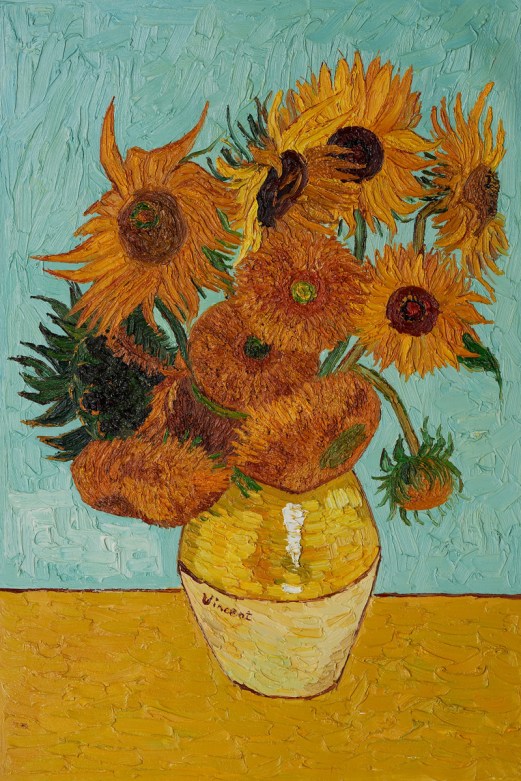
I think the same thing holds true of reading this book.  The paintings are mostly familiar, although you may meet some new van Gogh art (always a good thing!), but you may learn a few new things.  This is hard to express in words, so let’s try an exercise.  Three paintings by van Gogh, his description, and what struck me:  First, a certain familiar painting of sunflowers:

Sunflowers

with the words: “twelve flowers that are light on light.”  (I was caught up with the signature on the vase.  Yes, I’m weird.)

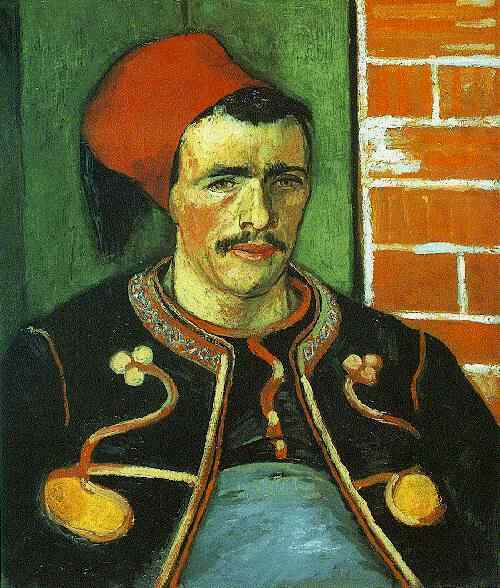
You’ll also get Zouave:

Zouave.jpg

van Gogh’s description: “a reddish cap and orange bricks.”  (I was fascinated by the small face emerging from big, embroidered coat.)

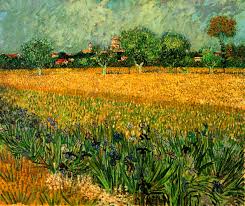
And, finally, View of Arles with Irises in the Foreground:

View of Arles.jpg

described as: “some very yellow buttercups.”   (My eyes were struck by the trees and buildings in the background.)

I didn’t just do that because I wanted to look at a lot of van Gogh.  I mean, I do, but I also have the book right here and the colour reproductions in this book are stellar, much better than the internet pictures I grabbed (a reason in itself to buy the book).  I mostly chose these pictures for three reasons: a) to give a sense of the scope of the book, which includes a wide variety of paintings, some more familiar to us than others; b) van Gogh and I focused on very different things; c) I thought those descriptions gave a sense of the variety and level of descriptions included in the book.  Some are a bit more abstruse (“light on light”) and some are very concrete (“a red cap”).  Some are about the main subject of the painting (“twelve flowers”) and some are deliberately not about the object in the foreground (“very yellow buttercups”).  Brief as the descriptions are, their breadth matches the breadth of van Gogh’s art: he touches on everything, and packs a lot into a small space.  Compare “light on light” with my atrocious attempt at art description above, and tell me which you think captures more in a smaller space.  (Hint: it’s not me.  Granted, I perpetrated that atrocity deliberately– mea culpa– but, still.)

That’s great then, that’s what van Gogh sees, and how I understand what he sees.  But what about children?  Have I forgotten them?  I can only speak to my Changeling’s reaction, I’m afraid, but it’s surprising how often what she picked up on aligned with the description.  In order, and I admit that I am somewhat paraphrasing here: “I see flowers!  They’re big.”; “Look at the red hat, do you see the red hat?”; “There’s so much yellow!”  Her reaction is very like her reaction to any other full-page illustration in a picture book, of course, so we’re not exactly looking for art critique here.  (Also, I acknowledge that the editing of the book has a lot to do with this as well; which is to say that the editing is great!)  What’s interesting is that she picks up on and describes the first thing to catch her eye, and, in most cases, that’s pretty much the aspect that van Gogh’s describing.  For Arles, for example, she pretty much didn’t notice the misty, dark irises in the foreground.  The bright yellow strip of buttercups?  Absolutely!  She wasn’t so interested in the man, but his red cap?  Sure thing!  It’s the brightness, the “light on light” which she sought out.

Now, isn’t that worth noticing?  I’m telling you: take your kid (or niece or nephew or grandchild or friend) and go to a museum.  Look with them, and be patient.  Listen.  You may see something you’d never seen before.

Swap!

I’m posting ever so slightly later in the day than is my wont, but I won’t apologize.  Why am I a bit later?  Because this morning, after dropping the Changeling off at daycare (excuse me, at “work”), I went to the seat of all that is happiest in life: The Children’s Book Shop.  That’s why I won’t apologize (except to the Changeling, who will be furious I went without her); I was off getting supplies to make you a better blog, a happier blog, a blog which purrs contentedly as you sit on your cushion and sew a fine seam and feed upon strawberries, sugar, and cream.  There are lots of places to go for supplies (the library, of course, being bread and milk for our darling blog), but every once in a while a blog needs those strawberries, sugar, and cream.  For that, there’s none compare to the Children’s Book Shop.  I feel a happiness and lightness in my spirit, and you’re going to love what we’ve got for you.

First things first, dear readers: I want to tell you a story of a good bookstore and why people should shop there.  When I walked into the bookstore today, I said, “Hi, I need new books.”  I named a few good publishers (Chronicle, Candlewick), but mostly said I wanted interesting things fresh off the press– I have a lot of classics, but I need something new.  Then I stood there while they trotted around saying things like, “Oh, there’s this one– and do you think she’d like…?”  Books rained down upon me and I chuckled and thought and sighed as I flipped through beautiful book after beautiful book.  That’s a good bookstore!  That’s food for the brain and inspiration for the soul!  And that’s why today feels a bit celebratory and revolutionary around here.

For example, I normally don’t post about picture books without first reading them with my daughter and having a good think or two first, but I read this at the bookstore and had such a good laugh that I couldn’t resist sharing it with you right away.  I’m sure the Changeling will forgive me when she sees what I brought home.  The book is called Swap! written and illustrated by Steve Light.

Swap!.jpg

Folks, this is a swashbuckling, chuckling, clever ride of a book.  It’s sheer fun, but with a puzzle-like twist from page to page, and a thoughtfulness to match.  The question the book asks is: “What do you do if you seem to have nothing, but want something very much?”  The answer is: “Are you really, really sure you have nothing?  Search again… and then?  Let’s SWAP!

First, let’s talk a bit about the story to this book.  There’s a sad sailor whose ship is old and decrepit.  His feisty young friend picks up a button which fell from the sailor’s outfit and says, “Let’s SWAP!”  And they set about swapping for all they’re worth: the button becomes two tea cups which become three coils of rope, two of which become six oars, then two oars become four flags… and on they swap until the ship is fully kitted out and the friends are ready to set sail on their new ship, happy again.  Ahoy!

Did that sound boring?  My apologies– blame me, because it’s not: that’s where two other factors come in, one of which I’ve already raised.  First, there’s the puzzle feeling.  You may have already sensed this from my retelling.  You figure out pretty early on that the friends are gathering ship-related things, and you can also be reasonably sure that, being a picture book aimed at children, they are unlikely to fail in this mission.  A tragic demise by falling timbers is probably not going to traumatize the sad friend even further, since it would probably also traumatize the intended audience.  So we’re left in a state of moderate suspense: “What next?  Will they get anchors?  Won’t they need– ah, yes!  But why three anchors?  Do they need three?  Oh!  Another swap!  And then they get sails!”  So, you see, there’s a constant question in mind: “What else will they need, and how will they get it?”  It never, ever feels dull, because you just don’t know where their ingenuity is going to take them next.

The other factor is the art.  Steve Light works mostly in pen and ink: lively, bold pictures of sailors and dockyards, mermaids and towns, birds and figureheads.  Each page is punctuated, however, by ink and gouache colours: perhaps for the oars, or someone’s outfit, or the ocean, or just a bird’s beak.  This lightly teasing approach, the lively continuity of the illustrations, along with the mischievous use of colour, precisely parallels the continuity of the narrative punctuated by unexpected swaps (I didn’t expect those glorious hats!), or the ultimate use of the swaps (A flag becomes a blacksmith’s tunic?  How clever!).  In fact, it’s the very simplicity of the narrative which allows for the unexpected to come through, and so it becomes a course of bubbling fun: “What’s next?  How will they make it work?”

That, of course, being the unspoken message of the book: “Persist, young friends!  There’s a way, if ye can but trim your sails and follow the true course!”  (Forgive me, I couldn’t resist.)  “Unspoken” being the operative word here; there’s nothing I loathe more than preachy books.  A book should open you up, give you an epiphany, a new way of seeing the world, and that’s what this one does: “Hey– if I have something he wants and he has something I want… we can swap!  And then we’ll both be happier!”  That’s a little epiphany right there, and the persistence that goes with it should be another one.  “Don’t give up,” the book whispers, “there will be a way.”  And it whispers lightly, engagingly, and we go happily along for the trip.

There’s one thing that concerns me with a book like this: it’s the work that must have gone in.  I see a light, funny, simple book like this and think, “Holy crap, that must have been a lot of work to make it seem so smooth and light!”  Those detailed pen and ink drawings, the choice of colour and where to colour, and, of course, the simple, effervescent feel of the words… that must have been hard to accomplish, and yet may not be evident in the outcome, so I want to give an extra flourish of my plumed hat as I bow to Steve Light.

I can’t wait to read this one with my daughter.  I predict that it will be a favourite of hers as well as of mine, and I thank the Children’s Book Shop for seeing to it that I got it!

Fairyland

You may possibly remember that I’ve mentioned Catherynne M. Valente‘s Fairyland series several times.  I may have sounded a little nervous about approaching the actual process of really putting words on the page to actually talk about the books, though.  There are a few reasons for that: a) I usually try to keep these posts below 1500 words, definitely below 2000, and talking about a series of five jam-packed novels is a little ambitious for a concise blog post; b) I love all of the books I write about here, but the ones I really love the most are usually picture books from my childhood.  In other words, the type of love is nostalgia and sweetness, not a raw, bleeding heart whispering, “Yes, someone gets it!  That’s just what that’s like.”  The closest I’ve come to that here is when I talked about The Fox and the Star, which I discovered at much the same time as Fairyland.  But it occurs to me that there’s real value in talking about the raw, bleeding love books as well as the nostalgic, sweet love books.  Maybe someone else will find them and whisper, “Yes, someone gets it!”  That would make me happy.  So here goes.

As I said, there are five books in the Fairyland series: The Girl Who Circumnavigated Fairyland in a Ship of Her Own MakingThe Girl Who Fell Beneath Fairyland and Led the Revels ThereThe Girl Who Soared Over Fairyland and Cut The Moon in TwoThe Boy Who Lost Fairyland, and The Girl Who Raced Fairyland All the Way Home.

Let me start by pointing out a few things.  First, if there are any books I’m just hanging around waiting for the Changeling to read when she’s older, these are those books.  I can’t wait to talk about them with her.  Second, the blog-name “Changeling” for my daughter comes from these books (more on that later).  Third, I want to be best friends with September, the “girl” who’s running through these books.  That’s not really relevant to anything; I just felt the need to note that right up front.

But maybe you want to know more about September.  September is a girl from Omaha whose father is away at war and her mother’s at work.  The atmosphere running through September’s Omaha isn’t unlike Neil Gaiman’s Stardust: it’s just old enough to be a little archaic without being alien.  But then one day the Green Wind shows up at the window and invites September to Fairyland.  She leaves with him on the Leopard of Little Breezes and that’s the beginning of her adventures, including finding her friends Saturday (a Marid) and A-Through-L (a wyvern, and possibly my favourite character).  Except, of course, that the adventures she has are all on account of September and who she is, not on account of being a kid plonked into Fairyland.  And yet, without Fairyland there would be no adventures.  And that’s the fine line on which all the books are balanced: we need Fairyland, but we are who we are with or without it.

Now, what are these adventures?  Well, here’s where I find myself in a muddle.  I don’t normally mind spoiling the hell out of books over here.  They’re picture books, or old books, or some kind of book that doesn’t mind being talked about up and down the block.  But these books you really need to read.  That said, I can tell you a few things.  First and foremost, what’s central to these books is something very traditional in all fairy tales: the Quest.  Each book is centred around some form of questing.  Either September is on a Quest for an object (the first book), or a mission of some kind (the next two books), or, in the fourth book, the Quest is someone else’s job (but ultimately leads us back to September), or, in the fifth book, it’s a good old-fashioned race… always, always, there’s the Quest.  There are even discussions of Questing Physicks.  In modern terms it’s really a job to be done, but Cat Valente and Fairyland know the rules, and so does September: there are patterns to a Quest.  You can’t just saunter over and clock in at the beginning of a day, do your 9-5 hours, then clock out.  A Quest has to be treated with respect and seen through according to traditional rules.

“How dull,” you think, “it’s just another retelling of a fairy tale, then.  I may as well pick up The Sword in the Stone and be done with it.”  Well, I’d reply, I do hope you will pick up The Sword in the Stone because that’s an excellent book, but don’t write off Fairyland just because I’ve done it a disservice and made you believe it’s just a rote rehashing of fairy tale rules.  First of all, I don’t think there can be such a thing as a rote retelling: fairy tales are too tricky for that; you may try to tell the story in a straightforward way, but it will always run slyly around you and turn things upside-down… just ask The Sword in the Stone.  Second, Cat Valente’s particular genius is taking the traditional fairy tale format and using it faithfully, generously, kindly, lovingly, and in a completely original, fresh way.  No one has done what Cat Valente has done.  These characters are new (A-Through-L?  I love you.), and the way they respond to the rules are new.  More than that, at the heart and soul of all of these factors, there’s no narrator like Fairyland‘s narrator.  If you don’t read the books for any other reason, read them to make the acquaintance of the narrator.

Who is this narrator?  People like to use words like “intrusive” and “unreliable” for narrators who show the slightest sign of personality.  I’ve heard things about Jane Austen’s narrators which would put a basilisk to shame when it comes to words like “venomous” or “murderous,” and it’s always seemed unfair to me.  People like her narrative voice, don’t they?  So what’s wrong with a little humanity?  Besides, “intrusive” and “unreliable” are such mean words.  Fairyland‘s narrator isn’t unkind.  A little teasing, perhaps (be warned: the narrator has a terrible habit of interrupting particularly exciting moments for a nice chat with you), but even the teasing shows love for the characters and their various plights.

Remember when I talked about the raw and bleeding heart?  That was an actual reference to the books.  The narrator cares a lot about hearts, about growing a caring, loving, and generous heart; a heart which can feel compassion is important to September, important to the narrator, important to the story Cat Valente is telling.  And if you have a compassionate, caring heart, a heart which feels things deeply– as I’m sure you do– then you’re going to feel like you’ve found your home wherever September and her friends are, whether Fairyland, Fairyland Below, the Moon over Fairyland… or in Omaha or Chicago.  Welcome, we’re all caring people, we’re all tormented by love and fear and turmoil, we’re all at home and never at home: “No one belongs when they are new to this world.  All children are Changelings” (The Girl Who Raced Fairyland All the Way Home, p. 85).  (I told you I’d come back to Changelings.)  If you ever feel caught between worlds, or like you haven’t found your world, or like you long for adventure but need the comfort of love and friendship, you’ll feel that you’ve found a home in these books.

But here’s the thing: doesn’t that sound like something which could be said of any realist novel?  “You can relate to the characters and feel like they relate to you,” I’m telling you.  “They feel anxiety and homesickness and all the vulnerability of growing up and developing meaningful relationships.”  Judy Blume does the same things.  Hell, so does Jane Austen!  Well, yes, that’s what I’m telling you.  The scenery moves back and forth between Fairyland, Omaha, and Chicago, but people are people no matter where they are, as Cat Valente’s narrator will remind you.  You don’t have to be a fantasy or fairy tale fan to read these books; caring about people is quite enough.

That said, as I said above, these books really are deeply rooted in fairy tale tradition.  If you love Fairyland already then you’re going to have a lot of fun meeting your old friends (and plenty of new ones) here: wyverns and fairies and, oh yes, a Dodo named Aubergine.  If you’re new to fairy tales then you’ll learn the rules fast enough; if they’re familiar then you’ll still find a lot that’s new in your old haunts.  And, more than that, being rooted in tradition gives Cat Valente a lot of material to use as she explores questions like “what do I want to be when I grow up?”  Well, she ponders, how did the Sibyl choose her job?  See what I mean by originality rooted in the traditional?  You can’t get much older than a Sibyl, but don’t you want to know what you want to be when you grow up, what your place in this world might be?  I know I do.

These are the questions Cat Valente exposes in September’s raw young heart, and, no matter how old you are, I think you’ll find them in your own heart as you read.  Some advice, though: don’t rush these books.  Read them when it’s a little quiet around you, when you have some time to think.  Read them when you need a friend, or want to talk earnestly with someone.  The narrator will listen to you and give you something to think about.  You’ll feel better.  And, through the narrator, you’ll make a friend in September.  You can ask the narrator to tell her that you’re glad you found her; I think she’ll be happy about that.

I’ll add one last thing: my Changeling might be too young for these books yet, but we do have an A-Through-L, a red Wyverary we got at the toy store.  When we want to go on an adventure, my daughter always wants to bring Ell with us because “Ell likes adventures.”

And, Cat Valente?  Congratulations on this series.  I’m so glad I found these books.  They’ve added something to my life and to my library (A-through-L and beyond), and I can’t say more than that.

The Balloon Tree

We’ve talked about Phoebe Gilman before, haven’t we?  We talked about how I loved that she inspired us to do, to jump in and try things out.  Well, one of the best proofs of that I can think of is Phoebe Gilman’s first book, The Balloon Tree.  Already an artist, Phoebe made up a story for her daughter one day, and they liked it so much she wrote it down and illustrated it.  She persisted in the face of multiple rejections, and all of her wonderful books are the result.  She tells the story of how the book came to be in more detail here, along with some other fun tidbits.

The Balloon Tree.jpg

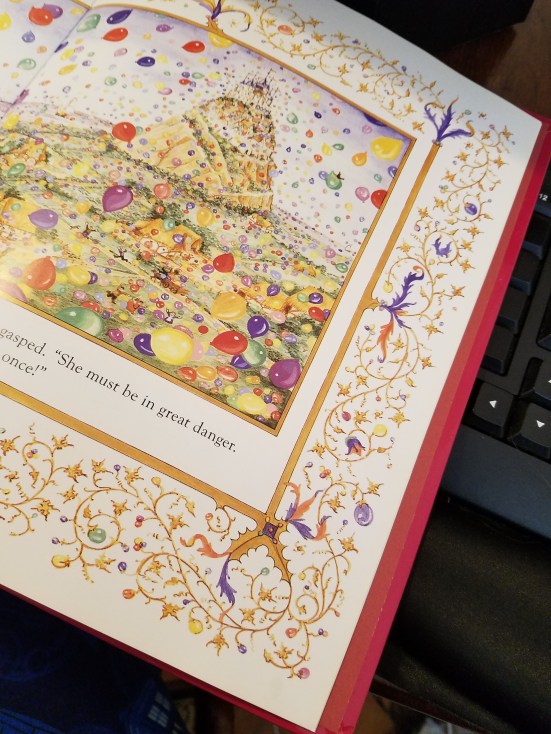
In addition to being a truly wonderful book in its own right, and unfairly good for a first book, The Balloon Tree has particular resonance for me as the book where I finally found the aesthetic which has stayed with me my whole life.  Look at these two pictures.  This is from the book (apologies for the cellphone shot in bad lighting):

balloontree.jpg

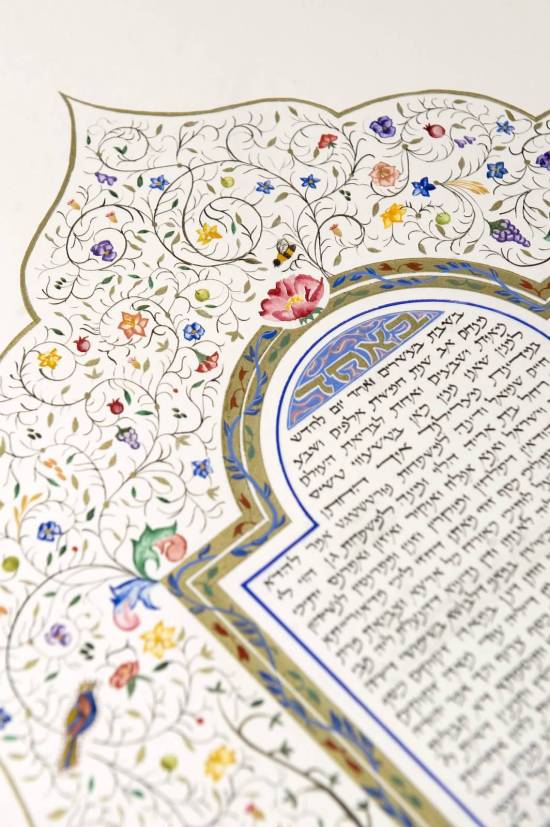
And this is from my ketubah, Jewish marriage certificate, commissioned from the marvellous Laya Crust:

wedding_211

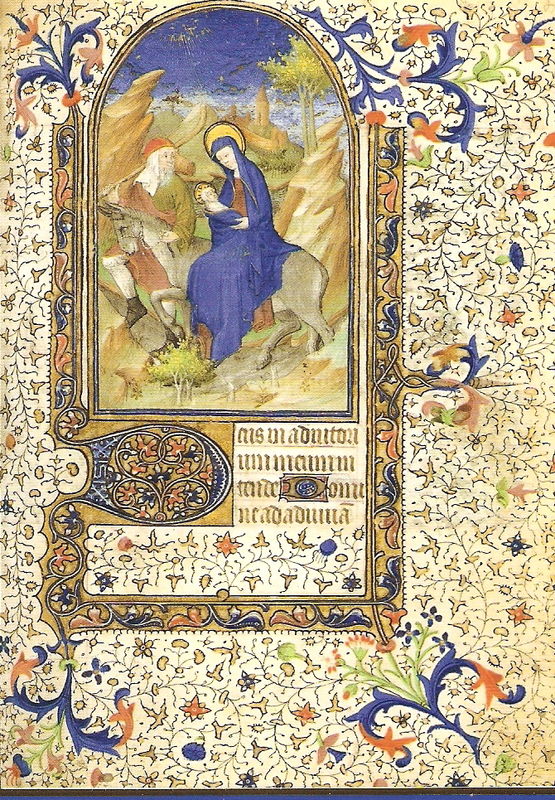
No influence whatsoever, nope!  And if you see any resemblance to Les Très Riches Heures du Duc de Berry then you’re completely… accurate.

TresRichesHeures.jpg

If you accuse me of just filling this blog post with images I want to stare at for hours, you’re also accurate.  But it’s a funny thing: I had no idea about the Très Riches Heures or of medieval art or of anything to do with art when I was a kid first reading this book with my mother.  And yet, here I am studying 14th- and 15th-century poetry, works from the period (more or less) which would have inspired Phoebe Gilman.  If I wanted, I could probably blame my life’s work so far on her.  I’m responsible for the unfinished dissertation, though.

Now, let’s think a little more about this 14th- or 15th-century influence.  (And, no, I don’t think I’m taking this too seriously.  I’m a freaking academic, people!  Academics never think they’re taking things too seriously.  That’s how we ended up with Middlemarch.)  Excuse my alter-ego; she gets a little worked up.  The point is that there’s the aesthetic from the illustrations and the story itself, and I think it’s fun to look at how they line up.

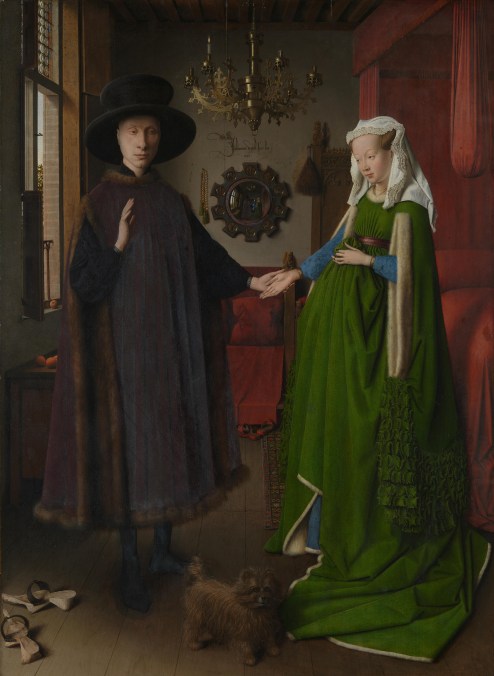
The story goes like this: Princess Leora, who loves balloons, lives with her father, the king, in a lovely castle in a small, happy kingdom.  Happy, except for her uncle, the grouchy Archduke, whose appearance was drawn from Jan van Eyck’s portrait of Arnolfini:

Van_Eyck_-_Arnolfini_Portrait.jpg

When Leora’s father leaves for a tournament in a neighbouring kingdom, he leaves the Archduke in charge, with Leora to help him.  In case of any problems, he tells Leora to release a bunch of balloons from the tower and he’ll see them and come home.  The Archduke imprisons Leora in her chamber and orders all balloons to be popped, but she escapes to the Wizard and has him tell her how to solve the problem: she has to find one whole balloon before the moon fades and plant it in the courtyard while speaking a magic verse.  She does, and the tree starts bearing balloons as the sun rises, thus summoning her father and saving the kingdom.

It’s a charming story, but with echoes of much, much older, darker stories.  I’m warning you again: I’m an academic, and there’s no help for it.  I could talk about how heart-warming the story is.  How brave Leora is, and how great it is to have a strong girl winning the day.  I could talk about how we all love balloons (except for my husband and father) and how fun the balloons are in this book.  And that’s all true.  But I’ve been waiting for years to think about whether the pictures are an overlay on a modern story, or whether there are older resonances to match the pictures, and I think there are.

Let’s start with the imprisonment in the chamber: how common is that?  Very common. If you want the 14th C illustration to go with it, look up Charles d’Orléans as pictured in a manuscript of his own poetry (BL Royal MS 16 F II, f. 73).  If you want a more apt historical comparison, there were fears in England in the 12th century that Prince John would steal the kingdom while Richard Coeur de Lion was imprisoned overseas.  Queen Eleanor, their mother, was kept under house arrest for years.  In my own area of study, Wales, imprisonment of family members was commonplace in family struggles over territory. Usurpation and imprisonment were occupational hazards of being nobility or royalty.

Thus, miraculous escapes from tyrannical rulers become a common aspect of folklore.  There’s the story of Richard’s escape, of course, and then think about the story of King Arthur having all babies slain in an attempt to get rid of the baby who was to be his own downfall, his son Mordred.  We’ve even got a Merlin equivalent in our story!  It’s a gruesome story, and comparing killing babies to the attempt to pop all the balloons seems tasteless, but, well, it came to mind, I’m afraid.  Of course, the Arthur story is just a free retelling of the Massacre of Innocents, which itself has strong overtones of the Egyptians killing all baby boys in Exodus.  These stories always go farther back, somehow.

My point being that I think there are, if you’re willing to way overextend things, hints of historical undertones– even overtones!– to the story as well as the art.  But it’s a fun book, not a serious or scary one.  And that, too, spans both the art and the story, and that’s where we come to the balloons and the kick-ass Leora, and the kids helping kids to save the day.  Any royalty from the 14th century would have killed to have Leora on their side.  No, really, they would have killed, so maybe step back a little.  And get a weapon.  They would probably castrate your husband or send your wife to a convent, too.  They weren’t nice; they wanted to win.  Point being, someone with Leora’s courage and persistence is like the answer to those old historical problem stories’ prayers, and let’s not forget the friends who help her: the Wizard and the little boy in the cottage who sweetly gives up his last balloon to Leora.  It’s a historical story turned into a modern fairy tale with a kick-ass female child heroine saving the day.  And her daddy the king wears glasses, and she has cute bedroom slippers.

Are those just cute details and wish-fulfillment, though?  I don’t think so.  I think this is a story with roots, I really do.  Artistic roots, historical story roots: they give the story depth.  But the real depth is in how they’re used, and that comes from Phoebe Gilman’s own brain and own brush.  The generosity, persistence, and strength of Leora and her father are much more important than the fear the old noble families of Europe lived with.  They provide motivation for Leora to show her mettle, that’s all.  And the beauty?  That’s important, but rubber ducks in a warm family environment are more cuddly, in the end.  Both matter.  Both are important.  But let’s not underestimate the sweetness in the illustrations of the king hugging Leora: after all, the real motivation in the story is family love, and Leora shows us that’s worth preserving.

But the balloons are worth preserving, too.  Kids?  Go get your parents to blow up some balloons.  I’ll get one for my Changeling.

Ice Cream Summer

I was faced with one of the horrors of life today: a dentist appointment.  Do you hate going to the dentist?  I do.  It’s the poking and the scolding and the predictability of having done something horribly wrong.  Point is: after having endured the tender ministrations of the steel hooks and picks in the hands of the dentist, then the best antidote is frivolous fun.  Which is why today we’re going to be talking about one of my favourite books from last summer, which it’s really time to revisit for this summer: Ice Cream Summer, written and illustrated by Peter Sís.  (I’m linking you to his wonderful website so you can poke around there.  I bought my copy at The Children’s Book Shop in Brookline because they tricked me into it by showing it to me and then I couldn’t let go.  They’re like that there.)

Ice Cream Summer

If I had to think about one word to associate with Ice Cream Summer, it would be “chuckle.”  It’s not a hilarious book, or a silly book, although it has great puns and jokes and a hefty dose of silliness in the pictures.  It’s not a serious book, although it has really interesting history and a little math and cartography.  This is Sís at his best: not walking the line between fact and fun, but merging the two.  He doesn’t need to sweeten his nonfiction with humour.  He just writes the book he needs to write, and thereby shows that fun and fact walk hand in hand.  This isn’t a fiction book, but it’s not a serious nonfiction book, either: it’s just a book.  It’s not a laugh, it’s not a thoughtfully furrowed brow: it’s a chuckle.

How does Peter Sís get this chuckle out of us?  It doesn’t hurt that his topic is ice cream.  It also doesn’t hurt that he’s really, really ready not just to write about ice cream, but to write about the platonic ideal of ice cream which we all know to be out there somewhere: ICE CREAM SUMMER.  Ice cream which I imagine to be cold and refreshing without being so cold as to numb your throat when you slurp it down.  Ice cream with sprinkles and a cherry on top.  Ice cream in all colours, but which somehow emanates a frivolously pink nimbus of frothy delight.  Ice cream in sundaes with velvety sauce and real whipped cream.  This isn’t just ice cream scooped from a tub in your freezer, maybe with crystals: this is the ice cream of your dreams.

How can I tell you that?  Because I looked at the front cover, sighed in delight (with a little smile starting), and then flipped through, chuckled at the pictures, and turned helplessly to the counter to buy the book.  In other words, the illustrations are glorious.  There are teetering towers of ice cream scoops in waffle cones, an ice cream-shaped lamp over an ice cream-shaped bed, a hammock swung between ice cream-shaped trees, and the boy protagonist tucked into a sundae bed for his Sunday rest.  The illustrations are whimsical and play into the jokes in the book (“I always take a break on sundaes”), but are also precise and detailed.  Sís does not jump manically into the swimming pool with ice cream in his hand– he leaves that to his main character.  Sís has careful outlines, refreshingly brushed with watercolours.  They look a little crazy, but much of that is in the content (the ice cream bed and trees, for example) rather than the execution, which is quite classic.

Classic with zany details really cuts to the heart of how this book works.  Take the concept: a boy named Joe is writing to his grandfather to tell him how his summer has gone and how he’s been so good that he really deserves the special trip his grandfather promised him.  He tells his grandfather about the reading he’s doing: “I am conquering big words like tornado and explosion!”  The illustration shows that he’s reading “mango explosion” and “cherry tornado” at an ice cream store.  “I practice my math facts,” Joe continues.  And the illustration shows him carrying ten scoops of ice cream as his dog carries three: “10 Scoops + 3 Scoops = ?” reads the page.  Yet what could be more traditional than a summer letter to a grandparent?  And what letter would be complete without details of camp life?  “Today we learned cartography,” Joe explains.  And shows off the ice cream map he built: Ice Land is in the southwest, while Mango Rocks and Pistachio Cliff are due north.

The longest passage is the exploration of ice cream history, beginning in ancient China.  Did you know that ice cream was invented there 2,000 years ago?  I didn’t.  Thank you, Peter Sís, for educating parents along with children!  Then on we go through Marco Polo and the Silk Road, over to Italy and  Catherine de Medici, who brings ice cream to France.  Joe’s letter states that he’s “researching the whole European continent,” and it’s not wrong.  It becomes clear that to study ice cream history encompasses a whole mass of topics and places, and Peter Sís shows it all concisely and engagingly.  You’d think this passage would be for older children (or adults like me) only, but, oddly, this is the Changeling’s favourite part of the book.  She enjoys pointing out the details in the illustration, and, bit by bit, I tell her what it’s all about.  She loves that.

In the end, as the letter draws to a close, Joe wonders where his grandfather will take him and you turn the page… to see a grandfather decked in ice cream gear and the words: “To the top of Ice Cream Peak?  Wow!  This is the best summer ever!”  And it is evident that the ice creamy adventures will continue.

You’ll have seen that in each aspect I’ve described you see the same perfect synthesis of exuberant fun and interesting tidbits, interesting facts.  Is this an educational book?  Well, you can learn a lot from it, and it even has a list of further reading discreetly tucked in.  But I wouldn’t say it’s sneakily trying to educate you.  I think it’s showing you that learning is fun, picking up facts can be entertaining in its own right, and why not do more of it?  I’ve never liked kids’ books which sneakily try to teach you, and if this were a sugar coating over an attempt at getting some information into your brain I wouldn’t like this book, either.  Manipulation isn’t a good look for books or people.  But this book is just having fun, and has no definite educational agenda it’s trying to push.  If you read it, you will enjoy it, and will happen to learn something, too.  Now, that’s what a good book should do, for children and adults both.

So, after you’ve had a rough day and a rough visit to the dentist, I strongly advise the following program: go to the bookstore and get this book; go to the ice cream parlour or grocery store and procure ice cream; sit down, read book, and consume ice cream.  Forget the dentist for the next six months.  Be happy.

In the Night Kitchen

Last night I woke up with a start.  I couldn’t tell you what woke me (I was dreaming about sharks, so maybe that was it), but I noticed again what I’ve noticed before: waking up in the night feels different.  It’s a bit more permissive, there in the dark.  Have you ever quietly talked in a dark room?  You can confess things: “I actually don’t like cilantro,” you whisper.  (Well, maybe you’d admit to something else, but if you say you don’t like mushrooms I’m afraid we can’t be friends.)  You can believe things in the dark, too: “Someone came knocking at my wee, small door.”  Maybe you even believe you saw a UFO.

But that’s just in the dark.  Maybe you stayed up late.  Maybe you’re drowsing in bed.  What about when you wake up?  You’ve been dreaming, and suddenly– what were you dreaming?  Was that a dolphin or a shark?  Your eyes struggle between open and closed, and finally settle on rising up, with that funny feeling as your eyelashes disentangle.  Is the room light or dark, you wonder as your eyes get used to being open.  And with that you get the distinction between being awake in the night and waking up in the night.  Is it light or dark?  Did that dream make sense?  It had made perfect sense, and it still does make sense, but in the morning it won’t make sense, and probably will have faded away.  When you’re awake at night and a bit drowsy, you might believe you see a UFO.  If you wake up in the night, you’re not entirely sure that you aren’t floating over to the UFO and having an extended conversation with the alien invading force about the difficulties involved in finding a really good teapot.

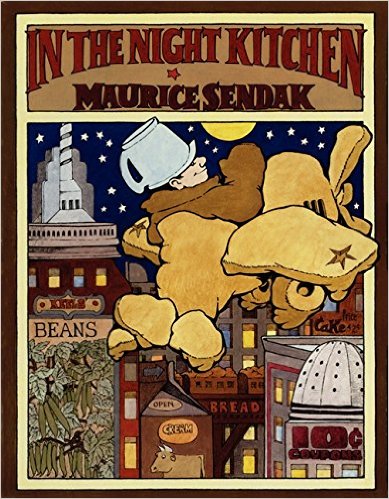
In the Night Kitchen, written and illustrated by Maurice Sendak, isn’t a story about being awake at night; it’s a story about waking up in the night.  And that’s what I love about it.

In the Night Kitchen.jpg

I thought about asking you if you ever heard of Mickey, but stopped myself: a) you have, I’m sure; b) that’s appallingly kitsch and Sendak would have winced.  I’m forcing myself to tell you as penance.  The point is, we all know of Mickey and his wild domestic adventure.  But has it ever occurred to you that the story is simply this?: “One night a boy woke up and helped bake a cake.”  It takes Maurice Sendak to take that story and make it wild, original, almost magical.  (Note: this isn’t the only Sendak story where that happens.  Chicken Soup with Rice takes the world’s most comforting food and turns it into a crazy adventure.  Sendak loves these contrasts.)  This is, in fact, the story the Changeling had to be read every night for several months, but when I recommended it to a friend as a good present for his nephew, he looked it over and refused: “It’s too scary.”

We’re here to consider how this simple story becomes such a wild, possibly frightening, adventure.  What does Maurice Sendak do?  Well, first of all, he probably woke up in the night a few times himself– I’m awfully sorry for his disrupted sleep, but it’s obvious he knew the good side of that disruption: that falling down of barriers and exploding sense of possibilities.  Some people pay a lot of money for terrible substances to get that feeling; others suffer from insomnia.  (In case it’s not clear, I fall in the latter camp, not the former.)  And he gets that sense of exploded barriers across by blasting through all barriers of storytelling.  Let’s consider a few simple aspects.

First, there’s format.  What’s the format for this book?  You in the back?  That’s right!  There’s no clear answer.  Is it a comic book or graphic novel?  (Graphic story, I guess?)  Well, sort of.  Is it a picture book?  Sort of.  It’s really what you get when you peel away the outer layers of each and let the ink from each seep together.  The picture book is still there.  The word balloons and panels are still there.  But it’s sort of a picture book where the pictures speak as much as the words and the words play a powerful part in the pictures and the panel layout really matters.  It’s a merger of formats, where the form powerfully informs the storytelling.  I have never seen a book where the form has done so much, or where the form’s beauty has been so little counteracted by an awkward taste.  (Sorry, I couldn’t help it.  Ten points if you get the reference, and a further ten points if you don’t smack me upside the head for it.  Also, I meant exactly what I said there.)

Let’s take a look inside the book.  As with How to Be a Dog, I’m snapping a few pictures for you because I think it’s important to look at what we’re talking about.  (I would like to thank the Samsung Galaxy S7 for making it possible for me to easily take and upload a not-t00-crappy picture to my blog.)

Here’s one:

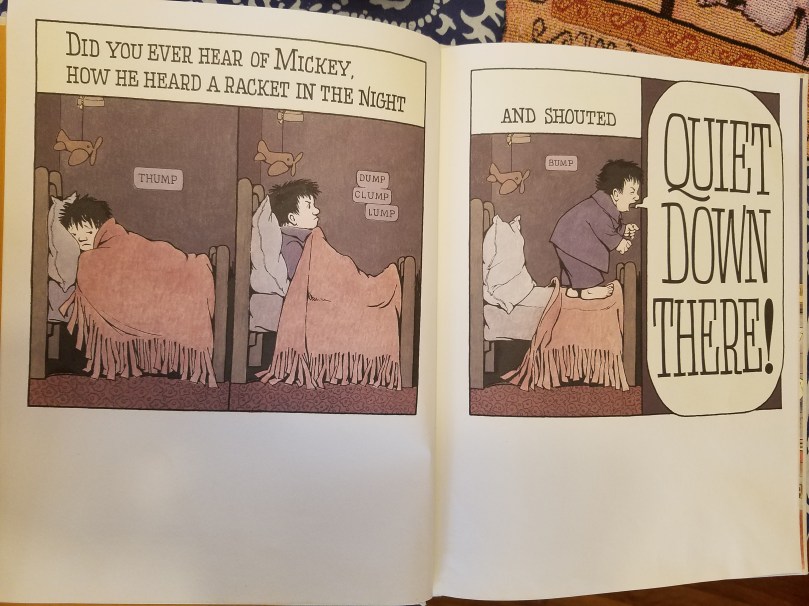
Quiet Down There

What do we notice?  Well, it looks nearly conventional until that last panel.  A bar at the top, perhaps bigger than we might be used to from DC or Marvel, gives context, and the picture illustrates what’s happening.  That last panel, though, explodes the barriers– quite literally breaking the space for the last image and overwhelming it with Mickey’s shout.  But what about another one?

Milk in the Batter.jpg

Now, this is interesting.  First, I want to note that the page layout is bigger.  Everything is bigger, somehow, except for a few things which are short and squat (the baking soda) or tall and thin (the orange flower water).  The sense of scale is topsy-turvy with the huge bakers, a huge bowl, a big table with ordinary ingredients underneath, dwarfed by the big spoons.  Mickey, of course, is disappearing in the bowl, one little hand poking up on the right.  There’s something Alice in Wonderland-like about the scale here, and pretty much as disturbing.  And yet there are conventional elements, too: incorporating the text into the table is original, but still works with the traditional structure of balancing text and speech bubbles, which appear on the right in the expected format.

Let’s look at a last page, one of the most famous:

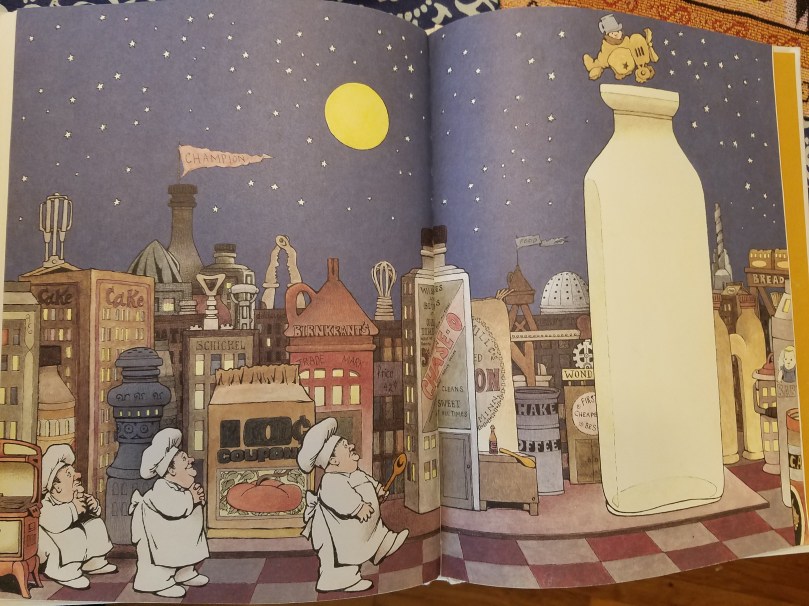
The Milky Way.jpg

First, let’s note that the Changeling firmly believes there’s an owl in this picture.  Whoever finds the owl gets a prize.  Onto the in-depth, serious analysis.  First of all, there are no words at all.  The picture here is speaking for itself.  Now, this isn’t totally original (if you want to see my favourite example of a wordless book see Escapade by John S. Goodall), but in this case what I love about it is that we see how our panels have exploded away.  We’ve left behind order, or even the semblance of order.  The bakers are exulting, expectant, waiting on tenterhooks, and Mickey has flown right out of bed, out of the oven, and is soon to abandon even the dough.  Gone, all restrictions are going to be gone, and he’ll be left crowing Cock-a-doodle-doo stark naked except for a measuring cup on his head as he balances on the top of the milk bottle.

This is only something you can think up waking in the night.  No matter how late you stay up, it won’t come to you: you have to burst through onto the other side of sleep to get there.

And it’s all domestic.  All of it.  It’s cozy, comforting, and utterly discombobulating and perverse at the same time.  It’s Maurice Sendak.

Red is Best

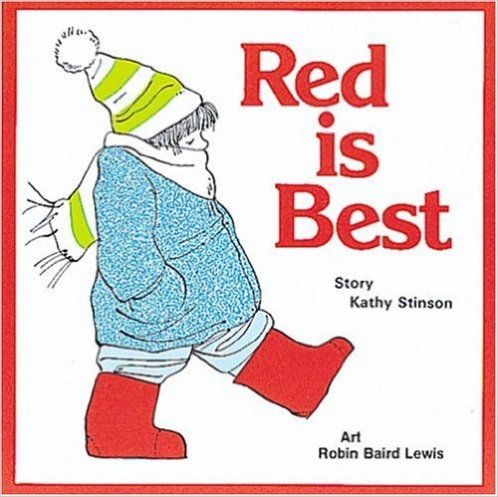
It’s cold and rainy and grey today in Cambridge.  I’d hope it’s warmer where you are, except that I know this rain is good for my garden, and maybe your garden needs rain, too.  But nothing apart from my garden wants rain.  I know I don’t.  I look outside and run to put on the kettle, wrap up in covers, and my eyes drowse over.  I want soup and oatmeal and homemade bread, but I don’t want to leave my little cocoon.  So I do the reading equivalent of oatmeal and fresh bread: childhood favourites.  There are so many of them: Matthew and the Midnight Tow TruckFreight Train, and, of course, today’s book for us, one which is quoted almost daily in our house… Red is Best, by Kathy Stinson, illustrated by Robin Baird Lewis.

Red is Best

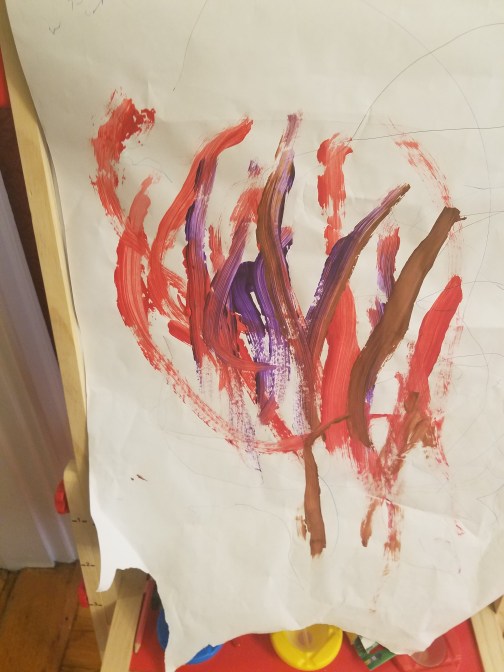
This is a Canadian classic, and one which is fortuitously available (although not widely known) in the USA.  I link you to Barnes and Noble, for example.  I’d say that this unwonted availability is because the book is so damned good, but that would be insulting to reams of other damned good books.  That said, the book truly is wonderful.  Why?  Well, this morning my daughter was painting– here, want to see her work of artistic genius?

artisticgenius.jpg

Isn’t it beautiful?  It’s a peacock for her daddy because she loves him.  (I’m not bragging, why do you say I’m bragging?)  But what I want to point out is that the base is red.  Her first paint choice was red, “Because red is best!”  This didn’t deter her from giving purple and brown their due after the red foundation was completed, naturally, since each of them is her “best of colours” in addition to red, green, blue, and yellow, but red paint had her chanting and dancing and painting.  It got her excited.

Why is this?  Well, first of all, red’s a pretty excellent colour.  Red is bright and glowing and dramatic and beautiful.  I’m a big fan of red.  Red is fire and flowers and hearts and jewels.  Red is dangerous and rich and lovely and warm.  I consider it inherently beautiful and harder to screw up than yellow, for example, which can be a very strong colour in the right hands, or a pasty, weak one in the wrong hands.  Who wants a pasty, weak colour on a day like today?  On a grey day you want warm red alpaca mittens, or red flannel pyjamas, or a snuggly red sweater.  Red warms you up.  So, yes, I may be somewhat predisposed in both the colour and the book’s favour.  That said, green is my best of colours (my snuggly sweaters are green, being honest, not red), so I refuse to own to complete prejudice here.

The real charm in the colour for the Changeling probably comes from the book as much as from the colour itself, however.  I do think red lends itself to the book, that without the brightness and warmth of a perfect, primary colour red the book would have a different character altogether, but the book defines something other than the value of a colour: it legitimizes a child’s preferences.  And, since it says it’s OK to love red best, the Changeling loves both book and colour: they tell her it’s OK to love something best of all.

Wait, I just realized you may not have read the book yet.  My poor reader, why didn’t you tell me earlier?  I forget that some people struggled through deprivation, not having memorized Red is Best at an early age.  Let me tell you all about it, and you can be part of the cool kids’ club.  There’s a girl, Kelly, who loves red.  Her mother doesn’t get it.  Over and over again her mother tries to get Kelly to wear her blue coat because it’s warmer, her white stockings because they match her dress, or paint with orange because there’s not much red left.  Kelly patiently explains that she needs the red ones for many reasons: she can be Red Riding Hood in her red jacket; she jumps higher in her red stockings; and her red paint puts singing in her head.  Whatever the situation, Kelly always has an answer why she needs red, but it’s all summed up in the final declaration, the declaration which is echoed in our house almost daily: “I like red, because red is best.”

I hear you, Kelly.  Even though red isn’t my “best of colours,” I get it, I really do.  In fact, I think we all get it.  I think we’ve all had moments when we loved something so wholly and completely that it didn’t matter if the mittens had holes or the boots weren’t right for the weather or if we’d already poured juice in the other cup.  We wanted those mittens, that pair of boots, or this cup right here.  For adults, I think we sometimes deny ourselves what we want (or argue with our children that they can’t wear the same underwear three days in a row) because we’re very sensible now.  For Kelly, she has the absolute clarity of a three-year-old.  Red is best.  That means the red mittens are best, and why would I wear anything else?

As I don’t need to tell you, it is very, very difficult to argue with a three-year-old’s logic.  This isn’t because they aren’t logical enough; it’s because they’re so absolutely logical.  Why would you wear second-best if first-best is right here?  The question is practically unanswerable.  The adult response is usually to try to prove that the first-best isn’t really so much the best after all.  This doesn’t often go very well.  The child knows what’s best: “I like red, because red is best.”  (What does work for me, all you parents out there, is to explain that the first-best needs a time out for some reason: needs to take a bath so it’s ready for tomorrow, or needs a nap, or whatever I can devise.  The Changeling knows what’s best; that’s unarguable.  But sometimes best needs a break, and she can understand that.  Our daily parenting tip is now finished.  You’re welcome!)

The charm of this book is that it’s reassuring to both parents and child: it validates the child’s views, while sympathizing with the unseen parent’s frustrations.  We’ve all been there: “Why do you need to wear your rain boots?  It’s sunny and warm!  Why do you need to eat only cheese?  We have plenty of other food!”  Oh, we’ve all been there, all of us, whether as parents or as children.  But how often does a kid get told that it’s OK?  Usually they hear amusement or frustration, and parents, even if we deep-down kind of sympathize, feel faced with obstinacy or tears, and we worry about being judged if we do let the kid out in rain boots when it’s too snowy or too sunny.  (I’m totally writing from personal experience right now, yes.)

It’s glorious to be shown reality in a case like this.  Just shown it, no judgment calls at all.  Looking it in the face, I say: “Yes, I’ve been there.  Both as the child and the parent.  And, you know what?  It’s OK.  It’s OK to say yes to the kid.  If need be, it’s OK to say no.  And it’s OK for each of us to feel frustrated.  And it’s OK to laugh.  And it’s OK.  We’re not alone.”

I like this book, because it warms me when I’m cold.  And today I’m going to read it to myself, because I love this book best right now.  And that’s OK!

How to Be a Dog

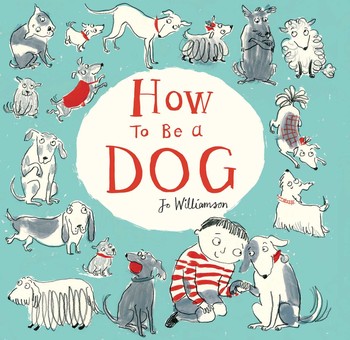
After such serious and intense writing for the past couple of days, I wanted something a little lighter and sillier to write about.  First I thought about A Castle Full of Cats, but I’ve already done that.  But then I was tidying away the day’s books, and came across one my daughter plucked from the shelves of the Harvard Book Store, How to Be a Dog, written and illustrated by Jo Williamson.  (I am not referring to A Guide to Being a Dog, by Seamus Wheaton, which, yes, I also have.  Apparently the Changeling and I really want a dog.)

How To Be a Dog

This was an interesting find.  It’s a debut book from Jo Williamson, and I consider it absolutely unfair that her first book is so charming and pitched so perfectly, and also I’m now very curious to see everything else she does.  But how did I find it when I’d never heard anything about it before?  Well, my daughter, animal-magnet that she is, ran into the children’s book section, paused, veered to the right, and snatched it from where it was inconspicuously shelved and said, “Let’s bring this book home!”  I swear to God she knew.  I swear she was sniffing when she paused there, that she muttered under her breath: “Dogs.  Today I want dogs.”  And she sniffed out “dogs,” and found the doggiest book she could.  Animal magnet.  This is a kid who once located a pit bull in a closed store and basically befriended the dog, who was wagging her tail enthusiastically, until the owner had to open the door to allow them a brief moment to say hello before we apologized and dragged her away.  It’s a little uncanny, but I’m hopeful her skill will one day get us a dog (don’t tell my husband I said that).

Anyway, the point is that it was love at first sniff, which is more or less how the story starts, with the dog narrator relating how dogs find their humans: they just know who’s right for them and make a beeline for their human.  Then they have to get used to living together.  The narrator goes through a list of tips or guidelines for how to live in your new home: finding your favourite place to sleep; greeting visitors; how not to, ahem, sully the floor; cleaning the floor of any delicious debris.  It ends by promising that even if there are occasional sad moments (such as bath time), dogs just want to be with their best friend, and will be very happy in their new homes with their special human: “Just like me,” says the narrator, and if you don’t break into a smile at that final page then I think that’s cause for medical concern.

Here’s the thing: this is a perfect book for dog-lovers.  I don’t have to justify this book to them– they’ve probably already ordered it as of the first paragraph.  I don’t even have a dog, and I love it, because I know dogs and I love them.  It’s also ammunition for me in communicating to my husband that my daughter clearly needs a dog because she chose the book, right?  Right.  But I’m really curious about how it plays with people who aren’t dog-lovers, whether they’re like my husband (who enjoys dogs but doesn’t need them), or my father (who’s really bizarre and seems to actually dislike them).  My husband does like this book, but I’d like to try it out on my father.  My suspicion is that it would at least garner a chuckle, but I have no evidence to back that up.

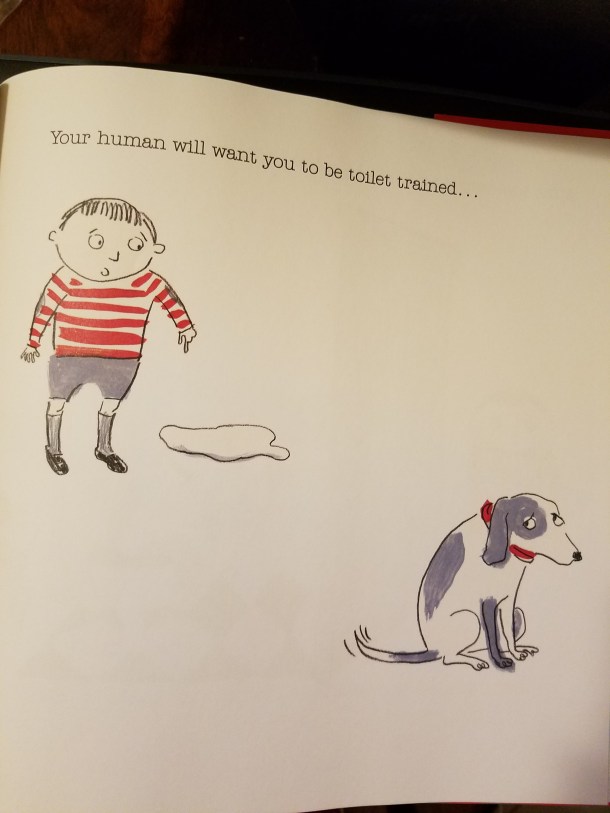
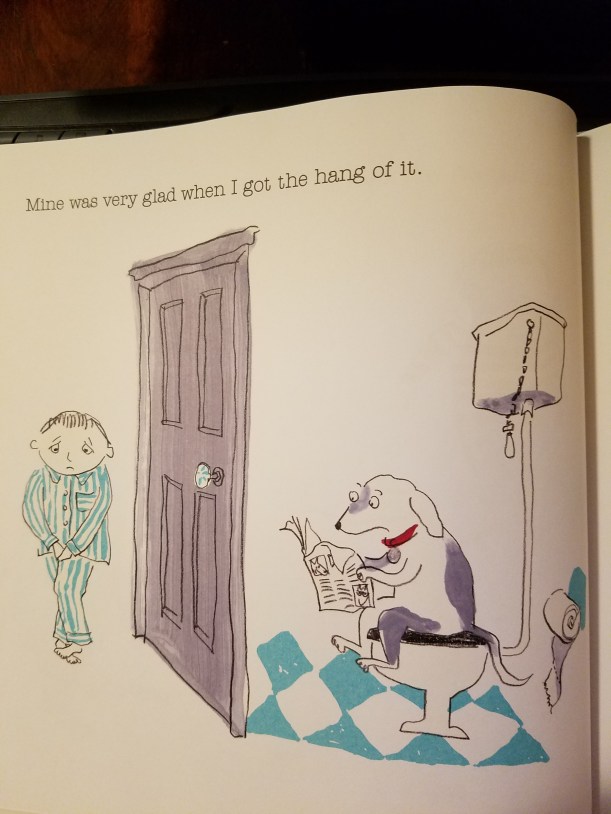
Why do I think such a dog-oriented book isn’t just for dog-lovers?  It’s got such perfect timing for its little jokes.  The text is straightforward, for example: “Your human will want you to be toilet trained… Mine was very glad when I got the hang of it.”  (Of course you can expect kids to giggle over that.)  This is all true, of course.  A human would absolutely desire a dog to cease and desist from leaving puddles on the floor.  And the first page indicates this clearly:

Not yet toilet trained

Notice what’s going on there?  It’s the illustration you need to read, right?  Hence why I snapped a couple of pictures, unlike usual: you’ve got to see the book to get the text here.  Jo Williamson’s pencil and watercolour images fill the blanks left by the text.  The text gives you the dog’s point of view; the illustrations show you what’s happening, and your reaction provides the human’s perspective.

Let’s look at the next page:

Toilet trained

Oh, whoops!  Not so typical, eh?  The timing is just right, and has a slightly retro, old-New Yorker feel to it.  The vintage feel is bolstered by the art: the very light, bold touch of the pencils sketching the form, and filled in largely by grey watercolours, highlighted by occasional blue and red details.  Of course, there’s also the old-fashioned toilet which I truly and dearly adore, and then the dog reading a physical newspaper.  Note also boy’s clothing: there’s something of the British schoolboy about him, again a little touch which brings seriousness and humour into relief.

There’s nothing about this book which is inherently funny.  It is told straight, it is illustrated straight.  It doesn’t “make jokes” at you.  It’s Costello, in Abbott and Costello.  You’re Abbott, reading it.  You make it funny, by stumbling from page to page, doing a double-take, then chuckling at what you see.  There’s a sort of dry, twinkle-in-the-eye humour here which I think anyone, dog-lover or not, will love.  I’d also venture to guess that any dog-lover, child or adult, would also love this (if you’re not already a dog-lover, you may need a child to introduce you to the book, though).  There are definitely jokes you need to be of a certain age to get, but pretty much any age should be able to enjoy this, thanks to those lovely, vintage-feel, vivid illustrations.  Oh, just scroll up and look at the pictures, then show them to the nearest child.  They’re an immediate attraction, and I frankly can’t wait to see what Jo Williamson does next.

I’d like to thank my daughter’s sixth sense for pulling this book off the shelf.  It’s been a joy getting to know a book and an author really new to me, and it’s been even more fun making my husband nervous as my daughter and I coo over every dog.  (Can we get a dog?)

Esther’s Story

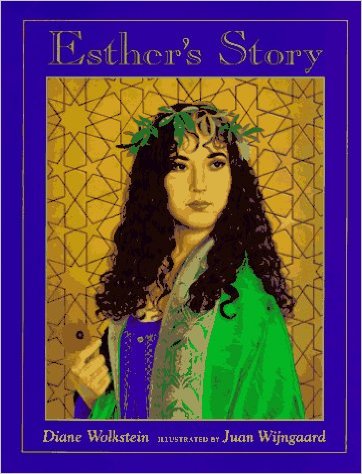
Today is Purim, and I get to spend the whole day with the Changeling.  One of the laws of Purim is hearing the story of Esther, and, while my daughter isn’t precisely obligated in the laws yet (toddlers tend not to be held accountable for, for example, paying taxes, and Jewish law works the same way), I still thought we’d read one of my favourite versions of the Purim story.  I’m awfully sorry to be giving you an AbeBooks link again, but this book is twenty years old (jeepers, and I bought my copy when it was just released!  I feel old…), so it’s not exactly widely available, although it should be: Esther’s Story, by Diane Wolkstein, illustrated by Juan Wijngaard.

Esther's Story.jpg

Do you remember how I’ve said over and over again of nonfiction books that I love the ones (such as A Bird Is a Bird and Feathers) which take the reader seriously?  I feel the same way about this book.  I’ll point out a few aspects to reinforce that right up front: a) It draws heavily and clearly on the written textual tradition; b) In fact, the whole premise for Esther writing her own story is drawn right from the end of the megillah, the original text of Esther (I’ll come back to that); c) the full-page gouache illustrations are meticulously detailed and drawn from the Persian material culture the book evokes.  Everything about it, in other words, is rooted in the historical and textual background of the story.  And it’s for children.  (OK, granted, it was too old for my daughter, but she still enjoyed it– try it on kindergarten kids and up, I guess?  But remember this post: Ages and Why I don’t mention them often.)

Let’s go back to that bit of text I mentioned from the megillah itself:

Then Queen Esther daughter of Abihail wrote a second letter of Purim for the pupose of confirming with full authority the aforementioned one of Mordecai the Jew. […] These days of Purim shall be observed at their proper time, as Mordecai the Jew– and now Queen Esther– has obligated them to do, and just as they have assumed for themselves and their descendants the obligation of the fasts with their lamentations.  And Esther’s ordinance validating these observances of Purim was recorded in a scroll. (Jewish Study Bible, Esther 9:30, 31-32.)

Diane Wolkstein uses this mention of Esther sending out the letter to motivate her entire story: Mordecai first encourages Esther to write, giving her a diary which she uses to record the early events of the story (yes, a little anachronistic, perhaps).  And, at the end of the whole dramatic story, we see the older Esther recording the final events in her letter to the Jews, and asking them to observe the fast which bears her name, Ta’anit Esther, the Fast of Esther, which immediately precedes the holiday of Purim.  That’s all pretty scholastic, perhaps, and it’s a premise which could be used for a novel as well as for a children’s book (if you were looking for the premise for a good novel: you’re welcome!), but it works remarkably well here.

Let me take a moment here to acknowledge a few things: yes, there are absolutely aspects of the story which are changed.  The book describes women being brought to the palace so the king can choose a wife, for example.  It doesn’t give Harem 101 for schoolchildren.  It doesn’t talk about the young women being brought to the king and the evening and away in the morning.  It doesn’t talk about that sketchy part at the end of the book where “Haman was lying prostrate on the couch on which Esther reclined. ‘Does he mean,’ cried the king, ‘to ravish the queen in my own palace?'” (Esther 7:8).  (It does show Haman tripping and falling in his terror, but not the possibly-probably-implied assault.)  There is a lot of fairly explicit sexuality in this story, and a lot of it exists in a grey-to-bad place, especially coming from our modern perspective.  This is heavily toned down for this book, but not so totally cut out that it’s unrecognizable, and I think Diane Wolkstein does it extremely well.  Kids should be able to read this, grow up, read the original text and say, “Oh, I get it!”

So, what does she do to achieve this balancing act between good storytelling for a child audience and what we might call an evocation of historical authenticity?  First of all, there’s the straightforward telling of a dramatic story in Esther’s own voice.  That does a lot, right there.  Most events come straight from the megillah, some are partly filled out from other sources, but  few are invented.  Personality, reactions?  Those come from the author, but are rooted in how she sees the text.  Thus, we see Esther first as a young, intelligent girl, being raised by her intelligent uncle who sees the direction events are taking.  When he sees Vashti banished, he changes Esther’s name from Hadassah to Esther and asks her to hide her Jewish identity; she wonders, but obeys.  As she gets older, she’s moved to the palace, and we see more and more of her own thoughts and her own growing courage.

I love that amplification: the original story is, as the Bible frequently is, devoid of those strokes of description which give you a sense for what people are feeling.  That’s what modern retellings can provide: good ones reach into the events and say, “how was this working?”  In this case, it went from happy-go-lucky childhood to slight bewilderment and tension at the palace, to an initial exhilaration at her becoming queen, and onto sudden seriousness when faced with a truly terrible situation.  No teenager, and if you care to do the math in the book Esther is probably around 16 or 17, should be tasked with facing sudden painful death on the one hand, or the extinction of her people (and, presumably, eventually herself) on the other.  It’s kind of a nasty place to be, she writes employing litotes, and, by focusing in on Esther’s reactions and feelings, Diane Wolkstein is able to make it believable and allow us to relive the story rather than wonder, “Poor lamb, how on earth did she feel about that?”  Obviously this is particularly good for children, who otherwise can’t quite amplify lines such as, “If I perish, I perish,” for themselves, but who are all too often faced with stories and plays which reduce it to a farce or some other form of pablum.  (Yes, I speak feelingly– dear God, I’ve seen some awful puppet shows of the Esther story!)

Naturally, a book like this wouldn’t work without good illustrations, and in this case Juan Wijngaard does phenomenal work.  Some of these pictures are good enough to frame, honestly.  His paintings, done in gouache, focus particularly on the material world of Persia, which ably draws out the material wealth which is the focus of the text, thereby juxtaposing the ease of life with life itself, so tenuous and ephemeral in the hands of unscrupulously powerful men.  If I had to say one word which jumps out of those illustrations, it’s “textiles.”  You feel that you could reach in and stroke the cloth, feel the stiffness of rich embroidery, the supple silks, the soft carpets.  As Esther fasts, anticipating the death that awaits her as she enters the king’s chamber the next day, Juan Wijngaard shows her lying on her rich carpet, her soft bed rumpled beside her (presumably she’s passing a restless, sleepless night) fingers twined, face sweaty, reading a book propped up on a soft cushion.  The sun rises, peeking through her carved shutter.  The whole story is apparent in that one image: “I’m going to die, one way or another, tomorrow.  And here I am, in my rich room… yet I’m going to die.  I am queen… I’m going to die.”  You couldn’t have a better artist for this book.

As I said, the Changeling’s really a bit young for this, but not all that young.  I think next year she’ll be able to grasp it a little better, and the year after that, even better.  I think it’s a wonderful book to grow up with– and I hope that I’ll be watching some parallel development as she watches Esther grow and develop from a young, intelligent girl to a strong, courageous woman.