Welcome to the Symphony

Welcome to my music-themed trip!  Remember how I said that journeys are often like music?  You usually have a motif or theme for any given journey (a search for good coffee or saying embarrassing things unintentionally due to lack of sleep– wait, that’s probably just me); movements of preparation, contemplation, activity, and farewell; moments of harmony or dissonance; and so much more.  To embark on this trip, let’s welcome you all with Welcome to the Symphony, by Carolyn Sloan, illustrated by James Williamson.

Welcome to the Symphony

I should mention right up front that I got this at 30% off at the Children’s Book Shop in Brookline because some of the physical aspects of the book weren’t working when I got it (the batteries had run out for the music panel you see on the right, and the panel was loose).  Well, great for me, because a little Super Glue got the panel firmly in place and new batteries were easy!  The book works like a charm now and I frankly feel sort of bad that I got a discount for such easy fixes (I guess I’ll just have to continue to give them my business).  But do be aware that they may be working out some teething problems in assembling these books– hopefully they’ll be worked out soon, because this is a truly excellent introduction to how orchestras and music work, and it’s aimed at very young children.  The Changeling loves it like crazy, and I’d like to apologize to everyone on our airplane on the way back from South Carolina last month in case they were disturbed by occasional bursts of Beethoven’s 5th.

Let me start by telling you the result.  After reading the book through a few times, we asked the Changeling if she’d like to watch an orchestra playing the symphony.  She agreed.  My husband found a performance on YouTube with a good view of the orchestra.  She sat on his lap and watched the first movement (which is the one outlined in the book), and apart from occasionally pointing out trumpets or violins, she just snuggled, watched, and listened.  Another day, she proposed watching it again.  I won’t say that Beethoven’s 5th is now her favourite piece of music and she’s become a genius musician and I anticipate that she’ll shortly be as famous as Karajan or Oistrakh, depending on which route she takes, but that’s hardly the point– or what I want.  What I was looking for was a fun introduction to the types of music she often hears in our house.  When she says, “What are you listening to?”  I usually tell her, “Mozart,” or “Beethoven,” or whoever it is.  She says, “OK!”  And that’s it.  This book provides a better answer, and that’s what I wanted.

So let’s look at that better answer.  In this book, there are three little mice who are going to the symphony, each with varying levels of experience when it comes to orchestral music.  This allows them to have little conversations like this:

Mouse 1: “Who’s that guy coming on the stage?  Is he late?”

Mouse 2: “He’s not late!  He’s the conductor.”

Mouse 3: “The conductor gets to tell everybody else what to do.  He’s the director!”

The illustration shows the conductor coming out. The main text then explains more about the conductor, dynamics, and tempo, each in a clear block of text.  I love that arrangement, personally: the illustration captures the big picture, the mice discuss the situation, and the blocks of text act as sidebars, giving you the details in easy chunks.  The illustrations, created digitally by James Williamson on a tablet, have the look of pen and watercolour: they’re vivid, dynamic, and always excellent at singling out the focus for each page.  Now, for us, the Changeling isn’t quite up to dynamics and tempo yet unless she’s in the mood for a really slow and curious read, so I generally skip them.  The arrangement of the text makes it very easy to focus along with the visuals and customize your reading to your child’s level.

The next page introduces the symphony itself, Symphony No. 5 in C Minor by Beethoven, and this is where the real fun starts for the kids.  They get to press buttons!  Well, technically they already got to press the button for “tuning,” but honestly that one usually seems less intriguing to the Changeling– as it ought, I think!  For the rest, you get to hear different aspects of the symphony.  First, you hear the first few bars of the symphony played straight.  Then, it breaks down: the main theme, different instruments from the orchestra, melody and harmony, a little conversation between instruments, etc.  This is what the Changeling loves best.  For example: “Can I press ‘Theme’?  What’s a ‘Theme’?  The theme is the main idea!”  And then I feel very proud because she associates the button with the name of the section and the little block of text.  Good girl!  You’re being indoctrinated properly!

I’m only half joking.  There’s a certain element of memorization that goes on with this book.  Each page has a quick definition of “Orchestra,” “Strings,” “Melody,” and so on.  The music and illustrations bring those definitions to life, and it’s impossible to say at such a young age how much of that really penetrates, and how much is simple association with pressing the button and hearing.  Presumably there’s some memorization, and some understanding, just as with adults, really.  In other words, I’m not particularly bothered by her understanding of “harmony,” but the fact that she’s curious and enjoys pressing the button ten times to hear what it sounds like is great (sort of).

Either way, she’s getting better answers to her questions than she was getting before: more depth, more definition, and more entertainment along with them, and she’s gaining new sources of enjoyment.  As far as I’m concerned, that’s a book’s job: opening new worlds and stretching your mind.  She’s being welcomed into the world of symphonic music, and having a lot of fun along the way.
Theme and Variations

Well, dear readers, I am afraid I will be away for a little while.  Oh, don’t you worry: I’m not leaving you bereft, but I’m the one who’s going to be off on a journey.  You see, Passover is coming up (I know, I really meant to review some Passover stories– check out this book if you’re still looking for a good one), and I’m going to visit my family in Israel for the holiday.  What that means is that I’ve got something a little different going on here for the next week and a bit.  Starting tomorrow, I’m going to have posts going up every weekday about music-themed books.

Why music? you ask, baffled by this new sign of eccentricity in your Authoress.  Well, I have a few reasons: a) Because I wanted to and this is my blog, so, well, I’m doing what I want; b) Because I have a lot of books about music, in one fashion or another, and I thought it would be fun to group them together and see what happened; c) Because I see a lot of similarities between a journey and a piece of music, and it seemed thematically appropriate.  I love the thematically appropriate, don’t you?

So, starting tomorrow, I’ll be introducing our theme (spoiler alert: the theme is “music in children’s books,” sorry for spoiling the surprise), and you’ll have eight days of variations on that theme.  Some of these variations will be pretty close to the original theme (books about the orchestra, symphonic music, instruments) and some will be a little farther (fiction books about compositions and composers) and some will seem way out there (I’m going to keep some surprises in my back pocket, so just wait and see).  But everything will come back to music in some fashion or other.

I have another little reason for doing this.  My Changeling is a big fan of music these days.  She loves listening and dancing and hearing stories about it.  She loves watching orchestras on YouTube, for crying out loud.  There’s a reason I have so many books connected to music– even more than I have bird-related books!  And it’s fun for me to delve into all the different aspects I just listed and think them through as the Changeling’s mother and voice actress.  What works so well for reading about the orchestra?  What works in the story of a composition?  Why?  What attracts her?  These are some of the questions we’re going to be thinking about for the next week and a half, so, while I’m off exploring my own theme and variations, I hope you enjoy these.

Pray for me: I’m not the world’s best traveller, she said making use of litotes to excellent effect.  I am, myself, praying that the theme won’t be sunstroke with variations of headaches, nausea, and a side-theme of social anxiety.  Fortunately, I’ll be with family, and I’m sure all will be well.  As for you, dear my blog, I’ll check back in here to make sure that everything’s running smoothly and posting as it ought to be, but do let me know if you’re in need, for we all know that the best laid plans of Blog an’ Authoress gang aft agley.

And now sit back, relax, and put on, oh, might I suggest you start with some Beethoven?  Why, no, that’s not a hint of any kind… but check back tomorrow to see where our musical adventure will begin.  (Vienna, 1808, Theater an der Wien.  Work from there to find out more.)

À la prochaine!

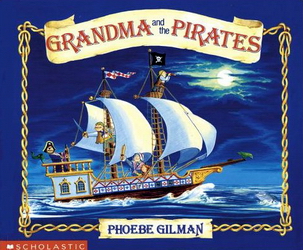
Grandma and the Pirates

It’s Patriots’ Day here in Massachusetts, so, patriotic Canadian that I am, I’m going to give you another book by one of my favourite Canadian authors, Phoebe Gilman: Grandma and the Pirates.

Grandma and the Pirates

Dear God.  I know I say this for every single Phoebe Gilman book, but this might really be my favourite.  The Balloon Tree speaks to me through its aesthetic, that fourteenth-century richness of line and detail and colour.  The Wonderful Pigs of Jillian Jiggs has a totally kick-ass protagonist who jumps in headfirst and figures out details later.  Grandma and the Pirates speaks to me through its story, and particularly through the cleverness of Melissa, who wins the day.  But you might be asking yourselves why Phoebe Gilman merits a third post here– I’ve already written about The Wonderful Pigs of Jillian Jiggs and The Balloon Tree, after all.  These are all by the same author, so what’s so new or different about this one?  Why bother?

I forgive you for asking the question.  After all, people probably asked Homer’s reviewer back in the day: “People already know about The Iliad, dude!  If they liked it, they’ll go for his Odyssey, too.  Why bother?”  Here’s the thing, though: these books are out of print, mostly.  I admit to having a sort of missionary spirit about them.  I am a Phoebe Gilman evangelist.  If I can do my small part to keep anyone thinking about these wonderful books, I will be satisfied.  As for this one, what sets it apart is its audacity and cleverness: let’s be audacious and write about as many of Phoebe Gilman’s books as we want, even if there’s someone with a furrowed brow or rolling eyes asking why.  Let’s prove them wrong.  This book is totally worth talking about.

From its opening line, this book is teasing and daring: “It was because of her wonderful noodle pudding that Grandma met the pirates.”  What can we glean from this line?  Noodle pudding and pirates.  Have you ever seen such a juxtaposition of opposites?  Dante, eat your heart out!  But that balance is at the heart of the book.  While Grandma is cooking a noodle pudding for Oliver, the parrot, Melissa is out in the field picking buttercups and daisies.  What an idyll!  Grandma wears a white cap with a pink bow.  Melissa wears a buttercup-yellow dress with dainty white frills at the cuffs.  There are roses clambering around the cottage window.  It’s all lovely and calm and clean and you hardly notice the pirate ship in the bay near the house…

But they smell the noodles and row ashore to get them: “Yo, ho!  Yum, yum!  We smell noodles!  We want some.  Yo, ho!  Yum, yum!  Look out noodles, here we come!”  And they enjoy the noodles so much that…

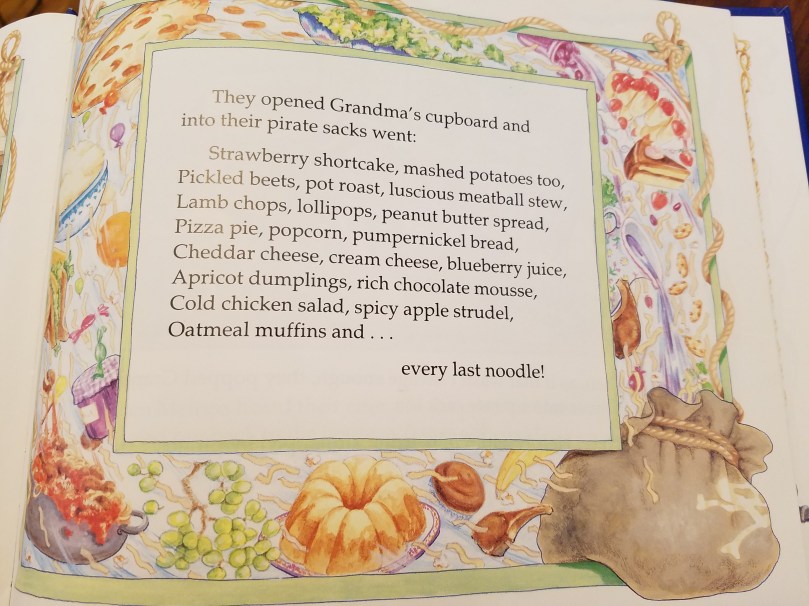
Pirate Sack.jpg

I grabbed that page for you because to me it gets across so much of what makes Phoebe Gilman a genius.  Which is to say that it’s one of my favourite pages and I love it.  Notice again the juxtaposition of the heimlich and the unheimlich: cozy comfort food, and theft; the warmest and safest things in life, and the coldest and darkest; home, and being torn from home.  But you hardly think about that black sack gaping in the corner while you’re bouncing along with the delicious rhymes and pictures.  I remember staring at that page for ages, parsing the pictures, when I was a child.  And now the Changeling does the same thing, so I get to experience it all over again through her eyes.  Yes, it makes me choke up a little.

But her grandmother’s cries at being kidnapped alert Melissa, who doesn’t quite make it in time.  She waits quietly until dark to go after the pirates, and this is our first sign of Melissa’s cleverness: “They’ll be eating all day,” she said to herself. “I’ll wait until dark.  It will be safer to rescue Grandma and Oliver then.”  Remember: this is the girl who was out in a field picking buttercups and daisies.  Now she’s chasing pirates, but not like some idiot hero swinging his sword and running headlong into traps: she waits, she watches, she deduces, she thinks.  And so she waits and swims out to the ship by the light of the moon.  Unfortunately the pirates wake up as she attempts to rescue her family, and she’s kidnapped, too.  Over and over again she comes up with clever plans to escape– lowering a boat as the pirates count treasure, hiding in treasure chests, etc.  But they’re caught and kept.  Meanwhile, she learns to sail the ship, and that’s where she gets her brightest idea: she makes a fake treasure map and acts distraught when the pirates steal it from her.  And, as they head off on a wild goose chase, she and her grandmother and Oliver the parrot make off with the ship.

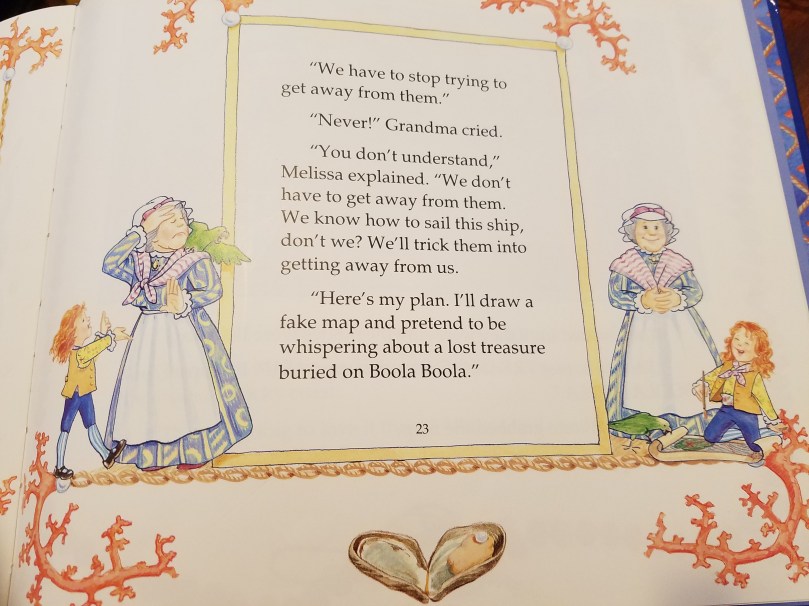
There’s nothing quite so satisfying to me as reading about cleverness in children’s books, especially a clever female protagonist.  Princess Leora is clever in The Balloon Tree, but what wins her the day is her courage.  I love courage, and Melissa is definitely brave enough and to spare, but meeting a clever girl in a book is always a delight.  Melissa isn’t just clever, though: she learns and develops throughout the book until she’s smarter than everyone around her.  Here, let me show you the page where she comes up with her plan:

Plan.jpg

Melissa isn’t the same girl who picked buttercups and daises in a field any longer.  She’s always been brave– dropping her flowers and running to the rescue isn’t the act of a coward.  She’s always been smart– she waited until dark to put her rescue plan to work.  But she’s watched and learned here and turned her lessons on their head: she knows the ship, she knows the pirates, and now she’s going to use that knowledge to excellent effect.  In other words, she’s learned something from and of the pirates.  They aren’t the brightest bulbs in the box, and she knows this, but she also knows their brute stupidity is hard to outwit by normal plans.  Play into their games, though, and you can move them where they need to be for you to make your own plans.

She’s a smart cookie, that Melissa, and that bold intellect is what sets this book apart.  So see if you can find a copy to suit you at that Abebooks link above, and set out to sea with Melissa.  See if you come back the same person you went away, or whether you’ll never again be able to pick buttercups and daisies without scanning the horizon for a ship with a black sail…

Leo: A Ghost Story

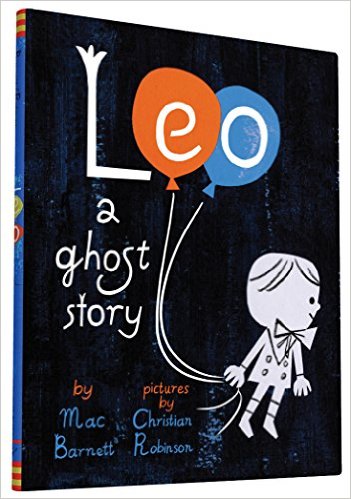
This book popped into my life yesterday.  I was at The Harvard Book Store in a state of severe frustration.  The world was not going my way– oh, please don’t worry, it will all be fine, I was simply in a mood where I wanted the world to be more interesting, you know.  I wanted September’s Green Wind to come along already.  So I did what I always did: I went to the bookstore.  But I was still whiny: I’d read everything, I wanted something new… I was completely insufferable, even to myself.  Then I turned around.  And Leo popped up.  “Oh, hello,” I said, a little surprised.  “I’m happy to meet you,” he said politely, offering me mint tea.  I accepted, a little dazed, my frustrated mood completely vanished.  “Excuse me,” I said, “but I didn’t see you a moment ago.  Where did you come from?”  Leo hesitated.  “Are you afraid of ghosts?” he asked, tentatively.  I smiled, “I’d love to meet a ghost, but I never have!”  Leo smiled back at me, then vanished.  I was left with this book in my hands: Leo: A Ghost Story, by Mac Barnett, pictures by Christian Robinson.

Leo

As I said, Leo came home with us yesterday.  We have already read him through several times together, the Changeling and I.  Some books just grab you like that, and this one has.  I’ll tell you why I think that is: a) It makes you feel special; b) It makes you feel seen; c) It understands you when you don’t feel seen.  I hear you grumbling: I’m telling you fairy tales and abstruse philosophy, you’re muttering, when you want to know what’s going on here.  Very well: let’s have a look at the story.

Leo is a ghost who lives in a house in a quiet sort of way.  Not everyone can see him– although you can.  One day, a family moves in and he’s excited for the company.  They, however, don’t see him, although they do see a floating tea-tray with mint tea and honey toast zooming towards them.  They make it clear that they don’t appreciate having a haunted house, so Leo leaves.  (I hope you feel sorry for Leo: I feel awful for him whenever I read that bit.)  He goes to the city he used to know, only it’s changed.  He roams along the noisy streets, unseen by anyone, until one day a little girl named Jane looks right at him and they become friends.  She thinks he’s an imaginary friend, and it’s clear that she can see him (as we can) because she’s ready to see things, unlike the unimaginative family which took over Leo’s home.  (I love that.)  Leo, still sore at being unseen and disliked, lets her think that until the night Leo saves Jane’s house from a robber and she realizes he must be something more.  Leo confesses, worried she’ll be scared of him, that he’s a ghost: “Jane, I told you a lie.  I am a ghost.  I said I was your imaginary friend, but I’m not.  I am just your real friend.”  Jane says that’s even better, and they go to the kitchen to have mint tea and honey toast.

It’s a real hefty story for a picture book, isn’t it?  I could imagine it amplified, filled out, and padded to become a slim novel– Roald Dahl-level, but with actually likable characters.  And yet Mac Barnett demonstrates yet again (we’ve met him before, you may remember: Extra Yarn) that he can pack a hell of a lot of story into a really slim space.  It’s so good as a picture book you don’t even find yourself wanting the novel version.  (Well, not much, anyway… oh, who am I kidding?  Mac Barnett, want to try your hand at writing a novel version of this book?)  More than that, he again demonstrates, as with Annabelle, that he can pack a hell of a lot of character into few words.  You saw that little dialogue with Leo I wrote above?  Well, how often do you feel that you’ve gotten to know a character from a picture book so well in just a few readings that you could imagine a full conversation with him?  I read a fair number of picture books these days, and the number of really fleshed-out characters I meet are slim indeed.  This isn’t to say anything against the more limited characters (often they’re wonderfully slim and flat, doing other work instead), but getting a rich plot and full characters is a pleasure.

One of the best parts for me is watching my Changeling relate to a full story and full characters.  “I want to read Leo!  Please will you read me Leo before we leave the house?” is what I heard right after breakfast this morning.  I asked her to bring me the book and she trotted up with it: “Tell me about the girl!  I like her.  Her name is Jane.”  This is what I hear over and over again.  I asked her why she liked Jane, and she paused and said, “Jane is so nice!  She’s a very nice girl.  She’s my friend.”  Remember, please, that my daughter isn’t yet three, so full character analyses aren’t what I would call her strong suit.  What’s clear, though, is that she’s really picked up on Leo’s loneliness, and Jane’s kindness in accepting him for who he is.  Jane means friendship, and the Changeling responds to that.  I think, although I can’t be sure, that the Changeling also responds to Jane’s imagination: there’s a glow in my daughter’s face as we read about Jane’s games (the Knights of the Round Table and hunting a dragon) which makes me think that she does get the imaginative brilliance in Jane’s character.

But I’m not fulfilling my role quite yet.  I’ve let a key aspect of the book stay invisible: forgive me.  You can, I hope, see the richness of the text, the richness of the characters.  But you can’t yet see the richness of the art, or how the art and text work together.  Mea culpa.  Dear readers, I’ve told you about Mac Barnett before and his skills probably don’t surprise you.  But Christian Robinson!  His work was new to me, and now I have to go find everything he’s ever done, and I’m thrilled.  His wit and sympathy come through perfectly in these acrylic and construction paper cutout illustrations.  They’re a perfect match for the text.  The illustrations are all in shades of blue, really drawing out (forgive me) the themes of imagination, invisibility, visibility, and the fading boundaries between them.  All are blue, but Christian Robinson uses clever tricks to delineate the distinctions between what and who is seen and what and who is unseen.  Leo is in outlines whereas other characters are solid colours.  Leo can sometimes interact with what is solid, but others may not see or feel him.  The illustrations reflect that cleverly as he sometimes appears, and sometimes doesn’t, pulling the reader’s eye around the page to find the little outlined figure.  “Oh, where’s Leo?” is a frequent exclamation from my daughter as we read.

Altogether, I think this is one of the most attractive, interesting, and clever new books I’ve read this year, and I don’t say that lightly– you know well, my dear reader, how many excellent books I see.  But this one came to me at the right time, just when it was wanted, and in the best way (thank you, Leo!), and I’m happy to read it as often as my daughter wants me to, and that’s quite a lot.  I think I’ll be keeping Leo visible on my shelves.  Don’t worry, little ghost, you’ll never go unseen around here.

Bébé Balthazar

I want to know if I’m alone in this, so tell me if this scenario resonates with you:

You’re a parent who speaks another language, and your child is younger than, say, two or three.  You’re talking with someone, and they chuckle and say, “Oh, are you, like, talking in Welsh to your kid all the time?   Wouldn’t it be awesome if your kid grew up talking in Welsh?”  (Or French.  Or Chinese.)

I have a feeling some of you are shuddering and nodding along (please tell me I’m not alone), and maybe others are thinking something along the lines of “Wait, you know Welsh?”  To which I say, “Why do people always italicize Welsh?”

The thing is, it’s not just Welsh.  I’m an academic, so I know a number of languages and I get people who, whether because they think it’s funny or because they’re really dead serious, inquire quite minutely into just how much I do in terms of introducing the Changeling to French, Hebrew, and, through my husband, Chinese.  Reminder: she’s a toddler.

I would like to note with great pride that, thus far, I have refrained from saying anything remotely rude to anyone, even when they proceed to give me advice about how singing songs with my toddler is pedagogically inadequate for conveying the finer points of syntax.  To be honest, my restraint in that case wasn’t due to self-control: I was just too stunned to think of anything to say apart from, “Oh?”  I didn’t even have the brain capacity to say, “Why the [expletive deleted–ed.] do you think this is remotely your business?  Also, your pedagogy seems somewhat flawed, not to say it’s complete bull [expletive deleted– ed.]” Ah, how we are haunted by life’s missed opportunities!  [Editor’s note: I would like to apologize for the author’s terrible behaviour.  I won’t let it happen again.]

Well, after nearly three years of being questioned, I’m finally thinking through an answer, and here’s my explanation.  I love languages madly, passionately, and deeply.  I have a particularly intimate relationship with French, which is as much a part of me as English.  I love how it sounds, I love the literature that’s accessible to you once you know it.  I love how closely it’s intertwined with English, like cousins: each their own world, yet visiting back and forth.  If you know about French and English, you know about families: their loves, their quarrels, their fights, their reconciliations.  Obviously I want to share this love with my daughter the way I want to share my love of music and of animals and of books and of needlework– and it would be super nice if she took to it.  If not, well, we can still talk about cats.

So, yes, we sing songs and read books in French, because I love them and she loves them, too.  If she doesn’t want to read or sing something at a given time, I shrug and put it down.  Maybe she will another day.  If she does– yay, awesome, I love that!  That’s my approach, really, and I find it much easier to resolve than how to respond to being questioned about said approach.  And, perhaps most importantly, no one else gets a say in any of this (unless you know some really good books or music we might enjoy).  Especially because I think the more interesting question is this:  Have you discovered anything new and interesting through re-experiencing a language you know at an adult level with the Changeling at her own level?

What an excellent question!  Why, yes, I have.  I’ve discovered that The Very Hungry Caterpillar works gloriously in Welsh, but only OK in French.  Interesting, right?  I’ve learned a number of new songs which my daughter and I both love.  And I’ve found some really lovely books.  You see, when I learned French it was through New Brunswick’s early French immersion, and I learned it at school.  I’m sure we did some story books, but I don’t remember much apart from worksheets and conversation.  By doing things just at home, for the fun of it, I’m finding all kinds of beautiful books, including some I recently bought at Schoenhof’s: the Bébé Balthazar books by Marie-Hélène Place, illustrated by Caroline Fontaine-Riquier.  If you don’t have a good French bookstore near you, it may be harder for you to find these, although I do link to the French publisher, if you don’t mind paying shipping from France.


These books are simple, simple, simple, and perfect in their simplicity.  They are at precisely the right level for my daughter: French being a foreign language, she can’t quite handle anything with too much of a story, but these are about at the level of Pat the Bunny, which is a bit too simple for her in English.  But what we love about these isn’t just the text; we love the books as a whole.  The layout, the text, the printing, the illustrations, the concept– the books as physical objects are, there’s no other word for it, charming.

I’m sorry that the only images I could find for you are somewhat blurry, but take a look at the covers up above and think about what you see at a glance.  There’s the gingham background, like a classic child’s shirt or dress.  There’s the beautiful script for the title.  And there’s the little illustration set in an oval: the little bébé Balthazar in his rabbit outfit hugging the big, fluffy grey cat, or walking in the water.  Pépin, his teddy, is the little fellow in red you see leaning up against the cat’s hind legs.  The covers encapsulate almost everything to love about these books.

Naturally, they do have something of a story.  In Bébé Balthazar Caresse le chat, Balthazar goes from animal to animal hugging, or kissing, or otherwise interacting with it, and the book is something of a touch-and-feel book.  You can feel the soft fur of the cat, the feathers of a duckling, and the prickles of a hedgehog.  In Bébé Balthazar Je t’aime, Balthazar goes for a walk in his garden and tells everything why he loves it: “Je t’aime fleur qui sent si bon.”  He loves the flower which smells so good, the water which runs over his feet, the ladybird which trusts him enough to let him hold it, and, in the very end, he loves Pépin, who has all the best qualities of everything he meets in his garden.  (Awww!)

In other words, the text is completely sweet: it has no disruptions, no cracks or ruptures to tease out.  It doesn’t teach you any huge lessons about the world.  These books are simply sweet and charming, and sometimes that’s all you need.  Sometimes you don’t need pedagogical complexity or deep lessons, sometimes you just want to enjoy curling up with your daughter and a gingham-patterned book with lovely, soft watercolour illustrations and whisper, “Je t’aime,” over and over again.  “Je t’aime, ma fille!”  I love you, Changeling!  And we both love reading these books together, and that, in the end, is the only part which truly matters, much more than pedagogy, and, I remind myself, much more than worrying about what anyone else thinks of our pedagogical methods.

Let’s all curl up and read a book, shall we?

The Nutcracker

Today has been a pensive day, a day to think about family and work.  And, thinking like that, what surfaces is what’s very close to you.  Right now, what’s close to me is The Nutcracker and a healthy dose of nostalgia.

Let me start by saying that small children have absolutely no sense of time and season.  You know how I’ve talked about having seasonal books?  Well, those are my preferences, of course, but then you have some books which are meant to be seasonal.  Valentine’s Day by Anne and Lizzy Rockwell, for example, which we recently read, because I guess April needs as much a dose of bright red love as February does.  The principle that small children are utterly negligent of time and season, however, is best borne out by the Changeling’s relationship to The Nutcracker, which is apparently of and for all seasons, day in, day out.  There is no day which cannot be improved by watching The Nutcracker, and very few which pass without my voice intoning, “Christmas was coming…” and so on forward through to the very end: “Beside Clara, on her pillow, the Nutcracker smiled with his glittering teeth.”

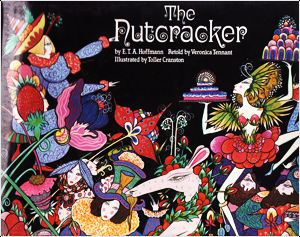
What’s that I’m reading?  Canadian children will know it for The Nutcracker, retold by Veronica Tennant, illustrated by Toller Cranston, and I will always be happy to read it at any season of the year.

Nutcracker

This one is another Canadian book from my childhood.  Veronica Tennant was always, to me, a writer, although I fuzzily knew that other people said she was a “prima ballerina,” which I took to be some kind of ballerina who could do really extraordinary things.  Of course that’s true, but I think that “really extraordinary things” in other people’s minds probably didn’t extend to being able to suspend themselves midair, which I really believed ballerinas could do.  My sister was the ballet dancer between us, as you can probably tell.  I knew, and know, squat about ballet: I just enjoyed it, and I still do.  And while I particularly loved Giselle, I had, and have, a soft spot for The Nutcracker as Veronica Tennant’s story.  We had the cassette tape which went with the book, and I still remember her voice reading us the story, clearly and passionately and mysteriously.  It was the mystery which stood out to us then, and which I try to draw out for the Changeling now.

Mystery?  you ask.  Yes, very much the mystery.  I like to think of Veronica Tennant and Maurice Sendak talking about The Nutcracker, you know.  Both of them wrote and published Nutcrackers, and each, in their own way, fought back against the popular, rather dull, candy-cane-and-flower Nutcrackers of the popular imagination.  Maurice Sendak went back to the original story to fight his battle out; Veronica Tennant, wedded to the ballet in which she had danced so many times, laid out her mystery using the components available to her.

Veronica Tennant starts with an older Clara, right on the cusp of becoming “a young lady,” as her godfather says.   She’s no child, and her childlike innocence is slipping away quickly.  She’s also rather perceptive, and keenly attached to her mysterious godfather Drosselmeyer, a clockmaker and antique dealer.  He shows up at the house on Christmas Eve with gifts: a clock, a céleste, and the Nutcracker for Clara.  While her brother, Fritz, bursts out that the Nutcracker is ugly, the more sensitive Clara examines him, enthralled.  Does she love him?  We don’t really know, but she definitely becomes attached to him and pleads with her mother (in vain) not to put him back under the tree with the other presents at bedtime.

It is the céleste, however, which is yet the more mysterious gift.  It is the gift of music, the gift of the ballet, and it subtly binds the text to the ballet itself.  In that rickety old cassette tape, you could listen for the céleste to make its appearances along with the other characters, but with it long gone, perhaps you’d best listen to the ballet itself as you read.  The céleste summons Clara from bed, and its music pursues her along her fantastic journey; it brings the Sugar Plum Fairy to her feet to dance, and lures Clara to dance along with her– and dance her way home again.  When Clara does return home (to find herself fallen at the bottom of the stairs– was it all just a fever dream?), she lies sick until she can hear the music of the Sugar Plum Fairy again, which is, of course, brought to her by her mysterious Godfather Drosselmeyer… how does he know what she needs?  Is it a kind of goblin market where she can only be cured by the music which felled her in the first place?

Very well, you say cautiously, but what of the Nutcracker?  Well, he’s her partner on this journey, isn’t he?  Her dance partner in the ballet, her fellow warrior against the King of the Rats, and her guide to the Land of Sweets.  But he, too, is bound by certain rules, certain laws.  He is only freed from wood for a few hours, and then he has to return– when the céleste’s music ends, Clara’s back home, and, with her, the Nutcracker is back in his wooden prison.  It’s rather sad, and only Herr Drosselmeyer seems to know more of the story.  And, in this version… he’s not telling.

No, I’m not going to digress into the E. T. A. Hoffman story presented by Maurice Sendak.  Frankly, I do have a sense of the seasons, and I’m saving that for Christmas.  (You can prepare yourselves by checking it out in the meantime!)  I will only say that, yes, there is more to the story, and I honour Veronica Tennant for carefully leaving those threads open, for leaving the mystery alive, along with the music of the céleste, so that children like me, growing up with her story, could whisper, “But I know there’s more…” and go looking for E. T. A. Hoffman as we grew older.  She didn’t wrap it up with a candy-cane bow and pretend that was it: she loved the mystery rather than repressing it.  And, more than that, she worked with Toller Cranston, who fully threw himself into the mystery with his twisted eyes and exaggerated lines and colours.

Come to think of it, the Changeling is right.  Who doesn’t need a bit of mystery in the springtime?  Each season has a little mystery to it, as Vivaldi knew, and the mystery of spring, as Stravinsky knew, is very potent.  As for the Nutcracker?  Well, wood coming to life and growing is definitely seasonally appropriate, isn’t it?  And so I recommend that you turn on some music, fetch a copy of Veronica Tennant’s Nutcracker (if you can find it) and just read and listen for the mystery.

Finding Winnie

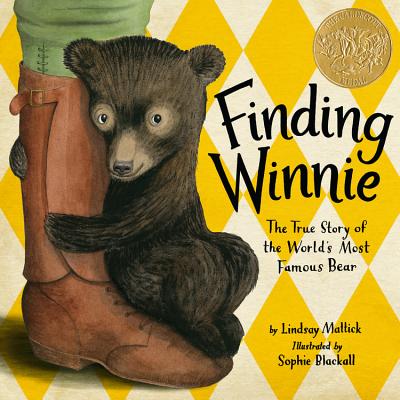
Last week I went to the Harvard Book Store to buy a few books.  They had just run out of the ones I wanted so they kindly ordered them in for me, but it’s terribly rude to leave a place without buying something so I came away with Finding Winnie: The True Story of the World’s Most Famous Bear, by Lindsay Mattick, illustrated by Sophie Blackall.  The sacrifices I make for politeness, folks.

Finding Winnie

Are there books which consistently make you cry?  Well, I’m not a terribly weepy person on a regular basis.  I don’t cry over just anything.  But when it comes to books, I can be a bit more susceptible, it occurs to me.  I mentioned Tess of the D’Urbervilles yesterday?  That one tears open my heart and leaves me a sobbing mess.  Maybe that’s unsurprising: I’m pretty sure that’s what Hardy was going for as Tess is progressively abandoned and lost to the point that her entire life and being are abandoned and lost.  But there’s another type of book which elicits another type of tears: books about the world turning and time going by.  Books about love which endures through that time.  Oh, Lord-a-mercy.  Holy crap.  Even typing those words brings prickles to my eyes as I think about Love You Forever by Bob Munsch, or the ending to Outside Over There by Maurice Sendak.  And here’s another book in that category.

I can now definitively affirm that this is a weepy book for me as it’s been requested on a daily or multiple-times-a-day basis since I bought it.  Let’s see if I can get through telling you a bit about the story without blinking my eyes with a little more than usual vigour.  The story begins with a boy requesting a bedtime story, a true story about a bear.  His mother tells him about a vet named Harry Colebourn from Winnipeg who has to leave for WWI to care for the horses at the front.  (And, yes, I love the Canadian connection.)  On the way, he sees a trapper with a bear cub, and being a mensch, he buys the cub and cares for her.  He names her Winnipeg (she’s called Winnie) and brings her along to the training camp in England.  When it comes time to go to the front, however, he can’t bring his beloved bear into danger, so he brings her to the London Zoo (oh, crap, there go my eyes– that page is beautiful).

Fast-forward to a little boy named Christopher Robin Milne who goes to the zoo and sees a special bear.  They make friends, and Christopher Robin is even allowed in to play with the bear.  He names his own stuffed bear after her: Winnie-the-Pooh.  When Harry Colebourn comes back from the war he’s happy to see his bear loved, and returns to Winnipeg, where he has a family.  Several generations later, here we are with Lindsay and her own son, Cole, named for Harry Colebourn, flipping through an album before bed and going over the family story and, yup, I’m sniffling a little.

I think our question is this: what gets my eyes prickling with sweet tears here?  There’s a few different strands, of course.  One is that we’re talking about a story we all know– Christopher Robin and Winnie-the-Pooh.  Finding something a little special behind those books would obviously elicit some emotions.  But that’s not all, and I know it.  I know that it’s the family aspect: it’s not Milne’s story (nice as that was) which made my voice crack and tremble over the last few pages; it was Harry’s and Cole’s.  It was tracing family history, sepia-tinted but still clear, and awash with love through time (love of the bear, love of each other, love of a child), which got me going as I read aloud Lindsay’s words to Cole: “When I saw you, I thought, ‘There’s something special about this Boy.'”  (“OK,” say I to myself, blinking furiously, “Don’t we all think that when our baby is born?”  “Why yes,” I respond.  “That’s the point.  That’s why you named your daughter after your own grandmothers. Now hand me a tissue.”)

Harry’s love and sympathy for a poor motherless bear cub is palpable.  (“What do trappers do?” asked Cole.  “It’s what trappers don’t do.  They don’t raise bears.”  “Raise them?”  “You know,” I said.  “Love them.”)  Harry raises Winnie.  He loves her.  The refrain throughout his section of the book is his struggle to make up his mind about what to do with Winnie at each turn of the war: the struggle between his head and his heart.  Consistently we read, “But then his heart made up his mind.”  Unlike that trapper, God rot his bones, Harry can’t leave Winnie anywhere she won’t be loved, so first he buys her (for twenty dollars, a fortune in those days).  Then he takes her to England.  Ultimately, he makes the hardest choice: he takes her to one of the world’s best zoos.  And that moment of painful love is the first place where the tears start: you think about war, and how the war broke up so many families… and here was another painful decision.   Even after the war, he sees that she is loved and cared for, and, seeing that, he lets her stay.

Let’s pause here a moment to think about another aspect of this book which draws out the love at the heart of the story: the illustrations.  You’ve probably seen Sophie Blackall’s work around.  I think this is some of the finest I’ve seen by her.  The cover illustration (scroll up) of that sweet little bear hugging Harry’s boot shows a confidence and affection which instantly elicits a smile.  But then you turn the book over (sorry I can’t find a picture of the back cover online, and my camera’s inaccessible right now): There’s another leg, and a little hand dangling down.  And from the hand dangles a little bear.  Now here’s a puzzle for you: which boy and which bear?  Is it Christopher Robin with Winnie-the-Pooh?  Or is it Cole with his own beloved Bear?  Who is it?  Answer: it doesn’t really matter.  What matters is that we all know that grip, that dangling hand confidingly wrapped around a soft bear’s paw.  Winnie clung to Harry, until she had to go to the zoo.  Christopher Robin and Cole clung to their own bears, made their own loved connections.  And Sophie Blackall captures those moments beautifully.

I love the Winnie-the-Pooh connection to this story; it wouldn’t have the same cultural resonance without that link into children’s literary history.  And yet the interesting thing is that knowing Pooh isn’t necessary to appreciating Winnie.  The Changeling is too little to really know Pooh: she hasn’t read The House at Pooh Corner.  Her favourite Milne poem is “The King’s Breakfast,” which doesn’t mention Pooh at all.  And yet she adores Winnie.  She loves watching Harry feed and care for her.  She loves the page when Winnie is left at the zoo.  There’s something special about that bear, whether as Winnie or as Pooh, and Lindsay Mattick and Sophie Blackall truly draw that Something out.

“It’s OK,” the Changeling assures me as she pats my back.  “She found her mummy.”  Well, “mummy” aside, my daughter is right: Winnie did find her family, and even her legacy, and it continues.

But I warn you: if you’re prone to weepy sentimentality, make sure you get an extra box of tissues when you buy this book.

Quackers

I wonder how many children’s books could really double as some of the best self-help books out there if people let them.  I can think of a number which have really made me think, right off the top of my head: The Little BookroomThe Snowy DayThe Fox and the Star are some I’ve written about, but there are plenty more out there.  Today we’re going to talk about one which, to me, exemplifies a good self-help book for both adults and children: Quackers, written and illustrated by Liz Wong.

Quackers

Don’t give me that skeptical look, and don’t run away if you think you don’t need a self-help book.  If you’re like me, you hate that term for the genre.  What I mean when I say “self-help” book is “a book which makes you think about who you are, who you want to be, and how to be the best person you can be.”  That’s pretty broad, and can apply to a lot of books out there, of course– Tess of the D’Urbervilles comes to mind– but some books are more conscious of it than others.  Lots of children’s books are very conscious of the formative role they have in helping children figure out who they want to be.  Some take a rather didactic route, and I don’t generally go for those books.  Others, and Quackers is a prime example, focus on building character and story, and the thoughtfulness slips into the story in a natural way.

Let me give you an example of how lovely this book is.  When I went to The Children’s Book Shop (which is where I found this one), the shop staff were browsing the shelves for some good options for me.  They stopped dead in front of the face-out display of Quackers.  “Awww,” one smiled.  Then the owner glanced over and chuckled when she saw it.  They told me, “We all just can’t stop giggling over this one,” and handed it over.  I looked at the cover.  “Awww!” I smiled.  I opened to the front page, glanced over it, and chuckled.  Who doesn’t love a book which automatically makes everyone smile and chuckle?

Hey, new plan for world peace: Someone send a copy of this book to every single member of the military in every country, and also to the world leaders and the UN.  Then declare it International Storytime for five minutes.  Repeat International Storytime as needed.  Then we give Liz Wong the Nobel Peace Prize.

I hear you, you load of skeptics.  (By the way, I really prefer “sceptics,” but no one seems to write that these days.  What’s your position on this pressing issue?)  You all want to know more about the book before delivering it worldwide.  I’d be annoyed by your skepticism, but: a) it’s my job to tell you about awesome books and I love doing it; b) I’d rather partner with you in my bid for world peace than with Amazon Prime.  Still, have a little faith, people!

But, sure, let’s talk about Quackers.  Quackers has four legs with pretty little paws, a tail, stripy orange fur with a creamy belly, and he meows.  He’s a duck.  He lives in the duck pond with his fellow ducks.  All of his friends are ducks.  But sometimes he feels out of place.  Everyone else quacks, the food is rather unappealing, and he doesn’t like getting wet.  Then one day he meets a strange duck who meows, just as he does, and they can talk!  The strange duck’s name is Mittens, who says he’s really a cat, and they chase mice, drink milk, and clean themselves.  Quackers fits right in– and this is where many stories might end.  Liz Wong is a smart cookie, though, and knows that Quackers’ story carries on.  He misses his duck friends, and goes back to see them.  The story doesn’t end there, either.  Why would it?  Here’s how it ends: Quackers splits his time between his two homes, and he’s a duck, he’s a cat, but, as the story tells us: “most of all, he’s just Quackers, and that makes him completely happy.”  (Feel free to smile and say, “Awwwwww!”  You’ll fit right in.)

My retelling here has an obvious failing: it lacks the illustrations.  Scroll back up to look at the cover image I embedded.  Liz Wong worked with watercolor and digital tools, and I love the combination.  The ever so slight shadings and variation in colour keep the illustrations from looking flat, while the precise rounding of the ducks and cats gives them a cuteness just short of being too cartoony.  To use the most technical of technical language, I’d say the cuteness is squishy-stuffed-animal-cuteness, not overly-exaggerated-anime-style-cuteness.  If you’re me, you’re going to find yourself with an overwhelming urge to dive through the book and hug Quackers on every single damned page.  I’m warning you all: reading this book may result in unintended stuffed animal purchases to follow.  (Oh, hey, I’m sitting right across the street from a toy store…)  Wait, I have an idea!  Can they make Quackers stuffies?  Quackers and his ducks?  Quackers and Mittens?  I would buy them all.

You’re probably all wondering when I’m going to get back to talking about how this book relates to thinking about who you are, though.  Well, in one way it’s obvious: Quackers (don’t you love that name?) thinks he’s a duck, and feels out of place because he’s not!  He has to find out who he is, and, once he has, he’ll be at home and be happy.  Just like the Ugly Duckling, right?  Poor duckling– he’s not a duckling, and once he finds out that he was really a cygnet, ultimately a swan, then he was happy!  Except that, with apologies to Hans Christian Andersen, Quackers is both more realistic and a bit less preachy.  (I love you, Andersen, but you really can verge on the preachy sometimes, you know.)

First of all, there’s the realism.  If one were a cat who grew up to think he was a duck (totally realistic), and one suddenly recognized that, in point of fact, the feline way of life came more naturally, would one entirely forget the ducks with whom one grew up?  I doubt it.  The first time I read Quackers I found myself thinking, “Oh, please, please don’t let him leave those cute ducks behind!”  And he doesn’t.  He knows his ducks, and he remembers them, and while he’s happy to have found other people like him, he still retains a kinship with the ducks.

Let’s turn that around a bit: say you’re a human, feeling a bit uncomfortable in your own skin for some reason.  You’re just not quite sure where you belong– maybe you’ve been pigeonholed as one thing for all your life, but it doesn’t feel 100% right.  You suddenly try something new, or maybe have an epiphany of some kind.  You’re in a new place, either physically or mentally or both.  But can you completely forget all you learned, all you once were, whether the experiences were good or bad?  Do you have to choose between who you feel you are more naturally and your entire past life?  And what do you want to be?  The ideal, I think, of what Quackers is aiming for, is to have the power of choice: he keeps what he wants in his own life.  He assumes he’ll never be abandoned by his old friends– and he isn’t.  He assumes his new friends will accept him for who he is– and they do.  We know, alas, that in daily life this doesn’t always work out so happily, but it’s a beautiful exemplar.

Let me tell you my secret: I think this book is about as good as Tess of the D’Urbervilles.  Stick with me.  Tess is out of place in her community from the very beginning, and the rape sets her permanently apart.  Her contact with her community, her out-of-placeness there, has ruined her for the world with which she more closely identifies, however; she feels an affinity for her husband’s world and way of thought, but is never going to fit in there, either.  And so, with no place in the world, the world cuts her out.  Sorry– this is where I always choke up.  But here’s the thing: I choked up when I read Quackers,  too.  It’s the story of Tess if Tess’s society were less dreadful and more accepting of differences.  It’s an ode to finding out who you are, accepting it, and being accepted.

As for the not being preachy?  Well, I think that comes from a few different aspects of how Liz Wong works.  First of all, Quackers is a pretty well-developed character for a cat who thinks he’s a duck.  (He’s so cute!)  We get to know him, and share his feelings as he’s a little out of place, then cautiously happy in his new life; as he misses his old home, and finally works out his own place.  In other words, we experience his life through his eyes.  It’s about him, not about him telling you who you should be or what you should do.  It’s like having a friend who says, “I see how you feel,” instead of, “This is what I think you should do.”  And it elicits the same reactions from you.  “I see how you feel, Quackers.  That must be hard for you!  Oh, you figured it out?  I’m happy for you!”  Lastly, there’s the silliness: if you embrace your own absurdity, how can you be preachy?  Well, Quackers enthusiastically embraces being a cat who believes he’s a duck.  It’s silly, even absurd, but it works, and it really undercuts any taste of moralizing there might otherwise have been.

The best way to show how this book works, I think, is to share the Changeling’s reaction.  As we read, she mostly picks up on Quackers’ feelings: “He’s sad!  He wants to go home!”  As we read on: “There’s another kitty!  What’s his name?  Oh, look at all the kitties!”  And, at the end, “Oh, look, he found all the ducks!  And the cats!  He’s so, so happy.”  I can’t even say how happy it makes me to see her picking up on expressing those feelings.  If she can express them for a duck-cat, she can express them for herself, and that’s a wonderful thing to learn.

So, folks, what do you say?  Are you with me?  Let’s get this book out there, and get Liz Wong the Nobel Peace Prize.  Or at least make sure as many kids read it as possible.

Who Done It?

When I made my recent trip to The Children’s Book Shop to get that kick to my inspiration, I found myself stimulated and refreshed by a wonderful chat about various aspects of the book industry, which is my way of adultifying what really happened which was a sort of love-fest for Chronicle Books: “Oh my God, yes!  It’s amazing how original they are!–” “Original, exactly!  Both in the content and in the physical–”  “Oh, absolutely, I don’t think anyone has a better understanding of the physical book than Chronicle Books!”  And so on.

Please understand that declaring my undying love for Chronicle Books is in no way an insult to the many, many other wonderful children’s book publishers out there.  Remember how I called myself la Coquette des Livres?  Precisely.  (I’m looking at you, Candlewick and Charlesbridge, right around the corner from me, and always wonderful!)  But that’s the nice thing about children’s books: they do so very, very much that there’s always room for more, somehow.  Whether it’s a clever nonfiction introduction to the doughnut (damn, tell me that book’s out there somewhere, I want it!) or a whimsical poem about a cat’s trip around the world, there’s room for a new book.  Chronicle’s particular skill, I think, is in finding and bringing to life the slightly off-beat, the quirky, the mischievous.  That being said, they’re also responsible for the dreamily lovely Swan and A Child’s Garden of Verses, as well as  Vincent’s Colors, but let’s just say that shows the breadth of what they’re capable of accomplishing.

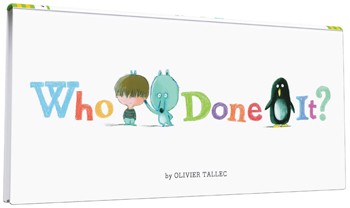
In this case, however, I’m sharing the off-beat, quirky, and mischievous side of Chronicle Books with you: Who Done It? by Olivier Tallec.

Who Done It

In this case, the genius of Chronicle Books was to look outside of the United States.  Originally published as Quiquoiqui? by Actes Sud in France , Chronicle Books translated this to English.  (And, look, it seems that there are more of them in the series!  And, yes, of course I want them, and want the original French editions, too.)  Let me tell you this: I wish I knew who done it the translation, because it’s wonderful.  I know from experience how hard it is to do a really smooth, flowing translation, and this one is simple, idiomatic, and suits the illustrations well.  My congratulations to whoever was responsible!

After all that gushing and background, I hear you grumbling, “But tell us about the book!”  Patience, grasshopper, patience.  I needed a moment to relieve my overburdened heart, and also wanted to prepare you for just how cute this book is.  First of all, there’s the format: long and thin, the spine is at the top of the book (I think you can see from the picture above).  This immediately captured the Changeling’s attention and she was absolutely enthralled by figuring out a new way to open a book.  I love this for a few reasons: a) it prepares the kid for something new from the first physical touch; b) it’s an excellent format for surprises.  The way it opens, each time you turn a page the whole previous page is covered, making the new page appear like a magic trick: “Hey, presto!  Here’s the new page!”

But what are the surprises?  Olivier Tallec has a lovely little cast of characters (les Quiquoi, in the French versions), and they’re getting up to mischief of all kinds.  Who Done It? is the question.  Who didn’t get enough sleep?  Who forgot a swimsuit?  Who ate all the jam?  To find out, you examine the illustrations.  Well, that little guy is playing the trumpet, this one is wearing a costume and gesturing wildly, and the little girl is holding a red balloon… but that bear is leaning on the sofa sleepily and the red fellow with the ears is falling asleep on his friend, so I guess they’re the ones who didn’t get enough sleep!  And, ahem, I think I see the one who forgot his swimsuit…   Oooh, that little dude up there is smeared with red!  I guess he ate the jam!

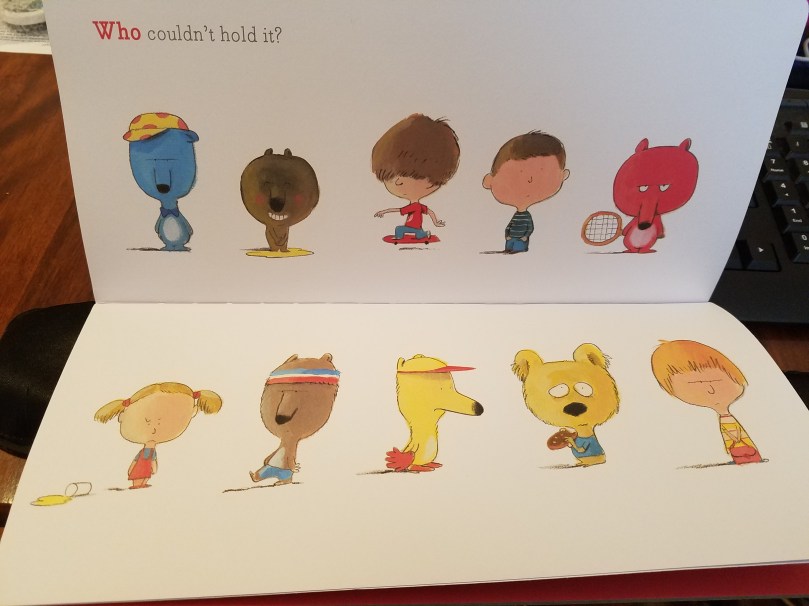
So, you see?  It’s a search-and-find game, a sort of puzzle, but with a difference.  Instead of finding “who stands out,” you read the text and watch for subtler clues to find who matches the description.  Instead of seeing who’s the only one wearing green shoes, you’re looking for hints about body language or behaviour.  My absolute favourite page, because I guess I’m about five years old?  (Apologies for the hasty phone photo– the book is hard to get flat on my own, but you should be able to see everything necessary.)

Couldn't hold it.jpg

The little blush, the grin, the puddle?  This is picture-book storytelling at its best.  Even the Changeling, at two-and-a-half years old, could figure that out, just by examining the little figures: “Oh, he made a pee-pee on the floor!  It’s a yellow pee.  I made a yellow pee!”  (Leading to a moment of blessedly unwarranted panic because she didn’t have a diaper on at the time…)

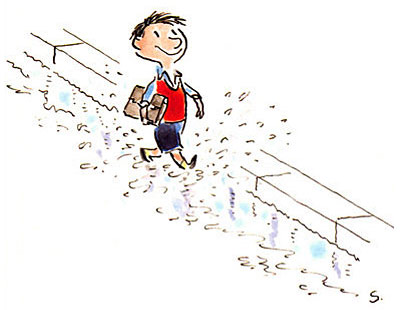
But let’s turn to those illustrations for a moment.  Note the clever lines and details, certainly, but also the pencil work.  It reminds me of nothing so much as Le petit Nicolas, written by René Goscinny and illustrated by Jean-Jacques Sempé.  Do you know their work?  Here’s an illustration for you, just in case:

petit Nicolas

Dear God, how I loved those illustrations when I was growing up!  And let me tell you how thrilled I am to have a somewhat similar style to introduce to my daughter right here and now.  Let’s take a look.  Note the free, sketchy lines.  I’d say that Olivier Tallec’s work aims for a somewhat more polished look, definitely with greater use of colour, but look at the noses and ears, those little pert curves.  Look at the slightly shaggy hair.  There’s a type of vigour and humour even in the outlines which I adore.  They announce: “We’ve got a joke, just follow along!”  If you’re familiar with the Astérix comics, they have a similar energy, although of course the style of drawing is very different.  Like a comic, however, we have here a perfect blend of visual humour in the style and content of the drawings.

Let’s finish by running through the reading experience.  First, you’re holding the book open with your child, and you read the first question.  You have to read it with a straight face, because the question is asked very straightforwardly: it’s a serious question!  The giggles start as you turn from picture to picture and identify who’s sleepy.  Then a moment of suspense: what’s next?  Ah!  A new serious question!  And so it goes.  Each page is a surprise with a simple question which has to be taken seriously, and illustrations which refuse to be taken seriously.

This is sheer fun to read with a little child, probably of any age, but definitely with a toddler.  It’s quirky, it’s intelligent, it requires thought from both parent and child, and it’s always, always fun.  The hard part with this book was getting it out of my daughter’s hands long enough for me to write about it.  The fun part is having it to myself to giggle about for a bit.  The really hard part is that now I want to go to her daycare to read it with the kids.

Warning: book may cause uncontrollable giggles and an urge to locate children to read it with you.

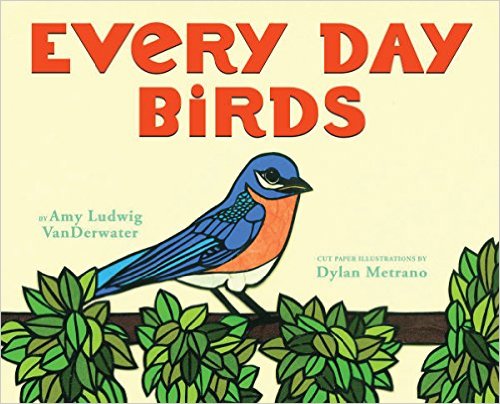
Every Day Birds

Did you know that the Changeling loves birds?  I think I’ve given you a hint, or maybe two.  Well, the sky is still blue and water is still wet, and she still loves birds.  When I went on my trip to the bookstore earlier this week, the lovely people who run the store and I were chatting about my daughter, and I remarked that I really love how she can express her own taste, including this love of birds.  The owner, who may actually be a character from Cat Valente’s Fairyland, now I come to think of it, vanished in a puff of smoke.  When she reappeared, she was holding this book: Every Day Birds, by Amy Ludwig VanDerwater, cut paper illustrations by Dylan Metrano.  (Over here you can also find Dylan Metrano’s original art for sale.  I mention this only because my heart is breaking that I don’t have the $350 to get the framed chickadee for my daughter’s room.  Curses!)

Every Day Birds.jpeg

You know, since I’m already talking about the illustrations and we have this beautiful cover right here, let’s jump right into talking about the illustrations.  You see, I had one concern in buying this book.  I adore the art, but it’s a different style than my daughter is used to for her birds.  I’ve talked before, for both A Bird Is a Bird and Feathers, about my love of precise, accurate, detailed illustrations of birds for these children’s books: ones which really show you what the bird looks like, and are in no way cartoonish or exaggerated.  Audubon for children, basically.  You can see from the cover that Dylan Metrano’s gorgeous cut paper art is accurate and detailed, but the style is very different from the paintings the Changeling and I love so much in her other bird books.  In fact, when the owner of the Children’s Book Shop handed this to me, I immediately blurted out, “Holy, it looks like a William Morris!”  I was thinking of images like this pattern, “The Strawberry Thief,” particularly in his stained glass (on the left, sorry I couldn’t easily find better images for you):

Obviously William Morris has more lush detail curling around his birds, but do you notice the markings on the wings and tails?  Around the eyes?  The slightly abstract, leaded look of those dark lines, almost as thought they were stained glass?  And yet, at the same time, they’re poised to move: I guess I’d call it an abstract realism.  Can you tell I have a major crush on William Morris?  (One day we’ll talk about my tendency to crush on historical figures, but today is not that day.)

Well, you get this vivid, bold, ever so slightly austere art for each bird (the chickadee is perhaps my favourite).  And my concerns that my daughter wouldn’t take to it, or wouldn’t recognize her favourite birds in these somewhat more abstract forms, were patently ridiculous.  Her reaction was positively gleeful: “Birds!  Oh, thank you so much!  Where’s the cardinal?  I found the cardinal, look!”  Nota Bene: Do not underestimate the Changeling.  This has been a Note To Self.  You may now go about your regularly scheduled blog.

All right, so we have our lively yet accurate illustrations.  What about the contents?  Well, part of the reason I started with the illustrations is because we go very much bird by bird in this book.  Unlike A Bird Is a Bird, which goes by categories (types of beaks, wings, eggs), and Feathers, which focuses on feather types, Every Day Birds progresses only according to common birds of North America, one at a time, each one accompanied by a lovely picture.  It’s an incredibly soothing read. We begin with a little verse:

Every day we watch for birds
weaving through our sky.

We  listen to their calls and song.
We like to see them fly.

And then we watch the birds course by, one at a time, still in verse:

Chickadee wears a wee black cap.
Jay is loud and bold.

Nuthatch perches upside-down.
Finch is clothed in gold.

This, again, is why I wanted you to think about the illustrations first.  When you think about these lines, you have to accompany it with one of those bold, strong pictures in your mind.  This isn’t just a chirpy (dear God, forgive me) rhyme; it’s a warm partnership with the illustrations.  They work hand-in-hand.  What you get, in the end, is a series of bird facts, charmingly tripping along in verse, each one accompanied by a really clear illustration of the fact.  After you’ve seen the picture and heard the words, you will never forget that nuthatch perches upside-down: there he is, clear in your mind.

So, maybe this doesn’t have quite the scientific accuracy of A Bird is a Bird‘s labelling of the males and females and so on, but it has extraordinary clarity about a few simple facts which children can easily learn to identify.  Look for the bright yellow of the goldfinch.  Listen for particularly loud blue jays.  Watch for the black cap of the chickadee.  The great blue heron goes fishing.  Nothing here is at all fantastical, and these are all good starting points for anyone interested in birds.  At age two, you don’t really need to be able to identify the finer points of the male vs. the female bufflehead, but you may be very interested in knowing that the oriole’s nest hangs from a tree.  And this is all told in that lovely, easy-going poem which makes it very easy (as I’ve found out) for children to remember the bird facts!

There’s one additional point about the book I’d like to make: something I didn’t expect my daughter to care about at all, but it turns out she gets highly affronted if I neglect to include it in a reading.  (I’m so sorry, Changeling, I won’t do it again.)  At the back of the book there’s a list of all the birds included in the book, each with a thumbnail of the picture and additional facts about the bird.  It’s great for a little further reading, but I wasn’t prepared for how much my daughter loves those pages.  She goes through and, effectively, tests herself: “This is the sparrow and the woodpecker and the blue bird and the…” On she goes, running down the list of thumbnails, trying to remember the name of each bird.  She’s in love.

For a perfect introduction– early, early introduction– to the birds you might see in eastern North America, I can’t see a better book than this one.  This would be a great book for right before A Bird Is a Bird, which is a great book for right before Feathers.  But they’re all great in any order, and my bookshop really, 100% pegged my daughter’s taste on this one.  It’s amazing.