
I want to say that I found next year’s Caldecott except that I think that when I say that it’s the kiss of death. Even so, I will say that Elisha Cooper’s The Rare Bird has all the elements that, in my estimation, show the creativity, sensitivity, and skill in art and narrative that take a picture book from “good” to “true art.”
I’m hoping that’s sufficiently periphrastic to avert the curse.
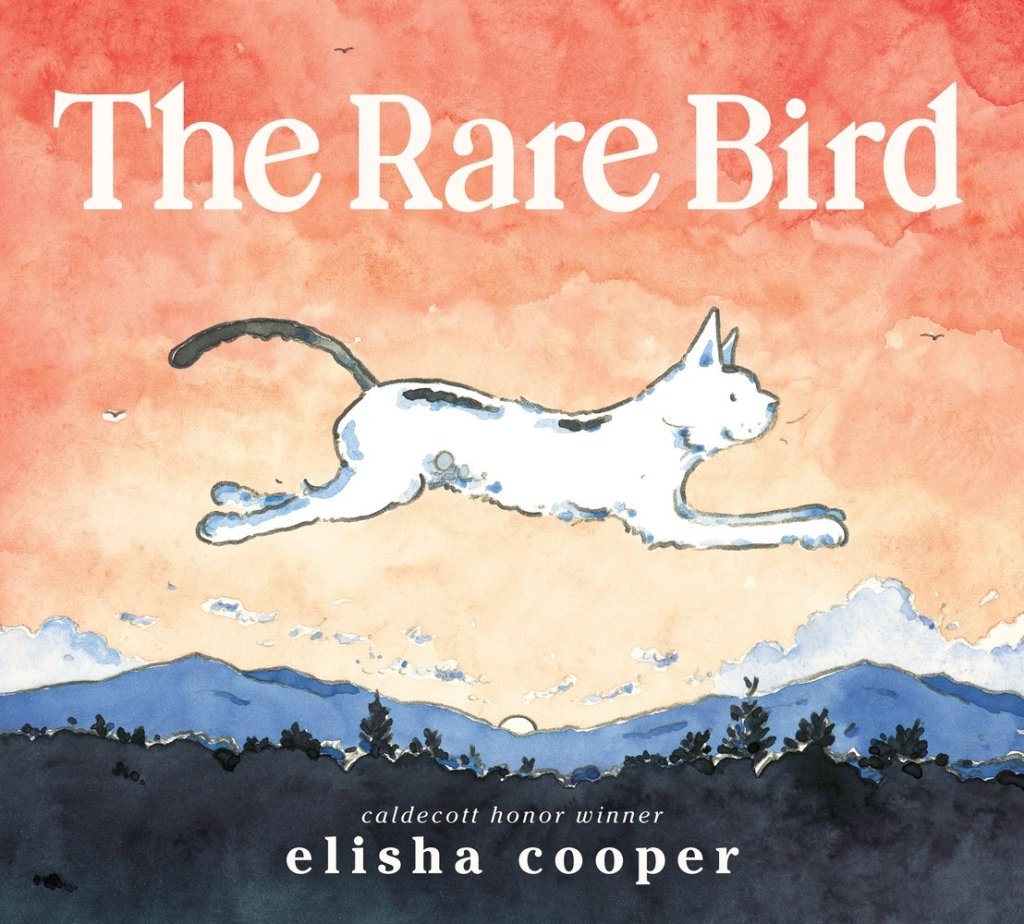
The absolutely first point is that no one, and I mean absolutely no one, draws a cat like Elisha Cooper. I could have stopped at “draws,” end of sentence, and that’s also true. His style is distinctive and has a deftness and vivid elegance I admire enormously.
I would say that in today’s picture book world there are three artists I think of as a style set: Elisha Cooper, Barbara McClintock, and Sergio Ruzzier. They all work with deft, loose lines. They all have great humour. They all communicate more and say less. All of this is as true of their text as their art. But each is highly distinctive: if you put down an illustration by each of them in a row, no one could confuse them. Sergio’s art is hilarious, Barbara’s is elegant, and Elisha’s is spare, economical. (This is extremely broad strokes, of course.) I have never, ever seen an artist do more with less than Elisha Cooper.
I have also never seen a single author since Maurice Sendak capture my youngest child’s attention and love so fully.
Mac Barnett and Jon Klassen have been harping on forever (and I’m here for it, I love it) about the need for art and text in a picture book to leave room for each other, for each to do things the other is not.
The Rare Bird does this in an utterly fresh way, and watching my little one pick up on that at the first reading, the way his smile grew and his eyes sparked with interest, was mesmerizing. He even noticed what the endpapers were doing as part of the narrative. The oddest sense came over me that there was a book above the book, a story above the story, that was doing something in parallel– hovering independently.
The book is absolute nonsense of the wisest kind. It’s not a bird, it’s a cat! Not a fish, not an elephant, not a forest, not a sea– a cat in an apartment!
My kid didn’t say any of that. He knew the story the cat (bird) (panda) was telling. He recognized it because he’s a kid who lives through story narratives of his own. A dancer, a book-lover, a storyteller in his own right. That’s what books do for us. That’s what art does for us.
Art will live forever, he knows, whether literary art, performing arts, visual arts– the art of the imagination above all– because through art we can be the rarest bird: a Bluebird, a Firebird, a cat climbing the curtains in a NYC apartment bird.
He could see that in the pages of this book without me pointing out a thing. He laughed with delight at the sheer playfulness of the Rare Bird’s double story, but he also shone with recognition, because that’s his story, too. It’s mine, it’s his, and it’s probably yours.
Don’t you think that a book that can evoke all that for a five-year-old, and with the finest lines and warmest watercolours in the coolest shades of blue deserves a Caldecott?
This is a book that’s easy to read the first time, but beautiful to read the second. After that, it might become something of a cult.
 The Children's Bookroom