
It’s been a tiring late summer and beginning of autumn on many fronts and for many people, to put it periphrastically and platitudinously. Or to adopt my friend’s blunter framing: “September is supposed to be for new beginnings but everyone is burnt out.” As a Jew, facing Rosh Hashanah, that resonates, and as an autumn-and-Halloween-loving soul longing for October, expecting September to be the build up to that best of months, I still agree. Something should be new and fresh about the year as we go back to school and back to cooler temperatures and back to routines…
Back. It’s funny, isn’t it, how going back and expecting something new come together in September? And every near year, especially at Rosh Hashanah but I think also in the Gregorian calendar (let’s think of the Janus in January), we look back and forward at the same time. Think of these sayings: “Everything old is new again,” “Plus ça change, plus c’est la même chose.” Which is all a long way around what I want to say which is:
Let’s read an old book. One of the things I love about Mac Barnett and Jon Klassen over at Looking at Picture Books is that they look at the old books and analyze just what’s at work in them. (Though I often have a few extra notes, because– I’m me. You can have two of the best creators in contemporary kids’ lit diving deeply into a picture book and I’m still going to think they haven’t gone far enough.)
The platitudinous, tame idea of a retrospective, of looking back as well as forward at a new year, is that it’s good to understand our past, our foundations, for where we will go in future. In short: what can we learn so we can do something with it? This may, possibly, be a decent approach if the goal is to understand something about, say, why we stopped exercising one week into January. It’s not useful in trying to understand book creation, the allure of art, or the creative heart of humanity– and maybe part of why we’re all so burned out. (Spoiler alert: we’ve lost track of the beauty of humanity in the world, as well as humanity’s craving for beauty.)
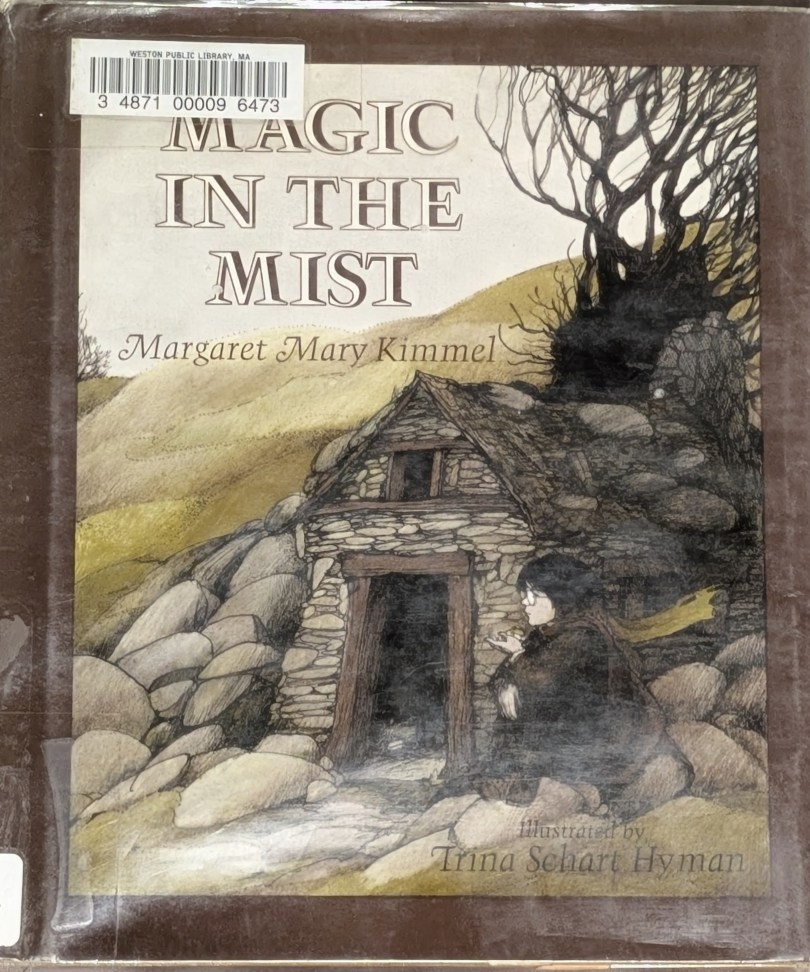
Which brings us to Magic in the Mist by Margaret Mary Kimmel and Trina Schart Hyman.
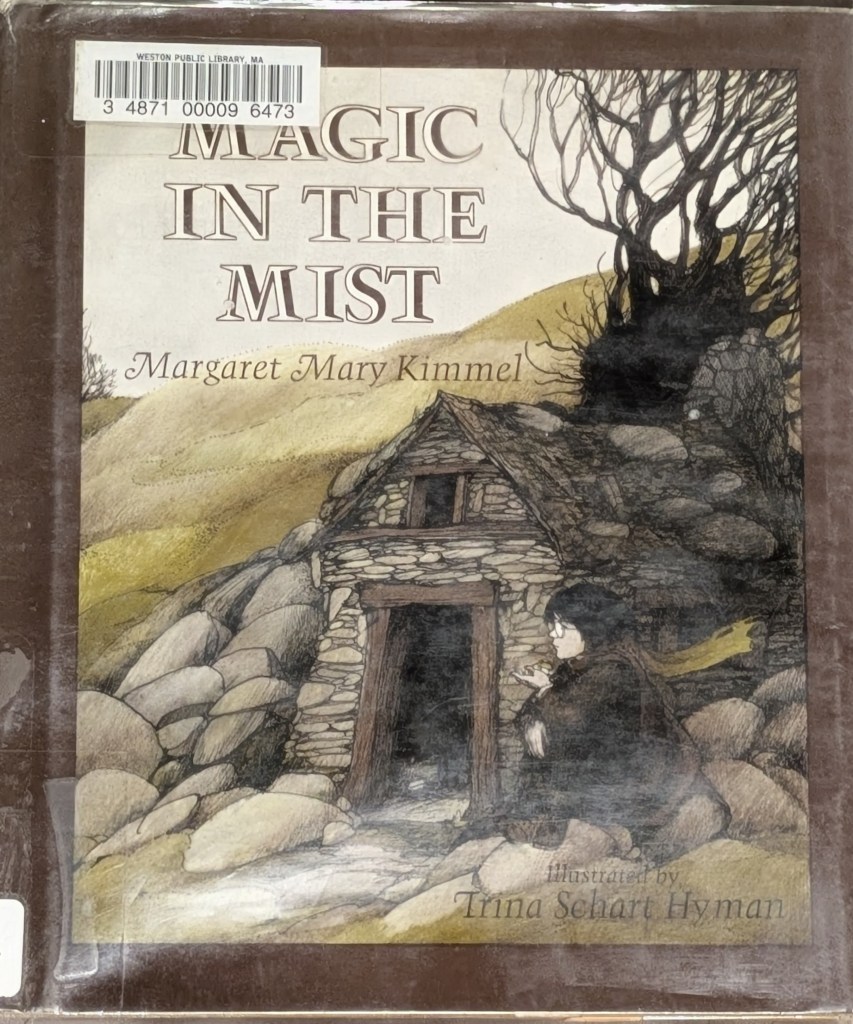
The first thing to understand about this book is that it tells you pretty much nothing. The book has barely more plot than Freight Train, one of the most perfect stories out there. I’m not sure of how to define the time frame, plot, or characters. The setting is pretty clear– it’s a leaky hut beside a bog in Wales, usually in the mist. Generally speaking, when someone says, “[Book X] would never be published today!” I think, “How on earth do you know that?” I never agree with them. But with this one, I’m fairly confident it wouldn’t find a publisher; it’s very quiet, very grey, and relies entirely on atmosphere, evoked by Trina Schart Hyman entirely through dark lines without colour. Picture books today by and large are lean in text, rich in colour, personality, and activity. Most want a plot and characters. This, by contrast, is rich in lines of text and art, and lean in pretty much everything else.
It is also utterly and completely perfect. (Also: out of print. Published in 1975 by Margaret K. McElderry. You’re on your own for this one– I recommend biblio.com or alibris.com, or your local library.)
Thomas, who lives in this leaky house beside the bog, is studying to be a wizard. Why? And does he have a teacher? Family? What is his motivation and where did he come from? Idle questions, all! Also, he doesn’t seem to be very good at it. His magic is weak and he can’t even light a fire. But a toad does hang out with Thomas, and Thomas calls him Jeremy. Jeremy is good company, and hums, and once his humming seems to do something a bit magic, and Thomas goes out and finds a tiny dragon and brings the dragon home with him and feeds him. The dragon helps him light a fire in the grate, then leaves quietly in the night. And Jeremy and Thomas hum together sometimes after that. Sometimes his spells work. That’s about it.
I refuse to make my summary prettier or tidier; it would be to prettify and tidy up a book which has very, very little to do with that line of story. Instead, every single element of the power of this book comes from evocation: the text evokes images which are echoed and amplified but not fully realized by Trina Schart Hyman’s lovely lines; the two echo together in the mind’s eye until something forms there; the something in the mind stirs up thoughts of “didn’t I once hear or read–” and maybe a small melody, like a toad humming, unfolds in some of the lesser used bends in your memory.
Why look back? Because a book like this has value in itself. If you try to learn a lesson from it to build on it in your own book– you’re going to fail. It’s the sort of thing you read and re-read and it will, absolutely, do you good, but it’s not a magic pill and it’s not a lesson-book. It simply enhances you to read it and think about it. And it’s beautiful, pleasant in its deeply unsettling oddity.
What you can learn is that we’ve always made beautiful things, and sometimes the current drive to make things fit into a diagram of some kind doesn’t result in beautiful things. But we, we poor humans, need beauty to survive with any kind of humanity. Beauty isn’t in resolution or usefulness or happy endings; it’s in itself, and in a book well-made of its own unsettlingly odd kind.
So, this September, this new year– as you look back and plan forward– think about being a bit useless sometimes, and go to a museum, read a beautiful book, throw your smartphone in the trash and, after a moment’s reflection, follow up with your other smart devices, and utterly neglect your email. Go to the ballet to see fellow humans give their bodies to beautiful lines onstage, and go to the opera to hear humans give their voices to the most soaring heights. At the symphony, you’ll hear the clear lines of melody coming together in harmony. (Make sure you’ve already trashed your phone, because that way no phones will go off during the performances.)
And remember that once upon a time, two women made a small book that was simply unfolding a glimpse of a boy striving to be a wizard, though he wasn’t very good at it, but one day when his toad hummed, they met a baby dragon for a little bit. And that glimpse– was it. In lines of text and art, none perfectly clear, but inscrutably perfect.
 The Children's Bookroom