
I haven’t written about novels very often recently for the very simple reason that, for the most part, I’ve been ambivalent about, simply forgotten about, or given up on most MG or YA novels I’ve read or started since Ferris, which, of course, I adored. This isn’t universal, of course. I’m deeply invested in Jessica Townsend’s Nevermoor series, but it’s so hard to write about a chunky fantasy series without getting into Fantasy Series Discourse, which I’m not keen to do. (Simply put: Jessica Townsend’s books are brilliantly funny, intelligent, tightly plotted with characters who remain true to themselves from book to book while simultaneously unfolding greater depth throughout. They are, simply put, more like Dickens than like Rowling.)
But, for the most part, I’ve been looking for something that I wasn’t finding, until I found two novels (both, interestingly, acquired and edited by superstar Taylor Norman at Neal Porter Books). These two books could not be more different, in many respects.
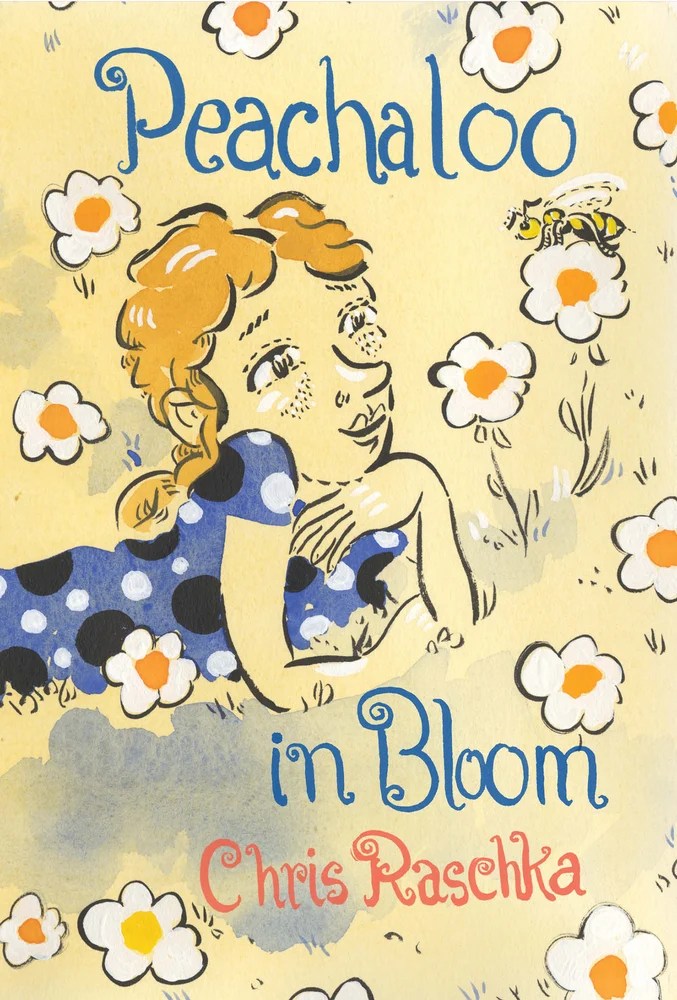
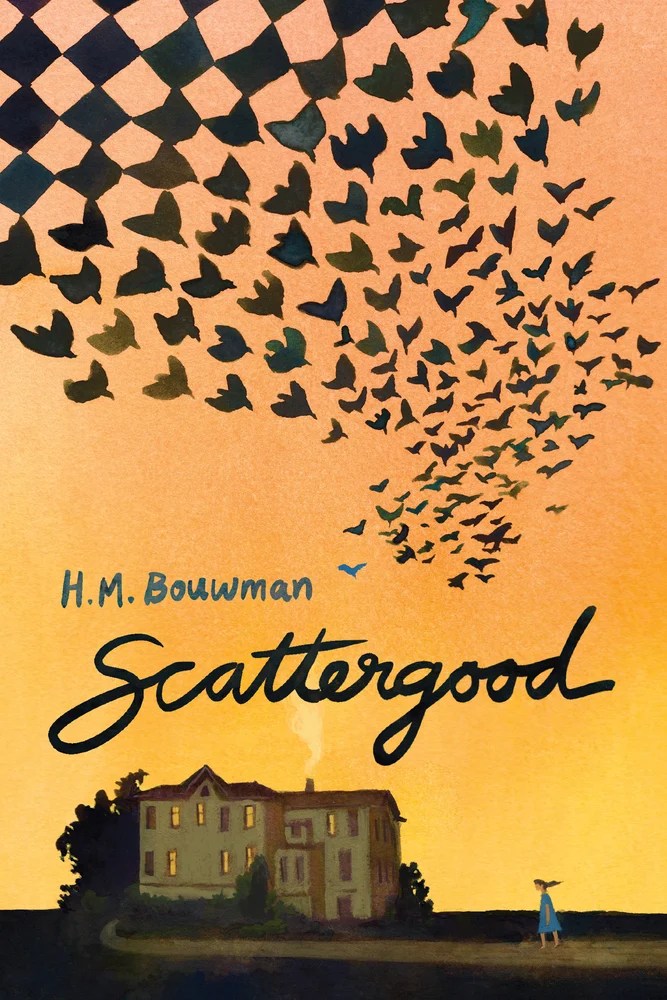
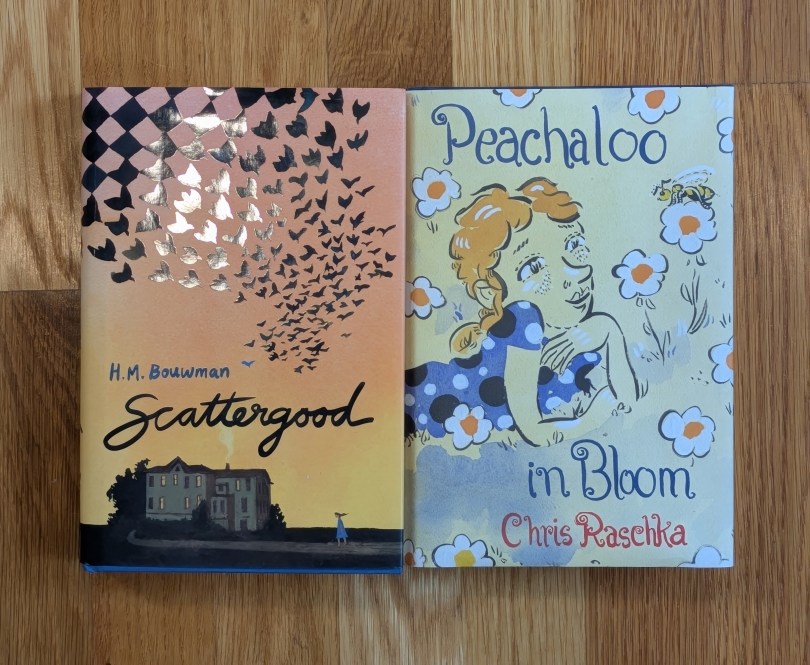
Behold Peachaloo in Bloom by Chris Raschka and Scattergood by H.M. Bouwman. One is bubbly, the other often bleak. One is set probably now, and the other in the past. One is optimistic, and the other enmeshed in the confusion of no right answers. The protagonist of one is named Peachaloo, and the other Peggy.
That said, both books are wise, both have their feet rooted in the ground where they sprouted, and both feature protagonists who are true to themselves as they can be. Alan Garner insists that it is integral to find your place and write from it; for him, it was his family land, going back for as long as could be. These books may not have had such an ancient lineage, but both have an extraordinary sense of rootedness, and that gives them a “potency of life” (thanks, John Milton) which allows them to move actively in the mind, spry and lively.
Let me start with Scattergood, largely because it’s such an unlikely book for me to recommend. Set during WWII, on the eve of the American entry into the war, it follows Peggy in quite a pedestrian timeline through her summer and into the beginning of the next year of school. She’s simply a farmer’s daughter in West Bank, Iowa, doing her chores and dealing with the folks she’s always been around and grown up with, and who grew up with her parents, and so on back. Until Scattergood, the Quaker school nearby, is reopened as a hostel for refugees from Hitler, Jews who managed to get away on a boat here or there, leaving family behind, sometimes hearing, as time goes by, of a death, or being stuck in a limbo of not-knowing. Against the background of all of this, 12-year-old Peggy, rational-minded and a burgeoning mathematician, is watching her dearest cousin, Delia, die of leukemia, which is a problem she can’t solve, and beginning to take notice of her parents’ marriage.
Novels I usually don’t enjoy include: anything gritty or bleak, anything involving the Holocaust, and anything that could be described by the words “coming of age.” I came of age once already, and didn’t much enjoy the process. And I’ve read too many novels for teens with Holocaust refugees, crushes, and internal agony, so this should be a novel I would pretend didn’t exist.
And yet– I won’t say that I loved it, I’m not even sure it’s a book I could imagine holding with the same cuddly affection I have for Rabbit Hill or Martin Pippin in the Apple Orchard. The rawness of tragedy is too real for that. But the scope of the book is not the war, not refugees, and not coming of age: it’s Peggy’s interiority, and watching a teenaged mind and soul unfold to accept the limits of what is knowable and of action.
I will admit that I still don’t love so much attention to crushes in YA, including Scattergood. The romance was certainly done with sensitivity and fit in with the larger scope of the story; it didn’t feel tacked on. Even so, the tactile truth of the book was rural Iowa during the looming shadow of WWII over the USA, the fear of the draft, the poverty, the hard work, and the Quaker school, Scattergood, reopened as a hostel for the traumatized refugees, every single one of whom has lost everything and everyone (or, at least as bad, is living in the uncertainty of wondering if anyone is left). This is the context Peggy is living in, but its her mind, puzzling out what that means, that we functions as our window onto the area of West Bank, Iowa. In that world, leukemia is incurable; loss of control for a few minutes means a farming accident that costs money and limbs; and there’s no such thing as denial of responsibility.
Frankly, the very truth of it, the unwillingness to take the easy road in storytelling, the integrity of reality in Peggy’s story makes Scattergood a hard read, but Peggy is dearly worth getting to know, and so are various others in her life. Above all, I want to credit H.M. Bouwman for her staggeringly detailed research (I looked up Dr. E.C. MacDowell: he existed and studied leukemia in the 1940s, yes, and that link is for my husband), and her combination of sensitivity and down-to-earth directness as she shows us real people through Peggy’s eyes, but without passing judgment. You can judge them, as the reader, but I don’t think she wants you to. I encourage you simply to get acquainted. Once you do, you’ll find it hard to get them out of your head.
Peachaloo in Bloom by Chris Raschka should seem frivolous after this. Lightweight, funny, and cheerful, it’s the polar opposite– isn’t it?
Not on your Nelly. (I looked that up: variant forms are “not on your nelly” and “not on your Nellie,” and it’s UK slang, apparently, with earliest clear usage in 1959. Fascinating additional tidbit: the OED lists “Nelly” as Australian slang from the 1940s for cheap wine. This seems to be totally unrelated, but I have questions about what Nelly was up to. Or Nellie.)
There’s a frankly stupid tendency in criticism to privilege the grim or simply less-funny books as wiser, deeper, or better than funny ones. I’m going to go ahead and assume you’re better than that, so we’ll skate past that topic to focus instead on something altogether more interesting.
The true distinction between Peachaloo and Peggy and their respective books isn’t in heartbreak or confusion. It’s in circumstance. When Peggy’s life is upended and she finds herself trying desperately to understand her cousin’s needs and her friends’ and her own feelings, she doesn’t have an open chat with anyone until, at the very end, she unloads everything to the person she thought least likely. Peachaloo tells her beloved grandmother everything. She directly and openly tells her that she gained a superpower to understand the meaning behind others’ speech after she was stung by a wasp.
A summer in Fourwords, PA spent swimming with her grandmother and skipping with her friends is sheer glory to Peachaloo Piccolozampa: the rhythm of her walk, with one leg an inch shorter than the other, fits the rhythm of the town and its dance-skip approach to life and ritual. Peachaloo sees no reason to alter either or to pay either more than the most matter-of-fact attention. When new owners come to Ajax Mansion and plan to take what was once common ground and close it for profit, Peachaloo and her grandmother (as powerful and delightful a grandmother figure as any in literature) get to work. Their work? Delving into archives, interviewing, writing, auditioning, performing, and skipping. Much of this work has to do with history: the local history behind Ajax Mansion and the Skippers there; investigating the town’s myths and history relating to the bank robbers Ronnie and Donnie Day; honouring and understanding history while allowing time to evolve, and much more.
If you want to understand Helena and Peachaloo, I’d say the thing to do is add a few extra books to your reading list: read Joan Aiken, read Eleanor Farjeon. They’re worth it anyway, but the Piccolozampa willingness to see the world at a 45 degree angle from everyone else feels straight out of the oddball worlds those two authors recorded with such love.
Most interesting to me, though, as an academic type of adult, is the world and literary history I see enmeshed with the fictional local history in the book. What is Major Gasbag, the new owner of Ajax Mansion, doing, after all, but what the English landowners did for centuries: enclosing the commons? Peachaloo understands the wrongness intuitively, but our sense is that her academic-minded grandmother, Helena, a historian, has a library in her mind that tracks this farther back and across so much more time and space. We are with Peachaloo in this book, admiring her grandmother’s spunk and skill in speaking up for the Society of the Brothers and Sisters of the House of Ajax, that group of misfits who cared for one another and left the grounds open to the communal enjoyment and use of the entire town. We see her learning the skipping rhymes her grandmother collected and studied, and we see her deepening understanding of why this work is important.
But I, for one, also sense that there are depths to Helena Piccolozampa’s research unrevealed. Did Helena know of Elsie Piddock (from the mind of Eleanor Farjeon, in fact) and the skipping grounds of Caburn? Did she know of the Lord there who sought to enclose the top of Caburn and close it to the people, and of Elsie Piddock’s ploy to preserve it against his greed? I’m sure she did.
In the end, Peachaloo is surrounded by the closeness of her family, bigger and broader and more confident for her enrichment in standing up for truth, reality, and firmness in the face of gaudy cheapness. Peggy grew, too, through her understanding of human complexity and her acceptance of the truth, of the limits of the human ability to change outcomes, and of just how damned hard life is. But if you want to know these books– take a look at these covers.
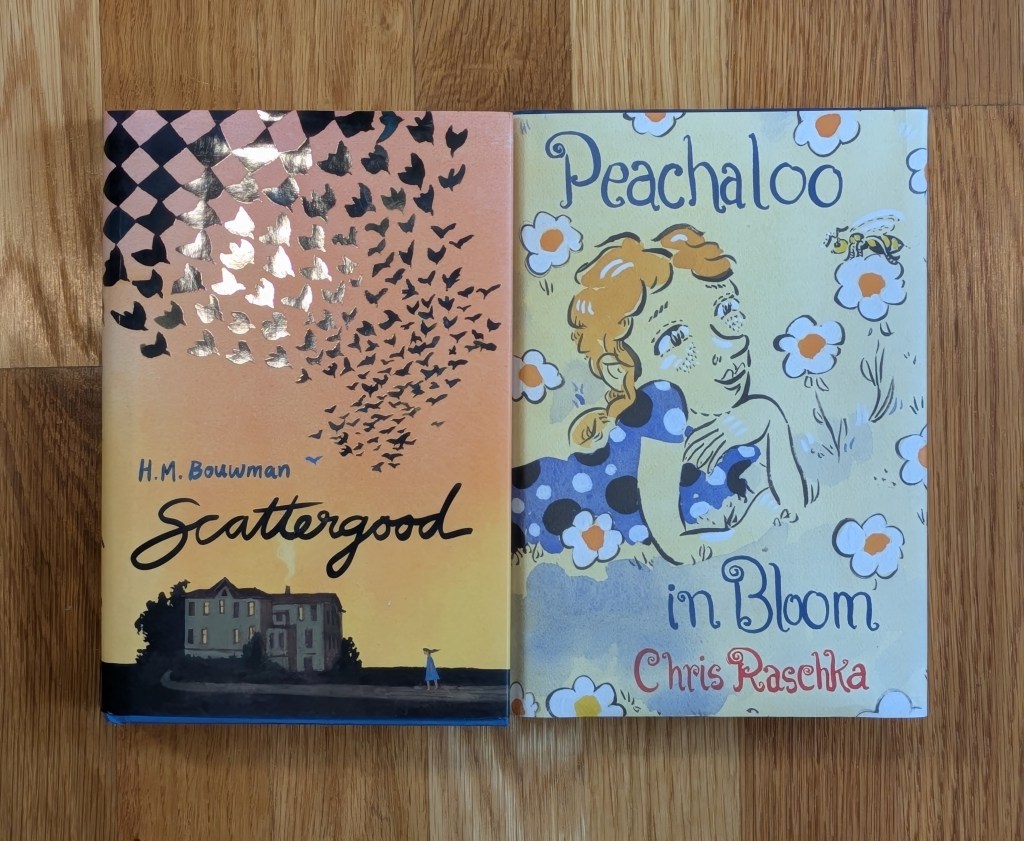
Scattergood is marked by a painterly beauty, merging a firm foundation with an interior landscape (cover art by Angie Kang); and Chris Raschka’s classic looseness, with precision evoked rather than set down firmly, and ever faithful to the soul of the book.
If you’re looking for just a few more books to read before summer runs out, these are here for you. Scattergood if you need to chew on this unsolvable world, and Peachaloo in Bloom if you need laughter and hope, but Peggy and Peachaloo are two girls worth getting to know. I think they’d be friends.
 The Children's Bookroom