I was walking through a gentle rain to pick up my Spriggan from daycare when I got a message from my husband with the news of Allan Ahlberg’s death at age 87.
Well, that hit very hard. They all have, in their own ways: Tomie dePaola, Eric Carle, Lois Ehlert, Ashley Bryan, Shirley Hughes, Jerry Pinkney, Ed Young, and many others, recently. Genius creators, they lived well, made so much beauty– utterly distinctive to each of them– and left us books that live on daily while also reminding us of their lives and what they did. Of course each loss hit hard.
In Allan Ahlberg’s case, I quite simply didn’t think it was possible for him to die. Like Elsie Piddock in Eleanor Farjeon’s marvellous fable, I thought he would simply skip on, rhyme on, atop Caburn, becoming fairy tale and nursery rhyme and something of a myth– forever.
The very best of Allan Ahlberg was a lightness with rich substance to every word. He knew, somehow, that the iamb is rarely the best foot for a children’s book. We can probably thank Mother Goose for passing that along, and when I say that, my soul is absolutely certain the two had a chat on a picnic blanket in the orchard while the goose wandered nearby. “GOO-sey, GOO-sey, GAN-der…” “I spy Tom Thumb…” “Here’s a little baby…” “Ho Ho for the robbers!”
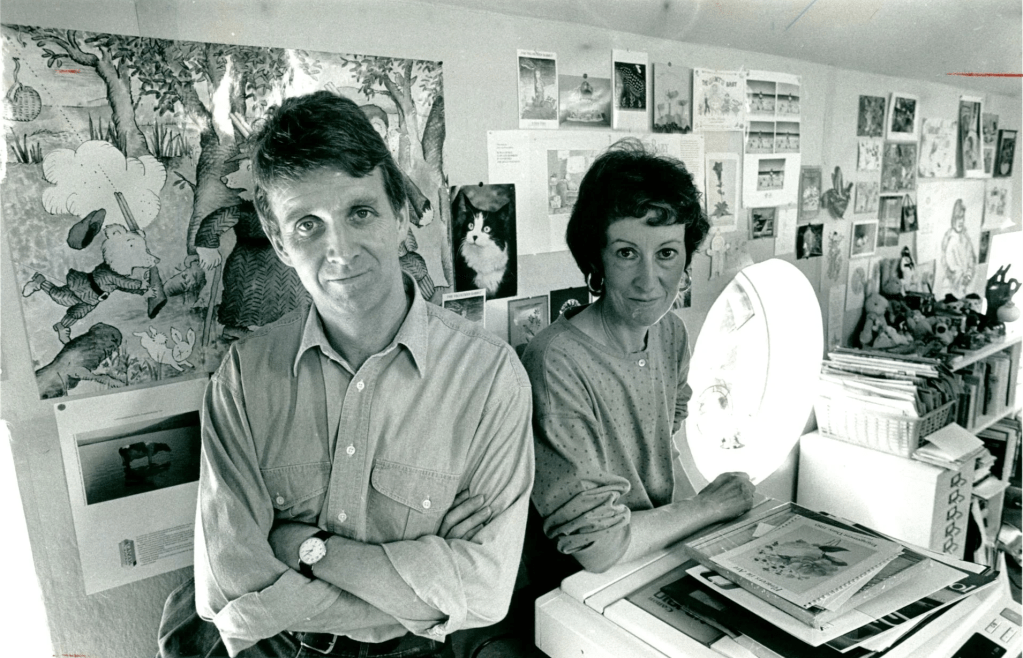
It’s impossible, of course, to write about Allan Ahlberg without reference to his greatest collaborator: first wife, Janet, who died in 1994. I’m not entirely sure Janet wasn’t, somehow, also Mother Goose, discussing those beats and measures and showing how they would look on the page, alive with tiny yet weighty details– before flying lightly off on her goose.
Of course this all just goes to show why one should never speculate too much about an author based on their books. Janet and Allan Ahlberg were real people with lives and loves and troubles and professions I’m only just learning about by reading obituaries (“He once worked as a gravedigger?” I think incredulously. “That might explain Funnybones, but then was he also a captain in the Napoleonic wars? Oh, doesn’t seem to have been. Maybe The Baby in the Hat was fiction, then.”), but these reactions also show what the greatness of someone’s work in life can leave behind them. In this case, a sense of the myth and motion of story as rhythm and rhyme, even through the pragmatic drudgery of our efficient days. Like the Jolly Postman, we take our time through his books: we pause, we laugh, we bounce, we have a cup of tea, we dream from page to page so that a page with ten words on it may take you a cuddle time to read, and who cares how long that is by the clock?
To Janet and Allan Ahlberg, small details mattered intensely: a mirror with a rainbow rim, such a captivating moment. And it’s those moments that catch a tiny finger pointing, with a bigger one beside it, on the page.
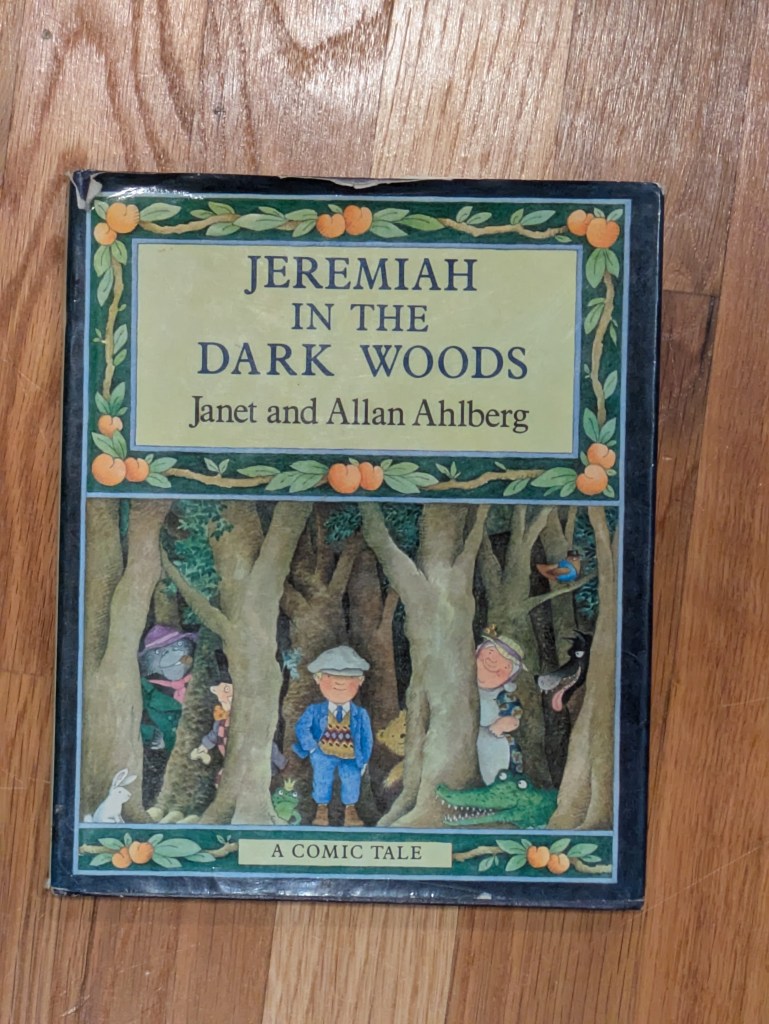
And so– Ho Ho for the Ahlbergs! Thank you for the storytimes. You’ve been, and will continue to be, great company. Tonight, I’ll be reading this.
This book pulls on me. I have no idea how to write about it, but it pulls on me so I can’t not.
I don’t think there’s really much that anyone needs from me for this book other than to let you know that it exists and you should get it and read it, either yourself or with any child you can find.
But it won’t let me go, so I can’t help but try to say more. I’m going to do an awful job, I am not Brian Floca and I am not Sydney Smith, but here goes. Island Storm by Brian Floca and Sydney Smith reads in my mind like a scene from my very own childhood, only more so.
I can’t imagine a more beautiful book, and if there is anything I’m angry about in this world, it’s that this book isn’t eligible for the Caldecott. This book is, in every respect, a clear example of the kind of quality we need more of, and, not to put too fine a point on it, I want THIS on my wall. (Dear Sydney, please send me the original, and I’ll get it framed. Thank you. Or– really any page.)
I’ve quite often talked, recently, about how really good picture books have a core element of truth and that this fundamental honesty (whether it be the goblins Ida pursues Outside Over There to get her baby sister back or the blueberries in Sal’s bucket) come across most clearly when the picture book creator is coming from a place of specificity. I’ve seen an increasing amount of talk, recently, about universal appeal in art, and I passionately advocate for seeing the universal appeal in art. But it is almost always found* through the faithful rendering of something deeply specific.
In this case, we experience a storm on what I’m absolutely certain is an island in the Atlantic, definitely somewhere around Canada’s Maritime provinces, and I know this because it feels viscerally familiar. I’ve been there, I have walked that storm, I’ve gotten totally drenched in it and been a bit scared in that high wind. I’ve also had parents deeply pissed off at me for going out in it, actually.
Interestingly, all of that feels like it comes to me through Sydney Smith’s art, and that is one of the thrillingly interesting things about a picture book: each book is collaborative, even if it doesn’t feel like it. Even when conceived and executed by an author-illustrator, they are collaborations between the art and text. (To say nothing of the role of the editor and all the others in a good publishing house.) The ideal picture book appears, in the hand, to be a single and unified object, which it is, but it must be synthesized from various sources working together.
I think, and I’m sure that you think, of Brian Floca as an illustrator. In this case, he is the author and the book’s art is entrusted to Sydney Smith. I find that simple fact, in itself, fascinating, particularly because Brian Floca isn’t from my childhood region and Sydney Smith is from right next door to where I grew up in the Canadian Maritimes, so to my mind this collaboration was done precisely so I’d have a book just for me. Logically speaking, this may not actually be the case. Intuitively, it totally is.
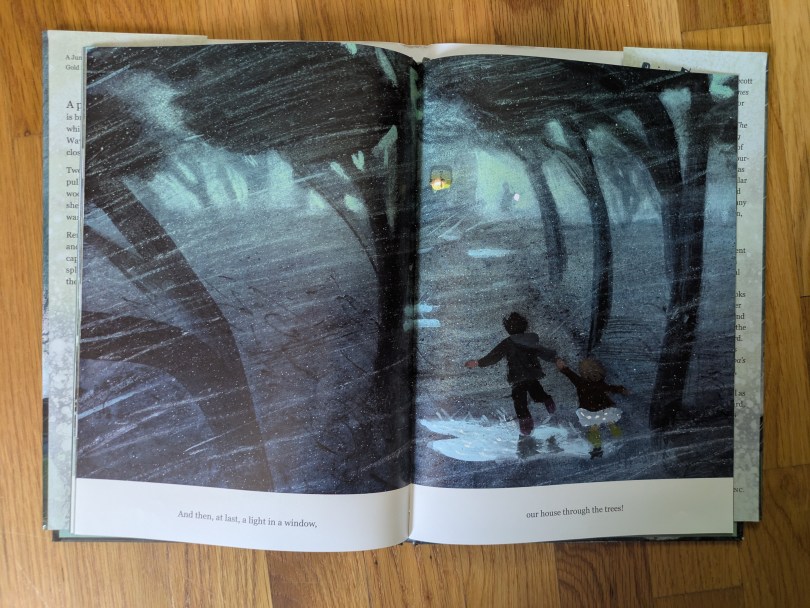
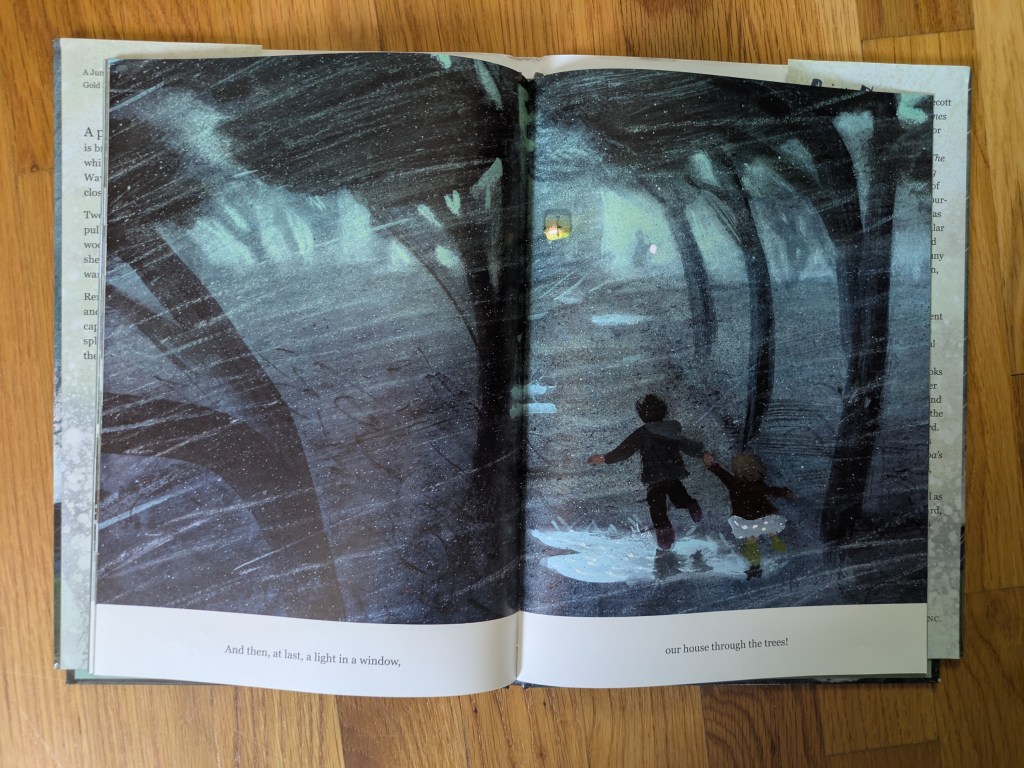
The text is simple and pared but calmly confident in its evolution: “Now take my hand,” it opens, “and we’ll go see the sea before the storm.” Quietly, we enter the children’s eyes and walk with them, feeling their feet on the gravel road and their anticipation of the storm as the wind rises and the ocean booms, and the urge to try for just a bit longer, just a bit more, as the wildness of the weather nears and grows. “You pull on me, I pull on you.” The weather, too, might be addressed here, and the scenery, and the wildness and the sea and the driving wind and rain. I know this, because I’ve been in a storm– so, too, has Brian Floca, and so, too, has Sydney Smith. I know this from the text and from the art, but, as I said, the art is so visually arresting a force for me– I’ve seen this place, I lived there– that in reading it to a child I find myself expecting to turn the page and come out on the street.
And yet, look at that art. It is not in the least photorealistic. It feels hasty and hazy. We see through the children’s eyes but don’t see their eyes. The rain on the window: “How does he do that?” my beloved librarian friend asked when I showed her the book, pointing at this page. “Is this book eligible for a Caldecott?” she added. I know exactly how she felt, and I felt the same, but also I was remembering rain on windows like that. The lowering skies, the crashing storm, the driving rain– we don’t get rain like that here. You don’t know the meaning of “driving rain” until you’ve been out in it.
But, surely, this is almost too specific, too area-specific, too situational to be universal? Well, the funny thing is that when this book showed up, I really, really needed to read it aloud to a kid and my Spriggan was in daycare and my daughter was out with her friend, but, fortunately, the friend’s little brother was quietly playing in my living room. (NB: I love being the safe house for kids to show up in. I don’t always know who will be here, mind you, but I love these kids and it’s nice to see them happy here.) So I apologetically asked if I could please pull him from his game to read a story to him. He kindly agreed and curled up on the couch beside me and I read it to him. He was quietly absorbed until we came to the crash of thunder and pouring rain, when he got visibly excited: “That was like last night! We had thunder!” And I realized– this child has English as his second language and moved here only a couple of years ago from far inland in China. He had never seen a storm like this, and this scene was as strange to him as the plains of Mongolia would be to me.
Consider Stravinsky’s The Rite of Spring. As originally conceived, musically and visually, it was a decidedly specific story, scene, and idea. The collaboration between Stravinsky, Nijinsky, and Roerich created a unified piece on stage– a picture book in dance, in a way. It is a difficult, demanding, and beautiful piece, utterly alien to every single observer, which continues to be terrifyingly accessible, catapulting the viewer into the scene onstage only to emerge wondering what just happened. And when I once watched a totally rechoreographed version which was introduced as being “more universal,” in minimalist black and white, it left me completely cold; the music was still good, the dancing was good. But by trying to be open to everyone, it spoke to no one.
This scene, a storm on an island in the Atlantic, was as familiar to me as my own pulse. To the child I first read it with, it was new and exciting. But it pulled on us both, differently, but oh so beautifully.
And so I tell you: this book is out now, and you should get it and read it, either yourself or with any child you can find.
And see if you can find every shade of blue on its pages. They are, I think, as numberless as the waves.
* I say “almost always found” because I resist absolutes. But I can’t think of an example of the vaguely universal in a picture book which has appealed to me as a universal more than something specific. In fact, one of the most compelling single images in my mind is Joan Aiken’s description of a slice of bread being toasted. That’s it.



 The Children's Bookroom