
Both of my children found cats in a toy store. They looked to me like stuffed animals on a shelf, but my children, each of them as they were emerging from babyhood to toddlerhood, set eyes on a cat (think of Lisa finding Corduroy the bear) and recognized that cat as theirs. My daughter’s became Remy, I’m not sure how that name happened but happen it did, and Remy is no longer toted about everywhere but retains a position of respect and prestige in the toy box of my 11-year-old girl. The little one’s cat is Mrrow and has always been Mrrow and Mrrow is Mrrow and has not gotten another name. Mrrow has been to the hospital a few times and is a figure of real importance and comfort, to the point that I got another one just the same and kept the package, doubtful that it would be sufficient replacement but feeling it was imperative nevertheless– if only for me.
And then it happened. I couldn’t find Mrrow. I didn’t say anything but looked everywhere. And then the worst happened. My little 4-year-old boy with a passion for ballet, deep affection for Mrrow, and not so great lungs at the moment, had an asthmatic episode necessitating a trip to ER and Mrrow, who had been there for every other occasion, wasn’t there. I gulped, pulled out the backup cat, and off we went. My Spriggan was very respectful and nice about the new cat, and I was honest that I couldn’t find his original Mrrow but “this is what Mrrow was like when she was new,” and “I didn’t want you to have to go to the hospital without any Mrrow.” She was not Mrrow and we both knew it. But he’s a sweetie who reserves his tantrums for critical things like there being no molasses in the house when he wants to make gingerbread men, and he held the cat and said her name was “Hilda, like Hilda Hippo in Busytown,” and was very patient. I felt awful but there wasn’t anything I could do, so I didn’t have a tantrum, either.

Exactly one week later, my big, beautiful girl was taking my small, beautiful boy to the park. And they came rushing back, my daughter shrieking, “GUESS WHO I FOUND!” She explained all in a tumble that she thought she saw a dead squirrel in the dog park and went to check if maybe it was just injured and could she do anything, and it wasn’t a dead squirrel, it was Mrrow! You should thank your lucky stars that this was on Shabbat so I didn’t take a picture; it would not have been beautiful.
Filthy, saturated with spring rains and mud, probably mouthed by a dog or ten, but they were good doggies and didn’t tear her, I plopped her in the bath and ran in water and soap for a spa treatment. (To any Orthodox Jew reading this: do not take the above as halachic advice. I ran a mental calculation of “checking with the rabbi” vs “I have a small, emotional child here” and put cold water and soap in the tub with Mrrow and did not consult any rabbinic authority beyond, “this will have to do.” Hot water, scrubbing, and more came after Shabbat.)
Direct quote: “When I found Mrrow, he burst into tears. He told her he loved her and missed her and he was very, very sorry.” And he checked on her throughout Shabbat, talking to her and making sure she was getting on ok. The after-Shabbat scrub with hot water and soap was arduous but transformative. I wrapped her in towels and pressed out the water, telling him I’d put her to dry on a laundry rack overnight. He nodded politely, took a clean, dry towel, wrapped her up, and took her to bed with him. I didn’t stop him.
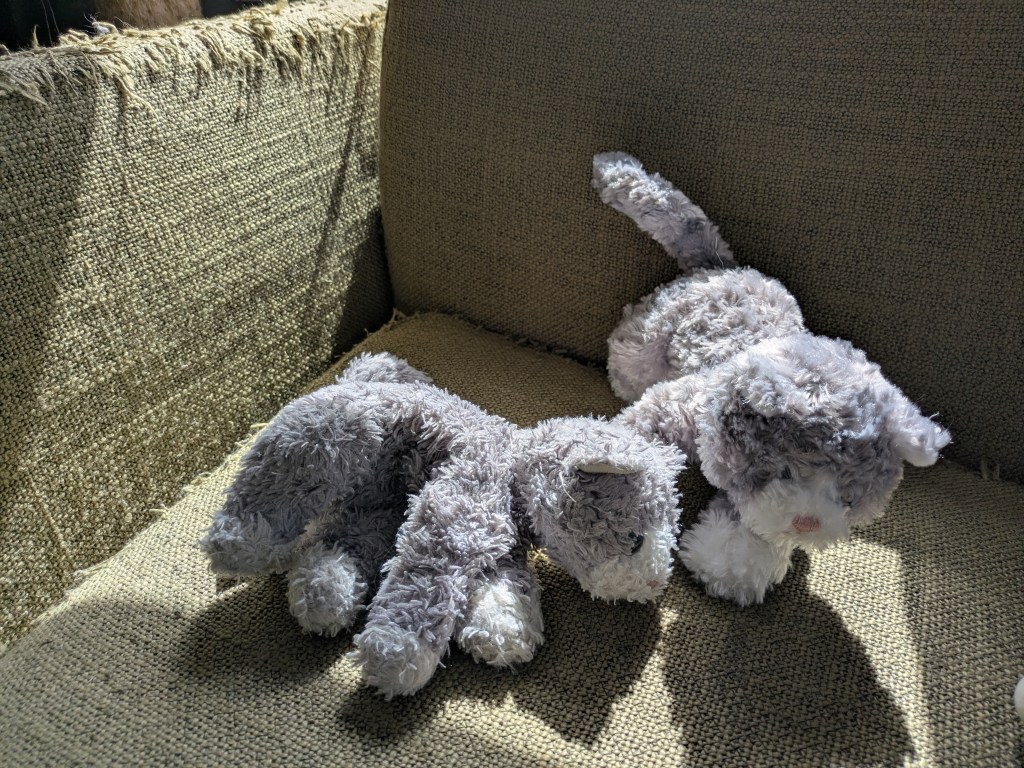
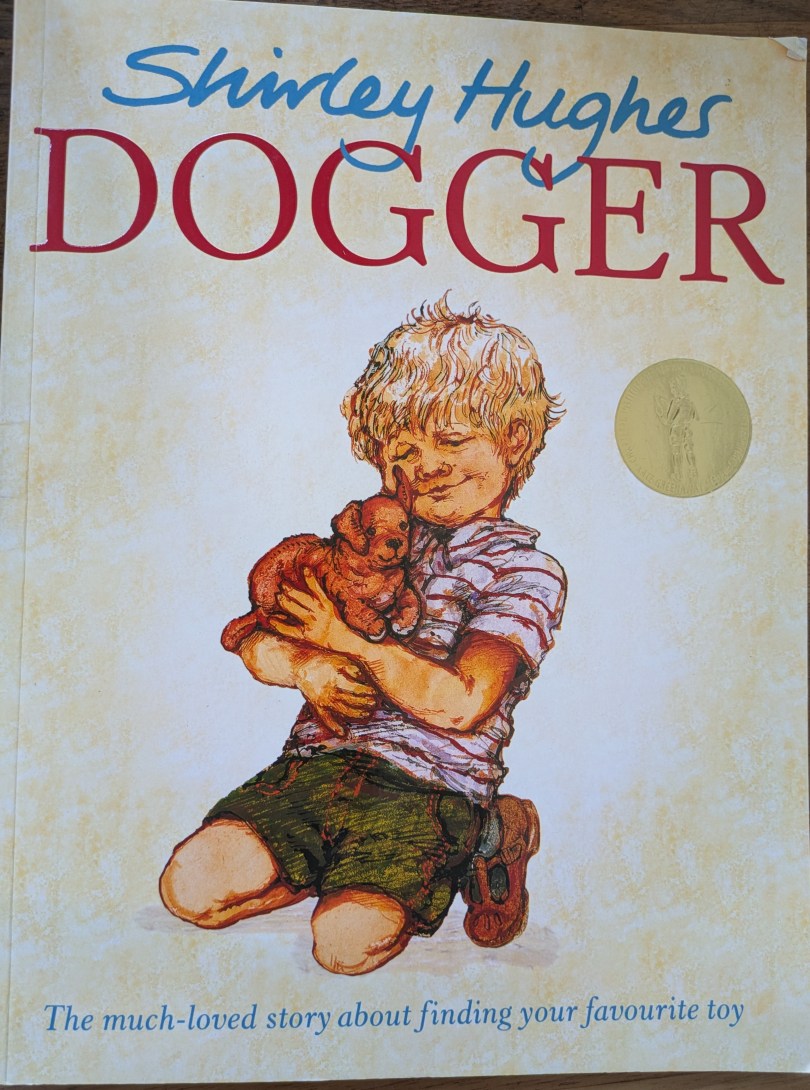
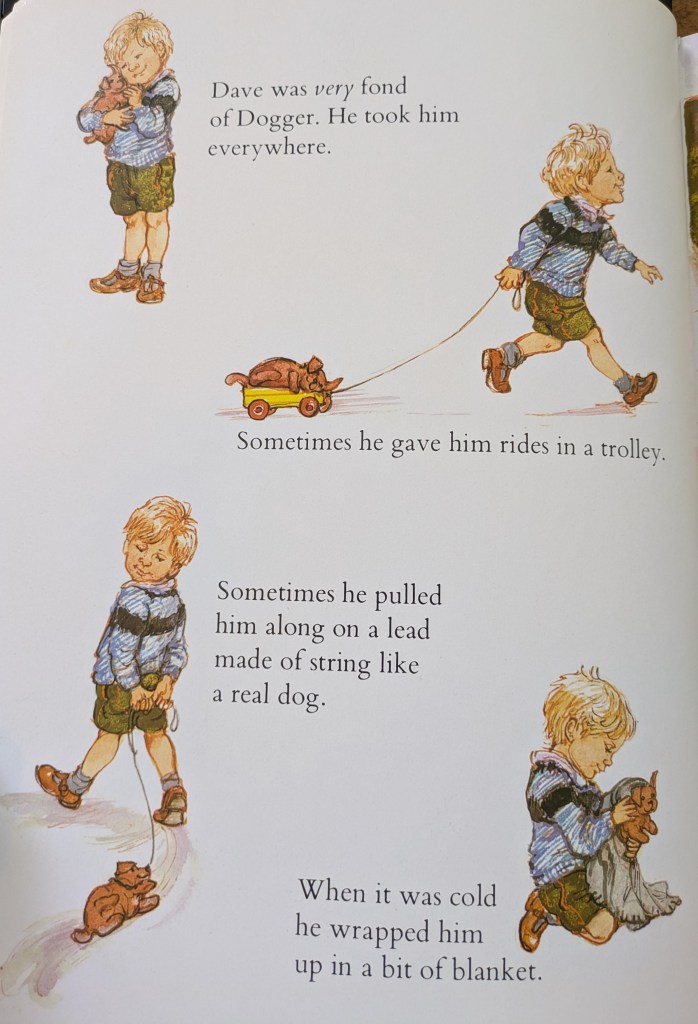
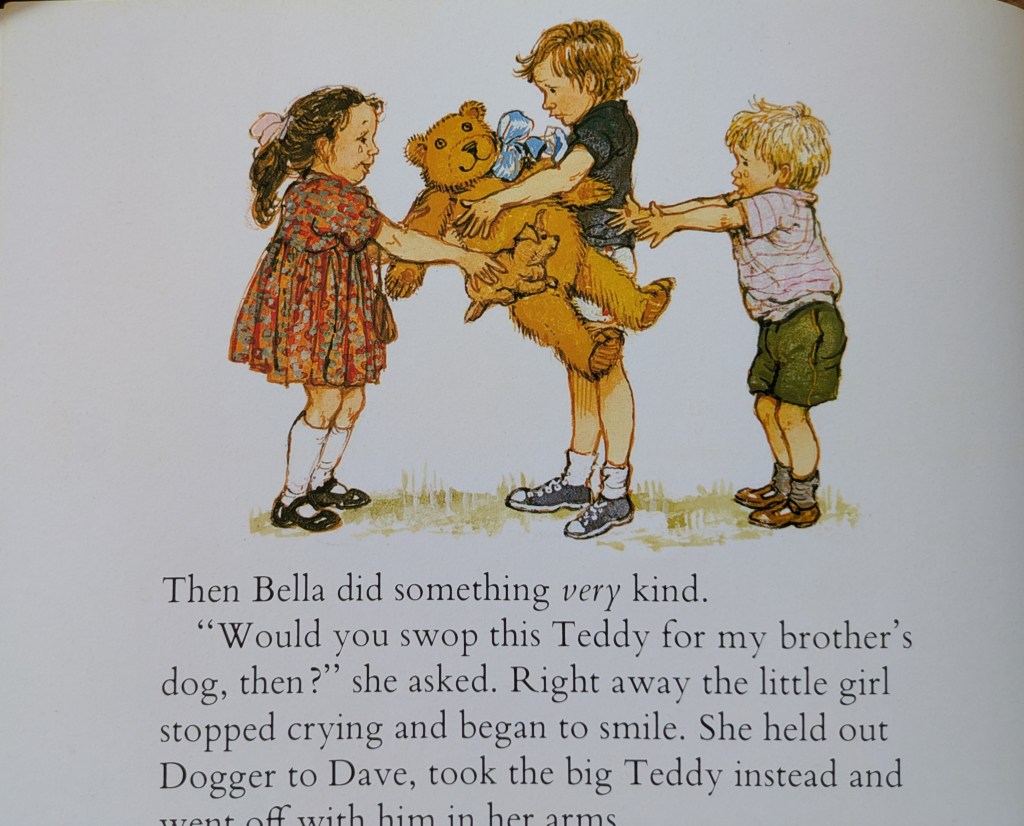
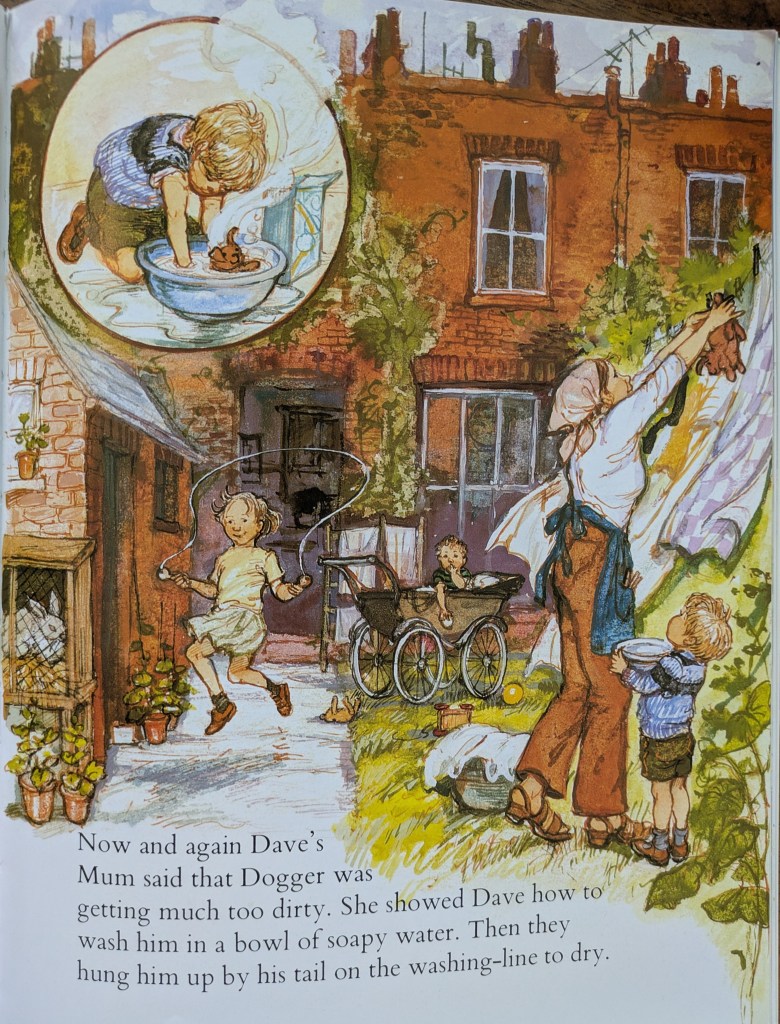
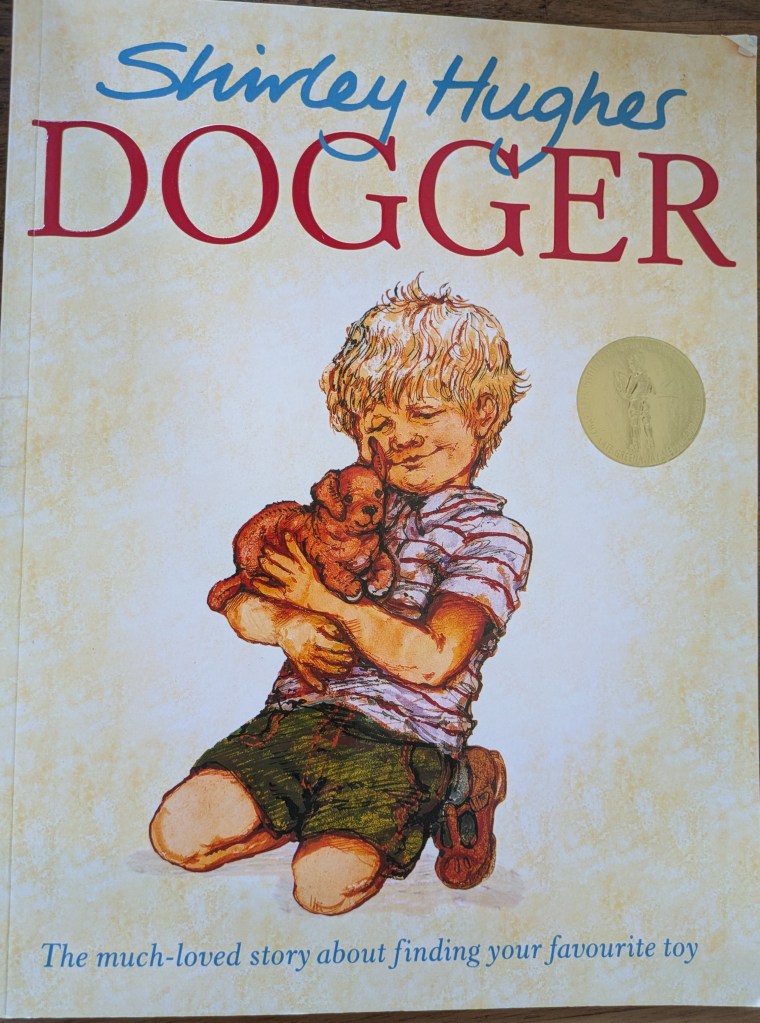
I think you can tell which one is Mrrow and which is Hilda. (Hint: Hilda is clean, fluffy, and sweet. Mrrow is, at least, clean.) But I’ve taken you through this not because of my kids or Mrrow. I walked through this story because I have a new respect for a few points about literature. All the above pictures (except the photo of the stuffed cats, of course) are from Dogger by Shirley Hughes. (I can’t find a purchase link to it in the USA, so if you’re in the US, you may have to get it either secondhand or from the UK. I bet it’s easier to find in Canada, though. No matter how you get it, it’s more than worth the price.)
I’ve noticed a trend, articulated also by Mac Barnett and Jon Klassen in a few places, of adult readers of picture books expressing anxiety that children will see what they read as prescriptive: “You, child reader, ought to behave like this.” Or they fear that children will imitate what they read: “If children read this book, they may drink juice instead of milk and water!” I think, too, that creators respond, consciously or not, by writing books that provide curative scenarios: “When you lose a beloved toy, you will feel sad, and that’s ok! You can feel sad! And also things will turn out just fine…”
Living through a real-life Dogger and Dave scenario, I didn’t even think of Dogger until after my daughter came running in with Mrrow. I was so immersed in the moment that I didn’t register it as being so perfectly in parallel, right down to the tiny blond boy and darker-haired big sister. But then I emerged with a jolt and realized that Shirley Hughes wrote this story down a while ago, didn’t she? And the astonishing thing is that it’s exactly a reassuring story, not because it’s curative, not because it tells you how to handle things, what you should do, what will happen, not even because it validates your feelings, but because it’s so damned real.
I absolutely hate realist fiction, by the way, especially for adults. It’s inevitably depressing and boring at the same time. You always know what will happen because the ending is never happy because happy endings aren’t real, you see? Realist fiction for kids is simply boring and half the time I hope it ends unhappily just for a change of pace. Realist fiction for adults ends unhappily because adults know that unhappy endings are the only real ones. Realist fiction for children ends happily because adults are writing it and are squeamish.
Children are sensible and knowledgeable based on experience, so when real kids’ books tell a real story, fairy tale or not, it simply feels true in your bones. Strega Nona blows three kisses to the pasta pot. The bear eats the rabbit and gets his hat back. Dave finds Dogger and Bella helps even the balance of toy distribution– and reunites the true friends. These are simply real events because they feel concrete and true rather than cutesy (in banal picture books) or dank and gritty (in banal adult literature).
We have a lot to learn from real books, and we have a lot to learn from kids.
Dave and my little Spriggan didn’t cry about the loss of Dogger or Mrrow. They were quiet and even quieter. But when Dogger and Mrrow were found, then they cried. This is simply human; Odysseus does the same on returning to Ithaca. (He also cries earlier in The Odyssey, but usually when his companions are killed. He cries a lot; he’s human.) The outpouring of emotion is on resolution. The prelude is sadness or anxiety. But the accuracy is the point, and the click of recognition is pure.
Prince Siegfried in Swan Lake can be fooled, in his immaturity, into accepting the decked out Odile for Odette. When he recognizes the inner being, the truth of Odette, it’s too late to save her. They die together, though, ultimately saving her friends and vanquishing von Rothbart. Dave and my little one are so sensitively attuned that only Dogger and Mrrow are recognizable as real to them. And that’s how they had their happy endings.
 The Children's Bookroom