Where Are You, Brontë?

When Tomie dePaola died, he left behind a world of loss.

When Tomie dePaola’s dog, Brontë, died, Brontë left behind a grieving Tomie.

And, so, when Tomie died, he also left behind a manuscript, spare and simple, about loss–but also about memories.

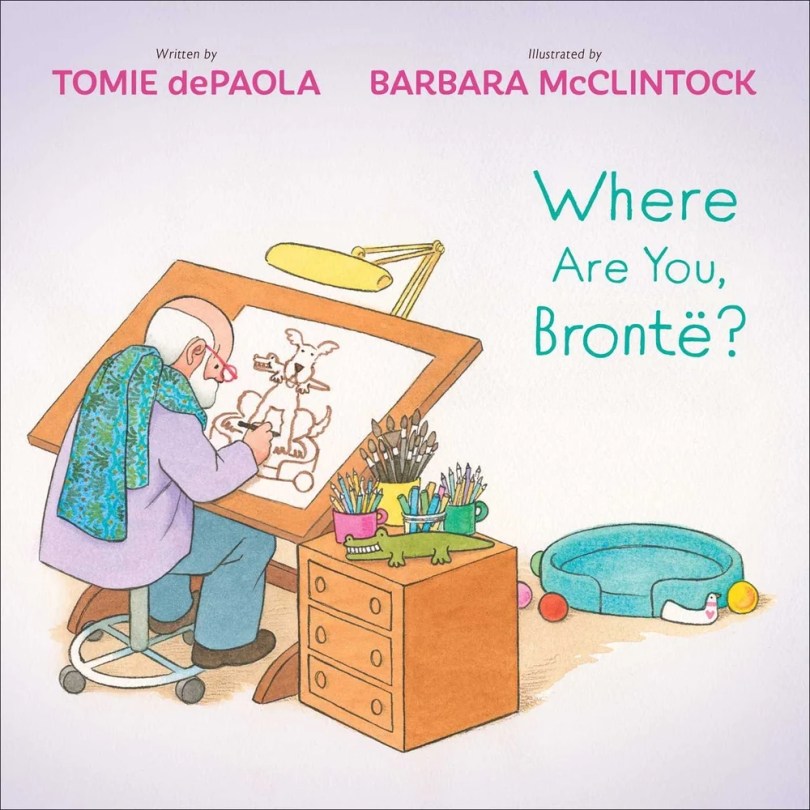
That manuscript was sent to Barbara McClintock, one of the finest artists of our days, to be illustrated and released posthumously: Where Are You, Brontë? by Tomie dePaola and Barbara McClintock (pre-order at that link and you can get a copy signed by Barbara). Given that it deals with Tomie’s death and bereavement, losing his beloved dog, the manuscript naturally carries a lot of extra feeling in our own bereavement– the loss of a beloved author, illustrator, and human being. (Frankly, I’m struck with a panoply of feelings that have nothing to do with the beautiful outcome: I’m relieved here. The book had the potential to be turned into a soppy, tear-jerky mess of fluff that would probably have made Tomie dePaola gag. In Barbara’s hands, we are safe: we have every nuance of honest sentiment and no false sentimentality.)

Loss is a funny beast. It feels physical, like a real yank of something integral away from you. No matter how intact your body may be, it feels less. A family friend recently died, and with it came a wash of memories: some about other friends lost, others about visits with my friend and his family, others about times that may have been technically unrelated but felt emotionally linked. I found myself making crème caramel for a reason that was not exactly related, as such, but kind of was. Anyway, it resulted in crème caramel, so it’s not like I’m going to complain about that. Memories go with loss. Jews sit shiva after a death, a seven day period of gathering around the bereaved and listening and sharing stories. Many cultures and faiths have memorials, funerals, and other customs involving sharing memories and stories– consider vigils and wakes, for example.

These memories feel tangible. They are an evocation of a person’s presence. It’s almost like the gap of physical loss is filled, something like a phantom limb in our spirits, until our minds are reconciled to the absence.

On every page of Where Are You, Brontë?, Tomie dePaola is present, and usually Brontë is, too. The book is incredibly simple. The repeated question, “Where are you, Brontë?” is asked, section by section, with a few lines of text building up to an overall answer. The early spreads show Brontë’s arrival, and how he settles in, sleeping with Tomie, playing with toys but never destroying them, and working his way into Tomie’s books. As time goes on, Brontë becomes an adult, and then an old, blind dog, but maintains his joyful spirit until the end, when he has lived every day of his life and is now gone; and, of course, Tomie is sad. We see him looking at the dog bed with only a toy and no Brontë. The food and water bowls, empty, with no Brontë. Having breakfast at the kitchen table, and no Brontë around, only an empty collar. Those two spreads are the only ones with no Brontë, but they sting, keenly. There’s a page turn, then, and we see Tomie on a solo walk, his face lighting up as he sees a rainbow and his eyes catch Brontë in the clouds, and all those memories from all the way through the book flood back to the reader’s mind (or at least they did to my mind) in that moment: “But then I knew you were right here.” Another page turn: Tomie draws beautiful Brontë, whose memory endures. As, of course, each adult and aware reader knows, Tomie’s memory endures in his own books, from the earliest to this one.

And that’s when the children’s librarian I showed my review copy to rushed out of her office with puffy eyes and said, “Oh my goodness this book needs to come with a YOU WILL CRY warning!” (Sorry!!! I really thought you knew the backstory of this book, or I would have warned you!)

Now, here’s the hard part: Barbara’s job wasn’t to reflect that rich layering of death, memory, and endurance, of both the dog and Tomie himself. It was to illustrate a very, very simply written book for children left by an author whose style was well known to be deceptively simple. The effect of how she did this was layered, rich, and covered a gamut from the beautifully simple picture book all the way to provoking tears in children’s book lovers in their library offices. But the actual, real task was to do a good job of illustrating a simple manuscript, and that must have been absolutely agonizingly difficult. And Barbara aced it.

I can tell you how I know she aced it. I read the book to my very convenient 4-year-old on hand, my Spriggan, and he loved the book (and kindly comforted his sniffly mother at the end). He wasn’t in the least distraught because it was such a nice book! We enjoyed it together very much, as every book to be read aloud should be enjoyed, of course. That is the goal, for the adult and child reader to enjoy the book together, but each in their own ways. In this case, that job was a really tall order because of the demands presented: a) illustrate a simple book with simple art, b) for a child, and the child will only have the context of the book itself, c) for the adult reader, who will have a lot more context about the author, and expectations to go with it.

You see, Tomie dePaola’s illustration style was described as folksy and simple. What that means, from everything I’ve read, and I recall a particularly colourful anecdote from Trina Schart Hyman describing an attempt she once made and certain colourful language she deployed along with crumpled pieces of paper being tossed around, is that it’s torturously difficult to replicate. When I close my eyes and call to mind Barbara McClintock’s art, I always see delicate flowing lines (think of another “where” book she illustrated, Adèle & Simon) that are more closely akin to Trina Schart Hyman’s than to the simple, broad lines of Tomie’s Strega Nona.

Simon’s drawing of a cat is very good. I think Brontë would like it, and Tomie would, too.

So, choosing Barbara with her lovely lines and keen eye for children for this job was absolutely genius. She would take the job seriously, reverently, even. Her respect for Tomie dePaola is total, and that means that her respect for the picture book (also demonstrated over a long career of brilliant books) is also total. She would have her own expectations, but ignore the expectations of adult readers when they competed with the all-important child; by doing so, she would take that manuscript and make a beautiful book. And so her art brings the words to the book to life not as Tomie dePaola would have done it, but as Tomie as a character in his own book of life, illustrated by Barbara McClintock. Barbara as illustrator and artist, who loves picture books by people like Tomie, knows when art is active and when art is illustrative. She imbibes elements of his style in grateful and graceful homage, but does it in her own way, with the breath of life only an artist doing her own work can do. There’s a little mouse I’ll let you find who appears in her wispy fine lines, simple but perfect, popping up in the broad folksy grasses, evoking a curious Barbara exploring a world of Tomie’s making. I can tell, on every page, that she worked with love, awe, and enjoyment.

And I read it, snuggled in bed with my own tiny boy, and we read it with love, awe, and enormous enjoyment– and, in my case, with damp eyes and a sniffly nose. I got patted on the head and given a hug and a kiss. It was fine– better than fine. I hope you’ll enjoy it, too.

It’s a bit like falling into a picture book world, thinking about all we’ve gained from all of these creators over all of these decades.
Here Is a Book

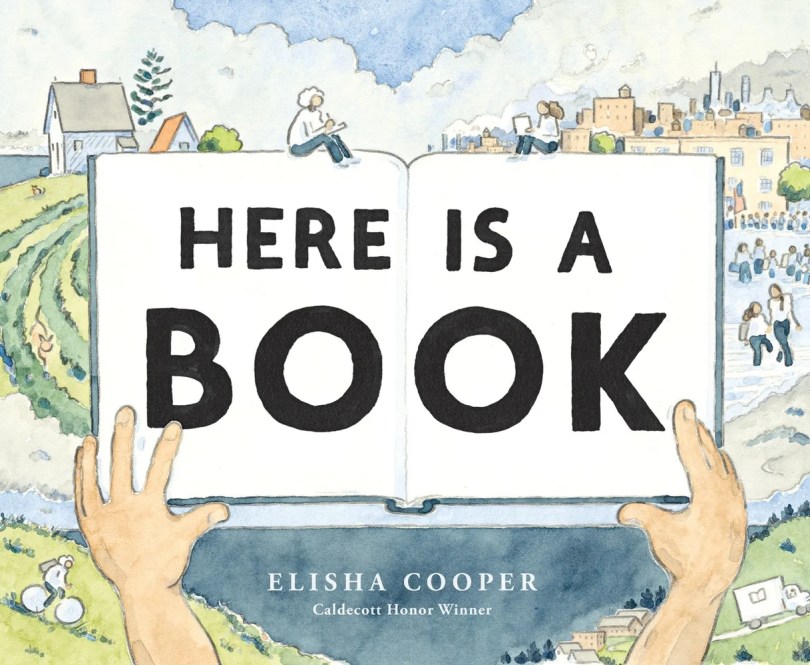
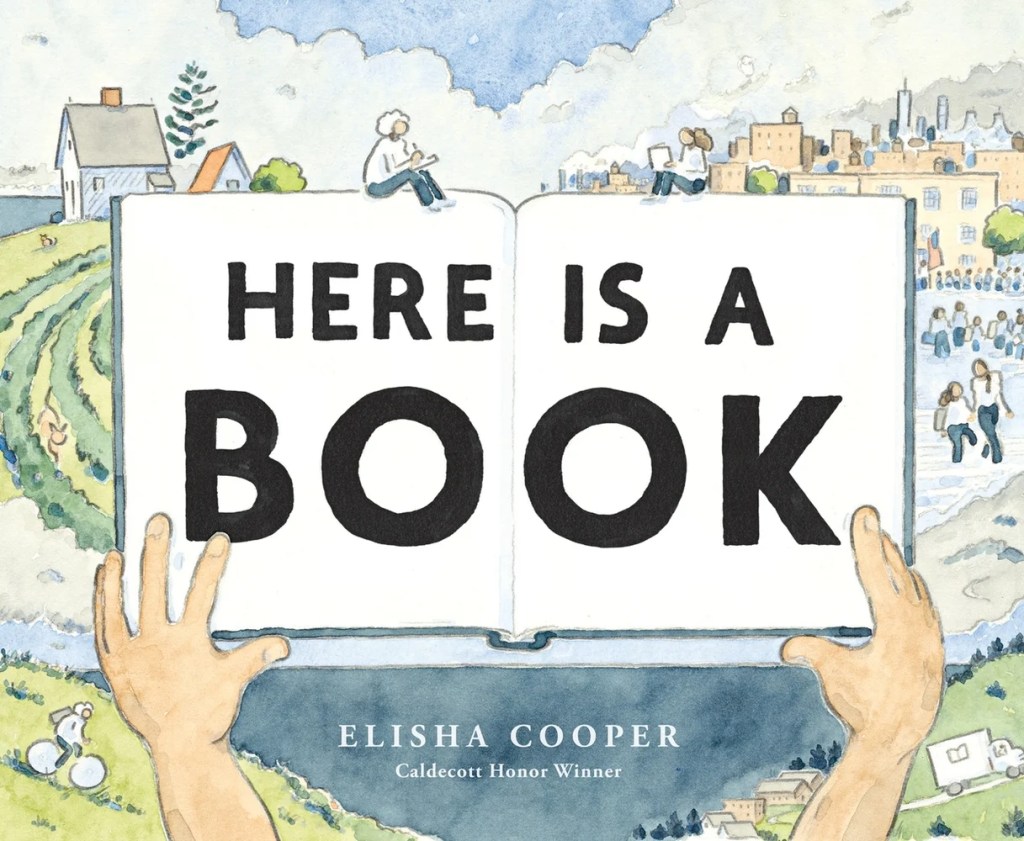
There is a grand total of one thing that I don’t like about this book, which is that styling the title in writing is a little irritating. Here Is a Book is what makes most sense, but then you have two tiny words beside each other “is” and “a” and one is capitalized but the other isn’t. But “is” can’t be left lowercase because it’s a verb, which just doesn’t sit well. Naturally, Elisha Cooper can gleefully duck this by elegantly clean typographic layout in all caps. Book designers, editors, art directors, authors– they have all the options. The reviewer is stuck thinking, “Are you doing this to us on purpose, Elisha?” (NB: This isn’t just Elisha Cooper. I adore Jan M. Ziolkowski’s clean and thoughtful book, Fairy Tales from Before Fairy Tales. But why is “from” lowercase but “before” capitalized? Why?) Elisha Cooper is a tease. Like, say, when I was at the book event for Sergio Ruzzier’s elegant beauty of a book, Bianca and the Butterfly, all hopped up on book fumes, and Elisha whipped an early author copy out of his bag, showed me, and wouldn’t let me so much as touch it. Kindly observe this cover which he showed me and didn’t let me touch.

But it’s ok, I don’t hold a grudge.

Not for longer than a century, anyway.

What, exactly, is a book? And how do you make one? What does it hold? How do you end up with a title and how do you format or style it?

Books about books and book-making aren’t a new idea, and they are, as is typical, extremely variable in quality, to be polite. I’ve written about some which are good or brilliant. I’ll let you search, if you want to, but I looked up some of my old reviews and wrinkled my nose at my prose, so you’ve been warned. I still think the best of them is This Is Not a Picture Book! (NB: Styled as such in most databases, though it is now sadly out of print, but the cover cleverly formats it in the French style: This is not a picture book! just like a normal sentence. The Brits do that, too. It is by far the best way.)

This is not a picture book! (going against the herd there) channels the feeling of vulnerability or anxiety about facing a new and potentially dangerous type of book and turning that into cautious exploration of uncharted territory, exciting and unexpectedly beautiful. Children have that as they gain literacy skills, learn to parse words, or find themselves navigating a page without pictures. I get that feeling as I open a book in a language I haven’t yet mastered– right now, Italian. The feeling Sergio puts on the page is visceral and, even as I choose to get that hard book, I still feel the duckling’s anxiety and rage as I face a page that, somehow, inexplicably, doesn’t make immediate sense to me. (Note to self: It doesn’t make sense to you because you haven’t yet learned to read it with full confidence. That takes time. It’s exactly that simple.)

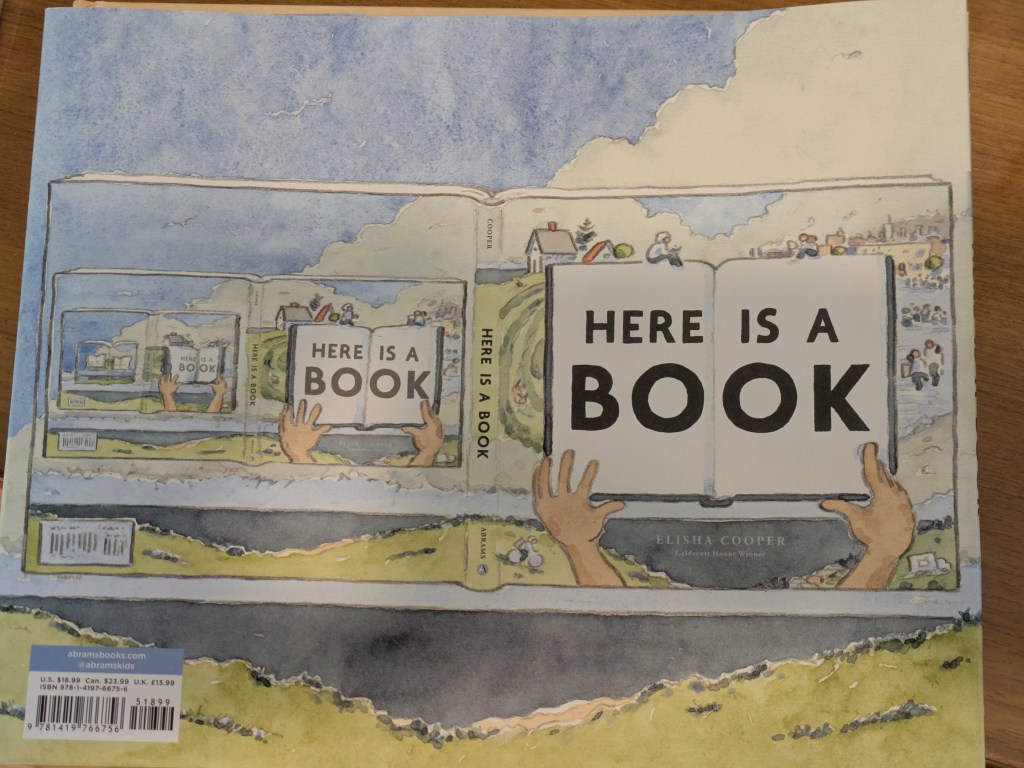
Elisha Cooper’s new book, Here is a book (hee hee), places itself with more detachment, but is, fascinatingly, a portal you fall into. Look at the cover: a book on a book. Look at the back cover, now.

With his usual brilliant humour, he shows on the back exactly how, though apparently we are getting a detached, bird’s-eye view of the book-making process, we will really be tumbling through the pages of the book, landing in the artist’s studio, meeting the editors, and, as we take the book from the library, emerging into our own chair, holding the book we made with the artist at the end. Only she is the one who made us, the readers, in a very real way. Or maybe not, I don’t know. Let’s look under the dust jacket and start again.

Isn’t it pretty? There are more languages on the back, but you can find those when you buy your own copy. Let me just show you one little thing. The eye searches for patterns, and we see a gradual fade from red on the right to blue on the left, except… it’s not quite so. So, if you’re me, you start tracking languages. Those are also mixed. Wait, green is — no, also pops up and out. Integrated, yet sorted. Rhythmic patterning, with mischievous pops of the unexpected. The very cover (on and under the jacket) is telling us what to expect. A serious, rhythmic book describing the book-making process, but unexpectedly humorous and immersive. [Publicist, take note: the preceding sentence is your pull quote.]

We, the readers, flip it open to see a beautiful landscape. The eye takes in a soaring sky and lovely house. We likely miss the quiet, solitary figure sketching. Until we flip to the title page, where we are suddenly looking at the sketchpad with the hands holding a pencil exactly where our hands would be if we were sketching. We are in the place of the sketcher. Page turn. We pull back, and see: “Here is an artist, looking.” The artist isn’t just looking, of course. She is sketching, and we see the sketches flowing up, to the left, drifting seamlessly behind and away. The effortlessness is part of the landscape of the book. It is the poetry of the text, the metre of the art. [That is the kind of thing I feel passionate about, write, but makes a bad pull quote for a publicist.] Page turn. Beat. “And look, here is the artist’s garden” and the stanzaic structure emerges: “made with sun, rain, dirt, shovels, seeds, and love.”

Paragraph break for me to point out: contrast the effort of the garden with the apparent effortlessness of those sketches drifting left and off the page. But the rhythm is smooth and almost whimsical on the tongue. A list of things you use to make a garden, that’s all.

Page turn, next stanza: “And here is…” You see, here, that the opening of what I’m insisting is a poetic structure was the line: “And look, here is the artist’s garden.” That began with an imperative: “look.” Our attention is commanded. We are outside, looking in. But then the structure quietly takes over with “here is” and we walk with the artist wherever she goes. We go into her house and see the cat and the bread and the family. The list of nouns on this page culminates in “warmth,” a lovely match to “love” in the garden. It was Daniel Donoghue who casually mentioned to me in grad school when we were reading Beowulf that good lists build to the last, important beat in poetry. This holds true here, and though Elisha softens the “BAM” of that beat to more of a “bop” by extending the list length, the repetition makes it very clear that those culminating words, stanza by stanza, spread by spread, are absolutely core. Soon enough we are in her studio, where the list is topped by “wonder.” Love, warmth, wonder. This must be a lovely place to live, and we slip happily into the armchair with the artist, and pat her cat.

The next stanzas are linked and color, rhythm, and teamwork take us to the completion of the book’s development until it goes to a printer where the list of elements that make the book culminate in “time.” The finished, printed books, which we haven’t seen because the artist showed us sketches but won’t let us touch them, are trucked over hills and valleys and we watch the tantalizing progress through layers of fog, forests, rocks, bears, and (bop) beauty. The truck is still going along, tantalizing us with its travels (which we remember started with an artist simply looking) across a country ribboned with rivers (have you read Elisha Cooper’s River?) and so much more including (bop) adventure, until we travel with that truck into a city soaring with a list including (bop) grit.

That was the one that really made me blink with delight, by the way. I hate grit. I hate it getting into my eyes when there’s wind. I hate gritty realism in literature. Why is realism always gritty? Can’t it be delicate and whimsical? A butterfly is as real as a rock! But as our nouns went from beauty and wonder and adventure to grit, I thought of the other meaning of “grit,” namely “courage.” If I hadn’t been reading aloud, I would have laughed, but as it is I grinned at my sleepy Spriggan, who laughed back to me as I turned the page. Those books were finally delivered to a school library and a student took her library books home, so, finally we are back in a home, back with a new friend and new eyes, not the artist, now, but with her reader. The reader’s home is built with bricks and mortar and structure and her kitchen is filled with vegetable soup and two cats and humor. Her room is overflowing paper and pencils and days and nights and wonder– again.

The last two spreads take us full circle in a closing stanza of such fabulous capaciousness yet impeccable specificity that I’m leaving it to you to discover everything except one particular point: all those culminating “bop” beats? They pull together, with all their nuances of definition (grit, wonder, structure) into the last list of all.

The book is quite as immersive as This is not a picture book! even with the apparent detachment of that bird’s-eye view, which deceptively tumbles into a portal, as though that bird swooped into a rabbit down the rabbit hole, leaving me exclaiming, “Curiouser and curiouser!” as I turn the pages again and again and again.

Elisha Cooper, you are a blasted genius. I liked the pandas on the artist’s studio wall.