

In November 2017, I wrote a not particularly good but, I recall, intensely felt post about The Wall by Peter Sís. I recall the fear and agitation of the time vividly, and, of course, not much has changed. Some things have, of course, but, ultimately, what I see and hear swirling around me is a kind of misery contest of who is the first under attack: “It always starts with–” fill in the blank with your pick of women, LGBT+ folks, racial minorities, the arts, the intellectuals, the judiciary, or what have you. Historically, it all does start somewhere and with something and someone, I’m absolutely certain, but depending on what “it” is and where you set the goalposts, that will always shift, and–
Truly, it doesn’t matter, because it has already started, and here we are. Trying to figure out when and where it started is, I submit with a marked lack of humility, futile. At this point, we simply need to stop hiding, stop obfuscating, and say: We are living under the shadow of a new fascism.
Instead of blindly running around trying to warn that this is leading somewhere bad, please consider that it already is very bad and that fracturing into splinters of arguments over who’s most under attack is absurd while there’s what Jeffrey Goldberg of The Atlantic called “a Mack-truck-size breach” of security regarding war plans being discussed on Signal. EOs against law firms are putting a damper on lawyers, and while everyone loves to joke about sleazy lawyers and quote Shakespeare out of context, please recall that lawyers with the Department of Justice were methodically, thoroughly, and competently investigating and prosecuting January 6 insurrectionists, a fair number of whom had histories of violent conduct. These lawyers, who were upholding our rule of law and shoring up the integrity of our democracy in the face of an angry government, were fired for the very nature of their work, and the insurrectionists were pardoned.
Thus: this is a growing wave of totalitarian conduct.
And here I am, back to The Wall. And thank God Peter Sís created this masterpiece.
I don’t know a single person who has not, to some degree or other, been affected by this rising totalitarianism. My entire home country of Canada, for example. But also: teachers under scrutiny, scientists facing lost funding, friends with jobs lost or going to bed wondering if they’ll have a job tomorrow, or the biography of the guy who constructed the Sunday crossword noting that he just lost his job as a management consultant for federal agencies in Washington, DC. The maelstrom of chaos is, of course, deliberate, but comes into focus when seen not as a first step but as an accomplished act: totalitarian regimes are not clearly organized, they are incompetent, and discuss war plans on Signal.
I had been thinking of The Wall often, since I see the entire world through a lens of art. Literature, visual art, music: this is how humans have always processed our experiences, of course. The picture book is an ideal medium because it is so limited that the great creator is forced to hone the experience to a synthesized visual and verbal package with the rhythm of a poem when read aloud. I don’t mean that it must be in verse; rather that page turns create the marks of beats and accents of a poem. An ideal picture book works with that rhythm and the constraints of the page and format to distill an experience into a felt experience.
In The Wall, Peter Sís distills growing up under oppression, finding a secret voice, hiding it, and with wave on wave of growing pushes towards liberty from the Soviet regime, finally coming to freedom.
I pulled it from the shelf while fears for Ukraine rose in me, intending to read it to myself or handing it to the Changeling to read with me. She’s 11, and feeling this political climate more keenly than I’d like, but I think every parent has that uneasiness. I did not expect the 4-year-old ballet-loving, twirling Spriggan to ask me to read it to him. I had just heard about the Kennedy Center takeover; on our frequently watched DVD of Swan Lake with the Spriggan’s adored Angel Corella as Prince Siegfried, the performance is on the stage of the Kennedy Center and it opens with a clip from the dedication of the Kennedy Center. My love of the performing arts has deep roots, and one of the joys of my nuclear family is that my husband and children and I all share this taste. So that was back of my mind as we read The Wall.
This is not a book for a 4-year-old, and while he found it interesting and said he liked the art, he very sensibly went to look for other books by the same author that were more at his level, which are thankfully easily available on our shelves. One of my deepest objections to education in schools today is the rush, rush, rush away from picture books, but this is a book for older children, older classes, and families and teachers. It is perfect and it is beautiful, but classrooms and education haven’t kept pace with Peter Sís’s genius and tell children to grow out of picture books by the time they can read to themselves. And yet Grade 7 and 8 should read this.
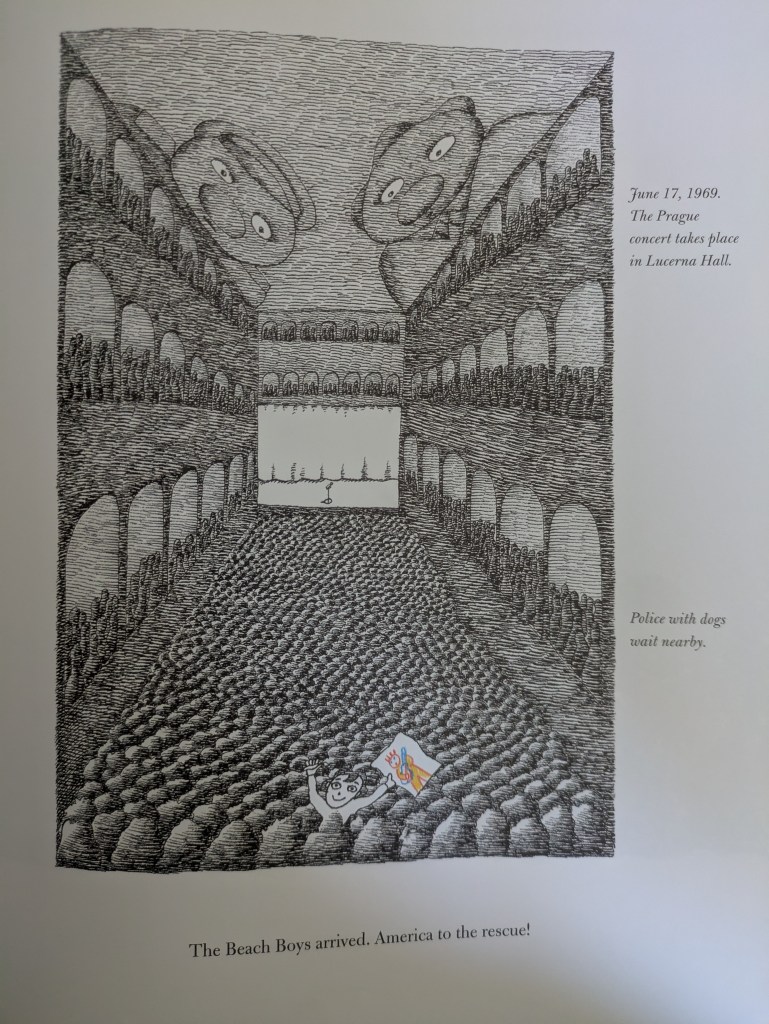
America to the rescue! I broke down a bit on that one.
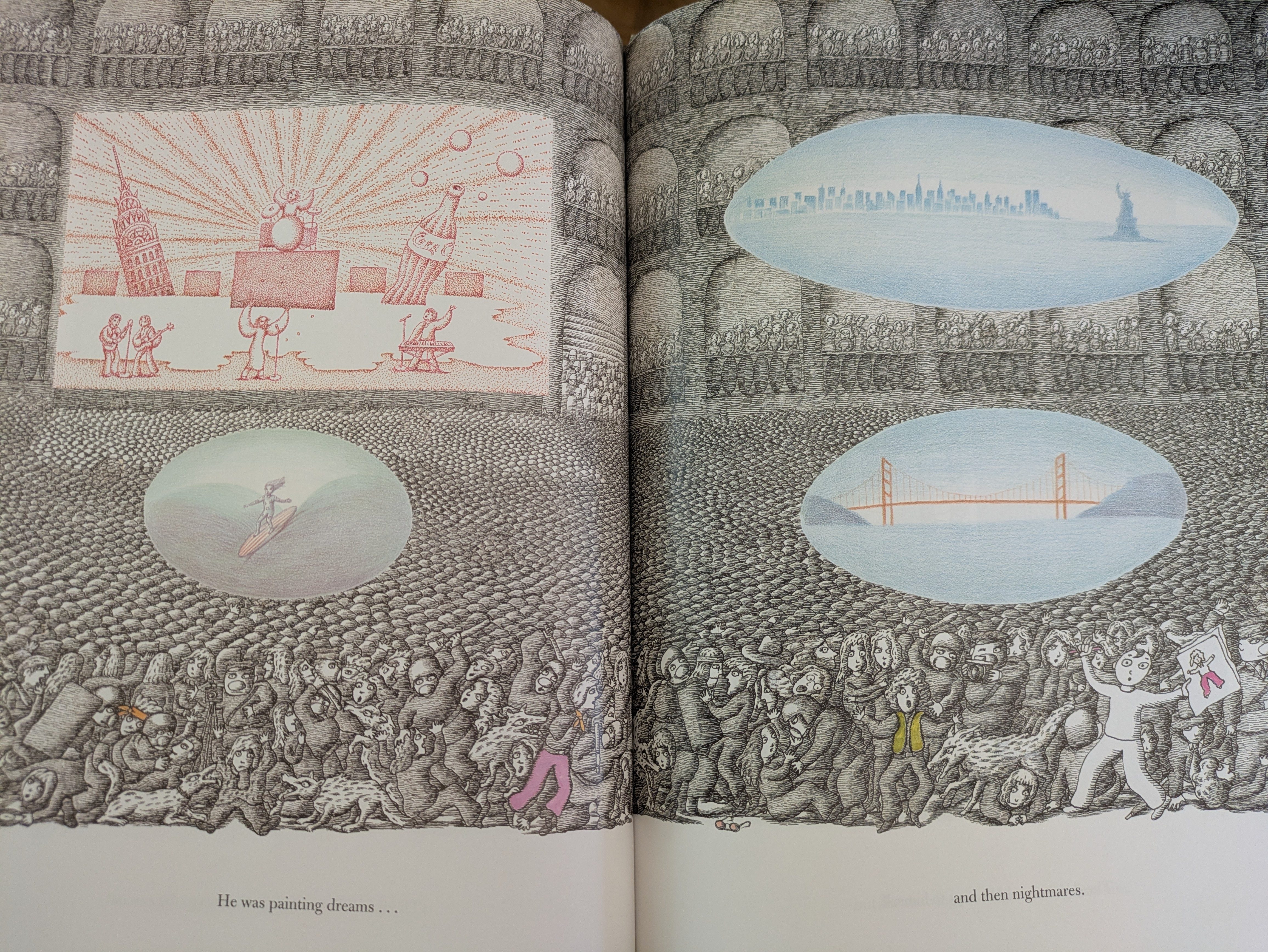
We are back to The Wall, and I can’t say what to do or how to function, but I would like to recommend: a) Cohesion rather than competition; b) Read good books, including this one; c) Don’t obscure reality. It doesn’t start with anyone; we are here.
Finally, some words from Jeffrey Goldberg when asked if he feared retaliation: “It’s not my role to care about the possibility of threats or retaliation. We just have to come to work and do our jobs to the best of our ability. Unfortunately, in our society today—we see this across corporate journalism and law firms and other industries—there’s too much preemptive obeying for my taste. All we can do is just go do our jobs.”
 The Children's Bookroom