
“I FOUND MY CALDECOTT PICK!” I shrieked on the way into my husband’s study and I think he was in a meeting but let’s pretend he wasn’t. I was excited.
I had been a bit apprehensive about Let’s Be Bees. I will confess: I was wrong.
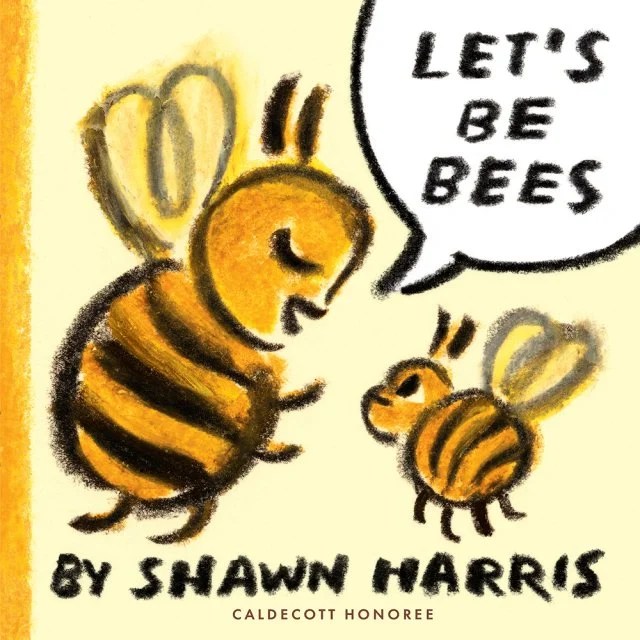
I adore Shawn Harris for his whimsically odd approach to picture books, for breaking with orthodoxy in a rather Ruth Krauss-esque way: in Have You Ever Seen a Flower?, the child shouts “HELLO” just to listen for an echo, and something about it reminds me of the jubilant page: “Yell, ‘Good morning, big fat world!'” in Roar Like a Dandelion.
And I keep somehow being nervous with Shawn Harris titles before I see them. I think it’s the presentation of simplicity that deceives me; will it be too empty? I cannot emphasize strongly enough that this is sheer stupidity, probably trauma induced from reading too many breathlessly inane titles about loving the whole world. Shawn managed to write the only book with a tiny pink unicorn that made me laugh and that doesn’t make me foam at the mouth and that I have even gotten as a gift for multiple children.
NB: I routinely lecture adults about the taxonomically incorrect unicorns in books and the media these days. Like, you know, hot pink unicorns. I pull out history books and demonstrate that these are not accurate based on documentary evidence. That Shawn could create a pink unicorn I grudgingly like is nothing short of gobsmacking, and I need to trust to the truth:
Shawn Harris can be trusted with simple books.
You see, not everyone is good enough to do simple well. Above, I compared him to Ruth Krauss, famous for, among others, A Hole Is to Dig. She did something simple and brilliant: she listened to kids. In reading her books, often illustrated by Maurice Sendak, who matched her in his acute and sensitive level of observation and respect for children, one has the sense of tumbling into the world delineated there. The logic is intensely obvious. It cannot be imitated, however, because Ruth Krauss is the one who did the work. She was the observer. Any imitation is going to be cute and coy and patronizing, and I will feel like feeding the offending book to an angry hippopotamus. For example.
Shawn, like Ruth Krauss, does the work. In this interview with Betsy Bird (shared by a friend– thank you, Macy!) he says this thought was the starting point: “Well, that was fun becoming a flower— now I want to be everything else on earth.” That thought catapults straight into the mind of a 4-year-old, and I live with one. Yesterday he was a beaver and a black swan. Usually at different times.
I’ve seen his books described as “weird,” and from an adult perspective, I totally agree. It is absolutely bizarre to have a spread that’s bloodred, just bloody. But we had a guest over who cheerfully told us about his 7-year-old child nemesis who wiped her bloody finger on his cheek to prove to him that she really was bleeding, ok, you stupid grown-up? Blood is visceral, she felt it, she needed him to feel it. And Have You Ever Seen a Flower? really gets that. In Let’s Be Bees, it feels weird to a grown-up to be anything but human, because we’re pretty convinced that’s who we are, see? My experience of 4-year-olds leads me to believe that their species identities are entirely fluid at all times, and the book feels natural to read with one. They move with the shifts. We need a little push to our less elastic brains. It’s a little odd, see.
Look, I’m too wordy. Let me share my Spriggan’s perspective. He wasn’t really feeling like a tree the day we read it, and my attempts to get him to rustle were met with indifference. But we came to what I’m thinking of as “the ROAR spread” and he had a lot to tell me.
“Mama, you read it wrong.”
“What?” I was surprised, a bit, because so far I thought he couldn’t quite read yet, and usually he trusts me to get the words right in books.
“That isn’t a fire.”
“Uh…”
Allow me to show you the spread:
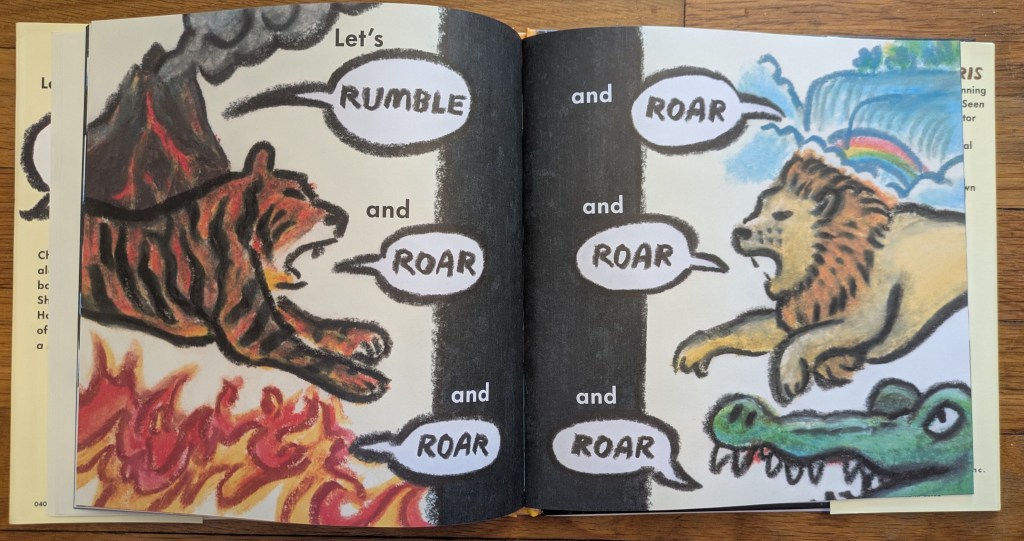
I really, really thought that was a picture of a roaring fire there on the bottom left, so I just kind of stared a bit. I do that an awful lot when a kid is telling me something, because, frankly, I’m so often at a complete loss until I get more clues. (To be honest with you, I think Shawn must be a lot smarter than I am; he seems to get it.)
“Mama, that’s a Firebird. Firebirds don’t roar.”
“Oh! What does the Firebird say?”
He thought. “…tinkle tinkle?”
He didn’t speak with conviction, and I was, I confess, pleased to have stumped him. He’s advanced a few other suggestions, but mostly he thinks it’s important to know that they have Golden Apple trees. When he’s a Firebird, he carries his own tree with Golden Apples around with him, so that’s a Firebird, do we really care what they say? He doesn’t– the Firebirds he knows are from the ballet, and don’t talk, they flutter their wings and pluck Golden Apples from the tree and they’re delicate but stronger than Kotschei the Deathless.
The genius of this book, and it is absolutely genius, it is serious genius, is that it is delightfully weird to the adult reader, and it is natural and delightful to the child reader. It’s a book to read together as a lap read, but it would also work as a classroom read. And I particularly love the cozy framing of it, so gentle, as an adult reading to a child– reading this very book, in fact. That gentle set in image frames the whole experience as a read-together, and puts the adult in the position of entering the child’s world. It is the adult saying, “Let’s be bees.” That imagery puts us, as adults, in the child’s park, and we are joining them in their logical centre.
For children, so often pushed to join us in ours, this is a rare experience. Ruth Krauss gave it to them, Sergio Ruzzier does today, and so does Shawn Harris. I think he’s great. And, Shawn, sorry I ever doubted you.
Let’s be swans!
And this book? This is it. This is my Caldecott pick.
Side note: I must give enormous thanks to the editor, Taylor Norman, for sending this for my Spriggan (who is a Black Swan today), and who dealt with my enthusiastic messages with forbearance.
 The Children's Bookroom