
The book would have been perfect at any time, in any age. Despite the nicely labelled dates (example: Saturday, June 7, 1986), it doesn’t feel stuck on any day of any month of any year. And this book is a not insignificant part of why I thought I’d really, really better go to NCTE back in November. I knew Scholastic would be there, and I just desperately wanted to see if I could talk to someone about how I could wheedle a review copy. Well, they just handed me a copy (and then I lost the card of the lovely person who gave me the copy, so I can’t email her this review– I’m bad at this! Sorry, lovely publicist.), so that part was easy.
What’s not easy is writing about it. I read it and my heart swelled and twisted so I wanted to cry. I made my husband read it. I re-read it. I tried and tried to write, and swore, and threw out drafts.
It’s difficult.
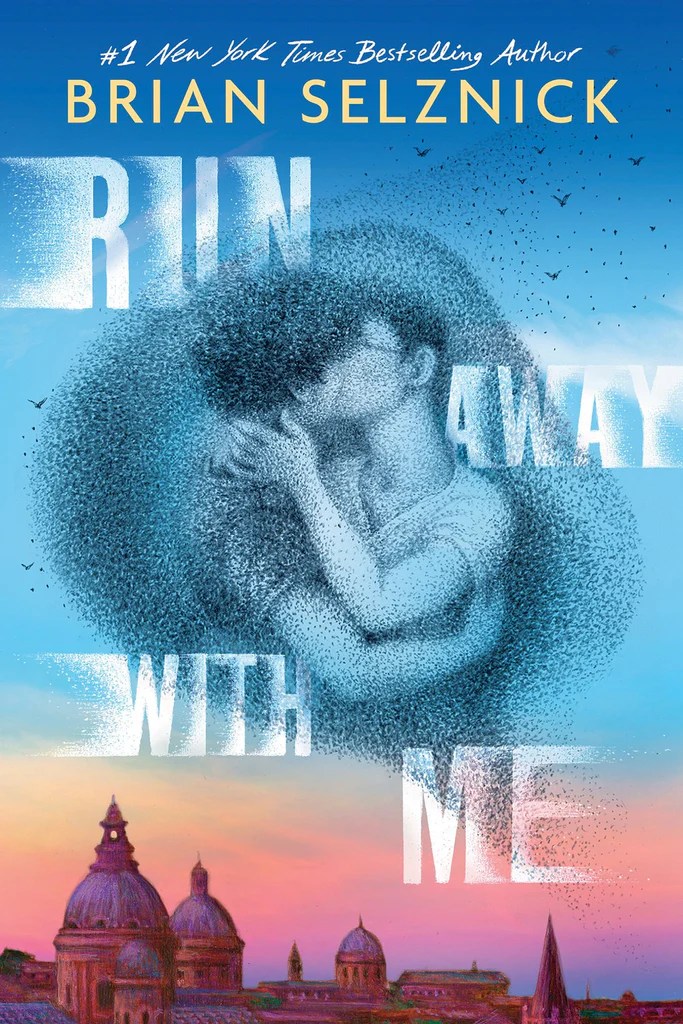
Danny, whose voice we hear for most of Run Away With Me, Brian Selznick’s new masterpiece (order from that link to Books of Wonder and you may get a signed copy), also struggles to speak sometimes. Angelo is the more loquacious of the two friends, young men finding each other in Rome. Angelo is the storyteller, but Danny, in his quiet way, elicits stories from Angelo and shares his own.
There is a manuscript, too, which is hidden and found, and the manuscript is in itself a hidden text, the secrets painstakingly unfolded by Danny’s mother, a paleographer.
Oh, yes, that’s right. There is paleography. My one potential quibble: the rare book librarians I know do not currently use white cotton gloves in handling books. Would they have in the 1980s? It’s certainly possible. I feel like Brian Selznick would have covered that in his extensive research. He’s such a thoughtful, careful creator. He doesn’t push books into being before they’re ready. He is eloquent, but not overly wordy. Like Maurice Sendak. Like Margaret Wise Brown. Like Sergio Ruzzier. Brian Selznick crafts his manuscripts deftly and considers them with care.
I flip through my heavily read and creased ARC of the book, and marvel at the work that went into each image and passage. Brian Selznick’s draft work must be art in its own right. I know it without seeing it.
But each of these elements shows the beauty of the silence between the words. As usual in a book by Brian Selznick, much of that silence is visual art, and much of that visual art is an unfolding mystery: connection, misdirection, and brilliant bridges across time and space. Is that one of the boys, maybe Angelo? No! That’s an angel in the church! Wait– no, the angel is Angelo? Or–
The text draws further deft lines between these links, and no I’m not going to explain any of the above, about Angelo or Danny or paleography or the angel in the church, because to do so would wreck your experience in following the delicate strokes of pencil and text, from scene to scene, drawing and description, music and flowing water.
Of all of Brian Selznick’s books, I think this may be his greatest masterpiece to date. I felt a strong pang of recognition in his depictions of aching loneliness and longing for beauty.
“They always seem lonely to me,” I said. “The obelisks.”
“They are lonely,” he answered, as if the objects themselves had been telling him their secrets.
Even when they have each other, Danny and Angelo are aware that the days are ticking down to separation. But Angelo has already told Danny: “To have had a friend,” he said. “Even for a short time. That’s important.”
I think this book will be a friend to many of us.



 The Children's Bookroom