
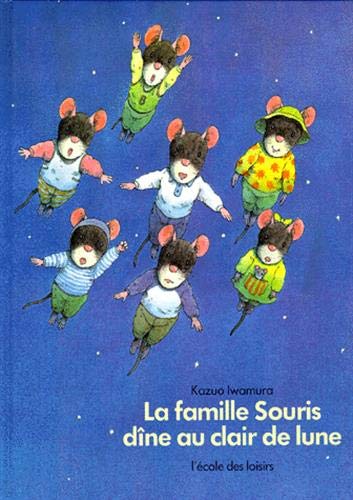
I think most of those who read my words here are Canadian or American, and I wonder… Have you heard of Kazuo Iwamura? The two countries where I met his books were not on this continent; I met him in France and in Israel. I fell in love with the kind of precipitousness one associates with romantic comedies, but to me evokes the openheartedness of children. He caught me right in the raw heart of my childhood delight in watching squirrels and mice. Beatrix Potter, Jill Barklem, Leo Lionni all understand this, and so did Kazuo Iwamura.
So when I saw an announcement through Librairie nordest, one of my favourite book shops in Paris, that Kazuo Iwamura had died on December 19, 2024, I cried, and then I looked around and was astonished to see that few people on my continent seemed to have noticed. And I thought for a second and realized that I’d gathered his books in French for my French storytime (I read to little kids at my local public library once a month and it is my absolute favourite time I spend do anything for kids who aren’t mine), but getting them in English had always been a little harder. (Many of his books, but not all, have been produced in English by NorthSouth, distributed by Simon and Schuster.)
So I feel like it rests with me to share a bit about the wonders of his books and try to encourage you to find a few, in French or English or Japanese or any language at all, really, to read to yourself or with a child. I like the English and French translations, both, though the French voice comes through with a particular pep and vigour, so I think he must have had a particularly excellent translator there. Truly, though, the engagement of the art, which is of such a breathtakingly beautiful quality, is so high, that the words serve as a guide to the art, like one of the rope ladders or pulleys that his little mice use to climb up to the treetops for a lunar picnic one night of the year. You can reach that lovely meal in the moonlight regardless, but it’s very nice to have the words to guide you there.
What is a Kazuo Iwamura book like? One of the ones I’ve read most often, both to the children at the library and to my own little Spriggan at home (he doesn’t know French but loves being read to in French), is L’Hiver de la famille souris (The Mouse Family in Winter). Has it been translated into English, too? I actually haven’t checked. I wonder if a British publisher may have done these. But the first view of the mouse family is not outside, and not in the snow. They’re cozy at home, making things. Some are cooking, others are woodworking, the little ones are playing or helping in those ways that small children play or help in the “getting under everyone else’s feet” method. It’s delightfully real. And after everyone enjoys a snack and a game they go outside. They play in the snow, the adults as well as the children. Then they go home.
That is it.
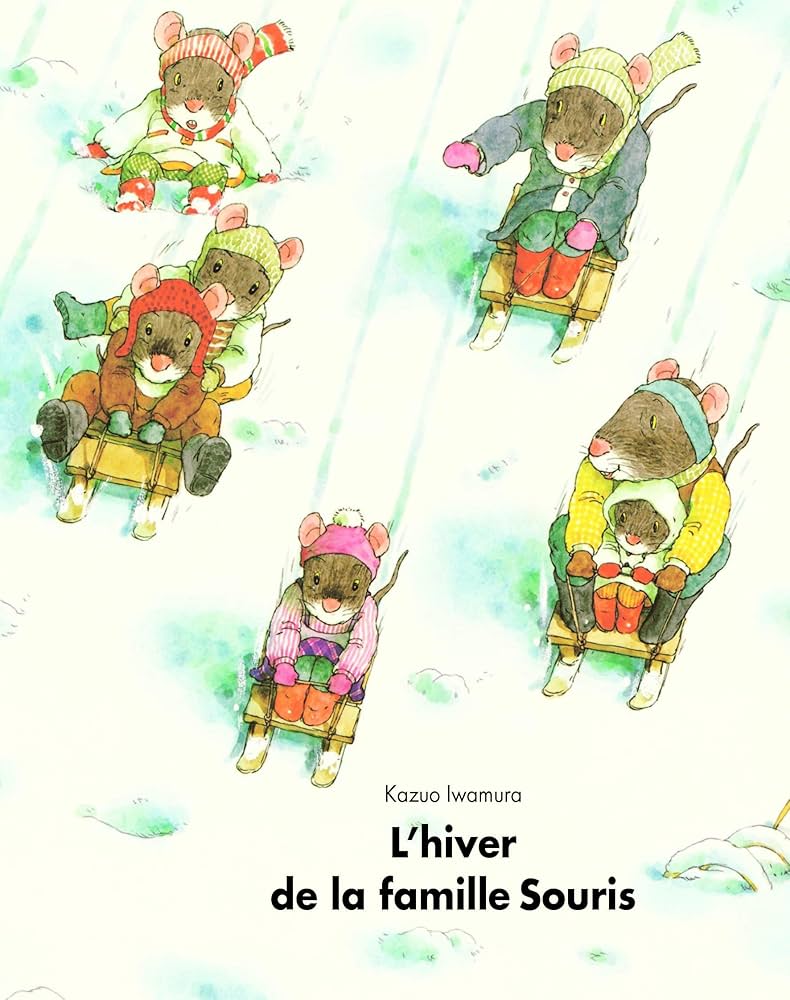
The environment, the atmosphere, the full family involvement and engagement, are all exquisite. There’s a sense of tranquility and a sense of mischief. There’s a bit of bickering. There are mishaps. They’re all in the context of generally good-natured interactions, and they aren’t reported immersively. That is: you certainly get dialogue, but the effect is at a distance, like watching a slowly developing fresco on a long passageway, as the mice go along from moment to moment and you’re walking along the mural, watching their day unfold before your eyes. The immersiveness isn’t in the characters but in the entire scenario, the landscape and the world.
This is how his forest resembles Jill Barklem’s Brambly Hedge or the Lake District in Beatrix Potter’s stories.
I find enormous comfort and huge joy in flipping through his scenes, and thinking that there was a man in this world who threw himself into art this beautiful and of such a high level for the sake of children. He built a museum for children and picture book art, too, the Kazuo Iwamura Picture Book Museum of the Hill in Nasu-Karasuyama. I can only imagine its beauty, because anyone who spent his time putting such tender care into the art he made for children must have created a museum with equivalent dedication and attention. I want to leave you with a quote from a recent interview he had with NorthSouth Books: “I’m convinced that it’s really essential for children not only to have top class picture books but also to become familiar with the real world of nature.” Thank you, Kazuo Iwamura, for giving children the top of the top class in picture books, and ones that are a window onto nature, and surely make them wish to go out and see it and feel it with all their senses. I will visit you in your books.
 The Children's Bookroom