
Writing about kids’ books off to the side like this, not for The Horn Book or SLJ or anyone, ultimately, but myself and my own fierce desire to deliberate on literary and artistic trends and what the finest achievements for children look like, is in many ways the ultimate exercise in navel gazing.
Except there’s a whole party going on around me.
Normally, my research looks like me sitting in a big cozy rocking chair with my Spriggan on my lap and a truly frightening number of unshelved books around. My kids are the only children’s literature people I talk to on a daily basis.
But from over here, I know that everyone is out there, and read about or communicate with many: writers, artists, editors, publishers, publicists, etc. Being me is like being at a party where everyone is chatting and you’re off to the side a bit, awkwardly wondering if you could get to talk to anyone or uh well maybe not… Maybe you’ll just stay over here. Incidentally, that’s exactly what I’m like at a party. Don’t invite me to any parties.
From my safe corner, not involved, but reading a lot, I’ve had the chance to observe books and where they come from for years. And I’m going to pay tribute here to one editor through one book.
Neal Porter is the one person I was secretly hoping to meet at NCTE but didn’t. I have admired so many books from his imprint for so long that I’d rather hoped to get to tell him so, but, frankly, given my display to Elisha Cooper (“YOU SENT ME A PANDA!”), it’s maybe better I didn’t. (I repeat: don’t invite me to any parties.)
But with the news that Neal Porter is stepping back from full time to emeritus status, I want to take a moment to look at a book from Neal Porter Books and think about Tony by Ed Galing and Erin Stead (2017, Neal Porter Books at Roaring Brook Press), and about Neal Porter and children’s books in general.
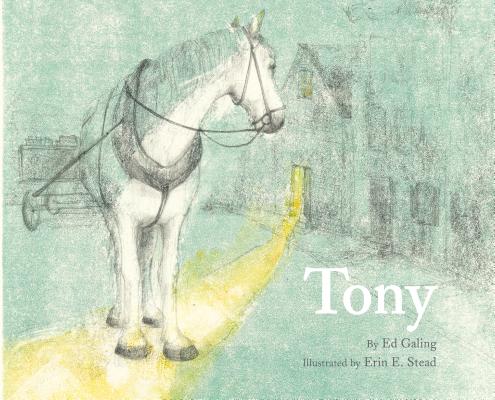
Tony has been on my mind lately, and I’m not sure why. The book is slim in format, succinct in focus, and the physical object is marked by the fine details in production that characterize a book whose team understands what makes its heart beat. In a funny way, all of those are characteristics seem muted and odd in the context of picture books right now. With so many being published and printed, I often feel they’ve grown louder, bigger, and shinier. Those who know me will understand I’m paying Tony the very highest of compliments when I say that the way in which the tightness of the text gives room to allow the reader to imagine a fully realized context around the narrow text reminds me of E.B. White and Alan Garner. As for Erin Stead’s illustrations, I admire her restraint: rather than filling in gaps unnecessarily, the art reflects and warms to the emotional atmosphere.
You flip open the front cover to find a sheet of vellum covering the title page. The vellum is printed with author, illustrator, and publication info. Muted behind the vellum, you see a horse’s head in gentle but confident pencils on an almost faded background, with the name Tony beside the picture. Turn the vellum, the face of the horse, rather an old and gentle horse perhaps?, becomes more distinct. Flip the page again– “that was his name.” The title page had become the first page, you realize in hindsight.
And as you turn through the book, you realize the lower case, the ongoing sentence, the dreamlike and uninterrupted thought as page follows page, all of that is simply what the book is. The beating heart of the narrative is an unfolding, deeply inward first person description of the narrator greeting a horse who’s being driven by Tom Jones the milkman doing his rounds. There is so much we don’t know about this story– none of it remotely relevant. For example, who is the narrator? Someone who loves Tony enough to wake up for 3 am to go out and say hi to a horse. (I love horses; I cannot confidently declare that would be me.) Is Tony an old horse or a young horse? I really don’t know. Where does the book take place? In a place with Tony.
The story is so quiet. It’s barely a plot (plots are overrated, anyway). The colours are so muted– I know, of course, that the book is set in the grey light of dawn but I feel it as crepuscular anyway, and not just because I love the word “crepuscular.” There is a sense of slight sadness that I associate with endings. Maybe because the world of a milkman doing rounds with a horse and cart is one I associate with nostalgia, like Sophie Blackall’s Hello, Lighthouse? But it does feel like it’s fading away somehow.
But some things are clearly not fading away. I associate Neal Porter’s acquisitions with an unfailing commitment to getting the best of a book out. Not masses of books; good books. And when I heard that Taylor Norman had joined Neal Porter Books (at Holiday House) and saw some of the books she edited there– Tumblebaby was one– I was first intrigued and then thrilled. Here, too, were books where the inner heart of the book was thoroughly understood on the grander scale, in the finished book. And as Taylor Norman will now be Editorial Director of the imprint, I think we can safely assume that the imprint’s dedication to acquiring judiciously and editing and producing a book with care will be in safe hands.
(Side note: I believe, if I am not mistaken, that one of the earlier books Taylor Norman edited at Neal Porter Books was written and illustrated by Philip Stead, The North Wind and the The Sun. It exemplifies many of the lovely characteristics I describe above. May the sun shine on all the books she edits.)
 The Children's Bookroom