O Rose thou art sick

In the only article I allowed myself to read today, Tom Nichols of The Atlantic writes, “If I may invoke Winston Churchill, this is not the end or the beginning of the end; it is the end of the beginning.” Of course he’s correct. Complacency, despair, defeatism, and useless alarm are all acts of cowardice, and we can’t allow them to take root. However tempting. Likewise, he briskly lists a number of places people are likely to point fingers (and do so correctly), but adds that “as always, the power to stop Trump rested with American voters at the ballot box, and blaming others is a pointless exercise.”

He might have continued, but didn’t, that we ended up with this result because enough voters wanted that result. We had article after article before the election with titles like “How Is It This Close?” and the obvious answer is that people were looking at the ballot and making a terrible, terrible choice. Tom Nichols gives a strong, thoughtful, and intelligent argument for where to take things from here, and we can all get to that in an hour or two. For now, I’m left thinking:

O America thou art sick.

We’ve let in all the loathsomeness that came with Trump, and here we are. He hardly needed to campaign. We will have post-mortem after post-mortem full of finger-pointing and “what if” and “if only,” but the plain fact that the inflamed American imagination, full of fear and the desire to cast blame was awakened by this worm whose loathsomeness is destroying the American life is unlikely to make it into those articles. And yet that’s what happened at the ballot box, and that’s what so many voted for. The journalistic urge is to shy away and say, “Oh, we can’t say ‘people are just that bad, I guess,'” but people looked at 2016, at 2020, and at the ballot in 2024 and said, “Why, yes. I shall, indeed, vote for a convicted felon and abuser who with a passion for dictators and a deep-seated loathing for women and minorities.” No matter how you blinker yourself as you go to your writing, that’s what the people chose.

Are people that bad, though? I mean, if the country is that sick, is there a cure? Or should we just curl up in the aforementioned despair, defeatism, and alarm Tom Nichols warns against?

No! While we are absolutely that bad, because we did this and we’re responsible, that is exactly why we have to get up and clean up the mess we made. The precise danger is in complacency and useless alarm and finger-pointing blame. Give over those post-mortems right now, and just say, “We really messed up.”

Not so long ago, I was pushed into the ludicrous position of defending American literature. I am not a fan, really. I do have my loves: Walt Whitman, Nathaniel Hawthorne, Herman Melville. But overall, as I told my correspondent, I feel that American literature suffers from a soul which is fearful of exposure. The answer, I told him, was in E.B. White, a writer of essays, but also books for children. I told him:

E.B. White was a man who wrote love letters to his wife in the office, who wanted to be certain that he expressed his trust and confidence in her and, fearing he’d muck it up by speaking wrong, would write it out plainly, simply, and sincerely. He was honest about his struggles and forthright about his principles and views. He was passionate about beauty and poetry and, as he employed precision in language to express the nebulous plainly, championed a similar precision overall. He wrote a perfect book, Stuart Little, which ends wistfully but hopefully, mid-quest, as Stuart continues his search for Margalo, the bird he loves for her purity and beauty. He was bombarded for years by concerned readers desperate to know how it ended, not realizing that the quest was the point, that the book ended perfectly. Seeking beauty is an end in its own right, and E.B. White understood this so perfectly he didn’t feel the need to explain it. He just wrote it and did it, all his life.

E.B. White is not bombastic, and he doesn’t give up, and he takes responsibility for his own wrong actions when he acts wrongly. Steadily. This is the spirit of America we need now. Someone who apologizes readily and has no trouble opening his soul because he’s confident in who he is. This is not what we have chosen. But neither are we allowed to give up, because it’s up to us.
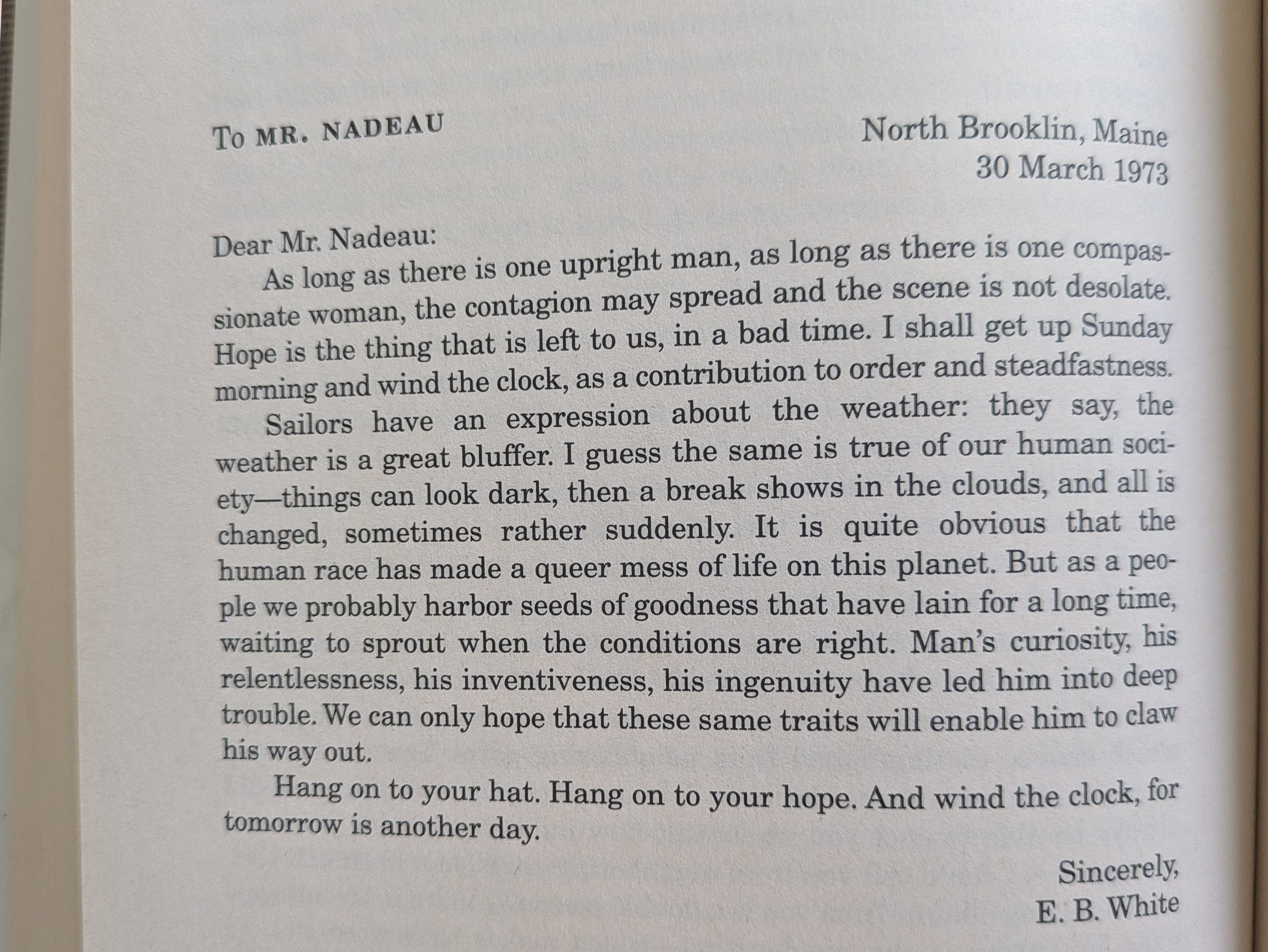
E.B. White wrote truly. Our relentlessness and curiosity have led us astray. But if we can own up to our mess, we can, I hope and I trust, pull ourselves up, and save ourselves from worse damage to each other, to the planet, and to the country.

But I do think that honesty is the first step.

We messed up. Americans messed up because, simply put, too many among us gave in to our pettiest selves and chose wrongly at the polls.
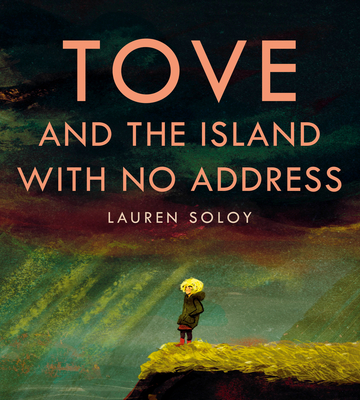
Tove and the Island with No Address

I’ve talked about Lauren Soloy rather a lot. If you listened to me right here, you already know about Tove and the Island with No Address because you pre-ordered it. And if you did, you have the book in hand, and you probably know what I’m thinking and feeling right now, which is, “What a beautiful, what a pleasing, book. What a satisfying, viscerally fulfilling, and sensory book. How on earth am I supposed to convey this to anyone?”

Let’s start with the probably category this book would be labelled as. It’s probably considered a “picture book biography.” Which is an iffy category, at best. Properly, it shouldn’t be. There are two kinds of books, of any books: Ones that are good (or achieve their potential) and ones that are not so good (or don’t achieve their potential). But there are certain types I approach with caution. I don’t mean ones like, say, romance novels, which can surely be fun and I’ve enjoyed thoroughly on occasion but it’s just not my thing for regular reading. Rather, I feel extra cautious around categories of books that, on a regular basis, I find fail to achieve their potential. A few groups I approach with extreme caution are ones listed for “social-emotional learning” and, yes, “picture book biographies.”

The problem is this. A good book needs a good narrative of some kind. That doesn’t mean it necessarily needs a perfect story arc. Freight Train, Circle Under Berry, and Le Chandail de hockey (The Hockey Sweater in English) are all books that have tricky to identify or unconventional plots. But there has to be some kind of inner cohesion to pull the book together in a tight, unified package, particularly if you want it to exceed those bounds with the explosiveness of a book that opens a portal of experience to whole new worlds beyond the space of the exquisitely smally parcel of words you set down. For example. Not that I have high standards.

You will not get boundary-pushing largeness without surgical precision in the conception and execution. It doesn’t happen.*

The problem picture book biographies face is that the trajectory the authors and illustrators often give themselves is dual: 1) the span of the subject’s life, and 2) the importance of their career. This doubleness isn’t insurmountable; in fact, it’s the same doubleness that adult biographers face and they manage it all the time. The only trouble is that it’s usually boring, likewise a trouble adult biographers face. But why would you want a shrunk down version of the life of Vladimir Putin in 32 heavily illustrated pages? To use a more appealing example, since Lauren Soloy helpfully handled these, why would you want that for Charles Darwin or Emily Carr, or Tove Jansson? They all did a lot and those details are better served in larger form. That’s not the job of a picture book, though.

If you want to give a four-year-old a lesson about Charles Darwin or Emily Carr, take the kid to the zoo or an art gallery and talk to them, listen to them, ask them questions, and listen to their answers. (For a beautiful example of having a serious and thoughtful conversation with your kid in an exquisitely rendered story which is enjoyable to read with a child, I commend you to Etty Darwin and the Four Pebble Problem, by Lauren Soloy.) If you want to read them a story, read them a story. None of Lauren’s books abovementioned will teach your child the entire history of the people in question. But they do encapsulate something particularly, keenly beautiful about them which will resonate with any reader. It will spark a feeling, a memory of an experience, or a vivid urge to experience.

“How many greens do you see?” I ask the Spriggan when we read When Emily Was Small. We count and finally he laughs and holds up his hands to the sky: “SO MANY! It’s twenty green!” (Twenty means “an unthinkably large quantity.”)

When we read Tove, I ask him what he thinks of the little girls, and so far I get different answers all the time, depending on his mood. Sometimes they’re very naughty and he wouldn’t want to play with them because they make him shy. Sometimes he thinks they’re pretty exciting. He always wants to explore the island, though, because of the myriad critters Tove doesn’t stop to see but are all around her on her excursion.

If you know anything at all about Tove Jansson and her writing, then you know that this reaction feels right for her. That this is an avenue she would be pretty peachy pleased about, and that if a kid felt like that when reading a story, she’d be pleased exactly as it was. And, therefore, I have no hesitation in thinking that she’d be thrilled that this book came from her and her story, out into the world as a Tove-adjacent book. It introduces the idea of Tove Jansson-style love of the wide wildness of an island with no name, the limits of the island only bursting the bounds of the possible, just like a tiny parcel of exquisite text can explode the boundaries of the imagination. Tove Jansson would love to know this book thought of her, and that kids reading this book today will, surely, hold one of her books tightly in hand while running across and island with no name tomorrow.

* This footnote is a holding place for the inevitable exception I think of later.**

**No, I still can’t think of one. I truly think that precision is simply necessary, I suppose. We’ll see if an exception crops up with time.