
Years and years ago, when I was young and the first universities were burgeoning in Paris necessitating the development of the first form of mass manuscript production, called the pecia system– my very, very dear friend got married to a lovely man and, even though the wedding was on a Saturday and I, being Jewish, wasn’t to be relied on as a bridesmaid, she made me an honorary bridesmaid, including me in everything, because she’s wonderful like that. And as an honorary bridesmaid gift she gave me a copy of Elizabeth Zimmerman’s The Knitter’s Almanac, a beautiful book, and meaningful because she was the friend who taught me to knit. And in that book, that treats the knitter’s year as a Round and Round in its own right, it says of September that “September is the logical beginning of the year.”
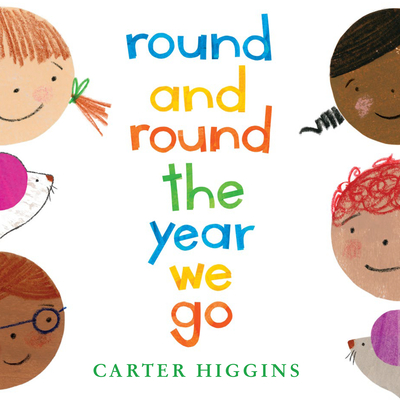
So, even though Carter Higgins’s new book, Round and Round the Year We Go, as logic dictates, begins in January and ends in December, it feels logical to me that it’s out in September, with an event this Friday, September 20 at Politics and Prose in DC– go go go if you’re in the area! And if you’re not in the area, you can do what I did and pre-order a signed copy here. And do I recommend that? Yes, I absolutely do, because that would make your little munchkin a lovely gift. It would also, by the way, make any pre-school or kindergarten teacher really, really happy for a beginning of school “thank you for getting this year off to a good start” gift, if you want to send them over the moon, or, if you’re the planning ahead sort? This is an ideal end of semester gift, something they might really use when starting back up in January. Just saying.
But it feels perfect, somehow, to see it out in September. It’s logical, perfect, and intuitive. As intuitive as each page in the book, as each turn of phrase or art.
I think my Spriggan has really grown up with a Carter Higgins book for each stage of his life. First, we got Circle Under Berry, a lovely rhythmic book that feels like you’re moving coloured block shapes or cutouts into patterns and chatting about them with your munchkin, except the book does it in a way that grows increasingly dynamic, fun, and clever, to both of you at the same time, inspiring giggles and chat along the way. The text is both conversational and lilting– perfect line flowing after perfect line with each page turn. I wondered how Some of These Are Snails would follow that act, and it somehow did, climbing in terms of what the cognitively developing toddler could handle, but without sacrificing the simplicity of form from Circle Under Berry.
Now, my Spriggan has colours under his belt, and is a fan of shapes– but tenses and time are the new puzzle. What, exactly, does “yesterday” mean and what do those names of months mean? What’s a January? It feels like only a month ago that “yesterday” was “any time in the past, generally” and “tomorrow” was “at some point in the future.” Now, in the past week or so, we’ve made another leap: “Once upon a time” refers to the far, far distant past, when once upon a time he had actual marshmallows to eat, oh those halcyon days of yore! Whereas “yesterday” is the more immediate past, when he was at daycare and was playing in the tent with his friends.
And, once again, Carter Higgins hit the nail on the head in terms of the right voice, the playful simplicity of shape and form, for this age. Some things are different: we see children playing in the illustrations, and instead of the lilting prose we have real poetry. But, still, she’s somehow keeping perfectly in synch with my Spriggan’s cognitive development (no, I do not think that’s actually on her work calendar, it’s just serendipity, but let me have this moment of glee): this is the next book his conceptual mind wanted.
But, oh my readers, oh my friends, this is what I want to tell you about this book, so hear me, hear me clearly: The poetry in this book is actually good. I anticipate that people who look at the book instead of finding the nearest kid and reading to them may be confused since the layout of the text doesn’t give away a dull iambic stanza form. It’s creative in its simplicity, like all of her wonderful books. So this book is not for a flip through in the shop, and not for a silent read; it’s for a lap or a classroom, and for that it’s ideal. As soon as a kid giggles, interrupts to repeat words or syllables after you, or excitedly tells you about what they’re going to do for Hallowe’en? The book will immediately become a favourite to you. That’s when you know you’ve got the pre-school/kindergarten hit.
And it’s oh so perfectly logical in art and text– read this out loud:
maybe hazy
maybe hot
maybe chilly
maybe not
Do you hear it? Do you? Trochaic dimeter, where the second and fourth lines, rhyming, are catalectic, meaning that the unstressed foot has been dropped to give it an extra bit of force? Oh, it’s beautiful, beautiful! The overuse of the iamb in children’s books is going to be the topic of my rant to be published in The Atlantic on the first page as soon as I can get the laundry under control and write it up. The title will be this: METRE MATTERS
Rhyme is secondary, in a kid’s book, to metre, but it is not unimportant. And what you’ll notice in Round and Round the Year We Go is that for each month the form of the rhyme shifts, because, and I didn’t quite pick up on this one until I inadvertently bothered the editor of the book (who was super sweet about me thinking I’d written to Carter Higgins, who is just the loveliest person, but I had not and was very embarrassed to be badgering a person I’d never spoken to before!), and she mentioned that they’d worked on basing the rhyme around assonance with the name of the month. A fascinating concept! It gives each month a distinct form, of course, because each month’s name varies in syllabic and accentual construction, of course– January vs May. Yes, that’s all very technical, and I highly doubt that Carter Higgins was pacing her study muttering “Auuu-gust, Auuu-gust… A trochee, after the iambic Ju-LY! But the key will be a short o sound…” And yet, not only did she do that (not just short o, also a short i– I would never have thought of that, but it works brilliantly)– but she seems to have realized that by cleverly dodging a strict rhyme and adhering to a combination of assonance and metre, she could get to the heart of August best… through some delightfully, playfully grouchy superlatives: longest, hottest, and the delicious coinage wrongest. They aren’t really, strictly, perfectly rhyming, but they feel like double rhymes, they do, and the vocalic echoes and the added nasal element of “ng” evoke the dull, sticky dregs of August in a way I’ve never seen done elsewhere.
I am utterly delighted with this book. So is the Spriggan, giggling and jabbing a finger at each page, chatting with the seasons and feeling the turn of the year in his mind and on his tongue as he develops a sense of his place in the cycle of the seasons.
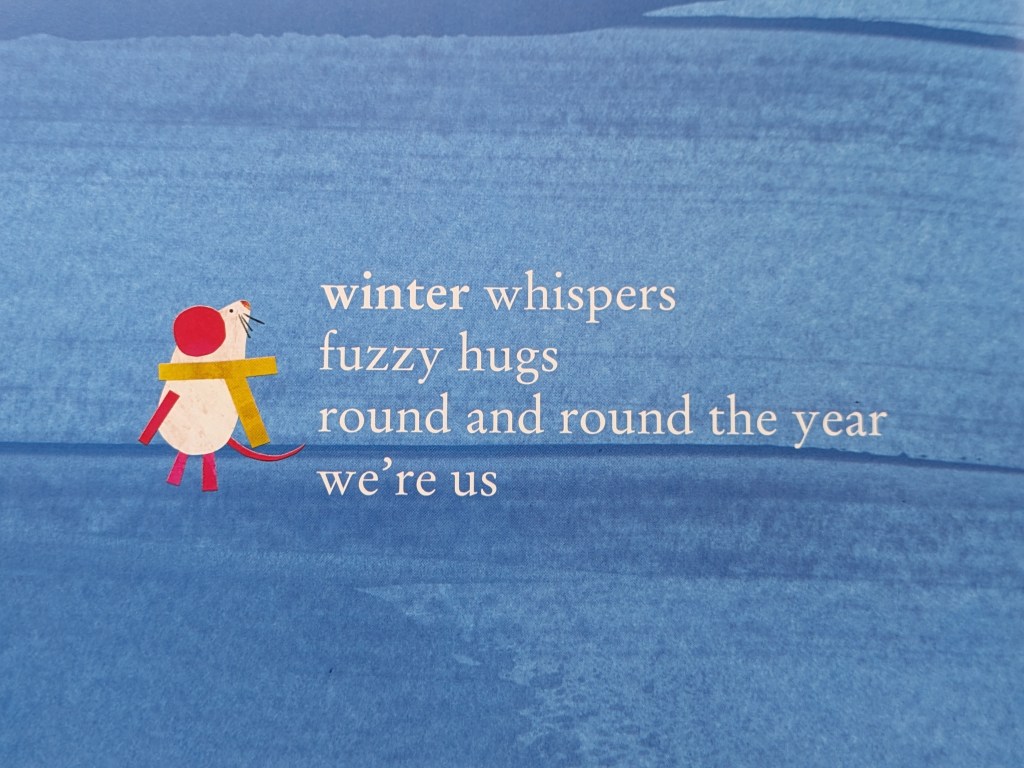
Oh, and did I mention the mouse? I didn’t? Oh– I will leave you only with this, and with a strict injunction to get yourself a copy, or request it from your library, before…
 The Children's Bookroom
[…] enough, I have already reviewed Tove and the Island with No Address, Emma Full of Wonders, and Round and Round the Year We Go and those links will bring you right back to the reasons why they’re good, but don’t […]
LikeLike