
It happens sometimes that I receive a book for review that, for whatever reason, I might love but I hesitate over the audience. One of my go to examples, though I didn’t receive a review copy, I simply bought it repeatedly, enthusiastically, and of my own free will, is A Child of Books. I have no idea what age of child that book was for, lovely as it is. But this book, Ukraine: Remember Also Me, by George Butler (to be released October 1, 2024) strikes me as never having been for a child, though published by Walker in the UK and Candlewick in the USA. To be clear: I do not criticize the publishers or the author-illustrator, George Butler, on this point. The book is clear and succinct, crisp in its diction, unflinching in its text and art. These are all good traits for a YA text. But all of those characteristics are also good for A without the Y. This is part of a bigger conversation about the puzzling categorization of books by age– but also about what we’re willing to publish for whom.
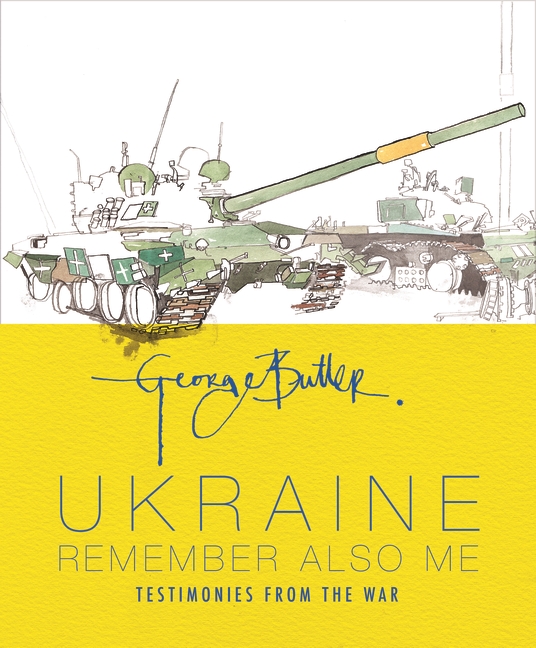
I have not seen a really good book like this for adults, and, frankly, I’m not in the least disappointed in Candlewick or Walker for publishing it for kids, I’m grateful they did; I’m irritated that I haven’t seen this for adults. Or much else, really. I recall early in the war, as Putin’s Russia invaded Ukraine– I remember watching the panicked news coverage and sharing with friends the stupefied feeling that “you can’t just do that anymore… can you?” Of course, the fact is that Putin was doing it, but we all knew it was wrong. And the stories of real people collected in this book indicate that a whole lot has happened to real people there while many of us stopped paying attention in a stupefied panic because we had things that we needed to do, and a whole lot of that was also worthy of the response “you can’t just do that, that’s wrong.” But, on the whole, while diplomatic efforts in the USA have not ceased, the public attention has waned, considerably.
And, no, I have not seen much of what’s in this book elsewhere, even though I do try to keep up with the news from Ukraine, and I’m frankly concerned that this excellent, necessary book, being on a children’s list, which means adults are doing the buying with children in mind rather than with adults in mind– and we’re so careful about what we buy for kids, we clodderheaded adults!– well, it makes me concerned that adults aren’t going to buy this for themselves or for other adults. And, if we’re grimly honest, it’s we clodderheaded adults, we who can’t keep focus on a major, autocratic power invading a neighbouring democracy (speaking as a Canadian and American, I will note that Ukraine is a very important ally, as well), we just can’t do it.
And, maybe, just maybe, if we look at the stories of real people who have suffered brutally from serious war crimes over there, and if we can recall the dangers of the loss of democratic rights, we’ll pay a little more attention.
Yes, I understand that there is always a lot to pay attention to in the world. I, too, have a massive laundry problem and my kitchen will not stay clean. I homeschool one child and the other child is a bundle of energy, ballet, and “reactive airways.” And the world is so very full of problems. How can we care about them all? What, after all, can we do but see what’s in front os us right now?
The answer is simple: Everything is very complicated and none of us will ever do everything right. Nonsense! When did we ever start to expect perfection, simplicity, and completeness? I am a Jew, and I recognize full well that I will never fully understand the words of the Torah I strive to adhere to. I am an academic, and I still find myself puzzling over the same texts which form the basis of my PhD dissertation. I am a mother, and my children surprise me daily with ingredients I’m damned sure I didn’t put into them even though I gave birth to them and have raised them ever since. Why should we expect to be able to understand or solve every problem?
But I want to point out something from George Butler’s Introduction which I highly doubt was intentional, yet struck me with enormous force. “However,” he writes, “the themes are not specific to Ukraine. […] These are experiences shared by others I have met in Gaza and Syria, Yemen and Myanmar.” NB: before anyone shouts, George Butler was in Gaza in 2016, and I’m presuming he’s referring to that time. And, as I write that, I have to smile at the twist here– I already anticipate within that sentence that Ukraine will fade from readers’ notice, readers who are adults not children, because the word “Gaza” appeared. And I didn’t in the least want to bring that up– I wanted to point out that something else in there is interesting. He lists countries and conflicts, but the country name not mentioned is Russia. And yet Russia has a hand in all of those bloody conflicts, whether directly or in allyship with Iran. In that list, in those areas where Russia is quite interested, destabilization of democracy is the baseline, and a leitmotif is brutality.
No, I’m not here to write about how we should all hate Russia, cancel Russians, or throw out Russian art. I have zero interest in any of that. All I am noting is that by sheer power of distraction, of allowing our attention to be misdirected and our focus to be swerved, we can miss a lot of context, lose track of the themes, and, worst of all, forget our own humanity and that of others. By way of illustration, let me share one of the stories in this volume.
In Bucha, a horrific scene took place with many civilians killed in the streets or even shot through windows if movement was seen, and this story is of Mariia (age 76) and her son Oleksandr (51). Mariia’s other son, Oleksandr’s brother, Dima, was killed on his own doorstep. Initially they didn’t dare bring his body in to be cleaned and then buried, lest they also be killed, and then the people hiding in their basement begged them to leave the body there because a dead body outside was protection; the Russian soldiers saw it and didn’t go check for other people to kill. “Dima was a sacrifice and he protected them,” Mariia said.
A few days later, when the situation was calmer and it was safer to walk out, they took him in to be cleaned and then asked for permission to bury him. One helped Mariia dig the grave. Oleksandr: “Mariia spoke to them but I refused to talk to them.”
Mariia said, “There was only one of the Russian soldiers who talked to the people here. He was a young man from Siberia, which is far from here. He answered our questions. He said that he hadn’t known they were coming to Ukraine, to the war, but he thought that they were going to military training. He seemed surprised. But people asked him, ‘Did you see how many people you killed? This is not training.’ And he just didn’t respond.”
An imagination is a curse, and clear and cogent reporting is unquenchable. George Butler’s art speaks more than a photograph can, and these words straight from a mother and a brother say yet more. I can see, as I read, as I look at the art, the people and their loss. And I can see, too, the young Siberian soldier, confused and, as I imagine it, only beginning to realize the level of trauma he’s going to have to live with for the entire rest of his life, trauma stemming from the undeniable knowledge of what he’s done, of the trauma he’s inflicted on others.
And I wonder, again, why this is a children’s book, YA? And I think it’s far too complex for we clodderheaded adults and we’re too scared to face it. Only children’s publishers, Walker and Candlewick, had the courage. All I can hope is that, if you’re an adult who read this far, I may have persuaded you, challenged you, to read it and share it with other adults.
 The Children's Bookroom