
Note that all links to Elisha Cooper’s books below will be to signed copies available at the Eric Carle Museum book shop, both because that place is lovely and because his signed copies are just so very lovely. He often doodles.
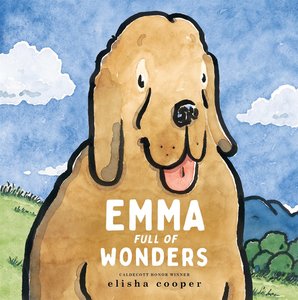
I’ve been wanting to write a review of Emma Full of Wonders since it was released, at the very least. Actually, I knew I’d want to review it before it was released, even though I hadn’t seen it. Elisha Cooper is that kind of writer, that kind of artist, that kind of creator. And, really, that kind of human being. The man sent me a postcard for Emma Full of Wonders even though (and I’m not fishing here, I’m not much for any outdoor sports) I’m not the kind of reviewer you need to woo for a book’s success. He’s simply that kind of person; the kind who, even though I’ve never met him in person, has impressed me with his humanity.
Now, I’ve been reading, in a desultory kind of way, The Letters of E.B. White, and since the Spriggan is on a passionate quest to get me to read every book by Elisha Cooper until the words and images are mutually imprinted on our inner landscapes in indelible lines and watercolours (I have no objection), I wondered whether my association of the two was just me, or have others noticed it, too? A Google search revealed, first, the true reason why I haven’t reviewed Emma Full of Wonders quite yet: Betsy Bird’s interview honestly does everything I may have wanted to. She’s so wonderful as an interviewer and reviewer I just think we’re lucky to have her. And then it turned out the mention of E.B. White Google was handing to me– was Elisha Cooper sharing a quote from him. I can’t find an older and wiser reviewer making the association, so it may all be in my head, but there it is.
And yet I still think there’s a writerly kinship there. At first I thought it was the succinctness of language, “Never a word wasted,” I said, either to my husband or myself. I did so much muttering I can’t recall what I said to whom. Then my mind brought up the much-referenced line from Strunk and, of course, White, regarding omitting or cutting or– well. Excising, in some sense, unnecessary words. As my own mind searched for le mot juste, it hit me, after quite enough years of doing my own writing that I ought to have thought this through earlier– trying to figure out what’s necessary and what’s unnecessary can be a bit of a headache, can’t it? And depends on the author and the work. And if that work is an illustrated picture book, the game changes.
It is not, simply, that Elisha Cooper, like E.B. White, is concise. There are plenty of short picture books which, at very few words, still contain many unnecessary words. Nor is it that each of these two authors takes a strong interest in the natural world. I believe the kinship between them is that each of them is keenly and sympathetically observant, relentlessly honest, and has a knack for and passionate, but quietly displayed, interest in sharing the observations of a world they see with accuracy and justness. I see this in every single picture book by Elisha Cooper I have read.
I can’t emphasize too strongly how much that means to me as a reader: I have not read a book by him which lacks sensitivity, keen observation, and a dedication to sharing those observations with honesty and sympathy.

This is a year, for me, in which I have seen more of death (and anticipate still more) than I would really like. So in reading Big Cat, little cat with my Spriggan, I was hit full force by the quietness and simple honesty of the page in which the older cat is gone: “And that was hard.” I don’t think I’ve had as full and honest a recognition of the pain of missing someone as is in that page. And it was four words and a cat. With it came the sense that he’d been there. He knew cats, and he’d seen it, and he knew people and he’d been there. And you could feel all of that in four lines and one cat on the page and one cat off. It’s a kind of magic, where he whittled away and got to the raw heart and said, “Yep, here it is. And it’s hard. It simply is.” And put that on the page.
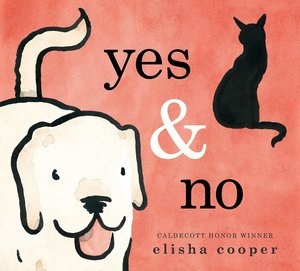
Of course, it’s not all pain! Yes & No has never failed to make every kid I read it with giggle, whether I read it in English or French. And most of the words are “yes” and “no.” There, the simplicity is in the art, and oh the full landscape pages. Oh the beauty. The nuance of a relationship– I defy you, flipping through, not to see your own relationships unfurling on those meandering paths of dog and cat. The words ebb, utterly unnecessary indeed, as the paintbrush flickers into vivid dynamics of sound and scent and the rush of a breeze across a field. Part of me, absurdly, felt that maybe I could just tumble through the page…
Of course, every variety of experience comes together in Emma Full of Wonders. Childbirth, historically and today, carries much of the weight of death alongside new life. It’s a time of pain and danger, anticipation and joy. No wonder Emma is full of so much sensation. So much sparkling wish and so many big feelings. I was quietly relieved, seeing the helping hands as she gave birth, to know that she had loving and helpful attendants to see her through.
But the thing is this: through this entire post, you hear me relating and projecting my mind and feelings through the animal characters. I think every reader, child and adult, even as we bounce out and say, “Oh! What a cute cat! We should get a cat, you know. Yes, I know we already have four…!” (for example) will also find themselves relating to the experiences of the animals in the pages. And yet– Elisha Cooper is not doing that for you.
“A lesser author would– ” is a line that’s kept playing through my mind as we’ve been, as I said, doing a lot of Elisha Cooper reading these days. The animals are adorable, for example, but the books are never cute. Emma’s puppies are the sweetest little balls of energetic joy I’ve seen and I have four cats in my house and know how to look for kitten videos on the internet. But the pared lines of the book hew to the experience of the oddness and responsibility and beauty of bringing new life, of pregnancy and childbirth, not the cuteness of babies. He shows the first puppy coming out of the dog’s vagina. Full in the middle of the page. “Daaang, he went there,” I thought in admiration. [Ensuing sentence excised for being too mean about the tendency of parents to be so blasted restrictive– oh. I’m doing it again.] I love cute animals, cute kids. I do not like cuteness. Especially in books. Children are adorable, of course. But the genius of Gyo Fujikawa’s adorable kids, for example, is how relentlessly real they are, sticky with jam, cranky and overtired, and covered in paint. These books are relentlessly real.
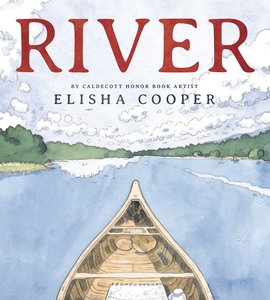
That is, I think, something that E.B. White, a careful observer of humans and animals and places, would recognize in these books. It is where the two meet, for me. Reading his letters, I found myself seeing and hearing New York, seeing and hearing Maine, seeing and hearing people– all in phrases of maybe as many as three to six words: of his little son “your tumultuous little Joe,” or of his wife “the person to whom I return,” or wistfully wishing his son were with him to hear “the lovemaking of the frogs.” I swear I could remember a letter where he joked about how he’ll take his canoe down the Hudson into New York, though of course now I can’t find it! But it brought River instantly to mind.

And then there’s the matter of pure philosophy. Because here’s the thing: I can talk about the writer’s craft, and being concise, and hewing to a point. And I can talk about what a writer might have to say. But then there’s the two together. Farm is a book that more or less pins it. The book is a whopping 18 years old, being published in 2006, [Ed. Incorrect, and I can’t believe I made such a silly mistake– the book was published in 2010, 14 years ago.] so in publishing terms it’s basically antique, but I defy all conventions! I will talk about old books!
The book starts out feeling like it might only be showing off what a farm is. (Precisely how many books of cartoony farm images showing sweet-tempered sheep and goats are out there, now? Too many.) And then we get the introductions to the animals, and the short, clipped phrases give me a feel for the rough boards of a fence and the muck on my shoes even though neither are mentioned. “Cats can look after themselves,” the invisible narrative guide says drily, as we, I imagine, walk along rough ground, leaning on rough fences.
“A lesser author would–” go into those spunky and independent cats, though. Or the cows: “What are they thinking? Are they dreaming? Who knows. They think their own thoughts.” And on we go. Impressively, for a picture book about a farm, a field (hah) so filled with horrifically saccharine books, all of which are so intrusive into the poor animals’ inner lives, giving them never a moment of privacy, the cows are left to their own thoughts, undisturbed. Until, later, they’re “sent to market.” Bye, cows. I loved, maybe, most of all the descriptions of weather. There is a storm– “And then it is over. The corn all bends in one direction as if to say, The storm went that way.” And at the very beginning of the book, we’re told that “weather must be dry for tilling. The farmer will have to wait. Weather can’t be fixed.”
The book is intensely full of challenges. There is no runt piglet about to be killed, but, honestly, there could so easily have been. There is life and death (a disappearing rooster, chipmunks, and more) and delay and the price of crops. Keen observation, the humming of life, the rhythm of reality, and muck, and beautiful views of a big sky and vast fields, and vaster questions. Clipped phrases let us into this world, so far from concrete suburban walls, with questions rumbling under tractor wheels and through named roosters and unnamed hens. Why aren’t you named, hens? What are you thinking, cows?
Elisha Cooper, like E.B. White, shows us. He lets us know he cares, that he sees with acuity and loves these creatures and fields and rivers with a passion, but he is not telling us what to think. He only wants to let us in, and he succeeds, beautifully. Looking with unguarded awe at a field with a cat and a dog ambling along, absurdly, for just a moment… I think I can go in.
 The Children's Bookroom