
The first days of Passover were a severe trial for me. Oh– no, not the holiday itself. No, I mean that I was in Toronto for them. Well, that was ok, too, because I got to visit Mabel’s Fables, which the Spriggan calls Mabel’s Stables. Actually, he fell so deeply in love with Mabel’s Fables that we went twice because he asked every single hour of every day when we were going back until we did go back, and, believe me, I wasn’t the parent who needed to be persuaded. So that was ok. But what was less ok was how I kept getting delivery notifications from UPS that I was getting boxes from Candlewick– and I wasn’t home to open them.
Truly, I was suffering severe torture of the spirit. But I came home to a beautiful pile– just look at these!
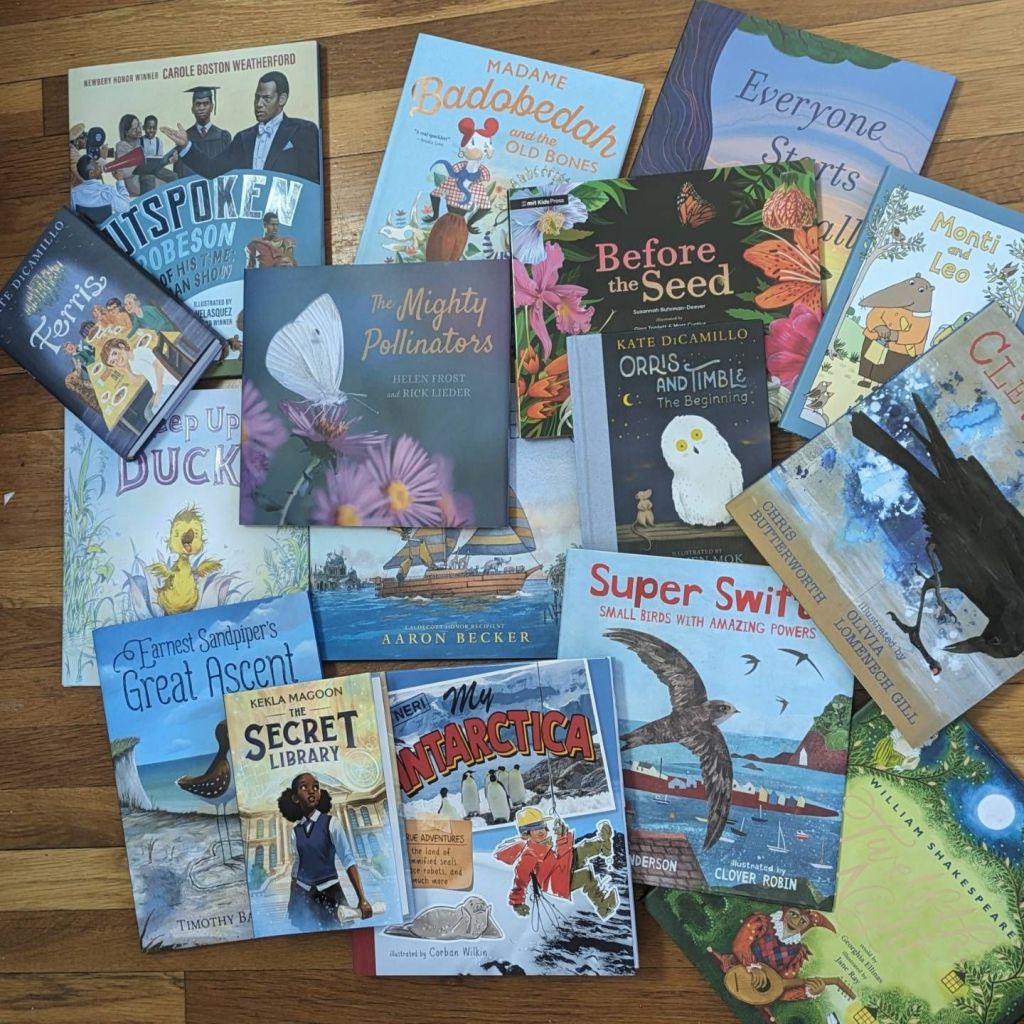
Which one calls your name? To me it’s a beautiful mix of authors and illustrators I already know and love and ones I had yet to explore. Some were surprises, some familiar.
Normally I’d be leaping to the unfamiliar, the one you may never have heard of. But there was one book in that pile from a very familiar author, but one who keeps surprising me, and this was no exception: Kate DiCamillo has two books in there, and I want to tell you about Orris and Timble. (I also loved Ferris and I hope you will get it and read it, too. In fact, the Changeling loved Ferris so much that even though she’s not allowed to read my review copies at the table because I keep them tidy so I can donate them, she snuck it to the table and dropped yoghurt on it and got a scolding.)

Why Orris and Timble? What about it got that pull of needing to talk about it? We all know that Kate DiCamillo is a reliable author and what she writes is good, so why bother? Well, the funny thing about Kate DiCamillo is that the first book I read by her was The Miraculous Journey of Edward Tulane and I thought two things: a) I really love this author, and b) I do not click with this book. My very dear friend from Grades 7 and 8 gave me Edward Tulane when I was in undergrad, and we were both fascinated by it, and discussed it happily. And it wasn’t a book I loved, though I fell in love with the author right away. And I’ve returned to Kate DiCamillo over the years, fascinated by her inventiveness, her voice, and her trust in her readers. She is to words what Sergio Ruzzier is to illustration: his method does not alter, but his inventiveness within it is endlessly fresh and brilliant; she writes in a similar fashion from book to book, but with boundless inventiveness.
I think that Orris and Timble strikes a new note again, but, as in The Beatryce Prophecy, she starts out telling us very little because she doesn’t need to. We’ll catch up.
By the way, how do you feel about the term “signposting” in book talk? I kind of hate it because it makes all books feel plot-bound. Now, I hate plots, too. Why do we need them? Tell me a story, and tell it how you like, but you, the author, should know what you’re doing, and I’ll catch up or I won’t. Alan Garner only sometimes bothers with a plot, but he always has something to say, and doesn’t say anything but what he needs to say, and either you catch up or you don’t. Probably, at this point, my husband would mention Proust, and the Changeling would screech, I would roll my eyes, and the Spriggan would throw back his head and giggle and tell him he’s a pie. No one knows what that means, by the way, but I think Kate DiCamillo would absolutely understand and would have a toddler calling his dad a pie in her next book.
I think that Orris and Timble, like The Beatryce Prophecy, is simply telling a story where there’s a plot of some kind (more so in The Beatryce Prophecy, less prominently so in Orris and Timble) but the plot isn’t the point of the story. As readers, we catch on fairly well, fairly early, to who Orris is: he’s a rather cranky rat, a rat we want to know more about. He reaches us, somehow, and we don’t know why, but we want to know why. In fact, we would very much like to know why it is that we want to know more of him, because, really– it’s puzzling.
That’s why we need Timble, the little owl. Timble helps us figure out Orris. And it’s not very long before they become a story we love. Timble loves hearing stories. Orris has stories to tell but no one to hear them. And we? We listen. We are an audience to their story. A cranky, sweet, ornery, and tender story.
It’s a story of stories, a story that goes beyond plot and into voice and into the heart.
Fresh and old, new and deeply rooted– it has everything I love about Kate DiCamillo, but is wholly original.
Also? Please note that the illustrations from Carmen Mok, whose work I first saw on Here Babies, There Babies by Nancy Cohen, are as tender and fresh as the words on the page. Altogether, it’s a lovely book for a fairly new or a more developed reader, and if you’re an old and cranky adult muttering about nothing being good these days, you may well find a new spring by reading this, too.
 The Children's Bookroom
I’m really looking forward to reading this book. i think i will buy it for Jude who is still struggling a bit with reading. Thanks for the shout out about Here Babies!
Nancy xo
>
LikeLike
I hope Jude loves it! It’s so much fun and a beautiful way to get into stories as much as into words.
LikeLike
[…] I wasn’t going to write about another Kate DiCamillo so soon after writing of my love for Orris and Timble, mostly because I didn’t want to seem like a total Kate DiCamillo fangirl. And then I […]
LikeLike
[…] snug in our own Children’s Bookroom, I’ve written about an early reader, Orris and Timble, featuring a cranky rat who seems curiously well-read, and a little owl who wants to hear stories. […]
LikeLike