This May has been unusually busy around the Children’s Bookroom given a lot of old things coming together, so I wanted to give a roundup of what I’ve done here and elsewhere!
An older review of mine for Hilary McKay’s Time of Green Magic was featured among other reviews over at Twinkl’s Magical Books for Kids to Beat the Summer Reading Slide. While I’ve never really understood the whole summer slide thing, I think that list of recommended books looks absolutely fantastic and am keen to check out a few of them myself, so I recommend taking a look.
I have already mentioned the review I got to write for Two New Yearsover at JArts, but if you click this link here, you’ll see all of my reviews there, including Aviva vs the Dybbuk by Mari Lowe, a collection of stories by Etgar Keret, and more.
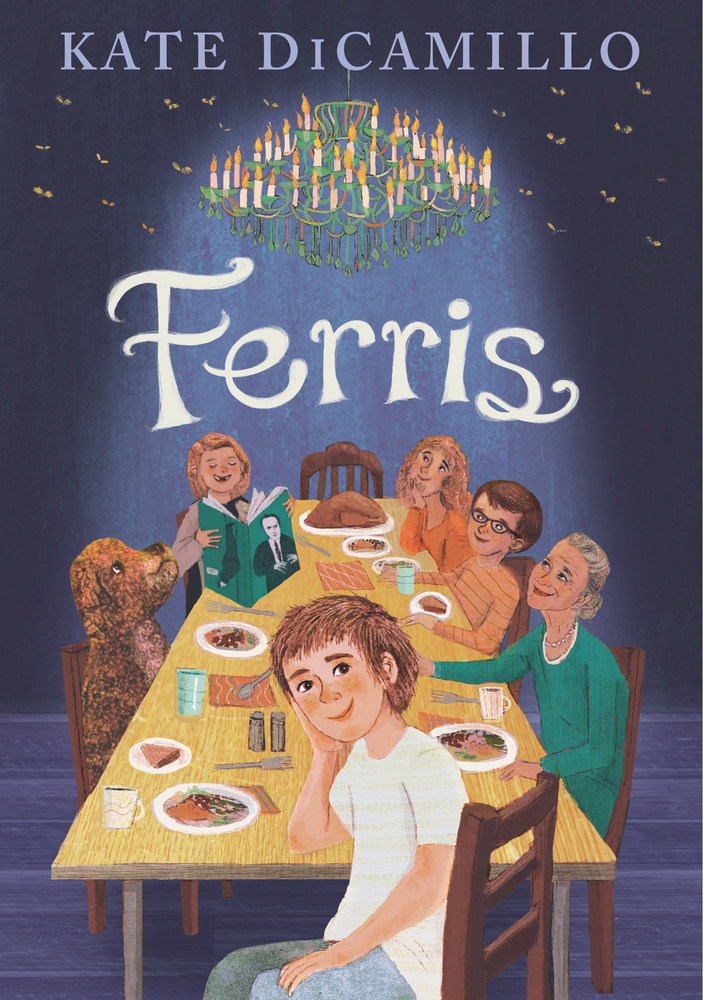
Here, snug in our own Children’s Bookroom, I’ve written about an early reader, Orris and Timble, featuring a cranky rat who seems curiously well-read, and a little owl who wants to hear stories. I have written about characters in Ferris who don’t so much leap off the page as beckon you into it. And I’ve written about A Poem for Peter and how sharing stories, as Orris and Timble do, can turn the misery Olympics on its head and let us all have our say.
I never do have any idea what’s next, here in the Bookroom, because it all depends what’s published, what mood I’m in, and whether a child elsewhere in the house decides to spill my coffee beans on the ground or starts to barf, but since the past few weeks turned out to have so much going on, I just wanted to make sure that anyone who cared could find what they wanted on the shelves, as it were.
First thing, before I hop into the review for this page on this day– I have another review up somewhere else, and I’m more than a little pleased with it, so I’m linking here: a review for Two New Years by Richard Ho and Lynn Scurfield over at JArts, a book I reviewed separately here! My review at JArts is a happy reflection on how JAHM and AAPIHM share the same time.
Now, over to Ferris! I wasn’t going to write about another Kate DiCamillo so soon after writing of my love for Orris and Timble, mostly because I didn’t want to seem like a total Kate DiCamillo fangirl. And then I thought… Well. The public has a right to know the truth. I pledge my allegiance to Answelica the Goat.
Some authors and illustrators are just like that for me. And why not? When there’s a new Sergio Ruzzier I rush to find out what the new oddness will be, and I have never once not wanted to revisit his characters endlessly. Kevin Henkes will always, always have me say, “Oh yes, that’s true!” in surprise at some simple view I would never have thought of without his gentle direction. Grace Lin’s deftly painted beauty merges stories so that I get the urge to step right in the way I used to want to walk through the looking glass. And so on.
Kate DiCamillo’s Ferris had me surprised I couldn’t just look up and talk with Charisse or Billy Jackson.
When I wrote about Orris and Timble I spent way too much time talking about signposts, and how elegantly Kate DiCamillo doesn’t use them, and honestly I could have done a better job there. So I’m trying not to repeat that error in talking about her casts of characters, and yet– I’m not fond of how we talk about characters these days. They’re so often either “fleshed out” on the one hand or bland and two dimensional on the other.
Kate DiCamillo does a fantastic job of building characters who leap to life in your mind as humans, just humans. Each is different because each was a human being. And she wastes precisely zero words on telling you anything about them.
Being frank, I have no idea how she does this so elegantly, so deftly. The only other author I can think of who tells you so very little about a character and yet gets you so invested in them is Alan Garner.
You may or may not know what high praise that is from me. I can’t for the life of me write about his books, because they’re so perfect in themselves there’s no point in writing about them. It’s all in the books, and every attempt at writing anything further is useless.
Kate DiCamillo’s characters will have things they do, certain external traits or hobbies. Billy Jackson plays piano, Pinky wants to be on a Wanted poster, and so on. And yet each character has a full inner life, a soul and depth of their own that defies any wordy definition, so she just doesn’t bother with wordy definition. We, the readers, feel and apprehend that full inner life, that soul and depth, but it isn’t defined exhaustively in words on the page. Why bother?
We know that she knows that character. She knows each human in her book so fully that we, too, know them. And we love them, as full humans.
I have no idea how she achieves it, exactly, but she does.
And so, no matter how ready you may be to dismiss a character early in the book, I’m sorry to say that each of them will grow on you. You may think, “Here! This is the person I get to dislike!” Dreadfully sorry, no. As each character explodes into your mind with a human soul, as you see that they’re neither fully good nor fully bad but fully human, flawed and frail and ultimately lovable, you will be unable to cordially loathe them. The best I was able to manage was thinking, “I don’t think I’d want to get coffee with THAT character, but I get what they’re going through, at least.” (And, no, she doesn’t painstakingly spell out that “learning to empathize will help you be a better person!!!” either. She trusts you to learn or fail to learn.)
I can feel a certain impatience from anyone reading: “Right so you’ve told us that one character wants to be on a Wanted poster and another plays piano. But what’s the book about? What age group is it for? Who even are the characters and what do they do? Is the book realist, fantasy…? Can I put it in my social-emotional learning unit?”
You’re asking awful questions! Sit in the corner until you can do better! None of that matters. I have no idea what the book is about. It’s called a middle grade novel, and my end of Grade 5 Changeling loved it so much and dropped yoghurt on my review copy because she wanted to reread it and it’s a horrifically disobedient nuisance. (She is wonderful and you can’t have her, sorry.) Use it in any unit you like, or just give it as a birthday present to every single human you know, which is my personal advice. I’m planning on buying the Brookline Booksmith out of stock this afternoon.
What are books ever about? I have no idea, and I certainly have no idea with Ferris. The book will make you think, make you feel, and if it doesn’t tear your heart open to let you appreciate the richness of what humanity is made of a little more… That’s absolutely not Kate DiCamillo’s fault.
I really don’t know how she does it, but I know that I’m entirely grateful she does.
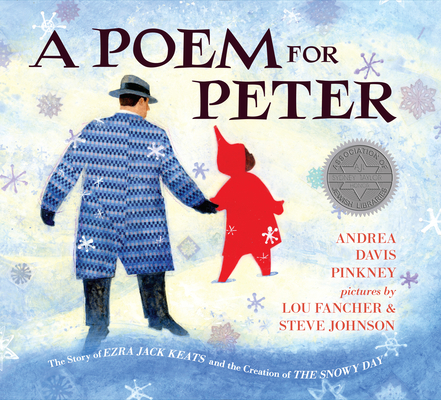
This month is Jewish American Heritage Month in the USA. (It’s also Asian American Pacific Islander Heritage Month, so I think everyone has to be extra special celebratory about Richard Ho’s Two New Years, just saying.) Now, there’s a big whomping chunk of Jewish American Heritage that a huge number of Americans, and folks across the world, experience and continue to enjoy, but have no idea is Jewish, and while I rather enjoy that it’s so universally relevant and beloved, one thing bothers me. It doesn’t bother me that people read and love Where the Wild Things Are without knowing that Maurice Sendak was Jewish, or that people continue to adore Frog and Toad without knowing that Arnold Lobel was Jewish. I don’t much mind that people have no idea that the author of The Snowy Day was Jewish. I had no idea about any of them for a long, long time myself, and it was a pleasant surprise to learn that, “Oh, hey! They’re like me!” But I wish more people knew about A Poem for Peter, by Andrea Davis Pinkney with art by Lou Fancher and Steve Johnson. Because she completes that story with beauty and vivacity and I want to tell you how. So read on.
I rather regret never writing about this book before; I never knew where to begin. But then another JAHM came and I didn’t see it on any lists, and the book was published in 2016, which, in the fast-moving world of publishers, may as well be 1916, so I was sad about that. I realized I want the staggering influence of Jews– trailblazing, vividly revolutionary, subversive, progressive, and forward-thinking Jews– in picture books to be recognized, and I want to give a huge round of applause to Andrea Davis Pinkney, who is herself part of a revolutionary and trailblazing family of picture book creators (she often collaborates with her husband, Brian Pinkney, an author and illustrator, and Brian’s father, Jerry Pinkney, won the Caldecott Medal for The Lion & the Mouse), for this beautiful book.
I’ll never forget reading The Snowy Day to a class of elementary school Jewish kids. “I know that book,” one kid announced, and the rest murmured that, yeah, they knew it, “it was for babies, though,” one obnoxious kid I particularly loved muttered. (He always started out being a brat and always ended up loving the books I read, and did I preen? Yes, I became an obnoxious brat in my own right, muttering, “Gotcha!” in my own quiet mind.) Not one kid knew the author was Jewish. “His last name was really Katz? But that’s my last name!” And then, as I read and showed the pictures, the room became quiet except for the good kind of interruption: “Crunch, crunch, crunch…” a few kids murmured along with me, remembering the words from years ago. Or: “Oooh that will melt,” a sympathetic kid exclaimed when Peter brought the snowball inside.
Do I need to tell you I got a bit choked up? And that my heart swelled a bit? These kids thought they were too old for a book like that. And they were rapt, attentive, remembering, feeling and noticing new details. And when I picked up A Poem for Peter and said, “Do you know who’s holding Peter’s hand?” they were curious. That’s the author and illustrator, I told them, and his name was Jacob Ezra Katz. And I read them the opening of Andrea Davis Pinkney’s book: “Brown-sugar boy in a blanket of white. Bright as the day you came onto the page. From the hand of a man who saw you for you.” I couldn’t afford the time to read them the whole thing, which pained me, but I gave a summary, and every kid left with a new bit of knowledge and a new bit of pride and a new dose of gratitude to Andrea Davis Pinkney.
Ezra Jack Keats’s family, the Katz’s, came over from Warsaw “a land,” Andrea Davis Pinkney calls it, “filled with impossible odds.” And she doesn’t sugar-coat the situation in America, either. No. It was hard. Jobs scarce, discrimination plentiful.
“But when it snowed, oh, when it snowed! Nature’s glittery hand painted the world’s walls a brighter shade.”
If you’re an east coast kid and remember back when we had seasons– you know that feeling, you know it well. And as you read that, I hope you’re also noticing the lovely cadence and alliteration of her poetry. Her free and lyrical style leans on accent rather than syllable count or rhyme, and the poem is replete with twists of rhetoric and style which add layered richness to the poem. She writes of Benjamin Katz, Ezra’s father, that he’s a waiter “his apron stained with fry-grease / and the longing for something better / than his battered flat on Vermont Street.” Each line break has a twist: first that sensory fry-grease right then and there; twist with an and: yes, it’s a connection, this longing, but also the eyes turn outward, to that “something better”…; twist: plump back to reality, that battered flat, another dash of realism. This is exquisite poetry.
But where is Peter? Peter is yet to come. Young Ezra is growing. The family has moved to America, and they’re struggling to get by, but through the bustle and hardship, Ezra grows and dreams. His dream is to be an artist. His father worries, but still brings half-used tubes of paint home from the artists who hang around Pete’s Coffee Pot, where he works– pinching pennies from his meagre wages to pay for them, but lying, unable to admit that he’s “supporting a pipe-dream / that might never come true.” But Ezra works. And works. Until the day before his graduation with scholarships to art school, his father dies of a heart attack. Grieving, and his mother plunged in depression, he has to turn on all of those dreams and hopes and give up the scholarships, and here is some of the most stunning poetry in the book:
“How to know which way to turn when every avenue is a dead-end street.”
The heart of it all. The heart of being beaten down by circumstance– and onward to rising above. Ezra did what odd work he could to get by, and learned as he went, with the Art Students League giving him a chance to experiment, learn, and play, until finally, when President Roosevelt’s New Deal came along, the WPA gave him a job painting murals. Finally! And onward to drawing comics.
“And that, little child, brought you one step closer. Yes, Peter, you.”
After the punch in the gut of those sharp, short lines of pain, the diffuseness and warmth of this direct address opens up so much, and they open us up to Ezra’s mind, wondering why all those heroes in the comics he had to draw were always so white, and, as he caught sight of a series of photos in Life magazine, we see his eventual model for Peter, the sweet-cheeked chubby child.
And this is all true, this is history. This is picture book history that Andrea Davis Pinkney, in her vivid, lyrical poem, opening fact to the warmth and pain and gentleness of her voice in a way no one else could, brings forward to us, to, I hope, kids who might be returning to The Snowy Day with questions as they grow. She shows us the Warsaw-born child struggling through discrimination, losing his dad who couldn’t ever admit to supporting him (though he did), while his mother is bitter and depressed, losing his chance at art school, working and striving, and seeing, with sharp eyes, that discrimination goes to more than just him– and he sees these photos and sees a person, a real person, and he cuts out those pictures and tacks them on his wall for twenty years…
And then he’s drafted.
And, again, Andrea Davis Pinkney minces no words in this book. She describes the war, thus:
“War rose throughout the world. Hitler, and evil beast of a man, was on a mission to rid every crevice and country of all Jews, and anyone else born with even a drop of difference.”
Well. That does just about sum it up.
And off Ezra goes to draw and paint posters and booklets and charts and maps and pictures to support the war effort. And then, coming back from the war, where he had served his country and combatted that “evil beast of a man” who wanted to “rid every crevice and country of all Jews,” Ezra has to find a way to get a job in a country full of want ads that say “No Jews Need Apply.” So he changes his name from Jacob (Jack) Ezra Katz to Ezra Jack Keats. “It was a name that only hinted at his heritage,” Andrea Davis Pinkney drily notes.
Soon, Ezra is asked to illustrate children’s books for others, and is good at it, but the art is all white. “The books on the shelves / made Ezra call out / like a daddy looking for his lost child: / Where are you?” Until he’s invited to write and illustrate his own story.
And then comes Peter. “And yet, you were there all along.” And he was. For twenty years, Ezra had kept those pictures, knowing that child had a story to tell– many, in fact, since Peter turns up again and again. And Peter tells Ezra who he is, with his red snowsuit and sweet-cheeked face, making snow angels and climbing mountains. Peter was eager, as Andrea Davis Pinkney tells it, to race along and have adventures, and Ezra was ready to yank up the shades of the picture book world and reveal “the brilliance of a brown-bright day.” (That alliteration, those firm accents!)
Andrea Davis Pinkney shows gleeful enjoyment in reading the story: Peter cheerfully smacks the trees with his stick, knocking down the ice-packed intolerance from narrow-minded branches. I laugh along, enjoying her reading, but I more love to look at the illustration of tall, hatted Ezra Jack Keats, looking warmly down at the little mite in the red snowsuit he’s holding by the hand. His darling, his child, who wanted to be there and sprang into the world with his love and support. The two go together, the tall Jewish man and the radiant, curious brown-sugar boy.
Ezra Jack Keats quietly and firmly opened that door, putting a Black child in picture books, front and centre, where he had always belonged. But it’s Andrea Davis Pinkney, vividly brilliant Black woman with the lovely, lyrical voice, who gave us a book about this Jewish man who faced discrimination but didn’t let it embitter him. Instead he handed the voice and the page to Peter, seeing that Peter had no voice. And Andrea Davis Pinkney tells that story, right back to us.
There need be no competition, no discrimination Olympics, readers and friends! There is only the story, and the need to tell it. And if you tell the story that needs to be told, and you tell it beautifully, with cadence and rhythm and bright red snowsuits sliding over that packed snow– everyone, yes, everyone will be better for it.
This JAMH month I want to thank Andrea Davis Pinkney for giving us Ezra Jack Keats, who gave the world Peter’s place.
The first days of Passover were a severe trial for me. Oh– no, not the holiday itself. No, I mean that I was in Toronto for them. Well, that was ok, too, because I got to visit Mabel’s Fables, which the Spriggan calls Mabel’s Stables. Actually, he fell so deeply in love with Mabel’s Fables that we went twice because he asked every single hour of every day when we were going back until we did go back, and, believe me, I wasn’t the parent who needed to be persuaded. So that was ok. But what was less ok was how I kept getting delivery notifications from UPS that I was getting boxes from Candlewick– and I wasn’t home to open them.
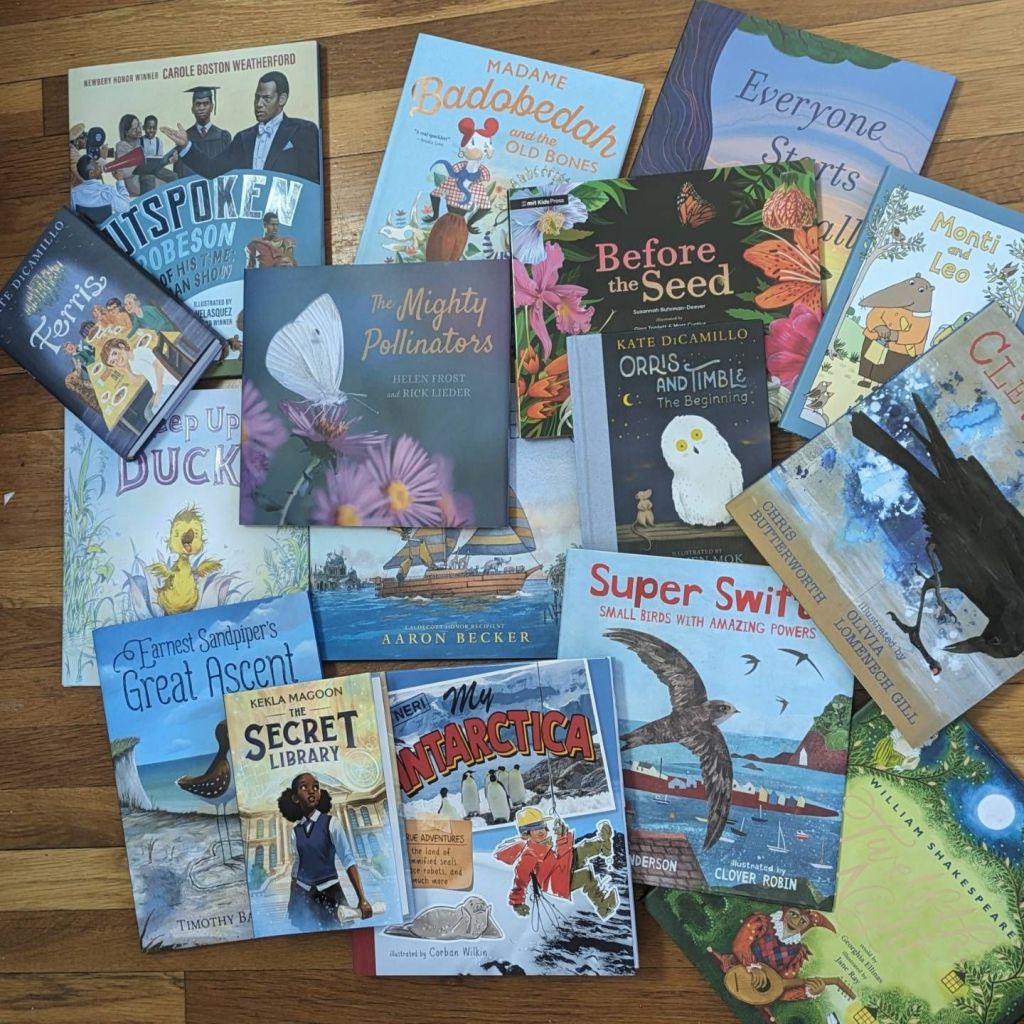
Truly, I was suffering severe torture of the spirit. But I came home to a beautiful pile– just look at these!
Which one calls your name? To me it’s a beautiful mix of authors and illustrators I already know and love and ones I had yet to explore. Some were surprises, some familiar.
Normally I’d be leaping to the unfamiliar, the one you may never have heard of. But there was one book in that pile from a very familiar author, but one who keeps surprising me, and this was no exception: Kate DiCamillo has two books in there, and I want to tell you about Orris and Timble. (I also loved Ferris and I hope you will get it and read it, too. In fact, the Changeling loved Ferris so much that even though she’s not allowed to read my review copies at the table because I keep them tidy so I can donate them, she snuck it to the table and dropped yoghurt on it and got a scolding.)
Why Orris and Timble? What about it got that pull of needing to talk about it? We all know that Kate DiCamillo is a reliable author and what she writes is good, so why bother? Well, the funny thing about Kate DiCamillo is that the first book I read by her was The Miraculous Journey of Edward Tulane and I thought two things: a) I really love this author, and b) I do not click with this book. My very dear friend from Grades 7 and 8 gave me Edward Tulane when I was in undergrad, and we were both fascinated by it, and discussed it happily. And it wasn’t a book I loved, though I fell in love with the author right away. And I’ve returned to Kate DiCamillo over the years, fascinated by her inventiveness, her voice, and her trust in her readers. She is to words what Sergio Ruzzier is to illustration: his method does not alter, but his inventiveness within it is endlessly fresh and brilliant; she writes in a similar fashion from book to book, but with boundless inventiveness.
I think that Orris and Timble strikes a new note again, but, as in The Beatryce Prophecy, she starts out telling us very little because she doesn’t need to. We’ll catch up.
By the way, how do you feel about the term “signposting” in book talk? I kind of hate it because it makes all books feel plot-bound. Now, I hate plots, too. Why do we need them? Tell me a story, and tell it how you like, but you, the author, should know what you’re doing, and I’ll catch up or I won’t. Alan Garner only sometimes bothers with a plot, but he always has something to say, and doesn’t say anything but what he needs to say, and either you catch up or you don’t. Probably, at this point, my husband would mention Proust, and the Changeling would screech, I would roll my eyes, and the Spriggan would throw back his head and giggle and tell him he’s a pie. No one knows what that means, by the way, but I think Kate DiCamillo would absolutely understand and would have a toddler calling his dad a pie in her next book.
I think that Orris and Timble, like The Beatryce Prophecy, is simply telling a story where there’s a plot of some kind (more so in The Beatryce Prophecy, less prominently so in Orris and Timble) but the plot isn’t the point of the story. As readers, we catch on fairly well, fairly early, to who Orris is: he’s a rather cranky rat, a rat we want to know more about. He reaches us, somehow, and we don’t know why, but we want to know why. In fact, we would very much like to know why it is that we want to know more of him, because, really– it’s puzzling.
That’s why we need Timble, the little owl. Timble helps us figure out Orris. And it’s not very long before they become a story we love. Timble loves hearing stories. Orris has stories to tell but no one to hear them. And we? We listen. We are an audience to their story. A cranky, sweet, ornery, and tender story.
It’s a story of stories, a story that goes beyond plot and into voice and into the heart.
Fresh and old, new and deeply rooted– it has everything I love about Kate DiCamillo, but is wholly original.
Also? Please note that the illustrations from Carmen Mok, whose work I first saw on Here Babies, There Babies by Nancy Cohen, are as tender and fresh as the words on the page. Altogether, it’s a lovely book for a fairly new or a more developed reader, and if you’re an old and cranky adult muttering about nothing being good these days, you may well find a new spring by reading this, too.


 The Children's Bookroom