
I am, and always have been, bad at reading. I didn’t read The Westing Game by Ellen Raskin as a kid. I first read it in, I think, January 2024, not very long ago. I should have read it as a kid; I certainly know that now, after having read it at age 36, eagerly enjoying the story and language in a double-helix of relaxing and letting the story romp and, simultaneously, admiring the deft skill of the author. But someone gave me the book, so I didn’t read it. It took a lot to overcome the natural suspicion with which I approached books given as gifts; either I needed a personal nudge from someone whose opinion I trusted, or I needed to be bored with only that book to hand, or else it needed better than usual cover art and a blurb that didn’t sound stupid. I was, as I said, a very bad reader. Fortunately, someone my daughter, age 10, still a Changeling, trusted gave her a copy of The Westing Game, and she read it, and she loved it, and she told me I should read it. So, at a guess, 28 years or so after it was given to me, I finally read it. And then I went to the Brookline Booksmith and, lo and behold… Mac Barnett wrote a new introduction to it.
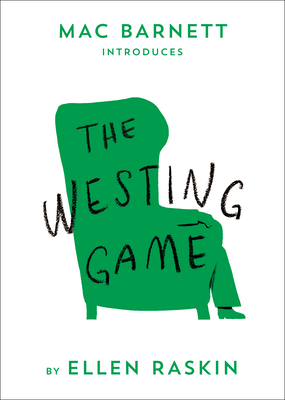
I got it. I had to get it. I was curious what he thought. Yes, fine, we already had a copy but– I wanted to know. I had my thoughts about this book I’d neglected for almost three decades, but I wanted to know what the author of Sam and Dave Dig a Hole, that saga of twists and turns, had to say.
I have a confession to make.
As soon as I read the introduction, I told a lie. I threw the book down and threw a tantrum at the same time: “I hate Mac Barnett!”
I mean, I don’t hate Mac Barnett. I haven’t met him in person and I always try, very hard, to reserve true and visceral loathing for people I’ve met and can detest on an up close and personal basis. And I’m not in the least petty enough to hate someone just for the crime of saying what I wish I’d thought of more lucidly than I could have and with exemplary structure: embedding the argument being made about Ellen Raskin’s literary skills in a structure which exemplifies the lessons learned from her in an exquisitely constructed homage to her. I think. You should get this edition– and please read Mac Barnett’s introduction– and judge for yourself if it’s that good. I think it is.
Blast it.
But what really, really got my goat is that he came out ahead of me at what I so hoity-toity think of as my own game. (I’m not good at chess, Sandy, sorry.)
I love sentence structure. I love style. I love voice and rhythm and beauty in writing. My love of Cat Valente’s Fairyland books and Peter S. Beagle’s Tamsin come heavily down to a love of their textured, beautiful sentences. I will tell anyone who will or won’t listen that just because a book is fun to read for content doesn’t make it fun to read aloud, and that prose style matters to the content, too, don’t you see?
If Ellen Raskin hadn’t been so skilled in subtly shaping her unexpected sentences, matching them to voice and thought and wrapping them around twists and turns, the novel would have collapsed into a boring mystery: first you don’t know what happened, then you do, the end. Boom.
And here was Mac Barnett writing about sentences. And I hadn’t given the topic a single thought.
Instead, uncharacteristically for me, I thought about character and plot.
I still don’t care about plot, not at all, really. The plot is a vessel moving from Beginning to End. I do have to admit that Ellen Raskin created a really exciting plot. Like Terry Pratchett, she has the eye of both specificity and breadth to see that a beginning is chosen, and she deftly picks up pieces here and there and back and forth, making me think less of someone playing chess and more of someone creating bobbin lace– though, from what I’ve read of her, the cigarette would get in the way so she couldn’t do that. A pin moved here… one there… between the threads, a pattern unfolds.
The threads are the words, those gorgeously textured, plainspoken phrases. The pins? Those are her characters. Those ugly, flawed, beautiful people she scars and makes us love. Books all over the place take characters and make you question them. Ellen Raskin starts off making us question the people, almost every single one presented as an enigma, or, particularly, as suspicious or unlikeable. And then, bit by bit, conversation by conversation, sentence by sentence, she makes them open up to us, and, as they do, we open up to them.
I recall, when I bought the book, that the conscientious bookseller noted that she loves the book, “and it does have some outdated language, but I think…” she paused, searching for the right words, so I tried to help out with, clumsily, “it doesn’t have an outdated heart. It cares about the people.” She nodded agreement.
A moment that struck me: the dressmaker with the permanent smile crooning to the young man in the wheelchair, Chris, who loves watching birds. Chris’s brother, Theo, abruptly tells her that Chris isn’t a baby. Chris’s thoughts, unspoken to the other characters, but read by us, interject: he doesn’t mind. He knows that she has pain under that smile. Later, we learn, her daughter had been born with what we, today, call Down Syndrome, and had died at age 19. She’d adored her daughter and continues to mourn her. Gradually, these inner lives and inner thoughts and sympathies come clear as paths cross paths and conversations interweave across the book. Threads deftly crossing make the pictures, each sentence shaped to each character so that nothing more is ever revealed than one person’s soul at a time, meeting another’s.
This is craftsmanship at its best. I don’t think it takes all that much to take a pretty picture of a person and spoil it. Ellen Raskin plucks a person from the street, takes your first impression, and then, bit by bit, helps you understand the wholeness and the richness of each person’s life. You may not love each character equally– but you will come away with more sympathy for each than you had at first.
I was quite prepared to loathe pretty Angela. And, somehow, she was the one who caught me. Her desperation was mine, hard and fast. Boom. I loved her. Theo, too. Almost every twist with him, every turn of his story, I thought, “Been there, Theo. I feel for you.” I liked him from the beginning, though. Angela? She surprised me.
And so it went– moving with each character, somehow the invisible craft slid by me. Mac Barnett, though, he’s a master lacemaker in his own right: he spotted the heart of the craft. Phrase by forthright, twisting, scintillating phrase, the characters dart around each other, pulling the picture together.
Oh yes, I know it’s a terrible analogy; delicate lace doesn’t feel right to such straight-talking writers, does it? But just you try to do it. I think you might find bobbin lace easier to create.
 The Children's Bookroom