
This is my third whack at writing this and by God I will post this today. I absolutely refuse to let war take more comfort and beauty from us, and, come hell and/or high water, I will post this review before the book is released, which is tomorrow. First things first, then: the book is The Little Books of the Little Brontës by Sara O’Leary and Briony May Smith, and you can just skip everything else here and take my word for it that you really, really want to go buy this book from your local indie, or from mine, and I ever so kindly supplied the link. Now, two paragraphs about the bitter crap, referenced yesterday, too, in my post here, or you can skip down and read the review.
A few notes about the Situation of All Things. I’ve been coping with a lot– well, I could leave it at that, couldn’t I? I think it’s true of many of us. This is my primary “place I write things” on the internet, but I should let you know that I do, in fact, have other places I appear. Notably, these days, I review Jewish books over at Kolture, which I link to as a whole due to the wide variety of excellent stuff there, but you can search for the Children’s Bookroom and find me. Once upon a time I was on a little site called Twitter which was ultimately acquired in a positively presidential tantrum by a poor fellow who was very annoyed people were saying mean things about him, but after he broke the site, I did a bit of soul-searching and realized something: I only ever joined any social media account because I felt an obligation to the publishers who sent me review copies and, above all, to the authors and illustrators (such as Sara O’Leary and Briony May Smith down below this paragraph– I promise I’m getting to you!) to give them easy ways to share my reviews telling people the books are good. What that means, and I swear I’m not only this dense, is that I feel this is professional. (I honest to God am not always this stupid, but yes this only just dawned on me.) So, I started an Instagram account I’ll tell you about (I’ll add a nice linky button on the main page, too, when I get to it, but here it is in the post): find me @childrensbookroom on Instagram, and here’s a link that’s supposed to take you there if you do use Instagram…
… and it’s actually been fun to just post pictures of review copies, random books I love, so it’s a bit of additional stuff about kids’ books, if that’s your cup of tea. And I guess that takes me from the Musk world to the Gawd-help-us Zuckerberg world. Well, ultimately, as I said: this is my home base, so this is where I’m all dug in, and you will always find me here, with lots of bookish things. This is the home of “Deborah seeking excellence in children’s literature,” and I do not intend to change that.
To the book! I’m going to be blunt about this one: I’ve been excited about this book since it was a scintilla of an idea mentioned by the author on what-was-Twitter-at-the-time, back when that website was still a mostly reliably useful place to get publishing news, not that I’m bitter. I recall Sara O’Leary mentioning that she thought it would be fun to do a book on the little books the Brontë children used to make. I think one of Charlotte Brontë’s little books was up for sale at the time (it ultimately went, as it ought, to the Parsonage), and there was a flurry of excitement. I responded with, I’m certain, my usual level of articulate encouragement (“Dear God, you have got to write that,” or some level of equally embarrassing burbling through the keyboard at an innocent author).
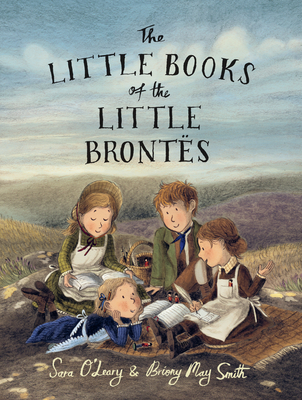
I was, therefore, lucky to notice and receive periodic updates that the book was happening: there was a deal, a title, an illustrator, a release date, and, finally, a review copy (which my daughter tried to steal; not unusual, but I did, I admit, demand first reader’s rights to this one). And this is the book! The Little Books of the Little Brontës by Sara O’Leary and Briony May Smith, a perfect match of author and illustrator.
I’m not sure where to begin with this, except that I want you to trust me that this is a book you and your family and your school and your library and your class and your friends need.
I have written a few times now about books that feel completely honest and say more than the words on the page. Sara O’Leary, in particular, exemplifies this in large part by her trust to her illustrators, and Briony May Smith more than proved herself trustworthy in this book, meaning that the book is charged, in the interplay of text and art, with vigour, beauty, and imagination. (I’m a little gutted this one won’t be eligible for the Caldecott due to residency rules, but I’m interested to watch myriad other awards– this is a winner.)
The basic, underlying truth of this book is that children love small books. (I kind of hope that a tiny companion book comes out, Tundra? Or tiny notebooks for Christmas gifts?) This is known, it’s not a mystery. Think of Beatrix Potter and the small size she advocated for when she wrote Peter Rabbit, and think of The Nutshell Library. The size was the point, for that. But have you never seen children making their own small books? It’s such a common game among the imaginative set.
Interesting personal story: I’ve twice done a “make your own picture book” class for groups of children. I make them each a dummy book for page layout before they create the final book. The students are always, always enchanted by the tiny dummy book. They’re excited to do the final book because it’s their book, of course. But they squeal over the little dummy book.
Sara O’Leary takes us back in time and shows us that children have always been children, and tells the child who loves to make a small book today that they’re not alone and have companions in storytelling. I felt very much that she was talking to me approximately 28 years ago. (Sara, would you very much mind nipping back 28 years to tell me then that I’d be able to talk to a real live author in the future? It would mean an awful lot.)
Now, this is not the first Brontë-world book I’ve written about. I’m shocked to see that The Glass Town Game was published six years ago (it still feels like yesterday to me), but these two books really feel partnered in my mind: They are the books of an author who loves another author and wants to share the secret heart of what makes the books magical with a new generation. “Here, this is the glorious soul of my beloved books; I’m giving you a gift.”
In The Glass Town Game, Catherynne M. Valente wanted to share the worlds the Brontë children lived in: their characters, their games, their gloriously vivid imaginings. The Little Books of the Little Brontës is similar in many ways, but, speaking to a younger audience, it reaches to a more basic level of sharing. Charlotte is making Anne a little book. My Changeling has made the Spriggan many little books, which, of course, we keep as carefully as we can while also letting the Spriggan hug and enjoy and destroy them– it’s a bit of a process. Any child in that zone between my two will be caught by this picture book of story-hungry children hiding and running and playing and then writing their little books between themselves. “The books they write are tiny, but the worlds inside them are huge,” Sara O’Leary writes. If that doesn’t make the kid on your lap light up with recognition, I’m not sure what will.
(I normally balk at backmatter, I really prefer to let a book stand on its own– but who can resist the “How to Make Your Own Little Book” at the back of this one?)
And it’s not just the text. It’s not even just Briony May Smith’s illustrations in the book, though they are active and calm and evocative of the Parsonage and the moors… It’s the book as a book. I do have pictures of under the dust jacket and of the endpapers but I’m not sharing them because I want you to go buy the book and look for yourself, touch the cover yourself! Although the book isn’t tiny, it feels somehow private. The endpapers feel like a scrap of wallpaper the children might have found and used for a cover. The cover under the dustjacket feels like a Victorian cameo, almost.
What is it about the Brontës as a topic? The Glass Town Game also felt like an intimate read, just for me. My daughter, when she read it, felt just the same, and played at being Emile Brontë for a week or so. Now, here we have another Brontë book, and it also feels intimate, lovely, and just perfect for a cozy read followed by, perhaps, accidentally leaving a bunch of nice scrap paper where a child could find it.
Watch this space for a giveaway. Books like these are to be shared, giving children that space to see the hugeness of the worlds inside them recognized on the page, so they’ll set them down on other pages, whether small or large.



 The Children's Bookroom