
Sometimes, when you’re dealing with something terrible in your life, it’s important to tread lightly and cautiously. Other times, you just need to push it off a high wall, watch it crash into pieces, then go gather the scattered pieces, smash each one to shards, gather every shard and burn them in the fire, watch them burn while drinking a cup of tea, sweep the ashes into a bucket, and drop the bucket of ashes into a bottomless pit.
Why does Otilla do this for the skull? How does she know to? The Skull by Jon Klassen leaves you with plenty of questions about “Who? And why? And how? And when?”, but, in the end, the strongest feeling washing over me was sheer catharsis.
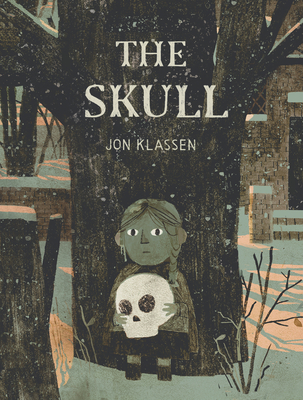
I suppose maybe the whole skull thing has people looking for darkness, but I’ll be honest: I’m getting perplexed by the fuss about how, apparently, The Skull is “darker” than Jon Klassen’s usual books for children written about it. You know, the ones he’s known for– lightweight, frivolous books about animals eating other animals because they stole hats. Jon Klassen has always, always left most of a book unstated. The text tells you 25%, the art another 25%. The rest is the unspoken part: everything from font to style to negative space and the air between the pages is textured in a Jon Klassen book. I like the return to a serif font, here, and the placement of the text feels like a cross between Little Bear or Frog and Toad and a Paul O. Zelinsky fairy tale book.
The book, we know up front, is a folktale, and, one feels from the moment of flipping it open, should be told by the fireside on a cold, snowy night, a warm family blocking the howling wind outside. The dark is out there, but the warmth is within as we hear about Otilla and the skull…
On Shabbat, the Spriggan and I were sitting outside in the synagogue flipping through The Skull because it’s a bit too text-heavy to read properly to a toddler but, honestly, no one told him that, so he still wanted to look at it and have me tell him about it and read bits aloud. We were not thinking of the darkness, in fact, but of the warmth Otilla finds. We were talking about Otilla dancing with the skull in the ballroom, pointing at their masks, and I looked up to see someone watching us curiously. “We’re just reading The Skull,” I explained, holding it up. He shuddered and left, quickly.
And I caught myself thinking of another oral legend. I’ve always been utterly terrible at knowing what’s supposed to be “age-appropriate.” I read The Odyssey when I was in Grade 3. My sister was annoyed and said I can’t really have, because maybe I did read the words but it’s impossible I should have gotten it, REALLY. An amiable child, I agreed. I didn’t get it, not fully. I loved the stories in the story, and I was intrigued by the odd way it started halfway and had a big flashback. I liked the rushing, undulating feeling of the words. I felt absorbed in it, stuck on the big boat rushing from danger to danger, and since that was a time when I really wasn’t happy, twenty years on a boat facing nothing worse than sea monsters sounded great to me. I liked living in the book’s head. I didn’t need to “really, fully get it,” because I liked the book, you see, and it held me when I felt alone.
Like Otilla held the skull in the ballroom, you know?
I’m not good at “age appropriate,” but I’m very good at quality. Some people think that In the Night Kitchen is horrifying because a (naked, heaven forbid!) kid gets put to bake in an oven, so surely it can’t be allowed in schools where kids are being put through active shooter drills. The innocent children might get scared, after all.
My Spriggan, by the way, gleefully crawls under the covers because “I’m in the oven, bake me in a cake! I pop out of the oven, I’m not the milk and the milk’s not me!” And he falls over laughing. It’s a terrible bedtime story, honestly– he needs to sleep, not play.
I’m thinking, yet again, of David Almond’s Nanty Solo in The Woman Who Turned Children into Birds, seeing Laura Carlin’s illustration of her in my mind, one leg nonchalantly extended: “But what on earth are you frightened of?” Are adults afraid of the oven, afraid of the dark?
Otilla wasn’t afraid of the dark. We never do find out what she was running away from. I do know one thing, and it’s that there is one, and only one, page of the book that made my heart crack. Otilla falls in the snow, listening for her name being called, and cries, lying on the snowy forest floor, alone. The mother in me wanted to scoop her up in a hug. Otilla, though, cries until she’s finished crying, then gets up and goes on.
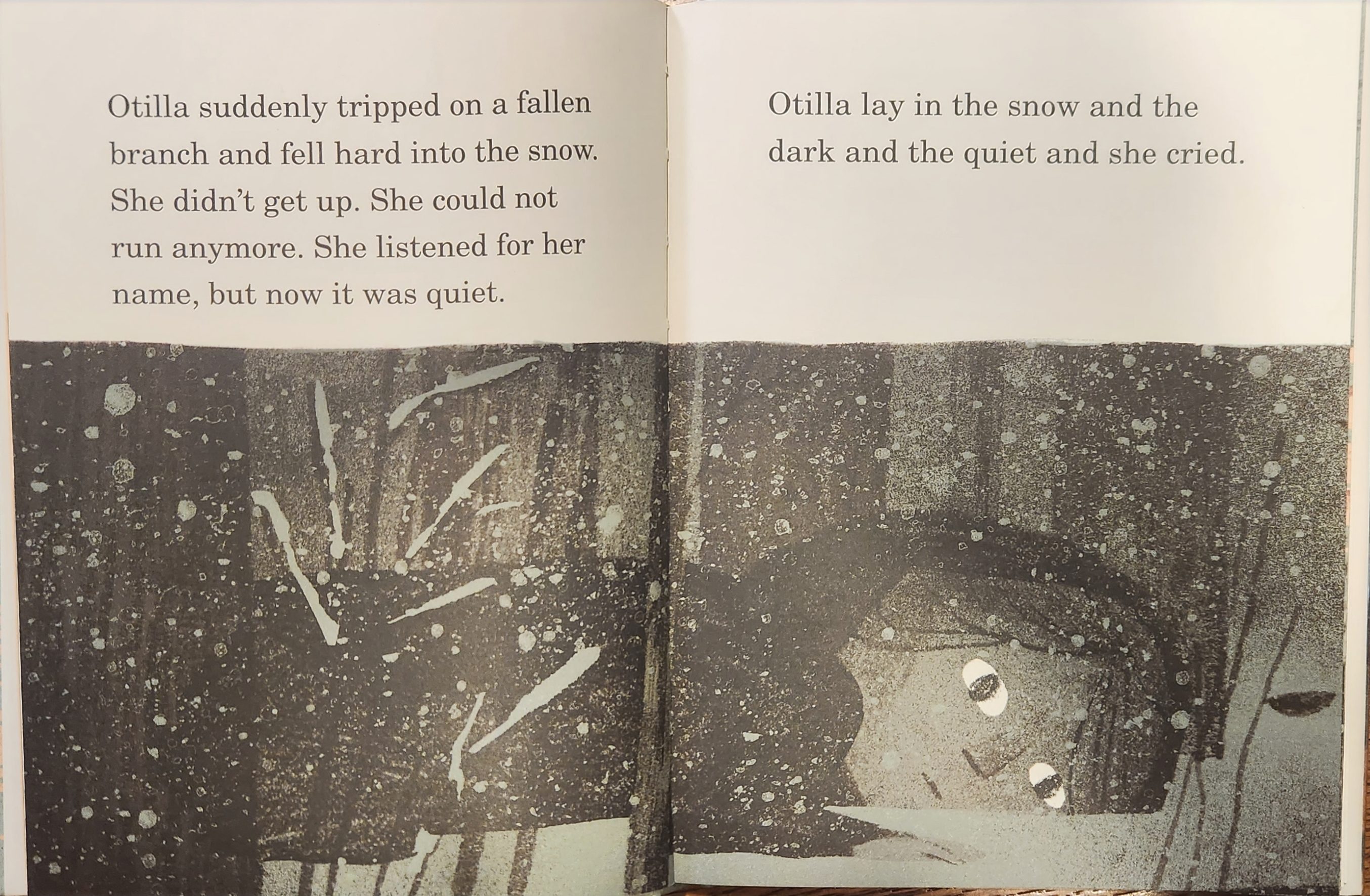
Brave, brave girl. Otilla gets up, and here’s where things shift.
Otilla has run from danger, though we don’t know what the danger was, and goes from being the endangered to the rescuer.
We all know, I think, that Otilla would like to have smashed her past danger, what it was she feared, to bits. She would like to burn her trauma and drop it into a bottomless pit. But Otilla can’t. What can she do? She can help someone more vulnerable– her new friend, the one who has offered her what he can: shelter, a pear, a dance, pyjamas. When the headless skeleton comes, Otilla is ready.
I don’t find that dark. I find it cathartic, hopeful, and I am ready to walk out into a lovely day with a skull on a sled, enjoying the knowledge that I have a friend and have lost the fear of a danger past.
 The Children's Bookroom