Big Tree (+ giveaway)

In my last post, I wrote about the need to fight book banning on all fronts right now, simply so kids have access to books, end of story. I said that we aren’t fighting for kids to get certain good banned books, but so they can get at books at all. But, always, my goal is to push for excellence in children’s literature. And, among the best– we have, with gratitude for art and words, Brian Selznick. (If you search here, you can see me rave about The Marvels, Hugo Cabret, and Kaleidoscope.)

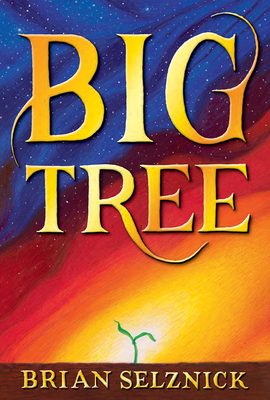
I had the great good look, the genuine fortune, to get to attend Brian Selznick’s book event for his new book, Big Tree, at the Brookline Booksmith (I linked to their page for the book, and when I was there yesterday they still had signed copies– one of which I bought to give away to one of you, read to the end for details).
I’m warning you I’ll take a bit to get to Big Tree, just as he did in his talk, because the background is important– but I’ll get there, and I want you to get there, too.

The thing about Brian Selznick is that he’s unabashedly an artist and storyteller. He has a visual mind, and the interleaving of text and image in his stories is something that’s hard to put in plain words, because you have to experience it to understand how it works. But it wasn’t until I heard him talk that I realized in something of a foolish epiphany, why it was so hard for me to pin down, even though he himself makes it quite clear from inside the books: his style is cinematic.

In his talk, Brian Selznick validated for the first time in my life something I’ve explained excitedly to multiple people who all looked at me like I was nuts until I burbled into silence: the opening page turns of Where the Wild Things Are draw the reader into the landscape with every page turn. The first inset image is rather small in a sea of white, and then with each page turn the images grow– and grow– and grow until you’re pulled into the boat alongside Max, sailing off through night and day and in and out of weeks and if you’re not seeing it in your mind’s eye right now, you’re really missing out. I was almost bouncing on my seat with excitement when Brian Selznick flashed the slides showing the page turns.

But what was so interesting to me (apart from feeling validation, honestly I was starting to think I was just a lunatic) was that we read the page turns differently. For me, reading those page turns aloud with a kid on my lap, both of us mentally closing our eyes to the room and letting the forest grow around us as we moved into the wider world of the opening mind– like when you fall into the art in a museum, or the music is moving around you and your mind floats free.

Brian Selznick flipped through the slides and we watched the art grow and grow on the big screen of his presentation and we really felt the cinematic effect of the page turns as he read. I’d never, ever thought of it this way, and so many things fell into place in my head. First, no wonder Maurice Sendak saw Brian Selznick’s potential, a visual reader like that, with the drawing skills to go with the eye and the mind! Second, no wonder Selznick’s art always has music playing in my mind! But, unlike Outside Over There, which has (oddly) either Mendelssohn or Schubert in the background (you’d think it would be Mozart, since he’s actually in the book, but I very rarely hear Mozart), Selznick has active music, dramatic music– film music.

Action, cinema, music, art– this is all story, and story is people, but this book is about trees. No people. None of the wonderful people we’re used to from Hugo Cabret and The Marvels and Wonderstruck. (Well, kind of: there are characters, they just aren’t human beings.) So, how does someone with that theatrical, cinematic skillset develop a book that doesn’t have people to do things?

Brian Selznick zooms out. He has a panoramic vision in this book encompassing the world at large, all of history and prehistory and all of the earth. And the truly incredible thing (my 9-year-old daughter, the Changeling you’ve heard of so often before, confirms this) is that the resulting book is readable and accessible to a younger age than some of his other books. I asked her why she thought that was, and she was flummoxed as to how to put it. (Kid, I relate.) “He always has funny bits in his books in a way, but this one has more because the seeds have to be different by talking, I think, and also it has more of a wrapped up ending? And kids like science.”

Three good points.

The story of the book is of two Sycamore seeds, Merwin and Louise, who are flung free before they’re ready and look for a safe place to grow. It’s about as far off a story as one can get: it’s set in the Cretaceous period, so no human beings, and most animal life is different, too. There’s a lot we don’t even know for sure (though Brian Selznick shares a lot of his exciting and meticulous research in an Afterword). And yet we’re drawn in through wondering what the next page turn will bring, how the story is going to unfold, who we’re hearing talk, who Louise is hearing, and will Merwin ever hear who Louise is hearing? And we do. It’s beautiful, it’s exhilarating, it’s heartbreaking– and it’s so unpretentious and uncondescending. (The impact, for me, is to feel, very vividly the aliveness of the world around you, leading to a fiercely protective love of the world– but it’s not about that, it’s not preachy.)

The book is, of course, conceived cinematically. In fact, literally so. Before the pandemic, Steven Spielberg asked Brian Selznick if he’d like to write a movie about plants communicating before there were ever even any humans. The movie didn’t work out for a variety of reasons (doubtless involving the pandemic to some extent), but I’m kind of glad of that because I’m more of a book than a movie person, and this is the book we get for it.

But what’s really, really interesting to me? For this book, this is the first one by Brian Selznick where I hear similar music to my Sendak music. The opening has, you can’t convince me otherwise, Felix Mendelssohn’s Hebrides Overture playing. Why? Look, I don’t know, I’m just telling you what I hear. I don’t think that this book is “more Sendak” than Hugo Cabret, but, for some reason, the music is.

GIVEAWAY:

First, I’m really sorry about this, but I’m calling this one North America only. I recently tried mailing to Ireland and was told my friend would have to pay, even though it was a gift package, a customs fee on receiving due to regulation changes. I’m so mad about it, but I don’t want anyone to be stuck with customs fees to receive a book from me.

Second, what’s on offer: I have two beautiful Brian Selznick books, a signed copy of Big Tree and a not-signed-but-lovely copy of Wonderstruck.

Third, how to enter: Comment on this post, or email me, with a picture book you hear music for, and what it is. Note also if you have a preference between the books. That’s it!

You have until Thursday, April 27 to enter, and then I will choose the winners by random number generator and email you for your mailing address if you win! Good luck, friends.
A Defense of Mediocre Books

I have a t-shirt I love because it has a beautifully defiant quote from LeVar Burton, one of my heroes, on it: “Read the books they don’t want you to read. That’s where the good stuff is.” It’s the best kind of rebellion! The kind that opens instead of narrowing the mind, like John Lewis’s “make good trouble.”

And, because I’m that kind of person, I just can’t leave it there. I agree with the quote and I argue with it. Look, I have a friend who’s an atheist who was asking me about faith and I think she almost fell over when I cheerfully said, “Oh no, I argue with my God and my religion all the time. It doesn’t give me any kind of peace; it gives me trouble.” I can’t not argue. Look, if I argue with God and even with Maurice Sendak, which I do, them obviously I’m going to argue with LeVar Burton, too.

Now, the basic truth is simple: in the USA right now, kids’ books are under attack. A few samples of things happening include: Elementary school teachers having to pack up all reading books from their classrooms, public libraries receiving vicious hate for having certain books on the shelves, teachers being punished for using certain books in classes, and much more. Authors and illustrators have also been more directly attacked for their work, and schools and teachers have been hounded for inviting authors to speak to classes. The list of authors and illustrators targeted is long and characteristics are intersectional: being too anything will get you scrutinized, whether for race, gender presentation, religion, sexual orientation, or having an opinion once in a time. I don’t know, the book banners are looking for any excuse, really. In a nutshell: book banning in the USA has skyrocketed, and it’s my impression that a large number of people don’t even realize how bad it’s gotten.

At a recent dinner, someone asked me if I’d experienced anything like this firsthand, and the really sad thing is that, yes, I have. I have, at a job I was doing, been asked more than once if I could, you know, not do so much of that diversity thing, in a nutshell. I wasn’t asked in writing, it was very quiet, it was one-on-one. That’s the other side of this: everything I listed above is only what you see in the news. How I can promise you it’s really bad is the rest of it, the stuff you don’t see. I promise you, and I wish I were wrong but I know I’m not, that the quiet censorship and self-censorship is much, much more prevalent and much, much worse than anyone thinks.

Which is why when my interlocutor at dinner went on to state indignantly that there were even LGBT books for kindergarteners these days, my goodness, really!, I saw red, and quietly but firmly said I thought we disagreed about this topic. In a later conversation with a friend, I was mulling over the conversation and noted that I probably dislike many of the books in kindergarten classrooms on any topic, and I was doubtless more critical of them than my conversation partner at dinner, but I was adamant they shouldn’t be banned… And it made me think, again, about that LeVar Burton quote. Well, LeVar, what if it’s not good?

Here’s the thing: I’m snobby and old-fashioned and part of what I do here is slow, meticulous reading and analysis of books I consider somewhere on the scale from very good to excellent because I stubbornly insist on quality books for children. Since I staunchly believe in positive reinforcement, I insist on slow analysis rather than punchy taglines– I want to show I take the books seriously, and I prefer to spend my time and words here elevating the good and excellent. What no one here sees is that when I’m not being nice about books on here, I spend a lot of time muttering and throwing aside books I don’t think are good enough. I rant. I show books to my friends and say things like, “Why a board book, board books are so hard to get right, this should never have been done as a board book, for crying out loud! Don’t people realize that most board books out there should never have been published as they were?”

So when I see the staggering, awful lists of banned books, and believe me they break my heart with sadness and outrage, on another level my eye is scanning the lists and my brain is sorting the books out, coldly assessing which ones I would put on my own shelves. And you know what? Some are truly phenomenal. Others are bad. A large number is simply meh– mediocre at best. And I have yet to see more than a tiny handful of books which, truly, should be removed from classes, and those only because they’re really out-of-date and there are better books, for crying out loud, not because they should be banned on moral grounds.

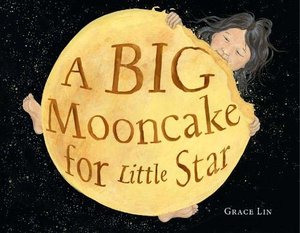
Let me give an example of an excellent book which has been removed from multiple classes by now and I really think should be the poster book for any defense against the book banners. Removing this from any class or library is truly outrageous: A Big Mooncake for Little Star by Grace Lin.

Honestly, the book is a masterpiece of gentle subtlety: it blends tangible reality (mother and child baking together, the temptation of a sweet treat, the sensory pleasure of a nibble of pastry and scattering crumbs) with the dreamy mythical feel of a story to explain the phases of the moon. The rootedness in Chinese customs gives heft and substance, while the nighttime art makes it a universal bedtime story, allowing any child to feel lulled to sleep in the sweet moonlight. It’s basically perfect, and the only possible rationale for kicking it off the shelves is sheer racism.

But, today, I’m here to defend not only the excellent. I can’t pretend that anything banned is good, because I’m stubborn. I really, truly want to spend my time pushing for excellence in children’s literature: I want more books of the caliber of A Big Mooncake for Little Star. I want really good books for all children, and I want all children to get to read books featuring stories from any culture, and I want publishers to have editors and readers pushing those books to true excellence.

And that’s why I’m royally pissed off that I’m having to spend so much time these days thinking about defending books I don’t even like, because, unlike some people who may or may not currently be in political office in Florida and who have really crap taste in books, I know that you have to give everyone broad access to books. In fact, kids need access to the crappy books, too. (Some of the books the Changeling reads make me cringe. Some of the books I read make me cringe, too.)

What do I not talk about? Well, I’ve been choking for days watching wonderful authors and industry professionals laud a book I really, truly believed needed to be set aside as a manuscript to marinate and then be pulled out for a fresh look and several rounds of new edits in order to be an excellent book. Right now, I do not think the book is excellent, and I find it more frustrating to see it in what feels to me like an unfinished state than to read merely banal picture books. I see how it could have been great. But to my eye it is not. (I can say this freely because it happens so often that I know no one will guess who I’m talking about– and don’t ask me, I will not tell you, I do not criticize authors even when I do not personally like them!) I have successfully not been a brat about it, not stormed over to a single library, and not tried to lead a parade of people on the internet or in person to destroy the author’s career. Remarkably, I have managed never to do that sort of thing in my life.

I am, in fact, prepared to be happy for any child who benefits from this book– and I’m sure some will! That’s wonderful, because even if I think the book could have been better and could have had better reach and more of a future had the editor and author given it another few months or even another year of work, if any kids love it now, as is, that’s better than it not happening at all. I can’t make those behind the scenes decisions, but I can take charge of my behaviour now. I quietly do not do negative reviews, and I loudly praise excellent books. But, these days? I’m also doing what I can to defend access to all books, for all children.

So, perhaps, this is me mostly talking to myself, but maybe you, too, need the reminder: this isn’t about defending books for being good. Right now, all books for children are under attack. And, unfortunately, we can’t limit ourselves to defending excellence in children’s literature. That’s the ultimate goal– I want to get back to pushing for excellence. Right now? I just want kids to be allowed to read at all.

And, yes, it’s that serious.