The Princess and the Pony

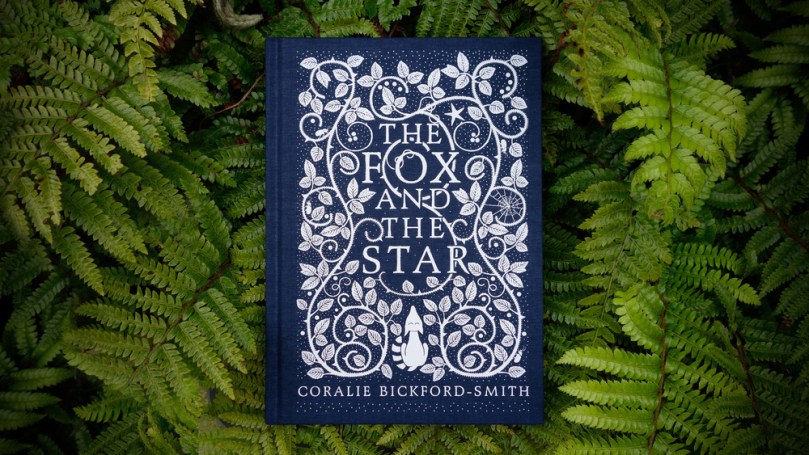
I never do this, but before we begin, here’s two notes: (a) I have been working on getting permissions to post images for various posts.  If you scroll down, for example, you’ll see some images from The Fox and the Star (thank you, Coralie Bickford-Smith!).  Do go look: they’re lovely.  Thanks are also due to Kate Beaton for giving me permission to use images from her website today.  (b)  On Sunday, I’m going to go to Catherynne Valente‘s signing at the Brookline Booksmith where I will try not to embarrass myself.  I will then gobble up the book, probably weep because it’s over, and then try to compose my thoughts about the whole Fairyland series into a blog post.  (That might take a while.)  If you are near any of the locations on her tour, may I suggest stopping by?  Her books are wonderful.

Do you know what?  That paragraph serves as a pretty good introduction to my confession: I am such a fangirl.  I pretend not to be.  I’m not much of a one for movies or actors or anime or any of the things I’ve decided are “fan” categories.  If you don’t chase the Beatles, you’re not a “fan,” right?  Wrong.  I’m an embarrassing, melty fangirl around authors I admire.  Ask my husband how long it took me to be able to open my mouth when I met [name redacted because, God, that was embarrassing].  He had to speak up for me before I could manage to get past, “Oh my God, I’m finally meeting [name redacted] and I’m making a fool of myself!”

Well, I’m like that for Kate Beaton.  When I saw she was coming to Boston for a signing  for  Step Aside, Pops and I couldn’t go: (a) I threw things at the wall; (b) I realized it was better to be sad I couldn’t meet her than to be a writhing ball of embarrassment for whatever I said or didn’t say if I did meet her; (c) I wrote a note to the Harvard Book Store to order a signed copy and beg them to ask her to personalize it.  I am not proud of that note at all, but it got me a personalized, signed copy, with a truly lovely little sketch from Kate Beaton’s hand, and I am proud of that.  You will pry that book out of my cold, dead hands.  Death, thou shalt die before I surrender that book.  Got it, buddy?  IT’S MINE.

Sorry, got a little carried away there.  My point is: people, Kate Beaton is fantastic.  And… She Is Canadian.  More than that, she is a Maritimer, from Nova Scotia, and, well.  First I read her historical comics lovingly teasing my own beloved Middle Ages and I truly admired them.  Then I heard she was from Nova Scotia and, I mean, I’m from Sackville, New Brunswick, right next door, and suddenly I became the girl who begged and pleaded with the Harvard Book Store to get me a personalized copy of her latest book.  And then I heard that she was writing a children’s book, The Princess and the Pony (this link includes activity sheets for your child), about one of my favourite of her comic characters, the pony.  You can see the pony, because Kate Beaton was nice enough to allow me to post this comic, below:
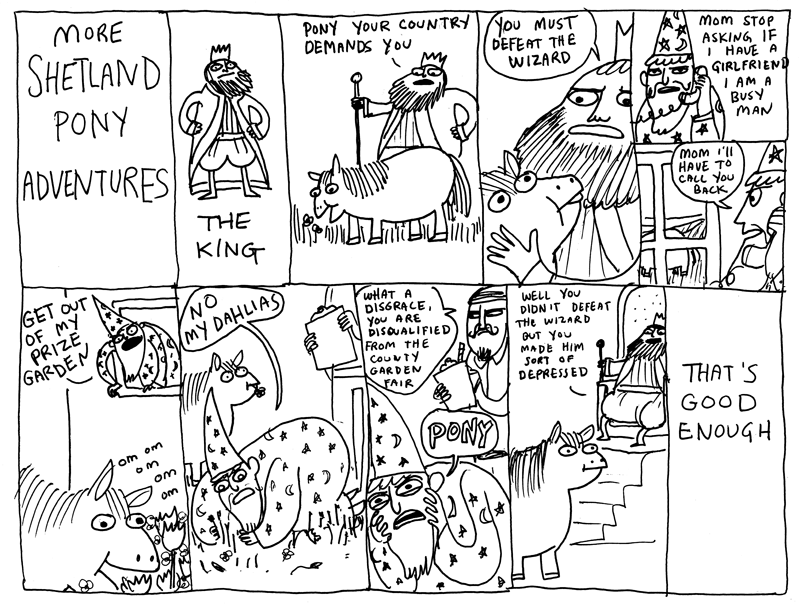
Fat Pony original

That one still makes me giggle, and anyone who giggled at that will be thrilled to know that this was relatively early work, and the pony’s character has developed considerably in The Princess and the Pony, where he works with Princess Pinecone to, against all her expectations, become champions.
Princess and the Pony

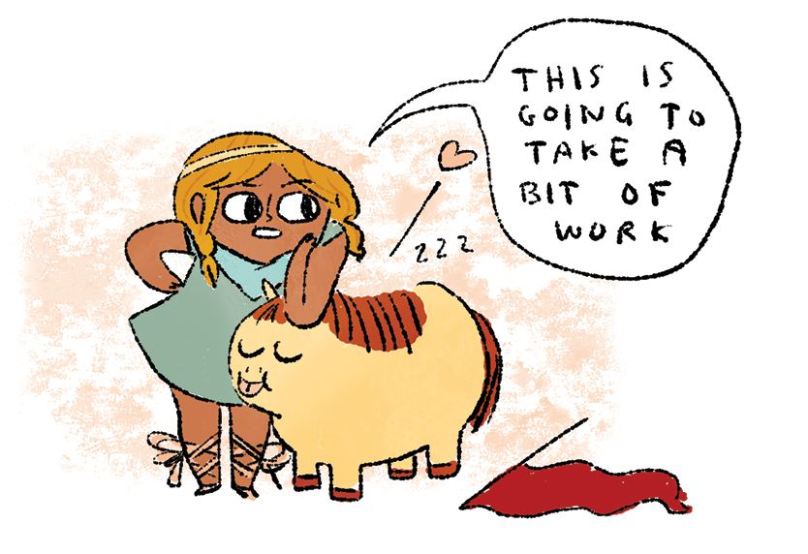
Princess Pinecone, you see, is a warrior, the smallest (and, arguably, most adorable) warrior in her kingdom.  She’s made it very clear what she wants for her birthday: a strong, proud, noble warrior’s horse.  Instead, she gets a small, round, funny little pony.  She is somewhat disappointed, but diligently works to try to teach her little pony to be a real warrior’s horse.  The pony ambles around, rolls on the ground, and farts too much.  Princess Pinecone is glumly convinced that they will never be champions, but when the battle comes up, the pony proves unexpectedly successful in a wholly new way, and he and Princess Pinecone are unanimously awarded the prize for Most Valuable Warriors.

It’s a charming little story, but the illustrations are what take this book from “Book I enjoyed” to “Book I truly love.”  As with Here Babies, There Babies and Jillian Jiggs, you’ll find someone in here who looks like you and speaks to you, which is an aspect I love: all colours and genders are represented here.  But Kate Beaton’s style, her humour, her zest, all come through here brilliantly in characters who speak as much through the illustrations as through words.  Pinecone, seen above, is a sweet and serious girl, very invested in her interests.  Her anxiety when she first meets her pony is visible: Oh God, do I sympathize with her!  An “almost” right birthday present can be such an awkward piece of business, yes.  But the personality is what truly pulls at my heart: trying so hard to make something not-quite-right work?  I’m almost 29 and I still identify with that.  Who doesn’t?

Princess Pinecone might be the most developed character (apart from the pony, perhaps), but my Changeling and I have endless conversations about the others.  She loves to examine each warrior’s face and equipment and talk about who looks “a little sad,” “a little angry,” or “so, so happy!”  She carefully analyzes the battle, Princess Pinecone’s parents, each ice cream cone on the battlefield, and all of the weapons of battle.  The detail, in short, is impressive, both in the layout of each large spread, and in the pages bare of background detail which focus on particular characters to tell you their story.  These are the pages my Changeling can “read” on her own, and I love watching her develop the stories from the art.

Most impressive of all in that regard, perhaps, is the pony himself.  He’s a major figure (and he has a most impressive figure!), but is limited in speech.  And yet he speaks to you so clearly: his big round eyes, his funny mouth (sometimes tongue out, sometimes in), his round figure, all tell you the same thing… “Awww,” you squeal with Otto the Awful, “what a cute little pony!”  The Changeling’s eyes bulged like the pony’s the first time she saw him: “I want a pony, too!” she announced.  (OK, I’ll admit it, she got one for Chanukkah: he lives in her crib, and you can get one right here.  Cave, submit, leave me not alone in my shame.  You can also get a onesie, shirt, calendar, or mug.  I don’t have those… yet.)

I’m still not clear on this pony, I’ll admit.  Shake your head all you want, but I still analyze him: how much does he understand of what’s going on?  He is a most reserved pony.  He watches more than he speaks.  Does he know what he’s doing at the battle?  Does he know what he’s doing during training?  I suspect he’s much more clever than he lets on, but I can’t swear to it.  I’ll just have to read it a few more times with my Changeling, and maybe ask her opinion again.  Last time, I got good suggestions from her.  She thought it over, and said, “Let’s read it again.”  I suggest you do the same.

(Kate Beaton?  Thanks so much for the permission to use your images, and sorry for the fangirling.  I really love your work, in case that wasn’t clear.)
I Have to Go!

Yesterday was a warmish, if slightly windy, brisk-feeling day.  I felt invigorated, and talked earnestly about a beautiful, deep, soul-enhancing book.  Today is grey, rainy, and I feel the need for lightness, laughter, and a bit of silliness.  Or that’s what I thought when I picked up today’s book.  Then I thought a bit more, and realized maybe there’s less of a difference between yesterday and today than I’d thought.

Let’s talk about Robert Munsch— Bob Munsch, as I grew up thinking about him, because, well, he felt like a friend.  I think all Canadian kids felt like he was our friend, honestly: Who spoke for us when we wanted markers?  Bob Munsch (Purple, Green and Yellow).  Who spoke for us when we got muddy?  Bob Munsch (Mud Puddle)!  Who, always and forever, told us we were loved?  Bob Munsch (Love You Forever).  I don’t think it’s quite easy for adults to understand exactly what Bob Munsch means to kids.  I remember going to one of his storytelling tours when he came through the bustling metropolis of Moncton, NB, and I was a kid growing up in the little town of Sackville, NB about 30 minutes’ drive away (wait– in those days I think it was 45 minutes away: that was before the big highway).  I loved my little town, and Moncton was a bit scary, but Bob Munsch was coming to talk, and I was thrilled.  I didn’t get to meet him in person, but, somehow, it still felt like he was talking just to me.  His voice and personality have that quality (to hear him read, click those titles up above), and it permeates his books, too.  He’s an adult who knows how to talk to kids, and if you’re that kind of adult, you’re special.  And kids will love you.  Every Canadian kid I know loves Bob Munsch.

Americans?  Well, those Americans I know who know Bob Munsch also love him.  I can count those Americans on the fingers of two hands– um: my cousin, my aunt, my other cousin, my uncle… um…

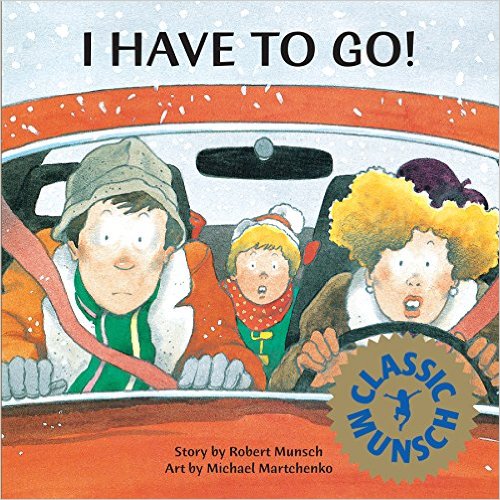
See, this is just another one of those cases where something really, really good didn’t quite cross the border properly.  And I want to tell you why it’s so good it’s worth seeking out.  The book we’re talking about is one of the current favourites of my Changeling, who is quite interested in the topic these days: I Have to Go!, story by Robert Munsch, art by Michael Martchenko. 

I Have to Go!

Do you know what?  I’m going to recommend a little homework.  Click that link, and listen to the story first.  It’s not every day that I can give you the story I’m about to read, but today I can, so give it a listen– it’s only a few minutes long.  Have you listened?  Good.  Now, here’s a secret: this is not exactly the story in the book on my desk, the one you can buy here.  That’s because Bob Munsch is telling the story, developing the story as he listens to his audience, and, in fact, you can hear the story of how the book happened right at the end.  That, in a nutshell, is Bob Munsch.  The listener, the understanding storyteller, the mediator between child and adult.

Why do I say mediator?  Well, think about another aspect of that recording– and, yeah, yeah, we’ll get to the story soon, but I want to talk about Bob Munsch right now.  Did you hear something behind the story?  The audience?  Did you hear the kids talking and sharing their stories?  I love that.  Did you hear when the kids laughed?  I love that, too.  Did you hear the adults laughing?  That’s why I’m an evangelist for Bob Munsch.  Folks: not every kids’ book out there has kid and parent laughing together through the same experiences.  Remember when my kid used up all the sheets in my house when she had her stomach flu?  I know I grossed some of you out with that.  Bob Munsch has all of you laughing at that, kids and parents both, and it gives you courage to live and go at it another day.  More than that, he gives your kid the language to talk to you: You heard those kids chanting with him: “I have to go pee!”  My Changeling does that, too… sometimes.  And when she does, I can carry her at the speed of lightning to the bathroom, and, hey, presto!  A diaper saved is a diaper earned!

What is it we’re laughing at, though?  There’s a kid (his name is Andrew in the book), his parents are desperate for him to let them know when he has to go pee, but the kid refuses.  No, no, no, no, no!  He has decided never to go pee again!  (Guys, I haven’t even opened this book yet– the words are ingrained.)  This pattern repeats throughout the tale, the parents are exasperated, Andrew is doing his own thing… and at the end, he turns the tables on the grownups, asking his grandfather if he has to go pee.  And the grandfather is not exasperated.  He listens, and he answers honestly: “Why, yes, I think I do.”  Note that, in the book, this beautiful moment is reinforced by Michael Martchenko’s illustration, showing the two of them smiling warmly at each other, holding hands, on the way to the bathroom.

There are two points I want to make about this.  First, I want to answer my own question (what are we laughing at?) and second, I want to add an observation about what Bob Munsch is teaching us.  I think we’ll see they’re related.

For my first point, let me point out how realistic these scenes are.  Andrew is being a kid, the parents are being parents.  When Andrew goes outside they “put on Andrew’s snowsuit.  It had five zippers, 10 buckles and 17 snaps.  It took them half an hour to get the snowsuit on.”  And then he throws one snowball and yells, “I HAVE TO GO PEE.”  Kids giggle, parents sigh and laugh simultaneously.  We all look at it and say, “THAT’S ME!!!”  And so we laugh, because it’s familiar.

But I think there’s something else, and that brings me to my second point.  When we say, “That’s me!”  Well, we’re also saying: “I’m not alone.”  It’s a feeling of relief.  “I’m not the only kid who wets the bed.”  “I’m not the only parent who weeps at 3 am with damp, filthy sheets and a deliriously exhausted child at my ankles.”  And what Bob Munsch is teaching us is: “It’s OK.  Be honest.  No one is completely whole and perfect.”

And that brings me to my final point: Bob Munsch has been open about his struggles with depression and addiction.  When I found out about that, a little part of me said, “I’m not alone.  If Bob Munsch has done so much, and spoken to me so much, while he’s been struggling, then I’ll be OK, too.”  Addiction isn’t a problem of mine, but depression is, and I’m humbled by how much Bob Munsch has accomplished by his openness, his generosity, his honesty.  He writes about this on his own website, in his own words, and finishes, “I hope that everyone will talk to their kids honestly, listen to them, and help them do their best with their own challenges.”  No, I’m not crying.  (Yes, I am.)

Listen to Bob Munsch, people, and buy his books.  Get them down south of the border, if you can.  We need his honesty, his openness, his warmth down here quite as much as Canada does.  We’re all people, we all need books like these.  I know my Changeling’s life will be better for Bob Munsch, just as mine has been, and I hope other kids will be able to say the same.

The Fox and the Star

I have been hesitating to write about this book for months, since before I started this blog.  Let me tell you why, before I start talking about the book itself.

I love it.  The very moment I saw the ARC at (you guessed it) my favourite children’s book shop I knew I needed it.  I didn’t just want it– it was talking to me, it told me I needed it.  I immediately placed a pre-order for it, and when I came out in November and I finally got to read it from cover to cover I have to admit that I actually slept with it under my pillow the way I used to with fairy tales when I was a kid, hoping they would get into my dreams.  That’s how beautiful this book is.  And that’s why I hesitated to write: Where do I start?  What can I say to get across its loveliness?  Am I good enough to get it across?

Then I read it with the Changeling this morning and I realized I loved it in my way and she loved it in hers, and, while the book might be one step over from absolute perfection in its own way, no one’s looking to me for the perfect blog post.  The book didn’t need me to be perfect.  All I want to do here is share, as best I can, how truly I, Deborah, love this book.  And I’ll screw my courage to the sticking place and do my best, with all my uncertainties.

One uncertainty is that I don’t know is whether it’s a children’s book.  Judge for yourself.

The Fox and the Star

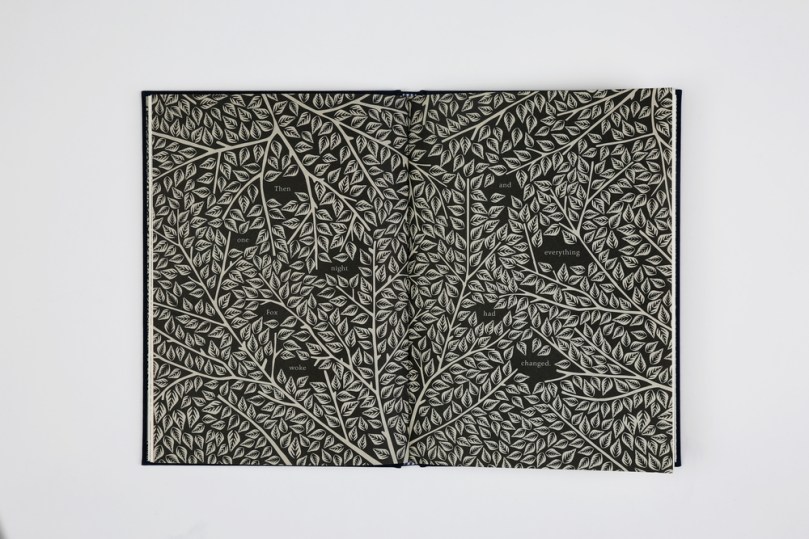
I do know that The Fox and the Star, written and illustrated by Coralie Bickford-Smith, is a work of art.  I mean that absolutely literally.  I said that with Madlenka’s Dog I stopped trying to protect it from the Changeling.  With this book, I keep it out of her reach, and when I read it with her I explain that this is one of the books I truly love and would like her to be careful about touching.  (Let me brag for a second: She’s such a good listener!  OK, I’m finished bragging now.)  The cover is beautifully designed.  I want the endpapers as wallpaper.  The illustrations are exquisite, each one lovely enough to be a print, or William Morris-style fabric (or more wallpaper– I love wallpaper).  The words, beautifully chosen in and of themselves, are integrated into the illustrations so that they make a seamless fabric.  Sometimes they’re set into the page like a tablet poised in the branches of a tree, sometimes each word is woven into the thorns of the forest, but, always, the words and the pictures suit each other.

Integration of text and image Fox and Star

And then there’s the story.  Or, perhaps, parable would be a better word.

I remember discussing with a professor of mine what the modern-day equivalent of the parable would be.  We agreed that children’s stories often work as parables: they’re stories in themselves, but often convey greater themes.  The Tale of Peter Rabbit would be a classic example.  He suggested Katie and the Smallest Bear as an even simpler and more exemplary option.  I think this book pares both the story and the themes and message so closely to the core elements that it makes an excellent example of a parable.

The story is about Fox and Star, and Fox’s love for Star.  The two of them, and all the others Fox encounters on his journey, are what they are, and need no other names.  Fox loves Star, his only friend, a friend he relies on for a soft glow of light at night in his dense, dark forest, where he walks only a little way from his den so that Star can light his path.  But one night he wakes and Star is gone.  (If you were reading the book, your eyes would fill with tears here.)  First, he huddles in his den, dreaming of Star’s return, lonely and scared, but finally beetles come seeking his den and Fox wakes up and eats.  Then he goes searching for Star.  He asks all those he meets about Star: the thorns, the rabbits, and the trees, but either they don’t know, won’t answer, or can’t hear him.  Finally, he comes to a lovely clearing and calls out his question.  Leaves fall, settling on the ground to tell him: “Look up beyond your ears.”  And when he looks up he sees a sky full of stars, and knows one of them, somewhere, is a star that once was his.  (If you were reading the book, not my measly summary, you’d be choking up right now.)  And Fox walks on through the forest.

Part of what scared me about writing up this book is that this is where you should say, “And this book’s message is X and teaches you Y and it’s so universal!”  I can’t do that to this book.  It does have broad, universal messages and themes and they’re beautiful.  If I put them into words it would diminish them.  To me, that’s why this is a parable: there are things that plain, sensible words can’t say.  There are things that you can only experience and feel through the interwoven, perfectly balanced mixture of words and images in this book.

I will tell you that this book came out while I was in a deep and miserable depression.  Frankly, it sucked.  It was horrible.  This was the first book I bought for myself rather than because I thought my daughter or husband would love it in a long, long time.  (As it turns out, of course, we all love it.)  The Fox’s lonely and courageous journey through a dense, dark forest, looking for beloved starlight spoke to me and got me to sleep at night and up in the morning.  It got me thinking about working in children’s books, too, because who wouldn’t love a world of books that can encompass everything from The Very Hungry Caterpillar to a book like this?  I will always love and be grateful to this book, and to the Fox’s courage.

As for my daughter?  She loves the Fox.  She loves watching the beetles crawl across the page, she loves the rabbits, she loves the leaves, but, most of all, she loves watching the Fox on his journey.  And when we come to the last page she bounces and beams: “He found the Star!  He found the Star!”  “Yes,” I answer, “he found so, so many stars!”

One day, I know, she’ll learn for herself why the Star had to go away so Fox could find so many stars– and what finding so many stars means to her, in her own words, and her own experience.  And maybe she’ll be able to tell me about her journey, and I can tell her mine.

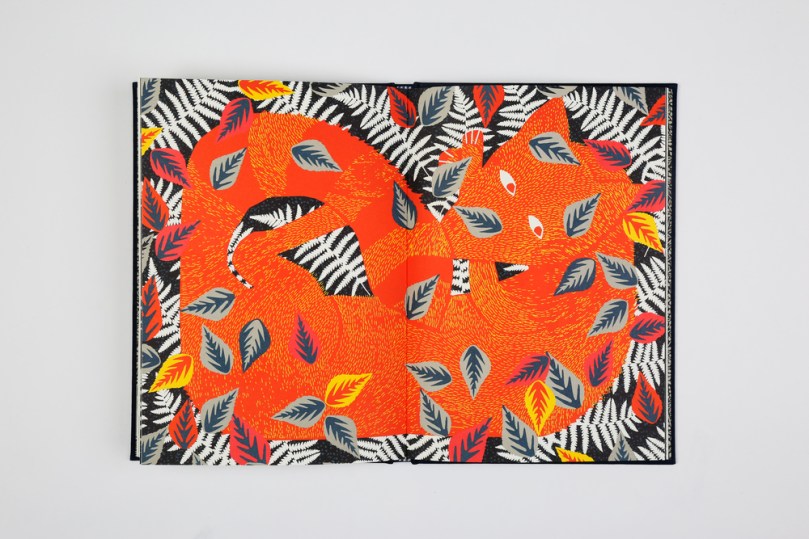
Fox and leaves Fox and Star.jpg

Look, I don’t say this for every book, but: Go buy this one.  And let yourself cry when you read it, if you need to.  It’s too beautiful not to move you, and you’ll grow for it.  Walk through the forest, look up beyond your ears, and find all the stars.  Then tell me about it.

Note: I updated this with pictures taken from Coralie Bickford-Smith’s website with her very kind permission.  May I point out she also has a store where she sells prints?